Category Archives: Mirror Worlds

मज़ाक मज़ाक में : किशोर

Guest Post by Kishore
(Summary: Article is about recent  racial comments on a  actress  and channel’s response to it.Now a days there is increasing trend of serving any thing in the name of comedy. This article raises questions on comedy. Is purpose of comedy is just to make us laugh or it has any social resposibility)
 पिछले दिनों तानिष्ता चटर्जी के रंग पर की गयी टिप्पणी के बाद वह एक मशहूर कॉमेडी शो को बीच में छोड़ कर चली गयी. बाद में उन्होंने इस टिप्पणी को नस्लवादी करार दिया. दूसरी तरफ इस चैनल ने इस आरोप को गलत बताते हुए कहा है वह तो बस “रोस्ट” ( एक तरह की खिंचाई) कर रहे थे और रोस्ट करना उनके शो में व्यंग करने करने का तरीका है . साथ में यह भी कहा कि उन्हें पहले ही बता दिया गया था कि उन्हें “ रोस्ट” किया जाएगा. किसी के रंग पर उलटे सीधे व्यंग करना कैसी  खिंचाई है इसका कोई स्पष्टीकरण नहीं दिया गया.
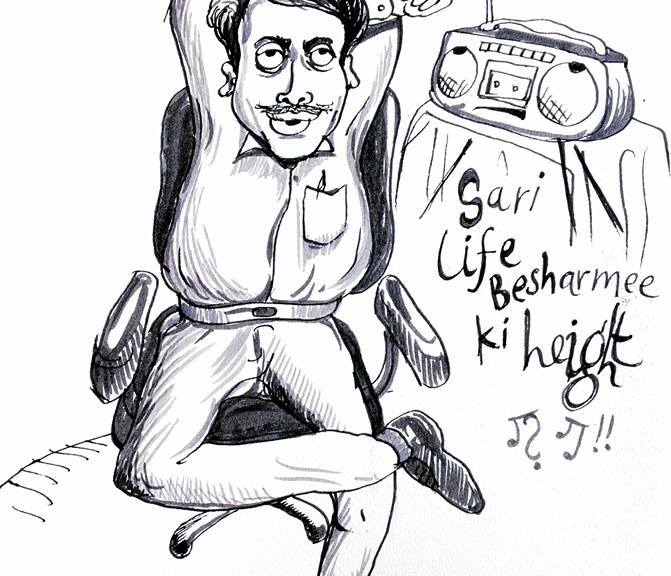
इसके बाद मुझे ध्यान आया कि पिछले कुछ सालों में टेलीविजन पर कॉमेडी शो की बाढ़ सी आ गयी है जो खुद ही कुछ कह कर खुद ही हँसते है. इन शो में किसी का मजाक उड़ाना कॉमेडी समझा जाता और इनमे किसी स्थिति से हास्य पैदा करने का सामर्थ् नहीं है. इन शो में कई बार किसी व्यक्ति या समूह को नीचा दिखा कर मजाक उड़ाया जाता है. अगर मैं कॉमेडी को एक विधा समझता हूँ या मैं उस समुदाय से सम्बन्ध रखता हूँ तो इस व्यंग पर मुझे हंसी नहीं आएगी.
वैसे मुझ जैसे अज्ञानियो को इन जैसे कॉमेडी शो से ज्यादा हंसी ए इस पर दिखाए जाने वाले होरर शो पर आती है जो डराने के मकसद से बनाये जाते हैं. खैर यह दीगर बात हएै पर एक बात तो तय है कि यह शो  बहुत लोकप्रिय हुए हैं और इनको देखने वालों की संख्या लाखो में है. भले ही तानिष्ता को उनके व्यंग करने के तरीके पर एतराज हो पर लोग इस अंदाज को बहुत पसंद कर रहे हैं.
मुझे उन लोगों की बात भी याद आई जो, जो मन में आये वह कह देते हैं और फिर कहते हैं इस बात को इतनी संजीदगी से लेने की क्या जरूरत है , यह तो महज एक मजाक था. इसी तरह किसी खास समुदाय और औरतो को लेकर बहुत से चुटकले चलते हैं जिनमें बहुत खराब खराब बातें होती है, और लोग हँसते भी है . आलोचना करने  पर इतना कह  कर बात टाल देते हैं कि यह चुटकला ही तो है. आखिर हम लोग कब कॉमेडी को संजीदगी से लेना शुरू करेंगे.
कॉमेडी का एक साधारण सा नियम तो समझ आता है कि कॉमेडी में जो हंसी का पात्र बनता है या बनती है उसे खुद भी अपनी उस स्थिति पर वैसे ही हंसी आनी चाहिए जैसे  की किसी और को आ रही है.  अर्थार्थ हंसी उसके रंग रूप , आकार या नैन नक्श से निरपेक्ष उस कलाकार के हाव भाव या उस परिस्थिति से आनी चाहिए. यह स्पष्ट है कि हंसी का कारण रंग रूप , आकार या नैन नक्श नहीं है.
दूसरी बात कि हंसी का कारण किसी समुदाय विशेष के प्रति पूर्वाग्रह नहीं होना चाहिए. हम यह कह कर मुक्त  नहीं हो सकते कि यह तो एक मजाक है. वास्तविकता यह है कि इस तरह के मजाक पूर्वाग्रहों को मजबूती देते हैं. यकीन ना हो तो अपने आसपास नजर दौड़ा कर देख लो. क्या इन पूर्वाग्रहों के सुदृढ़ होने मैं इस तरह के मजाक का हाथ नहीं है? क्या औरतों और पत्नियों के प्रति होने वाले मजाक ने समाज में उनकी स्थिति को प्रभावित नहीं किया ?
इन शो में से अधिकतर शो में कलाकार अपने हाव भाव और बातों से हंसाया जाता है. अब कोई पूछ सकता है कि हाव भाव या बातों से हंसाने में बुराई क्या है. सभी महान हास्य कलाकार बातों और हाव भाव से ही तो हंसाते थे या हैं. तो यह शो उन हास्य शो या फिल्मों से अलग कैसे हुए?
अंतर है कि किन बातों या किस हाव भाव से हंसाया जा रहा है. उस बात की विषय वस्तु  क्या है. कोई हाव भाव या बात फूहड़ या अश्लील  भी हो सकती है और सौम्य  भी. अब प्रश्न यह उठता है कि यह कौन तय करेगा कि यह विषय वस्तु फूहड़ या अश्लील है या सौम्य? हर समाज में फूहड़ या सौम्य होने के कुछ मानदंड होते हैं और कॉमेडी शो कि विषय वस्तु भी उसी से तय होगी. पर यह कहने में मुझे एक खतरा दिख रहा है? जिस तरह से किसी भी चीज को अश्लील या अनैतिक बता कर उस पर हमले हो रहे और कलाकारों की अभिव्यक्ति की स्वतंत्रता पर रोक लगाई जा रही  हैं उसमे इन शब्दों का प्रयोग बहुत संभल कर करना होगा.
मैं इस बात से आश्वस्त हूँ कि “ जाने भी दो यारों” नामक फिल्म में जो हास्य था वह उच्च कोटि का था और सौम्य था और जो मैं आजकल टी.वी. शो में देख रहा हूँ वह फूहड़ है. पर मैं यहाँ अपना तर्क गढ़ नहीं पा रहा कि क्या चीज “जाने भी दो यारों” को इन टी.वी. शो से अलग करती है. मेरा इस बात पे भी दृढ विशवास है  कि किसी के रंग रूप, नैन नक्श या किसी समुदाय के आधार मजाक उड़ाना गलत है . मैं पूरी तरह से इस शो के खिलाफ तानिष्ता का समर्थन करता हूँ.
बस मुझे बस इस बात पर संशय है कि किस आधार पर किसी बात को फूहड़ कहा जाएगा और किस आधार पर सौम्य?
(लेखक डेवलेपमेंट प्रोफेश्नल के रूप में  में कार्यरत हैं  और पिछले कई सालों से बाल अधिकारों के क्षेत्र में काम कर रहे हैं।)

A Fast That Ended in Hunger- Thoughts on Irom Sharmila and Hunger Strikes: Anirban Bhattacharya

Guest Post by Anirban Bhattacharya

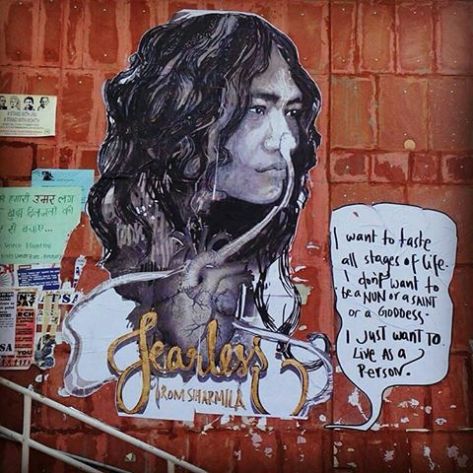
Iram Sharmila Mural at ‘Freedom Square’ JNU. Art by Shijo Suleman and the Fearless Collective. Photograph by Rebecca John. Image, courtesy, ‘The Great Walls of India’ blog on Graffiti and Wall Art

We may have differences in our political approach as to the way and means of the struggle, but what must be stated at the outset is the fact that Irom Sharmila has certainly been an icon of resistance and inspiration in the struggle against AFSPA.

Her 16 year long hunger strike has been a grim reminder of the crimes against the Manipuri people – rape, torture, fake encounters and massacres – committed by the armed forces with impunity under such draconian Acts like AFSPA. But her abrupt decision to end her fast accompanied with her willingness to contest elections in the upcoming assembly elections have met with a mixture of shock, scepticism, disappointment, puzzlement and even anger amongst her people in Manipur and even her close associates. There also seems to be a resentment against her being in a relationship and her plan to marry. Such scrutiny/dragging of her personal life are, however, quite deplorable. But overall, the disappointment with the decision of Irom to quit fasting and contest elections is so strong that, after breaking her fast in the hospital, when she tried to go to a local activist’s shelter, the locals disapproved. She had to seek temporary shelter in an ISKCON temple along with her police guards and then was shifted to a police station and finally she was forced to retreat to the same hospital that housed her for last 16 years. Now, this is telling. But what does it tell? The answer to this question would take us away from criticisms about any particular individual, but to the evaluation of the very method of struggle that she had been a part of, its scope, effectivity and limitations.

Continue reading A Fast That Ended in Hunger- Thoughts on Irom Sharmila and Hunger Strikes: Anirban Bhattacharya

Free Khurram Parvez – An Open Letter to Civil Society: JKCCS

Guest Post by Jammu and Kashmir Coalition for Civil Society on behalf of the signatories of the statement in support of Khurram Parvez

14355569_670864076420404_7479719579066415935_n
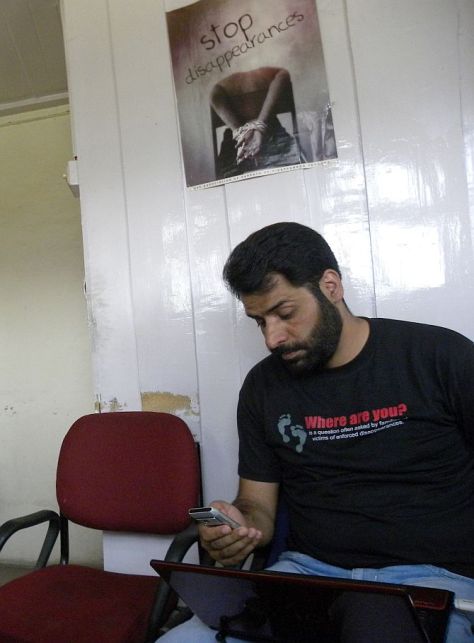
Khurram Parve, Image, courtesy JKCCS

We, the undersigned, call for the immediate release of Khurram Parvez, a distinguished and courageous human rights defender, and write in support of the enclosed statements issued by Advocate Parvez Imroz

As we write this, Khurram Parvez has been remanded to preventive custody in a sub-jail in the highly militarized Kupwara District of Kashmir. He is expected to be produced before the court on 21 September 2016.

An executive magistrate in Srinagar issued the order against Khurram Parvez, invoking Sections 107 and 151 of the Code of Criminal Procedure (CrPC) (pertaining to detention for breach of peace and design to commit a cognizable offence).

The actions against Mr. Parvez are symptomatic of the escalated repression in Kashmir by institutions of state since July 8.

We note with horror that since July 2016, over 80 persons have been killed, over 11,000 persons have been injured, over 1,000 persons have been arrested and over 100 ambulances have been attacked. For 70 days now, curfew has been imposed in various parts of Kashmir. Continue reading Free Khurram Parvez – An Open Letter to Civil Society: JKCCS

No Country for Free Speech : Shiv Inder Singh

Guest Post by Shiv Inder Singh

freedom of expression के लिए चित्र परिणाम

(Photo courtesy : humanrightshouse.org)

In an open letter, Mr Shiv Inder Singh, an independent overseas journalist from Punjab, claims that he lost his job owing to his criticism of PM Modi’s government. 

Dear Sir/ Madam,

I am an independent journalist based in Punjab, India. I have been associated with the media industry for the past fifteen years. My work experience includes the time period of five years as an overseas’ contributor for Canada-based radio stations in Ontario, Alberta and British Columbia. In that capacity I have been giving daily news updates and political commentary on India at these radio channels.

I want to bring to your knowledge that the Vancouver-based Radio Red (93.1) FM for which I have been working since October 2014 has arbitrarily suspended my services due to political interference which amounts to trampling of freedom of expression. Continue reading No Country for Free Speech : Shiv Inder Singh

What exactly happened in Jamia Millia Islamia on 13th August? Jamia Millia Islamia Students

Guest Post by Jamia Millia Islamia Students

What exactly happened in Jamia Millia Islamia on 13th August?

The sequence of events:

Just two days before Independence Day, all the hostel residents were informed personally by the administrative authorities to be careful as there may be some raid by IB or CBI or Delhi Police. Students were instructed not to keep any non-resident student in the hostel.

While it is okay to instruct students not to keep any non-resident student in the hostel, what is problematic is the atmosphere of fear that was created among students. Many of the students were told to be careful regarding ‘KASHMIRI STUDENTS’ in particular.

The hostel authorities repeatedly instructed the students not to come out of their rooms and to be careful.

On the 13th of August, at around 3 p.m., two police constables in uniform and around 15-20 officials in plain clothes were seen sitting just outside the hostel gate. Two constables came inside the gate and started having conversation with the guards while around 10 officials were sitting in their cars inside the hostel campus.
Continue reading What exactly happened in Jamia Millia Islamia on 13th August? Jamia Millia Islamia Students

Open Letter against Raids in Jamia Millia Islamia University Hostels: Protesting Students from Jamia Millia Islamia

Guest Post by Jamia Millia Islamia Students, Delhi

At the stroke of midnight Jamia Students are leading a massive protest against the administration at Jamia Millia Islamia university and while the concerned authorities are no where to be seen. The protests erupted following the intrusion of Delhi police personnals and some unknown people in plainclothes within the hostel premises. The proctor and the provost of Boys hostel who visited the protesting students stated that they had no information about any such “surprise raid” as it is being reported by a section of media. However, the same media reports are categorically mentioning that the Jamia administration says it was a routine exercise. The students who reside in the hostels are contradicting the administrations claim of being in no knowledge of the so-called “surprise raids” as they were warned by their care-takers that there will be a raid or search soon.

The proctor and the Provost along with other university officials came and assured the students that they are writing a letter to the DCP of Delhi police urging him to take cognisance of the matter and inquire into it. The students demand that the university officials shall call a press conference and tell the media that how without their permission the Delhi police entered the hostel premise. The students have vowed not to disperse from the main gate of the university as a mark of protest until the administration acts on the demands of the protesting students.

The students are articulating this incident with the larger attacks by the cohorts of this government and its various institutions upon universities and students. This incident has raised a plethora of question among students of the university. This institution on account of being a minority institution has been a target of this government and the party in power. Why only Jamia comes under the scanner? Why not such “surprise raids” in the premises of Delhi University, Jawaharlal Nehru University, Ambedkar University and scores of private institutions located in the NCR region? What makes Jamia, its hostel and students so suspicious elements that Delhi police needs to intrude into the premise without taking prior permission?
We students of Jamia Millia Islamia do not wish to be misquoted or misrepresented into the media therefore we take the onus upon ourselves to spread our word and request all democratic and progressive forces to stand with us. 
(A copy of this letter has been sent to Kafila, Wire, The Citizen and others)

Kashmir, Summer 2016: Angana Chatterji

Guest Post by Angana Chatterji 

In 2011, I had written an essay on Kashmir entitled: “The Militarized Zone,”which was published in an anthology on Kashmir (Verso Books).

What was apparent then is all too real now. I reproduce an edited fragment here today, in solidarity with Kashmiris who are being asphyxiated in their land and subjected to life under conditions akin to collective internment, and their allies across India who are being intimidated to conserve the silence. Speaking up on Kashmir is inevitably accompanied by fear for many even as silence is a betrayal of humanity. Continue reading Kashmir, Summer 2016: Angana Chatterji

Statement Against State Violence in Kashmir: Ashoka University Students and Alumni

Guest Post by Ashoka University Students and Alumni

Letter condemning the State Violence in Kashmir

To

The Govt of India. and the Govt. of Jammu and Kashmir.

We, the undersigned—current students, alumni of the Young India Fellowship, and faculty of Ashoka University—write to voice our deepest anguish and grave concern at the violent turn of events in Kashmir in the past few days. The violence perpetrated by the Indian State after the extra-judicial execution(1) of 22-year old Hizbul Mujahideen Commander Burhan Wani (2) is highly condemnable. The Indian Army, Kashmir Police and other task forces have reacted violently with bullets, pellets and lathis in the clashes that erupted after Burhan’s funeral. This was immediately followed by many more protests and demonstrations as part of Kashmiri resistance to the military occupation of Kashmir by the Indian State. In the violent repression of the protests which had a huge ground support (evident from the large attendance to Burhan’s funeral) , 55 civilians (3) have been killed and around 3100 people (4) were severely injured by the pellets(5), lathis and bullets, some of whom have lost their eyesight. We, unequivocally, condemn this brutal use of force by the Indian State in dealing with the protests after the killing of Burhan Wani. Continue reading Statement Against State Violence in Kashmir: Ashoka University Students and Alumni

Students Protest in JNU Over Rising Civilian Casualties in Kashmir

The number of unarmed civilians killed in instances of firing by the armed forces, police and paramilitaries enforcing the occupation of Kashmir by the Indian state in the latest wave of violence has crossed fifty. Many more have been blinded by pellet guns. Hundreds have been injured and hospitalized. Reports of protests are coming not only from the Kashmir valley, Kargil, Drass and Jammu, but also from many cities in India. From Delhi (where there has been a public protest at Jantar Mantar, a press conference at Gandhi Peace Foundation and a student protest at Jawaharlal Nehru University), from Kolkata, which saw a massive turn out in a public march, from Chennai, from Patna, and from Kochi and Tricky in Kerala.

On Friday 22nd July, I went to a night protest march and public gathering by students at Jawaharlal Nehru University, Delhi. The march was called by Shehla Rashid, Vice President, JNUSU and Rama Naga, General Secretary, JNUSU (Both AISA activists) There were perhaps two hundred students gathered peacefully. The march began around 10:00 pm, made its way around the university campus and the protest continued well past midnight. Several student organizations, AISA, BASO, Hundred Flowers, Collective, DSU and individual students participated in the march. Shehla Rashid, Vice President, JNUSU and an AISA student activist, addressed the gathering before the march began, stating clearly, that this was going to be a peaceful expression of the democratic right to protest against the atrocities being enacted by the Indian state on the people of the part of Kashmir that is under Indian occupation. She asked the students to be vigilant in case any disruptive slogans were raised by planted agent-provocateurs. The entire march, and the protest meeting was documented by the students, so as to ensure that no ‘doctored videos’ would raise their ugly digital heads in the days to come. The students raised the demand for freedom for the people of Kashmir, and for people in all parts of South Asia. The slogans connected the realties of the people of Kashmir, the North East, Bastar, Jharkhand, with the experiences of Dalits, Workers, Peasants, Women, Students and Minorities. Slogans were raised against the killings and blindings by pellet guns in Kashmir. against torture, again rape, against draconian acts like AFSPA and PSA. The march made its way through the entire campus and culminated outside Chandrabhaga Hostel, where a meeting was held on the steps. The meeting lasted over two hours, was completely peaceful,and more than two hundred students listened to the speakers with close attention.

Police officers and campus security guards were present, and recorded everything. The students also recorded everything. And the indefatigable Shamim Asghor Ali made video recordings of several speeches, and uploaded them on to youtube, which we are lucky to be able to share here. We are also grateful for the still images uploaded by V. Arun, several others also took pictures and videos, which are now being shared on Facebook. Continue reading Students Protest in JNU Over Rising Civilian Casualties in Kashmir

Kolkata Rally against Killings & Mayhem in Kashmir: Dwaipayan Banerjee

Guest Post by Dwaipayan Banerjee

Close to five hundred people came out in a rally yesterday, 15th July, to protest the ongoing killings and mayhem in Kashmir by the Indian State. The overwhelming majority of participants were students, but they were joined in good numbers by feminists, queer-activists, trade union activists, writers, journalists, academics, human rights activists, dalit rights activists, cultural activists, with many among them not affiliated with any organisation. Student and youth activists carrying flags and placards of PDSF (Progressive Democratic Student Federation), USDF ( United Students Democratic Front), AISA (All India Students’ Association), Progressive Youth League (PYL) and many from other student-youth organisations were present in good numbers, so were human rights activists from APDR (Association for Protection of Democratic Rights) and those from Bastar Solidarity Network (BSN). Many carried with them their own banners and posters. Like the rally in Delhi, protesters carried with them hand-written, hand-painted and printed placards with the names of civilians recently killed in Kashmir inscribed on it, and through those posters a connection of shared pain and solidarity flowed from the streets of Kolkata to the turbulent and stormy blood-stained streets in Kashmir. Those posters were reaching out to the people of Kashmir with messages that they were not alone in their hour of sorrow, anguish and mourning. Some of the protesters had written verses by the Kashmiri poet Agha Shahid Ali on their posters. One of those many posters summed up the mood of the rally, ‘Kashmir belongs to Kashmiris’.


[ Video by Peoples’ Camera]

Continue reading Kolkata Rally against Killings & Mayhem in Kashmir: Dwaipayan Banerjee

Kashmir Burns, Again

A hundred and twelve lives, most of them young, some very young, were lost in Kashmir when the army, paramilitaries and police forces opened fire on several occasions from June to September in 2010. That was only six years ago. The latest reports indicate that around twenty three lives have already been lost in the last two days alone, in the aftermath of state troopers, soldiers and paramilitaries firing at funeral protests, after Burhan Wani, a twenty two year old insurgent, who had acquired the aura of a folk hero in Kashmir, was killed in an ‘encounter’, along with two of his associates, on Friday morning in a village in Kokernag.

Several more people have sustained serious injuries. The body count is likely to rise. Curfews have returned, phone and internet links are suspended, but nothing seems to keep people from spilling out onto the streets, and unlike previous instances, the communications ban seems to be unworkable. No one can pretend that Kashmir is not in crisis, again, today.

The people in power, at the state and the centre, were different in 2010. Omar Abdullah, then chief minister of Jammu and Kashmir, was offering mealy mouthed rationalizations for killing kids then, while Mehbooba Mufti, was weeping crocodile tears. It is the other way round right now. Omar is being ‘sensitive’, Mehbooba, who the roll of the dice has placed in the position of chief minister now, is ’sullenly’ presiding over a badly timed by-election victory. Prime Minister Manmohan Singh was silent then, Prime Minister Narendra Modi is playing percussion instruments in Africa now. If Nero played the harp while Rome burnt, Modi beats drums while Kashmir goes up in flames.

Continue reading Kashmir Burns, Again

Indian Feminists In Solidarity with Dr. Homa Hoodfar

This statement was sent to the Iranian authorities and the Iranian Embassy in Delhi yesterday.

Here is a link to one of Prof Hoodfar’s most influential essays, “The veil in their minds and on our heads.”

homa_hoodfar

We, the undersigned, are in solidarity with Dr. Homa Hoodfar, a Canadian anthropologist of Iranian origin who has been imprisoned by the Iranian authorities on June 6, 2016. Dr. Hoodfar is a respected academic scholar and researcher on women and family in the Middle East and the Muslim world.  She travelled to Iran in March 2016 to visit family and for research on women’s participation in public life.

Prior to her arrest, the Iranian Revolutionary Guard interrogated Ms. Hoodfar repeatedly without the presence of a lawyer, searched and seized her belongings including passport, phone and laptop.  Ms. Hoodfar fully cooperated with the process and has been very respectful of the domestic Iranian judicial system.  Since her arrest however, her family, colleagues and supporters in Iran were left with no choice but to go public with the news of the arrest.

Iranian authorities have given no reason for the arrest and the charges under which she has been held.  She has not been granted access to her family or legal counsel.  Dr. Hoodfar, aged 65, is not in good health and has already suffered from a mild stroke in 2015.  Her family is concerned about her health and fears she may not have access to the specialized care that she requires. Continue reading Indian Feminists In Solidarity with Dr. Homa Hoodfar

Statement against the Attack on the ‘Velivada’ in Hyderabad Central University: SC/ST Faculty Forum and Concerned Teachers of Hyderabad University

Guest Post by SC/ST Faculty Forum and Concerned Teachers of Hyderabad University

In the early hours 28th May 2016, at around 2 P.M., the authorities at the University of Hyderabad removed the tents erected in North Shopcom around the Velivada and the venue of protest following the death of Rohith Vemula. This happened in the darkness of night, shrouded in secrecy and utterly insensitive towards the turmoil it was bound generate within the student community. Such an act reaffirms the dictatorial stance of the present administration as well as its intolerance to dissent.

The removal of the tent is a clear act of provocation against students since it is well known that they are emotionally attached to the Velivada and consider it as a place of mourning and memorial for Rohith. Especially for the Dalit students, it remains the site of challenge against caste discrimination. Further, bringing down the posters of Dr.Babasaheb Ambedkar’s quotes that surrounded the tent is a grave insult to the Father of the Constitution of this country and an atrocity in itself. It is indeed ironic that the university administration that overtly pronounces its intent  to celebrate Dr.Ambedkar’s 125th birth anniversary for a year has no qualms about removing his posters, or barring his grandson, Prakash Ambedkar, from entering the university. Such actions unmask the true character of the administration; revealing its deeply discriminatory, apathetic and disrespectful attitude towards Dalits and their leaders.

Perhaps the University officials have long forgotten that a University is not to be ruled and subjugated through the military doctrine of “shock and awe” (who can forget George Bush’s now ill famous use of the term during the military invasion of Iraq by the US in 2003!). Instead, patience, maturity and genuine dialogue with the students alone can help us through these difficult times. Unfortunately, the authorities have acted in an extremely unbefitting manner, without the slightest concern for the feelings of their own students. Further, this act of destruction appears doubly mindless and vindictive because the presence of a tent in the Shopcom area does not harm anyone. In fact, through the scorching summer, many people take shelter under it beating the intense heat—be it the students having their food there or other workers who need to be around the Shopcom area. Therefore, we see absolutely no justification for its removal, that too in such a stealthy and unceremonious manner, taking advantage of the the anonymity of the night during vacation. Clearly the authorities are well aware how heartless and unethical such an action is and the serious opposition that it is sure to encounter if carried out during daytime.

The thoughtless desecration of the Velivada compels us to ask a few critical questions. Is it necessary to instigate confrontations in a campus that is already struggling to come to terms with the tragic death of Rohith Vemula, the brutal lathicharge and imposition of false cases against students and faculty and the continuous harassment of students that takes many different forms? Is it not the urgent responsibility of the administration be a little more receptive to the concerns and feelings of the students, keeping in mind the larger interests of the University? It is a cruel irony that while the administration proclaims to the world that it wants “normalcy” to return to the campus, its actions remain blatantly aggressive, anti-student and discriminatory.

More than four months have passed by since that fateful night when a brilliant young man with immense potential and a strong sense of social justice gave up his life, hounded by the administration on the basis of a fictitious charge and non-existent evidence.  We may recall that the cruel and unusual punishment of suspension from hostels and all common spaces was handed out to the five Dalit students during another vacation—the winter of December 2015. Is it  just serendipity? Or, perhaps vacation is time of total impunity, when all natural and moral laws are suspended and humanity is forgotten? While the Rohith and his friends were forced to spend the cold winter nights out in the open, distraught students protesting the removal of the tent spent the day under the unforgiving Hyderabad sun near the main gate of the University on 28th May until they were pushed away by  the security guards.

Prof. Appa Rao Podile resumed office with the knowledge of a hand-picked teaching and non-teaching staff (after abandoning the University in a state of despair following the death of Rohith) on 22nd March, 2016, without so much as giving prior notice to the interim VC, Prof. Periasamy, fully aware how this would affect the protesting students and friends of Rohith. Now, once again, the Velivada has been desecrated when the world was asleep. We quote what a leading jurist Amita Dhanda had said recently with respect to the events at HCU: “A VC must not only be fair but be seen to be fair.” We leave it to our readers to decide whether the VC has ever acted or appeared to act as fair!

Evidently, the loss of Rohith’s life has not meant nor taught anything to the the University of Hyderabad authorities. Those who had closed their eyes to the evidence that screamed out that  Rohith and his friends were “Not Guilty”, have moved on. They now head important committees and speak on behalf of the University to the rest of the world. As ranks are bestowed upon the University, they brim over with pride and claim credit. It is well beyond their comprehension as to why large groups of students and faculty should hang on to a make-shift Velivada—with walls made up of flex-board images of Babasaheb Ambedkar, Jotiba and Savitribai Phule and Kanshi Ram. For them, it is time to “cleanse” and “sanitize” the Shopcom of those disturbing reminders that tell us that “Something is rotten in the state of the University of Hyderabad.”

But the memory of injustice is a powerful tool. The very same structure that has been an eyesore to the administration is our history—poignant, gut-wrenching and yet imbuing our present with direction and the strength to struggle. To recall a stirring line that has emerged through the Rohith Vemula movement: “A spectre is haunting the brahminical academia—the spectre of caste.” We welcome and embrace this history. The Velivada is the place where Rohith spent his final destitute days, anxious that his years of hard work and aspiration to give a better life to his family may come to nought. This is where we come to pay our respects and to remind ourselves that there should be no more Rohiths. Around this very place, a community has gathered—of those who may not have known each other  earlier but who understood how critical it was to work towards a world where “a man is not reduced to his immediate identity”. People thronged to this place from different Universities and from all walks of life to pay homage, and in solidarity. Those who could not come still became part of this imagined community—those from Uttar Pradesh, Bihar, Kerala, the North East, in fact, from every part of this country—threaded together by empathy and experience. Rohith became an icon and a rallying cry because his life struck a chord with the large majority of Dalit  and other minoritized and underprivileged groups in India for whom education is still a humungous struggle. More important, breaking into the bastions of higher education remain acts of transgression and trespassing. Perhaps that is why the august body that passed the fatal judgement on Rohith Vemula did not even bother to maintain a facade of impartiality. Unfortunately for them, the masses of India—the Dalit and the underprivileged, those who are the “wretched of the earth” in the immortal and evocative words of Frantz Fanon, recognized this judgement for what it is, even as it came cloaked in the language of discipline and bureaucracy.

The socially marginalized, struggling parents who dream of a better life for their children instinctively know what happened—they completely and empathetically identify with Radhika Vemula who sent her son to the big University only to lose him forever. Similarly, all those students and teachers who have relentlessly and often silently faced discrimination in the hallowed portals of premier institutions of learning also know. We, the concerned faculty and students at the University of Hyderabad know. We shall not forget. We cannot forget. The administration is bent upon erasing the Velivada. Can they erase our memory? Can they erase the memory of that fateful night of January 17th? Rohith has travelled from the shadows to the stars. We ask Mr. Appa Rao Podile and his believers, “Can you destroy the stars? Because every time, on each dark night, when we look up we will see Rohith Vemula and we will remember what he lived and died for.”

Perhaps the University Administration presumes that a Velivada rightfully and customarily belongs to the margins of the village—far far away from the modern, secular/brahminical, high-ranking spaces of the University. However, through an extraordinary and imaginative act of symbolism, Rohith and his four friends have re-installed the Velivada in the midst of the University, in our hearts and in our consciousness. We need not skirt past it or bemoan the loss of the Shopcom (as the administration has been doing). For us it is a living history of sacrifice and struggle, forcing us to continually work towards a more pluralistic and egalitarian idea of the University.

There is a writing on the wall that that the administration cannot whitewash! The Velivada can no longer be cast out into the margins; it is here to stay. The University must take note and be attentive to this momentous turn of history.

SC/ST Teachers’ Forum and Concerned Teachers, University of Hyderabad



बीएचयू में लाइब्रेरी को लेकर आंदोलन अभी भी जारी है: अनन्त प्रकाश नारायण

अतिथि पोस्ट: अनन्त प्रकाश नारायण

Guest Post by Anant Prakash Narayan

This is an urgent appeal from Banaras Hindu University (BHU) students to students, youth, intellectuals and journalists everywhere.  Please come to the support of BHU. Speak for BHU students. Students in BHU have been fighting for the right to study 24/7 in the BHU Library. The curtailing of the hours for which the library is open by the university authorities is a direct assault on the right to study. What else are students meant to do in an university? This is what has led students in BHU to agitate. Students even sat on an indefinite hunger strike for nine days in protest. Students have been assaulted and rusticated for their struggle to study in the library.  The hunger strike has been now lifted, because of the intense pressure of the university administration and the failing health of several students, but the struggle continues. BHU students are appealing to everyone to please send post cards in support of their demands to the Vice Chancellor of BHU.

You can also flood the VC with emails to his address  – vc@bhu.ac.in.

Bombard his office and email with messages in support of BHU students, in support of democracy and rights, for right to quality education and freedom of speech.

This slideshow requires JavaScript.

Students on Hunger Strike Were Forcibly Sent to Hospital by the University Authorities

‘बीएचयू में लडाई जारी है’

बीएचयू में लाइब्रेरी समेत 4 मांगो को लेकर 26 दिनों तक चला आंदोलन अभी भी जारी है। 9 दिनों तक चला अनिश्चितकालीन अनशन हमें प्रशासन के दबाव और साथियों की बिगडती तबीयत के कारण तोडना पडा लेकिन अपने सवालों  के साथ हम आज भी संघर्षरत है। इसलिए देश-दुनिया के सभी छात्रों, विश्वविद्यालयों और बुद्धिजीवियों से हम अपील करते हैं कि हमारे निम्न सवालों के समर्थन में आकर हमारे संघर्ष को मजबूत बनाएं और बीएचयू कैम्पस मे अभिव्यक्ति की लडाई में हमारी मदद करें
Continue reading बीएचयू में लाइब्रेरी को लेकर आंदोलन अभी भी जारी है: अनन्त प्रकाश नारायण

सामाजिक न्याय ही इस दौर की स्टूडेंट पॉलिटिक्स का मुख्य एजेंडा होगा: अनन्त प्रकाश नारायण

अतिथि पोस्ट: अनन्त प्रकाश नारायण

दिल्ली हाईकोर्ट के आदेश के बाद जे.एन.यू. में 16 दिन की एक भूख हड़ताल खत्म हुई. सभी तरह की सजाओ पर, जो जे.एन.यू. की उच्च स्तरीय जाँच कमिटी (HLEC) ने हम छात्र- छात्राओ पर लगा रखी थी, उन पर रोक लगा दी गई. इस आदेश को ले करके तमाम तरह की व्याख्याए/निर्वचन (Interpretation) है. इस भूख हड़ताल के दौरान कुछ ऐसी घटनाये घटी जिसे यह कैंपस हमेशा याद रखेगा जैसे एकेडेमिक कौंसिल को छोड़कर वाईस चांसलर द्वारा भाग जाना. एकेडेमिक कौंसिल में हमारी मांगे एकदम स्पष्ट थी. उच्च स्तरीय जाँच कमिटी को ख़ारिज करना, ओ.बी.सी. रिजर्वेशन को दोनों स्तर पर लागू करवाना, हॉस्टल में ओ.बी.सी. रिजर्वेशन और साक्षात्कार/ वाइवा के नंबर को कम करना इत्यादि. जब हम जे.एन.यू. की बात करते है तो हमे बिलकुल स्पष्ट हो जाना है कि जे.एन.यू. प्रशासन देश के किसी भी प्रशासन की ही तरह है और कई बार तो उससे भी बदतर. वह तो यहाँ का स्टूडेंट पॉलिटिक्स है जो कि इस कैंपस को समावेशी /इंक्लूसिव बनाने के लिए लड़ता है.
यह वही जे.एन.यू. प्रशासन है जिसने लगभग दस साल तक (1984-93) इस कैंपस से deprivation/ quartile पॉइंट्स को यह कहते हुए ख़त्म कर दिया था कि इस कैंपस में गाँवो से आने वाले स्टूडेंट्स के कारण यहाँ का अकादमिक स्तर ख़राब हो रहा है और कैंपस रेडिकलाईज़ हो रहा है. यह जे.एन.यू. का स्टूडेंटस मूवमेंट था जो की इसे जीत कर 1994 में वापस लाता है. हमने देखा इसी तर्ज़ पर किस तरह से प्रशासन ने ओ.बी.सी. रिजर्वेशन के मिनिमम ‘कट-ऑफ’/cut-off की गलत व्याख्या करके सैकड़ो पिछड़े वर्ग के छात्र- छात्राओ को 2008-2010 तीन वर्षो तक कैंपस से बाहर रखा. यह जे.एन.यू. स्टूडेंट्स मूवमेंट था जिसने कि एक लम्बे पोलिटिकल और लीगल बैटल के बाद एक सही व्याख्या को इस कैंपस में ही नही पूरे देश में लागू करवाया. मदरसा सर्टिफिकेट की लड़ाई हो या फिर अभी ओ.बी.सी. मिनिमम एलिजिबिलिटी का मामला हो, सारे मामले में प्रशासन हमारे खिलाफ ही खड़ा रहा है. आज जब हम ओ.बी.सी. रिजर्वेशन के उद्देश्य/स्पिरिट को इंश्योर कराने के लिए दोनों स्तर पर रिलैक्सेशन लागू कारवाने की कोशिश कर रहे है तब हम देखते है कि किस तरह से इस प्रशासन ने अपने सारी नैतिकता/ मर्यादा को एक तरफ रखते हुए पिछले वी.सी. के समय हुए स्टैंडिंग कमिटी के फैसले को बदल दिया और हद तो तब हुई जब जे.एन.यू. स्टूडेंट्स यूनियन के अध्यक्ष और महासचिव ने यह दावा किया कि इनविटेसन लेटर पर उनके हस्ताक्षर फर्जी किये गये है.

Continue reading सामाजिक न्याय ही इस दौर की स्टूडेंट पॉलिटिक्स का मुख्य एजेंडा होगा: अनन्त प्रकाश नारायण

How We Destroy our Future by Proxy – On The Ruination of Ruins: Rahul Sharma

This is a guest post by RAHUL SHARMA

humayun-1-2

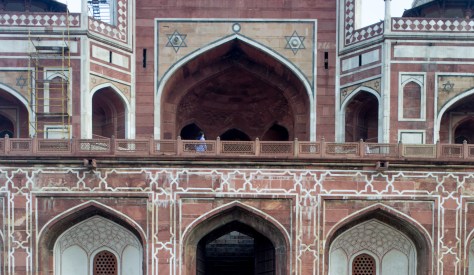
Why do we, if at all we do, really care about our material cultural heritage? Is it because it reminds us of what was, and is, good and great in humanity? Or is it the case that we look at a cultural objet and recognise that it is the Ozymandias complex materialized, that even the great and the mighty fail? Or is it that we may never attain the great heights in purity, simplicity, or other qualities we idolize and project on the remnants of the times past?

Or maybe we just want the tourism dollars and euros. Be that as it may, only someone obtuse, or with exaggerated tendency towards the behavior philistine, would say that our cultural heritage, our miniature paintings, our ruins, our tombs, forts, wall paintings, temples, mosques , books, manuscripts, and other things this essay is too short to quantify, are not worth preserving. Also note here that I said we, because we might be a bunch of separate kingdoms and separate principalities earlier, but deep down, we were one people, separated by religion and language, but united (willingly or unwillingly), by the plain and simple fact that you can’t chose your neighbor.

Continue reading How We Destroy our Future by Proxy – On The Ruination of Ruins: Rahul Sharma

Choice, Agency and the Naming of Names – The Trap of ‘Immediate Identities’ and the Vision of a Democratic Revolution: Chintu Kumari & Umar Khalid

Paired Guest Posts by CHINTU KUMARI and UMAR KHALID

[ Every struggle goes through highs and lows. The students who are part of the  movements that are spreading out of universities in India – Hyderabad Central University, Jawaharlal Nehru University and Jadavpur University have had their share of internal debates and disagreements, even as they have found moments of significant victory. and solidarity

Students at JNU who have recently concluded their hunger strike to give time to the university authorities to respond reasonably to the High Court directives on the HLEC punishments are now being criticized for having ‘abandoned the struggle’ by some sections who claim to play a role within the broader students movement, when, in fact, nothing of that sort has actually happened.

The majority of the students who were on hunger strike (including several JNUSU office bearers, and others) have said that they have given up the hunger strike against the HLEC recommendations in keeping with the court order.  In doing so, they have never said that they are suspending the agitation against the attempts by the JNU administration to weaken OBC reservation in admissions, hostel seats and deprivation points for women and oppressed sections of society.

In fact it is not as if the HLEC punishments issue has taken precedence over the other issues. It is actually the other way round. The students have decided to give priority to the struggle for ’social justice’ within the campus, while simultaneously giving time to the university authorities to respond adequately to the court directive on the HLEC punishment question.The call for a demonstration against the University Authorities by the JNUSU to continue the struggle on the social justice issues on the 16th of May is indicative of this fact.

13237814_1106943902682435_4288761213192298400_n

The attacks and insinuations against the majority of the students at JNU who were on hunger strike have also featured a deliberate attempt to create divisions within the unified ‘Red-Blue’ / ‘Jai Bhim-Lal Salaam’ dynamics of the movement on the grounds of identity. Activists, such as Umar Khalid, on the left have been singled out for being ‘Savarna-Syed’, if they happen to bear a Muslim name, and for being ‘sold out to the Savarna left’ if they are Dalit, as happened with Chintu Kumari and Rama Naga. This attack has come primarily from individuals representing organizations like BAPSA that claim to speak from a ‘Dalit’ position, and it is given traction by several other individuals eager to flaunt their disdain for the ‘left’ students on Facebook and social media.  Continue reading Choice, Agency and the Naming of Names – The Trap of ‘Immediate Identities’ and the Vision of a Democratic Revolution: Chintu Kumari & Umar Khalid

Run Jaggu Run — The JNU VC Runs Away from the Academic Council Meeting

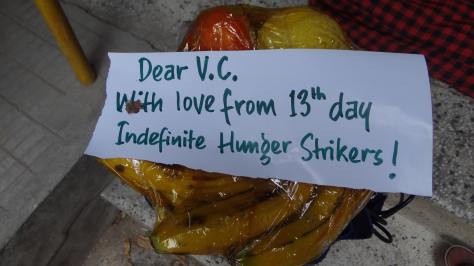
The 10th of May, the 13th Day of the Hunger Strike by JNU Students in protest against the HLEC Report was also the day scheduled for a meeting of the Academic Council of JNU. Students and faculty had resolved to stage a massive protest. Student and Faculty members of the Academic Council had also resolved to forcefully present issues related to the current crisis in the university at the AC Meeting. The events of the day are presented here through a series of videos and photographs uploaded by different people from JNU.

[ Video by Samim Asgor Ali, taken from his Youtube Channel ]

They tell the story of how students were generous with their tormentor, the VC, Jagadeesh Kumar, and how he ran away.

One day, his backers, Smriti Irani, Rajnath Singh and even Narendra Modi, and all the goons in the RSS headquarters at Mahal, Nagpur and Jhandewalan, Delhi will have to run for cover in a similar fashion when faced with the ‘gift’ of the fruits of their actions.

Photo by Samim Asgor Ali

The students gathered on hunger strike collected their meals from their hotel messes and placed them in front of the AC meeting venue as a ‘gift’ to the Vice Chancellor, JNU and the university administration. Continue reading Run Jaggu Run — The JNU VC Runs Away from the Academic Council Meeting

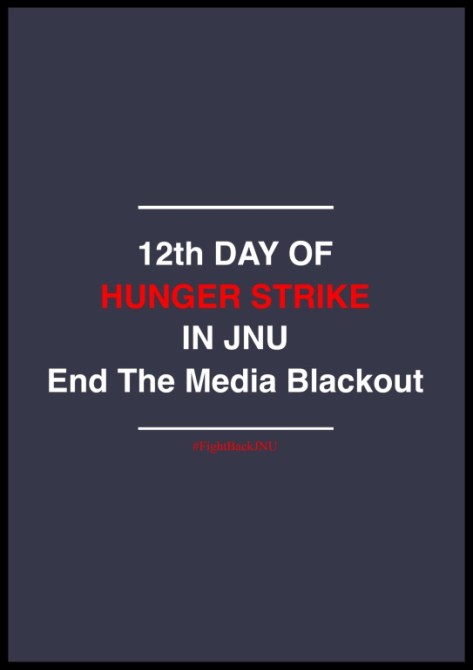
JNU Hunger Strike Day 12 : Game On – Students 1, Media, Authorities 0

The JNU Students’ Hunger Strike Enters Day 12. Ketone counts go up, Weight goes down, Morale stays miles high. Media fatigue shows that crusading news anchors are no match to hunger striking students when it comes to stamina, and, may we say, courage. The university authorities, the JNU VC and his gang, the government, the RSS-ABVP, remain what they are – losers.

(Images taken, with thanks, from the ‘We are JNU‘ Facebook Page, and the ‘Mothers Stand with JNU‘ Facebook Page.)

This slideshow requires JavaScript.

MEANWHILE, RADIOSILENCE CONTINUES (BESIDES RAVISH KUMAR’S SHOW) ON MAINSTREAM MEDIA

13177661_10153973732855546_8091436192653453340_n

This slideshow requires JavaScript.

जिशा, मेरी दोस्त, दलितों की जान इतनी सस्ती क्यों है? चिंटू

अतिथि पोस्ट : चिंटू

Josh
जिशा

जिशा, मेरी दोस्त मेरी यार, क्या कहूँ यार तुम्हारे साथ जो दंविये बर्बरता हुई उसके लिए मुझे  शब्द नहीं मिल रहे हैं कुछ कहने को. ये देश ये समाज हर रोज़ ऐसे झटके  देता रहता है और इतना देता है, इतना देता है, की हमारे लिए वीभत्स से वीभत्स घटना क्रूरतम से क्रूरतम घटना साधरण बन गई है और इन घटनाओं को पचाने की क्षमता में भी हम माहीर हो गए है. देखो न दोस्त, असाधारण कहाँ कुछ रह गया है. बचपन से आज तक तो यही सब देख- देख कर पले बढे हैं हम सब की, जो कुछ हो अपना हक़ मत मांगना, पढने लिखने की बात मत करना , बाप या भाई लात घूंसे  मार- मार कर तुम्हे अधमरा कर दे लेकिन एक शब्द भी उनके खिलाफ बोलने की गुस्ताखी मत करना, गाँव के उच्च जाति वर्ग के सामंती तुम्हे अगर छेड़े तुम्हारा बलात्कार करे तो उसका बहिष्कार मत करना कियोंकि ये तो उनका जन्म सिद्ध अधिकार है.

तुम्हारे लिए जो लक्ष्मण रेखा खिंची गई है उससे बाहर जाने की कोशिश की तो तुम्हारी शामत आना पक्की है. और शादी? ये तो दूसरी जात में तो दूर की बात अपनी जाति  में भी करने का अधिकार या आजादी की बात मत करना ये तय करना घर के बड़े पुरुषों के कंधे पर छोड़ो. सती सावित्री बनो, एक सद्गुणी बेटी, बहु और पत्नी बनो इसी में तुम्हारी भलाई है.


Continue reading जिशा, मेरी दोस्त, दलितों की जान इतनी सस्ती क्यों है? चिंटू

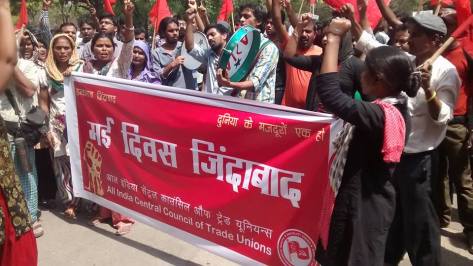
Workers and Students Unite on May Day in JNU: Aswathi Nair & Umar Khalid

Guest Post by Aswathi Nair and Umar Khalid (With Photographs and Videos by K. Fayaz Ahmed, Azhar Amim, Samim Asgor Ali, Reyazul Haque and Agnitra Ghosh)

Exactly nine years back, in 2007, ten students were rusticated (again) in the month of May for their “crime” of agitating along with workers to ensure the legally mandatory minimum wages for the workers here in JNU. It was the peak of summer, the time of holidays, and the administration (like this time, like every time) thought that they could break the unity of the workers and students with crackdown timed to coincide with what was thought to be the ‘weakest’ time for mobilization on campus. The administration’s plans did not bear fruit then, they will not work now either.

Workers and Students Unite in JNU on May 1, 2016, International Labour Day

We are in that strange time again. The summer of 2016 has witnessed a May Day wherein the workers in JNU not only took out their own rally, but also rallied with us students sitting on the 4th Day of their Indefinite Hunger Strike against administrative crackdown on our democratic spaces. Continue reading Workers and Students Unite on May Day in JNU: Aswathi Nair & Umar Khalid