Category Archives: Movements

UAPA – A Video Dossier: Media Collective, Arun Ferreira &Vernon Gonsalves

Video by Media Collective, Article by Arun Ferreira and Vernon Fernandes

Fifty Years of Unreasonable Restrictions

Arun Ferreira & Vernon Gonsalves 

Soon after its adoption, the Constitution of India was amended in 1951. At the time several progressive judgements[i] by the Judiciary held that laws which curb fundamental rights are essentially unconstitutional and fundamental freedoms could only be curbed in the most extreme of cases. The First Amendment, countered this by amending Article 19 to add the word ‘reasonable’ before restrictions and to add ‘public order’ as being one more ground for abridging Fundamental Rights.

The evolution of UAPA[ii] has to be seen in the background of this gradual but steady constriction of Article 19 which guarantees the fundamental freedoms of expression, assembly, association, etc. Continue reading UAPA – A Video Dossier: Media Collective, Arun Ferreira &Vernon Gonsalves

Looking ‘Right’, Talking ‘Liberal’ – The Twists and Turns of Makarand Paranjape: Anirban Bhattacharya

Guest Post by ANIRBAN BHATTACHARYA

[This missive to Makarand Paranjape, who is a professor at Jawaharlal Nehru University, comes in response to his recent op-ed piece in the Indian Express where he comments on the events at Ramjas College, Delhi University on the 21st of February and in their wake, in Delhi University, on the 22nd of February]

Mr. Makarand Paranjape. In your analysis of the post-Ramjas fallout in Delhi University in Indian Express on the 4th of March, one can see that you have donned a “liberal” cloak. But there were way too many holes in that cloak to go without a counter and hence this response.

Continue reading Looking ‘Right’, Talking ‘Liberal’ – The Twists and Turns of Makarand Paranjape: Anirban Bhattacharya

Statements of Solidarity for Ramjas and DU: A Collation

Please find below a collation of statements of solidarity received by Kafila over the past fortnight since the shameful incidents of violence by the ABVP occurred on the 21st and 22nd of February 2017. These are from: Ramjas Alumna, Ambedkar University Delhi Faculty Association, O.P Jindal Teachers: Students and Durham University Politics and International Relations Society, U.S.A; and students and faculty at the University of Minnesota, U.S.A.

UMN STANDS WITH DU
University of Minnesota Students and Faculty

The statements are preceded by a short write-up on what Ramjas College has meant to its alumna, by ANUBHAV PRADHAN.

Nostalgia is made of more than just happiness. It is sulphurous too.

To many who spent three or more years of their life in Ramjas College, visuals of violence in and around it on 21 and 22 February 2017 have been a source of deep, personal shock. The footpath and the areas adjoining the college gate were often sites of lingering conversations between friends, offering moments of respite from studies, tensions accruing from impending exams, or relief to those who had just accomplished a hectic ECA festival and were there catching up their breath or exhaling smoke.

The ABVP struck twice, once attacking the college Seminar Room and then coming back the second day to attack students. In the hundredth year of Ramjas’ establishment, a college founded at a time when protest was an active ideal for most Indians, this singular episode of planned, institutional violence against students and teachers is a grim reminder of the brute silencing of interrogation, peaceful protest, dialogue and dissent being normalised across our colleges and universities, and in our society at large. The audacity with which these perpetrators and their ideologues brand entire institutions and diverse communities of students and academics as anti-national—and therefore fit recipients for their brute censure—also gives the lie to the intellectual and affective bankruptcy of a rapidly emergent cultural orientation premised on simplistic binaries of good and bad, right and wrong, national and anti-national. In a society—and nation—whose ideals are peace, dialogue, and inclusion, these attacks on students and teachers point to the deep ideological rot in the perpetrators’ conception of nation, nationality and nationalism.

As an alumnus of Ramjas College, I cherish the right to self-determination and open debate. I feel outraged that the students’ and faculties’ right to decide what discussion to hold and whom to invite for it within college premises was usurped in this manner. It is disturbing that this violence rippled across the campus as it were, with students being followed, identified and harassed in their personal spaces for having asserted their right to listen to discussions on Bastar and for not bowing down to bodily attacks perpetrated through stones and fisticuffs by members of the ABVP and their affiliates.

Most alumni like me are invested in our respective professions, but the foundations of study and work were laid for us by Ramjas’ teachers and the college’s vibrant culture of extra-curricular instruction. This experience has proved fundamental to our engagement with our immediate workspaces, surroundings, power structures, and our nation. Denying current and future students their right to freely and openly debate issues of their choice in fora of their choice is tantamount to denial of a basic academic right. Threatening and manhandling academicians guided by the spirit of enquiry towards generation of dialogue will prove detrimental to the quality of collegiate education in our nation. We collectively issue the following statement of solidarity with Ramjas’ students and teachers in this moment of crisis:

Statement by Ramjas Alumna

Continue reading Statements of Solidarity for Ramjas and DU: A Collation

Longing for the Future – Two Days with Penkoottu and AMTU at Kozhikode, Kerala

Kozhikode, Hotel Alakapuri, 4-5 March, 2017.

Kozhikode has always upturned my feelings about the male gaze. It is of course a cheerful, bustling, place, full of fabulously good-looking people of all genders. The cheeriness has a certain effortlessly defiant quality – already evident when you look out of the window as the train from the south pulls into the railway station, and see bright, healthy, merrily-swaying wild flowers raise their heads undefeated by the ferocious summer sun– wild sunflowers in hundreds, magnificent vines of kulamariyan flowers ( literally, ‘over-the-top’ flowers, but known here also, interestingly enough, as Antigone vines), creepers happily, constantly, and untiringly winding over  little piles of rubbish and covering them with short-lived if emphatic trumpets of mauve, lavender, red, yellow, and white.  You pass this eternal artwork-in-progress of the flowers and vines and city trash and enter Kozhikode, but realise that it actually tells you a bit about the men there only when you meet them. Continue reading Longing for the Future – Two Days with Penkoottu and AMTU at Kozhikode, Kerala

A Tale of Two and a Half Marches – Two for Azadi and a Half for Ghulami.

[Videos of song by Shehla Rashid and of speeches by Nivedita Menon, Kavita Krishnan, Umar Khalid and Jignesh Mevani, courtesy, Samim Asgor Ali]

February gives way to March and spring returns to Delhi. And what a spring it is. The right wing thugs of the ABVP choose the wrong time to attack, once again. They must really get themselves a better astrologer, or at least a better class of charlatan who can tell them if there ever is a right time to stage their goon show. I suspect there isn’t.

Spring in DU - Fight Back DU
Spring in DU – Fight Back DU

Continue reading A Tale of Two and a Half Marches – Two for Azadi and a Half for Ghulami.

Hard Ways of Lucidity – Thinking About the Crisis in the University: Prasanta Chakravarty

Guest Post by Prasanta Chakravarty

As I see it, university spaces are being assaulted at least from two sides; though it seems as if the two sides are antagonistic to each other, in practice they come dangerously close to each other. How and why is this happening, and what can be done about it?

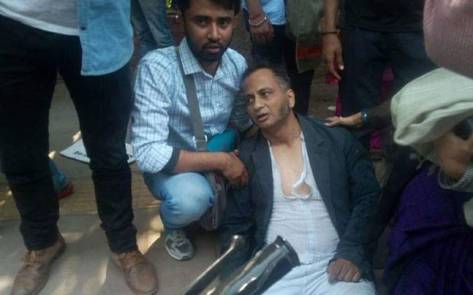
Prasanta Chakravarty, immediately after being assaulted on February 22nd. Image from the India Today Website.

Continue reading Hard Ways of Lucidity – Thinking About the Crisis in the University: Prasanta Chakravarty

ABVP Riots in Delhi University with Police Protection

For the second successive day, goons affiliated to the RSS-BJP backed right wing student mafia gang called ABVP (Akhil Bharatiya Vidyarthi Parishad) pelted stones and violently attacked peaceful assemblies of students and teachers in Delhi University. Journalists who were present were also beaten up. Phones and cameras and filming equipment were destroyed. An attempt was made to strangle a professor with his own scarf. He, and some other students who were injured had to be hospitalized. Luckily, they are shaken, but out of immediate danger. The incidents have been characterized as ‘clashes’ between right wing and left wing student groups by some sections of the media. Nothing can be further from the truth. These were not ‘clashes’. They were straight-forward one sided attacks by a mob intent on violence. A riot is not a clash. Continue reading ABVP Riots in Delhi University with Police Protection

After a Nuit Debout (night standing up), We Wake Up with a Political Strike: Charles Reeve

Guest post by CHARLES REEVE

[Note from Livia Bocadacce: During 2016, social movements in France and in India have been huge and tough. In both countries, youth, workers, students, oppressed people fought against governments who disregarded their desires of freedom and decent life, and have faced violent repression. But in France, we don’t hear about Indian struggles such as Una Dalits’ movement or Hyderabad and JNU students’ protests. In India, the very strong French movement of last spring, called “Nuits Debout”, has aroused very poor coverage. Because we believe we have to learn from the crossed experiences of fighting, because we refuse a globalization only based on trade and forced migrations, because we hope a globalization that could encourage the circulation of critical thinking and collectiveaction repertoire, we proposed this article on the Nuits debout to Kafila. Hoping it will generate debates and further interests. ]

Nuit Debout, image courtesy gaucherevolutionnaire.fr

After a Nuit debout (night standing up), we wake up with a political strike (1)

Living in a moment is always pleasanter than writing about it— it’s always risky to draw conclusions about situations still evolving or to speculate about what they will become. Going on for now over three months [when this post was written – AN], Nuit debout is a new kind of spontaneous, social movement along the lines of « Occupy » and Spain’s « M15 » movement. It has taken on an unanticipated size and importance, all the while developing characteristic features of French society. I won’t go back over its development or its collective spirit. The two texts already published in the May and June issues of the Brooklyn Rail, the first by Anouk Colombani and the second by Ferdinand Cazalis et Emilien Bernard (CQFD, n°143, mai 2016) have provided sufficient detail and clarity to let us grasp the essence and dynamism of these mobilizations.

Continue reading After a Nuit Debout (night standing up), We Wake Up with a Political Strike: Charles Reeve

Ex-ABVP Activists Reflect on How the ABVP Orchestrated 9th of February in JNU Last Year: Jatin Goraya and Pradeep Narwal

Guest Post by JATIN GORAYA and PRADEEP NARWAL

ABVP ARE THE FOOT-SOLDIERS OF THIS FASCIST GOVERNMENT WHO ORCHESTRATED THE ATTACK ON JNU POST 9TH FEB LAST YEAR!

APPEAL TO EVERYONE TO REJECT AND ISOLATE THE KILLERS OF ROHITH AND THOSE WHO ORCHESTRATED THE #SHUTDOWNJNU CAMPAIGN!

As JNU is still recovering from the aftershocks of last year sangh parivar’s attack on our university post 9th of February we are again facing an unprecedented attack on our university – its democratic space, progressive admission policy, its inclusive character. The latter has been the heart and soul of JNU which the student movement has built over the last four decades. Last year’s attack was an attack on our right to dissent, to curb our democratic spaces and to implement the fascist Hindutva agenda on our universities. This year, in the name of “academic quality” and “excellence”, by reducing the seat intake & closing admission they want to ensure that none is able to access higher education in JNU.

We were members of ABVP previous to the events of Feb 9 last year, and we subsequently resigned because of our differences with this fascist, casteist, Brahmanical and patriarchal organisation. These differences, as we have earlier said, had been long standing ones. But after the orchestrated attack on JNU, we felt a limit had been crossed and we could no longer associate with ABVP. Continue reading Ex-ABVP Activists Reflect on How the ABVP Orchestrated 9th of February in JNU Last Year: Jatin Goraya and Pradeep Narwal

In Solidarity with Adivasis in Bastar, Human Rights Defenders and Bela Bhatia in Bastar: Concerned Students in TISS, Mumbai

Guest Post by CONCERNED STUDENTS OF TATA INSTITUTE OF SOCIAL SCIENCES, MUMBAI

We, the concerned students of Tata Institute of Social Sciences (TISS), Mumbai condemn the continuing state repression of adivasis and recent attack on human rights activist Bela Bhatia in Bastar, Chhattisgarh.

On the 23rd of January, 2017, a group of 30-odd men attacked Bela where they barged into her house in Parpa, near Jagdalpur violently and threatened to burn the building down if she did not leave immediately. The mob also attacked her landlords and their children, threatening them with dire consequences if Bela was not evicted immediately. Despite Bela’s assurances that she would leave, the mob continued to be belligerent, in the presence of the police, and the Sarpanch. The mob has been identified with the right-wing vigilante group Action Group for National Integrity (AGNI). Continue reading In Solidarity with Adivasis in Bastar, Human Rights Defenders and Bela Bhatia in Bastar: Concerned Students in TISS, Mumbai

Maternity Entitlements were Legal Rights 3 years ago, not a New Year Gift: Statement of the Right to Food Campaign


On New Year’s Eve, the Prime Minister in his much-anticipated speech amongst other commitments made a vague announcement of a “nation-wide” scheme for maternity entitlements for pregnant women.

But the PM has not spelled out any specifics – neither the timeframe;budget nor its universal coverage as obligated in the National Food Security Act (NFSA) since2013. Clause 4B of the law already promises all pregnant and lactating women maternity entitlements of atleastRs 6000 for each child. But for three years, the central government didn’t honour this legal obligation. Though better late than never, re-packaging this legal right as the PM’s New Year gift is disingenuous.

Further media reports, from December indicate that the Finance Ministry may hike the budget by a mere 20 percent (instead of the sevenfold increase necessary for universalisation) and that too restrict the benefit to only women Below the Poverty Line (BPL). This would be in complete violation of the NFSA.

But there seems to bearecurring trend to subvert the law. For the last three years, this government continued with the pilot Indira Gandhi MatritvaSahyogYojana (IGMSY) in just 53 districts of the country despite repeated demands by civil society activists and women from across the country. This year, Right to Food Campaign activists from across India even sent postcards to the PM to remind him of the state’s obligation.

In September 2015, even the Supreme Court issued notices to the Centre on the non-implementation of maternity entitlements under the NFSA.

While the government did initially enhance the IGMSY allocations from Rs 4000 to Rs. 6000 to be in tune with the NFSA, neither the coverage nor the budget was enhanced which languishes at Rs. 400 crores. Instead to ensure that all eligible women are covered as per the NFSA, Rs 16,000 crores is necessary. A real test of the Prime Minister’s announcement will be in the fine print of the allocations in next month’s budget.

Do not let a university turn into a ‘shakha’ of a poisoned tree

Have the JNU students and faculty seriously considered taking legal action against the current Vice Chancellor? From every report that I have seen, all his actions in the recently concluded farcical Academic Council (AC) meeting seem to me to be instances of prima facie procedural violation. (Or am I incorrect in assuming this?)

From what I have heard, his conduct includes the deliberate misrepresentation of the minutes, pretending to consensual decisions where there were none, and disruptive and arrogant behavior towards Academic Council members. If this is indeed the case, could there not be strong legal grounds to ask for his removal on the grounds of his willful violation of institutional procedures and ethics? What do people with legal experience think of such a possibility? What do students and faculty think?

If recourse to legal action is not feasible or practical, what else can be done to remedy this situation? What kind of campaign can restore a semblance of sanity to JNU (and to universities, generally) that have been serially assaulted by university administrations acting at the behest of right-wing thugs.

It seems to me, that this man, Mamidala Jagadesh Kumar (the current JNU vice-chancellor) is acting like a criminal, and I think he should be treated as such from now on. Co-operating with his decisions, or even tacit acceptance of his manner of functioning, should now be seen as complicity with an agenda to destroy the university. Let us also not forget that this VC continues to protect those who assaulted Najeeb Ahmed before he disappeared from JNU. In the unfortunate possibility of anything untoward having happened to Najeeb Ahmed, this VC should be seen as being responsible. He creates the conditions of impunity that threaten the safety of each and every student. His decision to punish the students who protested yesterday with arbitrary and unjust suspension orders is exactly analogous to the authoritarian conduct of Podile Appa Rao, VC of HCU, that led to the tragic suicide of Rohith Vemula. The manner in which both Jagadesh Kumar and Appa Rao have acted suggests a pattern of the deliberate victimization of students on the basis of their caste identities. This only brings shame and disrepute to the institutions headed by them.

In my considered view, (and please view this only as a suggestion) the time has come for Faculty and Students of JNU to come together (irrespective of their political positions and postures) to demand the unconditional removal of Mamidala Jagadesh Kumar from the vice-chancellorship of JNU and from the university itself. I think that all limits have now been crossed by his conduct. His declarations about what the AC decided should be treated as null and void (also because they are violative of the principles of social justice and democratic education), and the suspension orders against the students who were targeted must be revoked. I hope that the present JNUSU and JNUTA will not fail in their responsibility to conduct a coherent and militant campaign to reverse this situation. If they vacillate, or, are unable to offer a coherent, well worked out strategy, they too will be seen as responsible for the mess that JNU is in today.

I hope that every student (and here I mean ‘common students’ as well as student activists within and outside organizations) and every teacher at JNU is able to rise above the temptation of negativism and needless point-scoring at this juncture. Just as the JNUSU crucially must not see itself as immune to criticism, or fail to act with militant resolve and clarity, and in resonance with the concerns of students, (including of those outside the union) so too, those outside the union could help matters by not falling to the temptation of adopting ‘holier than thou’ postures that impede practical unity. Let there be solidarity in struggle, and the kind of criticality that aids , rather than impedes, solidarity.

This time, this opportunity, this moment of necessity for thoughtful, militant, intelligent unity of all students, teachers and all friends of the idea or a free and open university is too precious to lose at the altar of either posturing or prevarication.

Restore freedom to freedom square! Do not let a university turn into a ‘shakha’ of a poisoned tree! Eject Mamidala Jagadesh Kumar! Reject Podile Appa Rao! Bring back life to our universities !

On Indian Exceptionalism and Kashmir: Dia Da Costa

This is a guest post by Dia Da Costa

‘If Trump is elected, I will move to Canada,’ many Americans noted in passing, in jest, and then in all seriousness once the results were out.

If it has taken this election result to make people recognize the pervasive racism in the US, that is because of the success of US exceptionalism and its ability to deflect attention from its ongoing colonization of indigenous land, relentless imperialism, Islamophobia, and ongoing brutalities against black people in the aftermath of abolition and the civil rights movement. If it has taken this election result to make people really want to move to Canada, that too is because of the success of Canadian multicultural exceptionalism. Apparently, Canadian exceptionalism is still able to pass as not-as-racist by deflecting attention from its ongoing colonization of indigenous land, relentless participation in imperialism cloaked all too often as humanitarian development, growing Islamophobia, and its self-congratulatory representation of itself as having no history of slavery even as its anti-Black violence pervades cities and small towns alike.

For those of us who can recognize these forms of exceptionalism, I want to ask if we acknowledge Indian exceptionalism, and its specific relation to Kashmir? ‘If Trump is elected, I will move back to India’, I saw many Indians say on social media. If it has taken this US election result to make Indians really want to move back to India, that is not just because of the apparent success of US exceptionalism among Indians, who could see racism but could ultimately deal with, and even love life in the US. It is also because of Indian exceptionalism. To be sure, Indian exceptionalism is nurtured by the caste and class privilege that allows some Indians to declare that they will simply up and leave when the going gets tough (whether it is in India or in the US), or joke about the same.

But there is more to it. Indian exceptionalism is a state projected discourse turned commonsense perception of India as a complicated and diverse nation that is ultimately unified against all odds by the absolute commitment of its people to democracy. Whether we believe it at face value or we critique the many excesses of the Indian state, ultimately something draws us to this idea of India as the world’s largest democracy. Continue reading On Indian Exceptionalism and Kashmir: Dia Da Costa

Appeal to Join “JNU Chalo” on 15 Nov Marking One Month of Najeeb’s Disappearance: JNUSU

Guest Post by JNUSU (Jawaharlal Nehru University Students Union)

15036279_10209603262232786_2873516424910911795_n

Friends, on 14th October night, Najeeb Ahmed, a student of M.Sc. Biotechnology, JNU was brutally assaulted and violently threatened by a group of ABVP students. From 15th October morning, Najeeb went missing from the campus. The disappearance of a student from a central university in the national capital after assault and intimidation of right wing lumpens is no doubt an ominous reflection of the dark times we are living in. For past four weeks, students, teachers, staff members of JNU, and citizens of Delhi have been coming out on the streets demanding institutional accountability to bring back Najeeb.

Continue reading Appeal to Join “JNU Chalo” on 15 Nov Marking One Month of Najeeb’s Disappearance: JNUSU

The Anatomy of a Disappearance: Shehla Rashid

Guest Post by Shehla Rashid. Videos by Haider Saif and Samim Asgor Ali

Students Gathering in a Vigil for Najeeb Ahmed at JNU


Think of the person closest to you, and the place that they hold in your daily life, the bittersweet memories that they create each day in your life, the daily fights and the moments of affection. At times, you fight and simply want to go away from one another, seeking a temporary calm from each other’s absence. You resolve never to call him/her again, or to speak to her/him anymore. However, by the time dusk falls, you realise the emptiness of your time without them, and you make a phone call, speaking reservedly, trying not to sound desperate or sappy. You tell them that you are coming home, and ask whether you need them to get anything- as if that were the reason for the phone call. This person could be you sister, your partner, or your best friend. Continue reading The Anatomy of a Disappearance: Shehla Rashid

The Importance of Being Makarand Paranjape: Anirban Bhattacharya

Guest Post by ANIRBAN BHATTACHARYA

A few days back, drawing from Oscar Wilde’s classic, Makarand Paranjape wrote a piece titled The importance of being Narendra Modi. He urged his readers to ensure a second term for Modi saying “If Narendra Modi gets a second term, he will certainly change India in a lasting and significant way.” That he is going to change India, and is doing so already is not that far from truth, but the question is which way is this change taking us. Given the track record of Modi Ji(o) so far, the change is surely going to be for the worse. But this piece is not on Modi Ji(o). This one is on the Makarand Paranjapes of the world. Yes, they are not one. They are in fact a particular breed not new in history, and they have a particular role. Specifically, we would evaluate this role of theirs in the light of a recent piece of his on the gherao of the JNU VC.

Some would say that the piece was on the issue of Najeeb. But no, it wasn’t. Najeeb, a new student pursuing M.Sc in Bio-Tech living in Mahi-Mandavi hostel was publicly assaulted by identified ABVP goons in front of students as well as wardens on the night of 14th October. He was showered with dire consequences of which too there are multiple witnesses including again the hostel wardens. A vicious communal slur-campaign was set in motion by the sanghis writing “Muslims are terrorists” within the hostel premises. Amidst all of this and in the given context Najeeb “disappeared” on 15th October from his hostel. He had called his mother last, who, as it appears, had reached Anand Vihar and was on her way to meet her son in distress. But, by the time she was here, Najeeb went “missing” mysteriously and is yet to be found. After five days of entreating an unresponsive university administration to be proactive in creating conditions for Najee’s safe return, JNU students undertook an all night vigil on the 19th of October.

Continue reading The Importance of Being Makarand Paranjape: Anirban Bhattacharya

2 Weeks No #JusticeForNajeeb – A Few Thoughts on Yesterday’s March and the Way Forward: Shehla Rashid

Guest Post by Shehla Rashid.

Video and Photo Inputs from Naushad MK, Samim Asgor Ali and Amit Kumar

[ This post was written shortly after JNU students gathered in front of Vasant Vihar Police Station to articulate their concern and anger at the lax attitude taken so far by the Delhi Police and other concerned authorities in relation to the disappearance of Najeeb Ahmed almost two weeks ago. In this text, (originally uploaded as a note on Facebook and then sent to us to be posted at Kafila) Shehla Rashid, thinks aloud about what has happened so far and looks ahead at the possible way forward for the students of JNU and their supporters to focus on making sure that Najeeb Ahmed, wherever he is, returns safe and sound to the JNU campus. We hope that it will be widely read, and discussed to evolve strategies for the evolving future of the campaign to give justice to Najeeb. Kafila]

Shehla Rashid and Others Being Confronted by Delhi Police at the Vasant Vihar Chakka Jam on Oc. 26, 2016


First of all, I’d like to express my gratitude to all the students who joined the Chakka Jam at Vasant Vihar police station, where the ACP refused to even accept the paper with our demands and, instead, ordered a lathi-charge on us. Students marched as one and stayed together till the end, despite all differences, for one goal- justice for Najeeb, and his safe return to campus life. I salute this spirit of JNU students. Having said that, I must say that we need to do more. Students need to come out in even greater numbers, as the attack on us is of immense magnitude.

Continue reading 2 Weeks No #JusticeForNajeeb – A Few Thoughts on Yesterday’s March and the Way Forward: Shehla Rashid

Requiem for the Undead: On Kerala’s Sixtieth Birthday

[The title is a tribute to Johnny Miranda’s exquisite Malayalam novel, Requiem for the Living (Jeevichirikkunnavarkku Vendiyulla Opees in Malayalam)

As Kerala’s sixtieth birthday – a year which was inevitably one of celebration for many Malayalis as the culmination of life, until the increasing life expectancy here rendered it redundant – approaches, evaluations on the health and well-being of the region (and not just the people, or individual Malayalis) are being offered. They do not bode well. There is a sense in which we feel that the magic that has somehow protected the region, placed a shining cloak around its shoulders once, has departed. This magic is none other than that which is captured by the term ‘Kerala Model’ – which, in our popular imagination, always exceeded being just social science shorthand for the complex array of historical factors that led to high social indicators in a society characterized by low economic growth once associated with us. The idea of the Kerala Model somehow represented the fairy godmother who had transformed Kerala from being the Cinderella in India, to a shining princess fit to be raised to the heights of the UN’s international development-circles in the 1970s. Continue reading Requiem for the Undead: On Kerala’s Sixtieth Birthday

The Twitter Gherao of Mamidala90 on the 10th Day of Najeeb Ahmed’s Disappearance from JNU: Shehla Rashid

Guest Post by Shehla Rashid

[ Between the 9th and 1oth day of the disappearance of Najeeb Ahmed from the JNU campus, the JNU Vice Chancellor, Mamidala Jagadesh Kumar decided to salvage his reputation on twitter, even as he squandered it on the grounds of the campus of the university he presides over. And so he let forth a volley of tweets, while sitting inside his office and his residence, even as he refused to meet or listen to the JNU students who have grown increasingly concerned and anxious at the university administrations callous laxity about the fate of Najeeb Ahmed, the missing students.

While students marched down the campus, forming a human chain that culminated at the gates of the VC’s residence near the university’s east gate, Mamidala90 (the handle with which the VC distinguishes himself in twitsville) began getting extremely active. While the students were peacefully assembled at the gates of the VC’s residence, very much not in ‘gherao’ or ‘blockade’ mode, Mamidala90 whined about being ‘blockaded’.

A Sample of Mamidala90's tweets while students gathered peacefully outside his residence. Is this what it felt like to hear Nero fiddle while Rome burnt?
A Sample of Mamidala90’s tweets while students gathered peacefully outside his residence. Is this what it felt like to hear Nero fiddle while Rome burnt?

Continue reading The Twitter Gherao of Mamidala90 on the 10th Day of Najeeb Ahmed’s Disappearance from JNU: Shehla Rashid

Bring Back Najeeb Ahmed to JNU: A Call to Resist Terror in Universities

14615765_679911288839993_8711625822412574391_o-1

It is now more than a week since Najeeb Ahmed, an MSc (first year) student of Biotechnology at Jawaharlal Nehru University, Delhi has been reported missing, after an altercation with members of the RSS affiliated ABVP student organization, which reportedly left him injured and severely traumatized.

Continue reading Bring Back Najeeb Ahmed to JNU: A Call to Resist Terror in Universities

Ezhuka Tamil – A Conversation about Democracy :Dharsha Jegatheeswaran and Gajen Mahendra

This is a guest post by DHARSHA JEGATHEESWARAN AND GAJEN MAHENDRA


On Saturday September 24, 2016, Ezhuka Tamil, organized by the Tamil People’s Council, became the largest rally to happen since the end of the war in the North-East of Sri Lanka. Over 10,000 people took to the streets to demand an end to ongoing human rights violations, particularly militarization and Sinhala-Buddhisization of the North-East,reiterate their demand for genuine accountability and justice and voice their expectations regarding the ongoing political processes. The political elite in Colombo and their supporters elsewhere have however chosen to read Ezhuka Tamil as an expression of ‘Tamil extremism’. This response requires us to critically interrogate the nature of democratic spaces in post-war Sri Lanka available to the numerically smaller communities and more largely what our understanding of democracy is. This is very necessary if we believe in the need for public participation in the constitutional and transitional justice process currently underway. Continue reading Ezhuka Tamil – A Conversation about Democracy :Dharsha Jegatheeswaran and Gajen Mahendra