Category Archives: Politics

Towards BJP’s Hindutva Lite Template

BJP’s Delhi campaign was not divisive by sanyog or coincidence. That is its prayog or experiment. Which it will take to other elections.

BJP’s Delhi campaign was not divisive by sanyog

Kitney aadmi thhe—how many were there?

A meme based on this famous monologue from the highly successful film, Sholay (Embers), from the early seventies, started trending when “David” Kejriwal, leader of the Aam Aadmi Party (AAP), defeated “Goliath” Bharatiya Janata Party (BJP) in Delhi’s recent Assembly elections.

No doubt this election’s result has put paid to the efforts of Home Minister Amit Shah to retain his image as “Chanakya” of Indian politics, at least for now. The result is despite BJP’s desperate attempts to win Delhi, as part of which pulled chief ministers, former chief ministers, cabinet ministers and more than 240 Members of Parliament to campaign in the city. Blame it on the high stakes battle that allegations surfaced that they had distributed cash and liquor ahead of the polls.

The result is for everyone to see.

The most toxic electoral campaign, perhaps ever, in which leaders of the ruling dispensation even provoked violence through their hate speeches, did not work. The BJP’s seat tally rose by merely five and a bloody nose.

( Read the full article here : https://www.newsclick.in/Towards-BJP-Hindutva-Lite-Template)

Why Pakistan’s Islamists Don’t Want India’s CAA Repealed

Of all reasons to oppose CAA, NPR and NRC, most worrying is the Islamists across the borders feeling enthused.

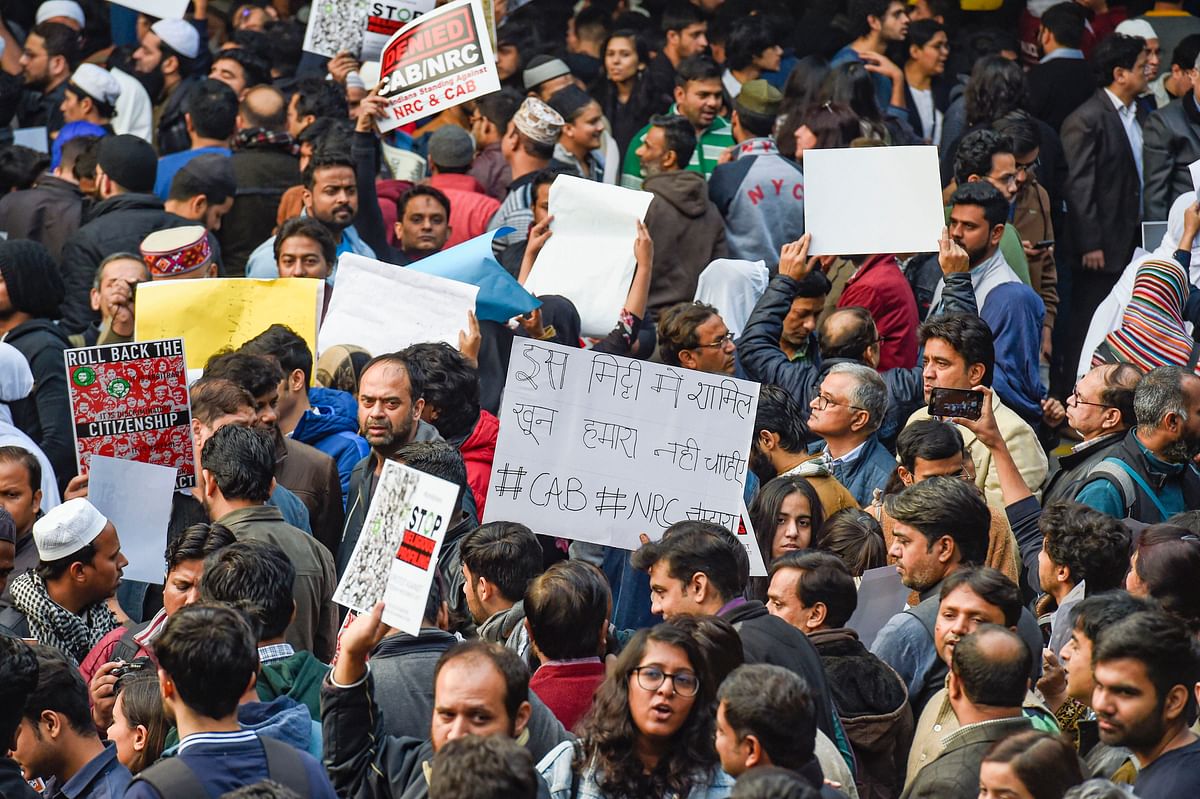
Anti CAA Protest in India

Seattle City Council, one of the most powerful city councils in the United States, recently made history. It became the world’s first elected body to pass a resolution asking the Indian government to repeal the CAA, stop the National Register of Citizens and uphold the Indian Constitution. It also sought ratification of United Nations treaties on refugees. The said resolution is being seen to be “leading the moral consensus in the global outcry against the CAA”.

Seattle is definitely not an exception.

Many concerned voices have spoken against the highly controversial discriminatory Citizenship Amendment Act (CAA) 2019, which excludes Muslims [and Jews] and enforces a selective citizenship criteria based on faith. This new law effectively reduces the status of millions of Muslims in India to illegal migrants. A similar resolution was tabled by members of the European Union Parliament last month. It stands postponed right now, but that will be a short reprieve, for the members have resolved to take it up again shortly.

For the first time in independent India’s history the Indian diaspora—which is normally projected as pro-Prime Minister Narendra Modi and which does participate in rallies in his support—has been protesting against the bill along with Indian students studying in the West. These protests have been going on for close to two months in different cities and towns in different cities in the West.

Couple this development with the resistance within the country spreading to new areas and broadening to include more sections of society, as people gradually wake up to the CAA’s grim portents. Definitely, there is growing discomfort against the Modi-Shah regime. Perhaps it is a sign of desperation that in order to legitimise this law the government has been peddling half-truths even in Parliament. Prime Minister Modi quoted selectively from the Nehru-Liaquat pact to buttress his case. He used the same Nehru-Bordoloi letter to defend the CAA, which his party had earlier used to slam the Congress. Gopinath Bordoloi was the first Chief Minister of Assam after Independence.

( Read the full text here : https://www.newsclick.in/why-pakistans-islamists-dont-want-indias-caa-repealed)

Delhi Elections and the Difficult Terrain of Antifascist Struggle


Three incidents of firing in four days – two in Jamia Millia Islamia and one in Shaheen Bagh – quickly followed open calls to violence (‘goli maro saalon ko‘) by Union minister of State for Finance Anurag Thakur and the demonization of Shaheen Bagh protesters by BJP MP Pravesh Verma (‘the protesters will enter your homes and rape and kill your daughters’ if Modi and Shah aren’t there). In the case of the Shaheen Bagh shooter, Kapil Gujjar, the Delhi Police (which has till date not managed to find out the JNU attacker Komal Sharma’s affiliation) was quick to link him to the Aam Aadmi Party (AAP) – an allegation expressly denied by his father. All these episodes, so obviously set up, basically aimed at provoking the protesters into committing some violence that the lapdog television channels would then play up, in their usual hysterical style (some of them may even have appeared on air in police uniform!), to vitiate the atmosphere.

On the very first shooting, one such channel did indeed keep doing precisely that till long after the identity of the shooter (in the clip above) had been clearly established. The clips were circulating almost instantaneously and you can hear the gunman shouting Delhi Police zindabad, and there was little chance of mistaking him for an anti-CAA protester. The channel knew exactly what it was doing and at whose behest but kept on at it till 9 o’clock at night.

Continue reading Delhi Elections and the Difficult Terrain of Antifascist Struggle

Gandhi and the Hindutva Right

From Nehru to Patel and Ambedkar, the saffron party has appropriated freedom-fighters or tarnished legacies. Gandhi, however, poses a different problem.

Why BJP’s Subjugation of Gandhi

Death ends all enmity’ (Marnanti Vairani) goes a maxim in Hinduism.

The story also goes that when Ravana was on death bed, Ram had even asked Laxman to go to him and learn something which no other person except a great scholar like him could teach him, declaring that though he has been forced to punish him for his terrible crime, ‘you are no more my enemy’.

It is a different matter that Hindutva supremacists — who are keen ‘to transform Hinduism from a variety of religious practices into a consolidated ethnic identity’ — are believers in the exact opposite.

For them, once the enemy is dead, the enmity flares up without any limits. They have no qualms that their adversary is no more to defend himself/ herself.

It has been more than five and half years that they are in power at the Centre and we have been witness to complete vilification, demonisation and obfuscation of many of their adversaries, all great leaders of the anti-colonial struggle. Of course, few were found to be ‘lucky’ enough that were promptly co-opted/appropriated by them, of course, in a sanitised form.

( Read the full article here : https://www.newsclick.in/BJP-Subjugation-Gandhi-Legacy-Roadblock-Shaheen-Bagh

CAA-NPR-NRC’s Impact on Urban Poor : National Coalition for Inclusive and Sustainable Urbanisation (NCU)


Guest Post by National Coalition for Inclusive and Sustainable Urbanisation (NCU)

The National Coalition for Inclusive and Sustainable Urbanisation (NCU) unequivocally condemns the unconstitutional and anti-constitutional CAA-NPR-NRC being unilaterally imposed by the National Democratic Alliance (NDA) government. The NCU is a network of activists, researchers, urban practitioners, lawyers, informal sector workers, collectives and individuals who, for the past two years have been involved with issues of urban class and caste inequalities and is continually monitoring this acutely dangerous social condition in our cities. Therefore, are working for an alternative paradigm of urbanization. These inequalities are brought to light when basic rights such as the right to housing, participation in governance mechanisms, right to livelihood and most importantly, equal right to the city, are denied to the urban poor.

India has been going through tumultuous times. The massive inequities in Indian cities are best highlighted by a recent Oxfam report. Shockingly, just 63 billionaires have more money than the entire budget of the government of India. This disparity is mirrored in asset holdings in cities. The difference between the top 10 per cent and the bottom ten per cent is 50,000 times in Indian cities! This is further accentuated by the huge informality that exists in urban India-93 per cent.This exposes the extreme vulnerabilities faced by urban population. Continue reading CAA-NPR-NRC’s Impact on Urban Poor : National Coalition for Inclusive and Sustainable Urbanisation (NCU)

संशोधित नागरिकता-कानून, जनसँख्या-रजिस्टर एवं नागरिकता-रजिस्टर – एक तथ्यात्मक ब्यौरा : सप्तरंग व नागरिक एकता एवं सद्भाव समिति

[संशोधित नागरिकता-कानून, जनसँख्या-रजिस्टर  (एन पी आर ) एवं नागरिकता-रजिस्टर (एन आर सी ) पर  निन्मलिखित परचा रोहतक ज़िले के दो संगठनों  – सप्तरंग  व नागरिक एकता व  सद्भाव समिति ने शाया किया है. जनहित में इस सामग्री का किसी भी रूप में प्रयोग किया जा सकता है। ये सारी जानकारी सार्वजनिक तौर पर उपलब्ध सरकारी या भरोसेमंद प्रकाशनों से ली गई है न कि अपुष्ट स्रोतों से। ]

भाग 1            

आसाम समझौता, नागरिकता-कानून में संशोधन एवं आसाम का नागरिकता-रजिस्टर

  1. नागरिकता कानून में संशोधन एवं नागरिकता रजिस्टर का विरोध एक कारण से नहीं हो रहा। यह दो कारणों से हो रहा है – उत्तर-पूर्व में अलग  कारण से और शेष देश में अलग कारणों से । दोनों तरह की आलोचनाओं का समाधान ज़रूरी है।
  2. उत्तर-पूर्व के राज्यों में इस का विरोध इसलिए हो रहा है कि इस के चलते अवैध रूप से देश में 2014 तक दाखिल हुए लोगों को भी नागरिकता मिल जायेगी जब कि 1985 में भारत सरकार के साथ हुए आसाम समझौते के तहत केवल 1965 तक आसाम में आए हुए अवैध प्रवासियों को ही नागरिकता मिलनी थी। (मोदी सरकार द्वारा पिछले कार्यकाल में प्रस्तावित नागरिकता संशोधन कानून का उत्तर-पूर्व राज्यों में भयंकर विरोध हुआ था। इस सशक्त विरोध के चलते मोदी सरकार ने 2019 में पारित कानून के दायरे से उत्तर-पूर्व के कुछ इलाकों को बाहर रखा है पर इस से भी उत्तर-पूर्व के स्थानीय संगठन/लोग संतुष्ट नहीं हैं। वे इसे वायदा-खिलाफ़ी के रूप में देखते हैं।)
  3. आसाम (और तब के आसाम में लगभग पूरा उत्तर-पूर्व भारत आ जाता था) में अवैध प्रवासियों की समस्या बहुत पुरानी है। इस के नियंत्रण के लिए पहला कानून 1950 में ही बन गया था। इस का कारण यह है कि भारत-बंगलादेश सीमा हरियाणा-पंजाब सीमा जैसी ही है। कहीं-कहीं तो आगे का दरवाज़ा भारत में तो पिछला बंगलादेश में खुलता है। भारत के नक़्शे के अन्दर कुछ इलाके बंगलादेश के थे तो बंगलादेश के नक़्शे के अन्दर स्थित कुछ ज़मीन भारत की थी। (इन इलाकों का हाल में ही निपटारा हुआ है।) बोली, भाषा, पहनावा एक जैसा होने के चलते कलकत्ता में पहले-दिन-पहला-फ़िल्म शो देखने के लिए बंगलादेश से आना मुश्किल नहीं था। ऐसे अजीबो-गरीब तरीके से हुआ था देश का बंटवारा।

Continue reading संशोधित नागरिकता-कानून, जनसँख्या-रजिस्टर एवं नागरिकता-रजिस्टर – एक तथ्यात्मक ब्यौरा : सप्तरंग व नागरिक एकता एवं सद्भाव समिति

The Constitution as the ‘Social Contract’ of Modern India


The  Constitution of India should be seen as a work-in-progress – not because it has been amended ever so often by different governments but because it has been taken over by ‘we, the people’, repeatedly, especially since the 1990s. The ‘authorized’ interpreters of the Constitution and Law are no longer its sole interpreters. The continuous battles over its interpretation in the courts of law are only one way in which meaning is contested. But from the dalits reclaiming it as “Babasaheb’s Constitution” to the pathalgadi movement  of the Jharkhand adivasis and finally as the banner of citizenship movement today, its meaning has been contested time and again in the streets and in villages.

It is customary, in most secular-nationalist and left-wing circles, to invoke the “great values of the national movement”, which is seen as synonymous with the “freedom struggle”, which in turn is reduced to the “anticolonial struggle”. On 15 August 1947, India attained Independence from colonial rule and on 26 January 1950, “we, the people of India” gave to ourselves the Constitution of India. The anticolonial struggle came to an end in August 1947 but that did not mean that all the currents that  comprised the larger “freedom struggle” – the jang-e-azadi – got their freedom. We perhaps need to make a distinction today between the “freedom struggle” (that is still ongoing) and the “anticolonial nationalist” movement.

We need to state emphatically that the “freedom struggle” of different social groups is not – and never was – reducible to the “anticolonial struggle”. There were many different strands and currents that  either functioned at a distance from mainstream nationalism , or even worked in opposition to it.

Continue reading The Constitution as the ‘Social Contract’ of Modern India

The Ongoing Movement Against CAA and the ‘Political’ Question


The question that is uppermost on most people’s minds today is what will happen to the Citizenship Amendment Act (CAA) and how long will the protests continue? The home minister Amit Shah declaring that the Act will not be withdrawn and the government will not move an inch, regardless of the  protests, is a direct challenge to the people of India. With  the Supreme Court looking the other way, taking up challenge thrown by Shah can only mean one thing now: if the Act does not go, the regime must. Mass movements have been known to  bring down oppressive regimes, and even in the recent past, we have seen that happen in different parts of the world.

Subsequent developments, however, also indicate that often forces emerge that basically take advantage of the mass movements to hijack them and install equally unpopular regimes – a matter we need to discuss very seriously. I will briefly return to this ‘political question’ later as it is of utmost importance that we grasp the possibilities and dangers inherent in the present moment.

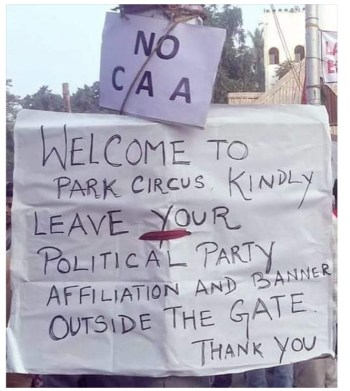
Notice outside the Park Circus protest venue

Continue reading The Ongoing Movement Against CAA and the ‘Political’ Question

A Moment of Unprecedented Possibilities


Beginning this week, we are starting a column which will appear every Thursday. The name of this column, ‘Parapolitics’, is meant to indicate something that happens all the time, outside the formally designated sphere of politics, or what is sometimes called ‘the political’ by political theorists. As a matter of fact, most of such politics – parapolitics – takes place everyday and is deeply tied to our everyday lives. It is also what we may call ‘existential politics’:  the dalit boys flogged by upper caste men inside a police station in Una, the woman of Unnao, whose family is decimated by the rapist’s henchmen, the mob-lynching to which Muslims are subjected on a daily basis, the farmer or the unemployed who commits suicide, the displaced adivasis or the workers who fight back – all these are instances of things deeply political but occurring away from or beneath the ‘proper’ domain of politics. The ‘proper domain of politics’ – that of state/government, parties, elections, alliances and so on – has repeatedly historically revealed its fundamental disconnect with such existential politics. Indeed, whenever faced by mass protests, the first response by the political class is to reduce it to the purported machinations of ‘opposition parties’. It cannot think of people, ordinary people, coming out in autonomous action. We might recall the response of the UPA government, at the height of the anti-corruption movement, challenging the locus standi of the protesters with the questions: ‘who are you?’ or ‘who has authorized you?’ etc Parapolitics is that unauthorized politics of everyday life, which often bursts out into the open but may also simply go on under the surface without any necessary public manifestation.

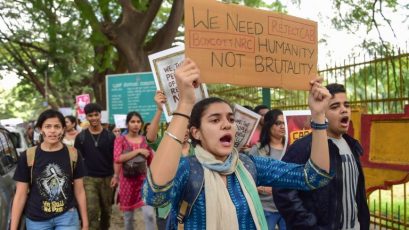
Students protest in Bengaluru, photo courtesy PTI

The most striking aspect of the present upsurge of popular anger around the Citizenship Amendment Act (CAA), as has been widely noticed, is the way defiant young women have become the face of the struggle. I am not referring here only to the women whose iconic images are circulating everywhere today, but also to the sheer number in which they have come out and the power with which they have been speaking their mind before the media. And they belong to all communities.

Continue reading A Moment of Unprecedented Possibilities

Muslims held hostage by a criminal state apparatus in UP – a report on Sambhal

Sustained reportage by dogged and principled journalists and investigation by citizens’ groups have gradually begun to illuminate the terrible darkness around anti CAA protests in UP over December 2019. Every single one of these has exploded the narrative fostered by the UP government, police and compliant local media, of violent mobs destroying public property and attacking police.

We have all noted that massive marches against the CAA have taken place all over the country, but have “turned violent” only in BJP ruled states. The various reports that are now emerging, reveal the extent to which the UP police either acted as a violent mob itself, or used police informers or local RSS organizations to start stone pelting and other such acts to disrupt non-violent marches, and to provide an excuse for violent police action.

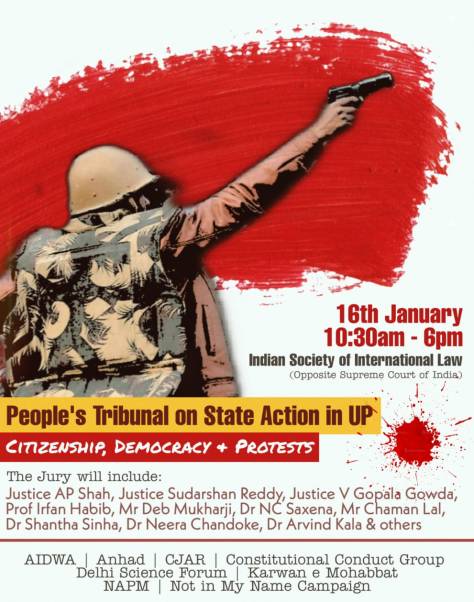
A public hearing on state action in UP will be held in Delhi on January 16th, 2020, bringing together all the information collected by different groups of people who have visited different parts of the state.

Here we present the report on Sambhal.

SAMBHAL

A team went to Sambhal from Karwan-e-Mohabbat on 2 January, 2020, consisting of Ayesha Kidwai, Farida Khan, Navsharan Singh, Nivedita Menon, Sandeep Yadav, Sumit Gupta, Tanika Sarkar and Varna Balakrishnan. Continue reading Muslims held hostage by a criminal state apparatus in UP – a report on Sambhal

The Yogi and the Erotics of Violence: Jaya Sharma

Guest Post by JAYA SHARMA

This article that explores the enjoyment of violence, epsecially in the social media world, in the wake of the brutal violence perpetrated by the Yogi Adityanath regime in Uttar Pradesh. It should be read as a sequel to Jaya Sharma’s earlier article published in Kafila in June last year.

‘Maza aa gaya Yogiji mazaLathi aisi lagi ki maza aa gaya…’

Maza is a word used often in tweets in response to police attacks on CAA-NRC protestors in UP.  Unlike it’s staid, sanskritized counterpart anand, maza has a charge, a buzz and could translate into English as ‘thrill’.  ‘Thrilling Yogiji thrilling’… ‘The way the lathi struck…thrilling’.  I’ll return to such tweets to explore the following questions.

Might it be that there is an erotic charge to political violence?  Might it be that the erotic charge is not limited to those who perform the violence but also animates the millions who hear, see or read that such violence has been meted out?  Well beyond “not caring”, might it be that they “get off” on such violence?  Can the proactive, enthusiastic support for political violence be understood only in terms of “ordinary folk” being corrupted by evil leaders? Might we also need to see what within the collective psyche could be pushing them towards a terrible kind of enjoyment of such violence? Continue reading The Yogi and the Erotics of Violence: Jaya Sharma

Nationwide NRC -The Devil at the Heart of India’s Draconian Digitalization: CP Geevan

GUEST POST BY C. P.  GEEVAN

NPR and NRC – An Enigmatic Clarification

It was difficult to miss the smugness with which the Home Minister of India (HM) addressed a TV show he had orchestrated through one of the infamous godi (lapdog) media after the central cabinet had approved Rs 39.41 billion for updating the National Population Register (NPR) and Rs 85 billion for Census 2021 operations.The show was meant to dispel the misgivings about the link between NPR and the nationwide NRC—National Register of Indian Citizens (NRIC). In meetings across the country and within the Parliament, the HM had been proclaiming or rather threatening to carry out NRIC. However, his enigmatic statements did nothing to allay the grave fears people across India have about NPR, given the government’s obsession and resolve to identify what they call illegal residents. There is no doubt that instead of pressing concerns such as unemployment, alarming fall in per capita consumption and an extraordinary economic slump, of late the single-minded focus of the regime is on dividing the Indian people into different categories, branding, imprisoning and even throwing some out of India. Continue reading Nationwide NRC -The Devil at the Heart of India’s Draconian Digitalization: CP Geevan

Statement Issued by ‘Netherlands against CAA’ (Citizenship Amendment Act)

Guest Post by ‘Netherlands against CAA’

अंतरराष्ट्रीय न्यायालय के सामने विरोध-प्रदर्शन।

(A series of protests have been held in Netherlands against CAA by the Indian diaspora since last few days.  There was a protest at International Court of Justice ( ICJ) based in Hague on 30 th December. It was the fifth protest in last ten days. Pasted below a statement issued on the occasion.)

Statement for Press Release: ICJ Protest

In light of the recent events in India, a group of Indian diaspora residing in the Netherlands, deeply disturbed by the turn of events have decided to protest against the Government of India before the Peace Palace. The protest is directed against the enactment of Citizenship (Amendment) Act, 2019 (“Act”) followed by gross perpetration of human rights violation against its citizens by the Government of India. Continue reading Statement Issued by ‘Netherlands against CAA’ (Citizenship Amendment Act)

Your Government Wants Revenge From You

Uttar Pradesh is dealing with CAA as it dealt with crime : encounters

Uttar Pradesh is dealing with CAA as it dealt with crime

Image Courtesy: PTI

Seventy-six year old advocate Mohammad Shoaib fought to have innocents branded as terrorists under repressive laws released, and risked multiple assaults by right-wing lawyers as he took these cases through various courts in Uttar Pradesh. His contemporary, former police officer SR Darapuri became a human rights activist and writer after he retired. Neither would have imagined one day they would be lodged in jail, charged with rioting and creating disaffection, under similarly draconian laws.

But as everybody knows, in Uttar Pradesh today Shoaib and Darapuri are not exceptions. They are just two notable figures among the hundreds of socio-political activists, writers and cultural workers—not to forget ordinary folks—who have been packed into various state prisons for opposing the Citizenship Amendment Act (CAA) and the National Register of Citizens (NRC). These protests are going on across the country, and started peaking after 19 December, when students spontaneously poured out in the streets against the new law and the proposed policy.

Uttar Pradesh’s administration has come down on those protesting with a heavy hand. The Chief Minister, Yogi Adityanath, tried to project the opposition to the bill as a purely ‘law and order issue: therefore, he sought to justify seeking “revenge” against those who damaged public or private property.

( Read the full article here : https://www.newsclick.in/your-government-wants-revenge-you)

Students Against Fascism in India – Bonn/Köln/Aachen Stand With Protest Against CAA and NRC

Guest Post by Students Against Fascism in India – Bonn/Köln/Aachen

IMG-20191223-WA0107

“We, the students of Bonn, Cologne and Aachen stand with the protests all across India condemning the Citizenship Amendment Act (CAA) and the National Register of Citizens of India (NRC). In particular, we condemn and are deeply disturbed by the police brutality unleashed on the peacefully protesting students of Jamia Millia Islamia and Aligarh Muslim University. The police laid siege to university campuses, vandalising the libraries, tear gassing hostel rooms and firing water canons. Several students sustained serious injuries in this process and some continue to be in police detention. To suppress the protests the Indian government has withheld internet access in at least five states. We admire and stand in unequivocal solidarity with students and protestors across the country who took and continue to take to the streets protesting the unconstitutional and unsecular CAA and NRC.

The CAA, passed by the Bhartiya Janata Party (BJP) dominated upper and lower houses of the government, offers Indian citizenship to Hindus, Buddhists, Sikhs, Jains, Parsis and Christians facing persecution on the grounds of religion in Afghanistan, Bangladesh, and Pakistan. It blatantly discriminates on the basis of religion by specifically excluding Muslims, a first for the otherwise secular Indian Citizenship laws and constitution. This combined with the NRC, which is aimed at the disenfranchisement and detention of undocumented immigrants, equips the Hindu nationalist government of BJP led by Modi to institutionalise the ethnic cleansing of Muslim minorities by rendering them stateless.

We stand together to condemn the inherently communal and divisive nature of various actions undertaken by the Modi-led BJP government. We assert to not let such dangerously fascistic moves of turning a secular India into a Hindu nation go unchecked and call on others to do the same”

10,000 Academics, Students, Teachers and Civil Society Against Police Brutality at Jamia Millia Islamia and Aligarh Muslim University

We, the undersigned, condemn in the strongest possible terms the police brutality in Jamia Millia Islamia University, New Delhi, and the ongoing illegal siege and curfew imposed on Aligarh Muslim University, Aligarh. On 15th December 2019 Delhi police in riot-gear illegally entered the Jamia Millia campus and attacked students who are peacefully protesting the Citizenship Amendment Act. The Act bars Muslims from India’s neighboring countries from the acquisition of Indian citizenship. It contravenes the right to equality and secular citizenship enshrined in the Indian constitution.

On the 15th at JMIU, police fired tear gas shells, entered hostels and attacked students studying in the library and praying in the mosque. Over 200 students have been severely injured, many who are in critical condition. Because of the blanket curfew and internet blockage imposed at AMU, we fear a similar situation of violence is unfolding, without any recourse to the press or public. The peaceful demonstration and gathering of citizens does not constitute criminal conduct. The police action in the Jamia Millia Islamia and AMU campuses is blatantly illegal under the constitution of India.

We stand in unconditional solidarity with the students, faculty and staff of Jamia Millia Islamia and Aligarh Muslim University, and express our horror at this violent police and state action. With them, we affirm the right of citizens to peaceful protest and the autonomy of the university as a non-militarized space for freedom of thought and expression. The brutalization of students and the attack on universities is against the fundamental norms of a democratic society.

As teachers, students, scholars and members of civil society across the world, we are watching with extreme concern the situation unfolding at Jamia Millia Islamia and Aligarh Muslim University. We refuse to remain silent at the violence unleashed on our colleagues (students, staff, and faculty) peacefully protesting the imposition of a discriminatory and unjust law.

This statement with a full list of signatories is available here: Jamia Millia and AMU solidarity statement.

CAA-NRC: Turning India Into a Warzone of ‘Peace’

Is the Indian state turning into a religious dystopia, like some of its neighbours?

CAA-NRC: Turning India Into a Warzone of ‘Peace’

Image Courtesy: Free Press Journal

The Bharatiya Janata Party-led central government has pushed the Citizenship Amendment Act through, but it is struggling to manage its fallout and the national outrage that a related proposal to create a National Register of Indian Citizens or NRIC has generated. At first, BJP leaders desperately assured those who were excluded in the NRC, or national register of citizens, that was finalised in October this year for the people of Assam. Its pleas were meant to reassure the Hindus who were excluded in the state’s citizen-count that it would hold a fresh all-India count of citizens, in which they will be included. The reason for the BJP’s desperation was the outcome of the Assam NRC, which turned out to be contrary to its expectations: out of 19 lakh found “illegal” in the state, only about 5 lakh are Muslim, almost all the rest are Hindu.

Yet, the fears of the citizenship law, combined with the resistance to an all-India NRC, have now given rise to tremendous mass resistance across India. There have been massive marches and rallies in many places, some of them culminating in aggressive confrontations with police and security forces. There is an ongoing massive crackdown on several universities, including in Lucknow, Aligarh, and Delhi where students were agitating against the new citizenship law and the all-India listing of citizens or NRIC.

( Read the full story here : https://www.newsclick.in/CAA-NRC-turning-india-earzone-peace)

Why the JNU #FeesMustFall is a Mass Intersectional Movement: Paresh Hate

Guest Post by PARESH HATE

It has been more than a month that students in JNU have been protesting against the new IHA Hostel Manual. The fight had initially begun against the exorbitant fee hikes, introduction of curfew timings and dress codes, lack of reservations and deprivation points in the manual, and the undemocratic manner in which the manual was passed. At this juncture, the movement has become broader, and articulates its resistance to the National Education Policy and its defence of the idea of public university and what it stands for.

While there have been many attempts to characterize the students’ movement as anti-national and free-loading as usual by the right-wing media, it is clear that the political articulation of students has managed to transcend these limited dimensions offered by the discourse set by the public perception. Even the propagandists are this time at a loss as to how to demonise the movement. All they have been able to come up with is that the protests ‘disrupted traffic’ and that the protests are ‘political’. One is unable to understand how the latter is a jibe, when protests are obviously always political in nature, especially this one. The demonization of JNU is not simply about the social sciences, or left-oriented student politics, but also a manufacturing of consent toward the commercialization and a legitimizing of this government’s agenda to destroy public avenues of welfare. However, due to the developments that have taken place in the last few weeks, politics itself of the campus is churning, wherein what is emerging is a cultivated intersectional discourse that has resulted in the breathing of new life into the campus. Continue reading Why the JNU #FeesMustFall is a Mass Intersectional Movement: Paresh Hate

Faculty Feminist Collective, JNU, condemns police violence on students

December 11, 2019

We, members of Faculty Feminist Collective, Jawaharlal Nehru University, condemn in the strongest terms the unprovoked police brutality on the peaceful protest marches of JNU students against the illegal adoption of a revised Hostel Manual by the JNU administration and the proposed steep rise in fees. Three times since November 11, 2019, the day of the JNU Convocation, the police have lathi-charged assembled and marching students. The first time, students were expressing a legitimate demand to meet the Vice Chancellor who now conducts all business outside the campus and has not met any member of the JNU community for some time now. On the second occasion it was a march to Parliament, to meet the elected representatives of this country; and the third time, to meet the President of India who is also the Visitor of JNU, to press upon them the urgency of the situation in which nearly half of the current students of JNU will not be able to come back next semester if the IHA Manual and the fee hike is not rolled back. Continue reading Faculty Feminist Collective, JNU, condemns police violence on students

Withdraw the Citizenship Amendment Bill! Not in My Name

JOIN THE PROTEST ORGANIZED BY ‘NOT IN MY NAME’ AGAINST THE CAB ON 14TH DECEMBER 3 TO 5 PM AT JANTAR MANTAR, DELHI.

WHAT IS THE CAB?

The Citizenship Amendment Bill proposes to offer Indian citizenship to Hindu, Sikh, Jain, Buddhist and Christian refugees from Afghanistan, Bangladesh and Pakistan. Muslims have been excluded. It is the Government’s argument that minorities of these three countries face persecution on the basis of religion.

WHAT DOES THE INDIAN CONSTITUTION SAY?

The framers of our Constitution made sure that religion and citizenship were delinked. Put together in the immediate aftermath of Partition, which witnessed the barbaric killing of lakhs of people and the uprooting of millions, the Constitution of India chose to strike out in a direction that surprised the world: our constitution guarantees citizenship irrespective of religion or any other identity. India was to be a country that belonged to all who were born here – and irrespective of their other identities. It is this sense of belonging that has kept India together.

WHY IS CAB DANGEROUS?

In the next few days Parliament will decide whether we continue to be an India that belongs to all. With the CAB we are being dragged back by more than seventy years, to follow the path of nations with a narrow minded view of citizenship, with the inevitable consequence of further divisions, partitions, enmity and violence. Continue reading Withdraw the Citizenship Amendment Bill! Not in My Name

We the people of India, Reject the Citizenship Amendment Bill