Category Archives: Politics

Muslims held hostage by a criminal state apparatus in UP – a report on Sambhal

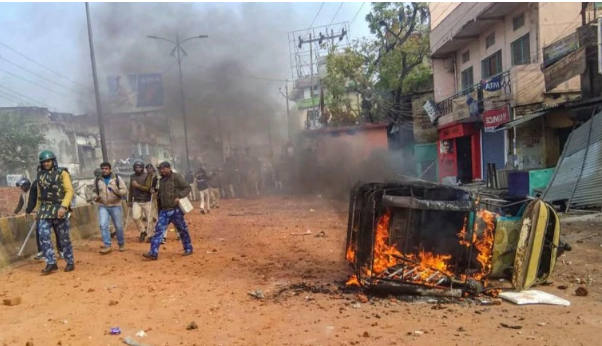
Sustained reportage by dogged and principled journalists and investigation by citizens’ groups have gradually begun to illuminate the terrible darkness around anti CAA protests in UP over December 2019. Every single one of these has exploded the narrative fostered by the UP government, police and compliant local media, of violent mobs destroying public property and attacking police.

We have all noted that massive marches against the CAA have taken place all over the country, but have “turned violent” only in BJP ruled states. The various reports that are now emerging, reveal the extent to which the UP police either acted as a violent mob itself, or used police informers or local RSS organizations to start stone pelting and other such acts to disrupt non-violent marches, and to provide an excuse for violent police action.

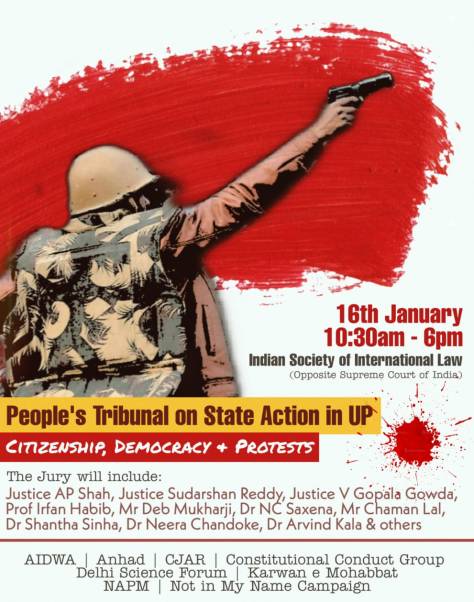
A public hearing on state action in UP will be held in Delhi on January 16th, 2020, bringing together all the information collected by different groups of people who have visited different parts of the state.

Here we present the report on Sambhal.

SAMBHAL

A team went to Sambhal from Karwan-e-Mohabbat on 2 January, 2020, consisting of Ayesha Kidwai, Farida Khan, Navsharan Singh, Nivedita Menon, Sandeep Yadav, Sumit Gupta, Tanika Sarkar and Varna Balakrishnan. Continue reading Muslims held hostage by a criminal state apparatus in UP – a report on Sambhal

The Yogi and the Erotics of Violence: Jaya Sharma

Guest Post by JAYA SHARMA

This article that explores the enjoyment of violence, epsecially in the social media world, in the wake of the brutal violence perpetrated by the Yogi Adityanath regime in Uttar Pradesh. It should be read as a sequel to Jaya Sharma’s earlier article published in Kafila in June last year.

‘Maza aa gaya Yogiji mazaLathi aisi lagi ki maza aa gaya…’

Maza is a word used often in tweets in response to police attacks on CAA-NRC protestors in UP.  Unlike it’s staid, sanskritized counterpart anand, maza has a charge, a buzz and could translate into English as ‘thrill’.  ‘Thrilling Yogiji thrilling’… ‘The way the lathi struck…thrilling’.  I’ll return to such tweets to explore the following questions.

Might it be that there is an erotic charge to political violence?  Might it be that the erotic charge is not limited to those who perform the violence but also animates the millions who hear, see or read that such violence has been meted out?  Well beyond “not caring”, might it be that they “get off” on such violence?  Can the proactive, enthusiastic support for political violence be understood only in terms of “ordinary folk” being corrupted by evil leaders? Might we also need to see what within the collective psyche could be pushing them towards a terrible kind of enjoyment of such violence? Continue reading The Yogi and the Erotics of Violence: Jaya Sharma

Nationwide NRC -The Devil at the Heart of India’s Draconian Digitalization: CP Geevan

GUEST POST BY C. P.  GEEVAN

NPR and NRC – An Enigmatic Clarification

It was difficult to miss the smugness with which the Home Minister of India (HM) addressed a TV show he had orchestrated through one of the infamous godi (lapdog) media after the central cabinet had approved Rs 39.41 billion for updating the National Population Register (NPR) and Rs 85 billion for Census 2021 operations.The show was meant to dispel the misgivings about the link between NPR and the nationwide NRC—National Register of Indian Citizens (NRIC). In meetings across the country and within the Parliament, the HM had been proclaiming or rather threatening to carry out NRIC. However, his enigmatic statements did nothing to allay the grave fears people across India have about NPR, given the government’s obsession and resolve to identify what they call illegal residents. There is no doubt that instead of pressing concerns such as unemployment, alarming fall in per capita consumption and an extraordinary economic slump, of late the single-minded focus of the regime is on dividing the Indian people into different categories, branding, imprisoning and even throwing some out of India. Continue reading Nationwide NRC -The Devil at the Heart of India’s Draconian Digitalization: CP Geevan

Statement Issued by ‘Netherlands against CAA’ (Citizenship Amendment Act)

Guest Post by ‘Netherlands against CAA’

अंतरराष्ट्रीय न्यायालय के सामने विरोध-प्रदर्शन।

(A series of protests have been held in Netherlands against CAA by the Indian diaspora since last few days.  There was a protest at International Court of Justice ( ICJ) based in Hague on 30 th December. It was the fifth protest in last ten days. Pasted below a statement issued on the occasion.)

Statement for Press Release: ICJ Protest

In light of the recent events in India, a group of Indian diaspora residing in the Netherlands, deeply disturbed by the turn of events have decided to protest against the Government of India before the Peace Palace. The protest is directed against the enactment of Citizenship (Amendment) Act, 2019 (“Act”) followed by gross perpetration of human rights violation against its citizens by the Government of India. Continue reading Statement Issued by ‘Netherlands against CAA’ (Citizenship Amendment Act)

Your Government Wants Revenge From You

Uttar Pradesh is dealing with CAA as it dealt with crime : encounters

Uttar Pradesh is dealing with CAA as it dealt with crime

Image Courtesy: PTI

Seventy-six year old advocate Mohammad Shoaib fought to have innocents branded as terrorists under repressive laws released, and risked multiple assaults by right-wing lawyers as he took these cases through various courts in Uttar Pradesh. His contemporary, former police officer SR Darapuri became a human rights activist and writer after he retired. Neither would have imagined one day they would be lodged in jail, charged with rioting and creating disaffection, under similarly draconian laws.

But as everybody knows, in Uttar Pradesh today Shoaib and Darapuri are not exceptions. They are just two notable figures among the hundreds of socio-political activists, writers and cultural workers—not to forget ordinary folks—who have been packed into various state prisons for opposing the Citizenship Amendment Act (CAA) and the National Register of Citizens (NRC). These protests are going on across the country, and started peaking after 19 December, when students spontaneously poured out in the streets against the new law and the proposed policy.

Uttar Pradesh’s administration has come down on those protesting with a heavy hand. The Chief Minister, Yogi Adityanath, tried to project the opposition to the bill as a purely ‘law and order issue: therefore, he sought to justify seeking “revenge” against those who damaged public or private property.

( Read the full article here : https://www.newsclick.in/your-government-wants-revenge-you)

Students Against Fascism in India – Bonn/Köln/Aachen Stand With Protest Against CAA and NRC

Guest Post by Students Against Fascism in India – Bonn/Köln/Aachen

IMG-20191223-WA0107

“We, the students of Bonn, Cologne and Aachen stand with the protests all across India condemning the Citizenship Amendment Act (CAA) and the National Register of Citizens of India (NRC). In particular, we condemn and are deeply disturbed by the police brutality unleashed on the peacefully protesting students of Jamia Millia Islamia and Aligarh Muslim University. The police laid siege to university campuses, vandalising the libraries, tear gassing hostel rooms and firing water canons. Several students sustained serious injuries in this process and some continue to be in police detention. To suppress the protests the Indian government has withheld internet access in at least five states. We admire and stand in unequivocal solidarity with students and protestors across the country who took and continue to take to the streets protesting the unconstitutional and unsecular CAA and NRC.

The CAA, passed by the Bhartiya Janata Party (BJP) dominated upper and lower houses of the government, offers Indian citizenship to Hindus, Buddhists, Sikhs, Jains, Parsis and Christians facing persecution on the grounds of religion in Afghanistan, Bangladesh, and Pakistan. It blatantly discriminates on the basis of religion by specifically excluding Muslims, a first for the otherwise secular Indian Citizenship laws and constitution. This combined with the NRC, which is aimed at the disenfranchisement and detention of undocumented immigrants, equips the Hindu nationalist government of BJP led by Modi to institutionalise the ethnic cleansing of Muslim minorities by rendering them stateless.

We stand together to condemn the inherently communal and divisive nature of various actions undertaken by the Modi-led BJP government. We assert to not let such dangerously fascistic moves of turning a secular India into a Hindu nation go unchecked and call on others to do the same”

10,000 Academics, Students, Teachers and Civil Society Against Police Brutality at Jamia Millia Islamia and Aligarh Muslim University

We, the undersigned, condemn in the strongest possible terms the police brutality in Jamia Millia Islamia University, New Delhi, and the ongoing illegal siege and curfew imposed on Aligarh Muslim University, Aligarh. On 15th December 2019 Delhi police in riot-gear illegally entered the Jamia Millia campus and attacked students who are peacefully protesting the Citizenship Amendment Act. The Act bars Muslims from India’s neighboring countries from the acquisition of Indian citizenship. It contravenes the right to equality and secular citizenship enshrined in the Indian constitution.

On the 15th at JMIU, police fired tear gas shells, entered hostels and attacked students studying in the library and praying in the mosque. Over 200 students have been severely injured, many who are in critical condition. Because of the blanket curfew and internet blockage imposed at AMU, we fear a similar situation of violence is unfolding, without any recourse to the press or public. The peaceful demonstration and gathering of citizens does not constitute criminal conduct. The police action in the Jamia Millia Islamia and AMU campuses is blatantly illegal under the constitution of India.

We stand in unconditional solidarity with the students, faculty and staff of Jamia Millia Islamia and Aligarh Muslim University, and express our horror at this violent police and state action. With them, we affirm the right of citizens to peaceful protest and the autonomy of the university as a non-militarized space for freedom of thought and expression. The brutalization of students and the attack on universities is against the fundamental norms of a democratic society.

As teachers, students, scholars and members of civil society across the world, we are watching with extreme concern the situation unfolding at Jamia Millia Islamia and Aligarh Muslim University. We refuse to remain silent at the violence unleashed on our colleagues (students, staff, and faculty) peacefully protesting the imposition of a discriminatory and unjust law.

This statement with a full list of signatories is available here: Jamia Millia and AMU solidarity statement.

CAA-NRC: Turning India Into a Warzone of ‘Peace’

Is the Indian state turning into a religious dystopia, like some of its neighbours?

CAA-NRC: Turning India Into a Warzone of ‘Peace’

Image Courtesy: Free Press Journal

The Bharatiya Janata Party-led central government has pushed the Citizenship Amendment Act through, but it is struggling to manage its fallout and the national outrage that a related proposal to create a National Register of Indian Citizens or NRIC has generated. At first, BJP leaders desperately assured those who were excluded in the NRC, or national register of citizens, that was finalised in October this year for the people of Assam. Its pleas were meant to reassure the Hindus who were excluded in the state’s citizen-count that it would hold a fresh all-India count of citizens, in which they will be included. The reason for the BJP’s desperation was the outcome of the Assam NRC, which turned out to be contrary to its expectations: out of 19 lakh found “illegal” in the state, only about 5 lakh are Muslim, almost all the rest are Hindu.

Yet, the fears of the citizenship law, combined with the resistance to an all-India NRC, have now given rise to tremendous mass resistance across India. There have been massive marches and rallies in many places, some of them culminating in aggressive confrontations with police and security forces. There is an ongoing massive crackdown on several universities, including in Lucknow, Aligarh, and Delhi where students were agitating against the new citizenship law and the all-India listing of citizens or NRIC.

( Read the full story here : https://www.newsclick.in/CAA-NRC-turning-india-earzone-peace)

Why the JNU #FeesMustFall is a Mass Intersectional Movement: Paresh Hate

Guest Post by PARESH HATE

It has been more than a month that students in JNU have been protesting against the new IHA Hostel Manual. The fight had initially begun against the exorbitant fee hikes, introduction of curfew timings and dress codes, lack of reservations and deprivation points in the manual, and the undemocratic manner in which the manual was passed. At this juncture, the movement has become broader, and articulates its resistance to the National Education Policy and its defence of the idea of public university and what it stands for.

While there have been many attempts to characterize the students’ movement as anti-national and free-loading as usual by the right-wing media, it is clear that the political articulation of students has managed to transcend these limited dimensions offered by the discourse set by the public perception. Even the propagandists are this time at a loss as to how to demonise the movement. All they have been able to come up with is that the protests ‘disrupted traffic’ and that the protests are ‘political’. One is unable to understand how the latter is a jibe, when protests are obviously always political in nature, especially this one. The demonization of JNU is not simply about the social sciences, or left-oriented student politics, but also a manufacturing of consent toward the commercialization and a legitimizing of this government’s agenda to destroy public avenues of welfare. However, due to the developments that have taken place in the last few weeks, politics itself of the campus is churning, wherein what is emerging is a cultivated intersectional discourse that has resulted in the breathing of new life into the campus. Continue reading Why the JNU #FeesMustFall is a Mass Intersectional Movement: Paresh Hate

Faculty Feminist Collective, JNU, condemns police violence on students

December 11, 2019

We, members of Faculty Feminist Collective, Jawaharlal Nehru University, condemn in the strongest terms the unprovoked police brutality on the peaceful protest marches of JNU students against the illegal adoption of a revised Hostel Manual by the JNU administration and the proposed steep rise in fees. Three times since November 11, 2019, the day of the JNU Convocation, the police have lathi-charged assembled and marching students. The first time, students were expressing a legitimate demand to meet the Vice Chancellor who now conducts all business outside the campus and has not met any member of the JNU community for some time now. On the second occasion it was a march to Parliament, to meet the elected representatives of this country; and the third time, to meet the President of India who is also the Visitor of JNU, to press upon them the urgency of the situation in which nearly half of the current students of JNU will not be able to come back next semester if the IHA Manual and the fee hike is not rolled back. Continue reading Faculty Feminist Collective, JNU, condemns police violence on students

Withdraw the Citizenship Amendment Bill! Not in My Name

JOIN THE PROTEST ORGANIZED BY ‘NOT IN MY NAME’ AGAINST THE CAB ON 14TH DECEMBER 3 TO 5 PM AT JANTAR MANTAR, DELHI.

WHAT IS THE CAB?

The Citizenship Amendment Bill proposes to offer Indian citizenship to Hindu, Sikh, Jain, Buddhist and Christian refugees from Afghanistan, Bangladesh and Pakistan. Muslims have been excluded. It is the Government’s argument that minorities of these three countries face persecution on the basis of religion.

WHAT DOES THE INDIAN CONSTITUTION SAY?

The framers of our Constitution made sure that religion and citizenship were delinked. Put together in the immediate aftermath of Partition, which witnessed the barbaric killing of lakhs of people and the uprooting of millions, the Constitution of India chose to strike out in a direction that surprised the world: our constitution guarantees citizenship irrespective of religion or any other identity. India was to be a country that belonged to all who were born here – and irrespective of their other identities. It is this sense of belonging that has kept India together.

WHY IS CAB DANGEROUS?

In the next few days Parliament will decide whether we continue to be an India that belongs to all. With the CAB we are being dragged back by more than seventy years, to follow the path of nations with a narrow minded view of citizenship, with the inevitable consequence of further divisions, partitions, enmity and violence. Continue reading Withdraw the Citizenship Amendment Bill! Not in My Name

We the people of India, Reject the Citizenship Amendment Bill

Remembering December 6 – A letter to the people of India: Constitutional Conduct Group

Statement by CONSTITUTIONAL CONDUCT GROUP

We, a collective of retired civil servants deeply committed to the values and guarantees of the Indian constitution, share with our fellow Indians our extreme grief and deep concern about where India stands today, 27 years after the demolition of the Babri Masjid in Ayodhya on 6 December, 1992.

We recall that 6 December is also the anniversary of the day on which the man who led the creation of one of the finest constitutions in the world, Dr Bhimrao Ambedkar, left this world.

The battle for the land on which the medieval mosque in Ayodhya stood was at its core a battle for the defence of the highest values of this constitution.

This was not simply a title dispute over a tiny piece of land in a dusty small town. It was not even a contest between a medieval mosque, now razed, with a grand temple, still imagined. It was a dispute about what kind of country this is and will be in the future, to who does it
belong, and on what terms must people of different identities and beliefs live together in this vast and teeming land.
4. We feel intense anguish because 27 years after the mosque was demolished, those who were responsible for this crime which tore India apart and led to the highest levels of communal bloodletting after the Partition riots, have still not been punished, even though
the Supreme Court directed that this criminal case be heard on a day-to-day basis. Instead, many of those who led and participated in this assault not just on a mosque but on India’s constitutional morality, have held some of the highest offices in this country.

We worry also that the recent judgment of the Supreme Court of India in effect rewards this grave crime. It also creates a false and illusory notion that a verdict favouring those who claim to speak for the majority community can result in peace and reconciliation and
everyone should move on, injustice notwithstanding. Continue reading Remembering December 6 – A letter to the people of India: Constitutional Conduct Group

कितनी आज़ाद है ग्रामीण पत्रकारों की कलम? : पी. साइनाथ

Guest Post by P Sainath

(बनारस के पराड़कर स्मृति सभागार में 29 नवंबर, 2019 को “पत्रकारों पर हमले के विरुद्ध समिति” CAAJ द्वारा आयोजित कार्यक्रम में दिया गया व्याख्यान)

मैं पांच भाषाओं में बराबर खराब बोल सकता हूं। यहां मैं मुंबइया हिंदी में बोलूंगा। आप लोगों ने सम्मान दिया, किताब रिलीज करने को बुलाया, यह मेरे लिए सम्मान की बात है क्योंकि ग्रामीण भारत के बारे में बहुत कम छपता है। इस किताब में दस राज्यों से रिपोर्टें हैं। ये वे दस राज्य हैं जहां देश की आधी आबादी, करीब साठ−सत्तर करोड़ लोग रहते हैं। इसलिए ये बहुत अहम है। इसकी अहमियत समझने के लिए आप ये आंकड़े देखिए।

हिंदुस्तान के नेशनल अखबारों में ग्रामीण खबरें कितना छपती हैं, इसके लिए इनके फ्रंट पेज लीजिए। दिल्ली में एक संस्था है सेंटर फॉर मीडिया स्टडीज़। एन. भास्कर राव की। वो तीस साल से रिसर्च कर रहे हैं मीडिया के ऊपर। अभी उनका आपरेशन कमती हो रहा है क्योंकि मीडिया में रिसर्च को लेकर इंटरेस्ट नहीं रह गया है। अब मीडिया वाले मार्केट रिसर्च एजेंसी के पास जाते हैं, इनके पास नहीं जाते। सीएमएस की स्टडी में ग्रामीण खबरों पर एक रिसर्च निकला था। ये नेशनल डेली का पांच साल का डेटा है। नेशनल डेली का मतलब वे अखबार जिनका एक एडिशन दिल्ली से निकलता हो। हो सकता है कि एक ही एडिशन निकलता हो कुल दिल्ली से, लेकिन वो भी नेशनल डेली है। बाकी सब एंटी-नेशनल डेली हैं। तो नेशनल डेली के फ्रंट पेज पर पांच साल का एवरेज ग्रामीण खबर का स्पेस है 0.67 परसेंट। ग्रामीण इलाके में जनसंख्या क्या है? 69 परसेंट, 2011 के सेंसस में। 69 परसेंट आबादी को आप देते हैं 0.67 परसेंट जगह। अगर जनसंख्या के 69 परसेंट को आप 0.67 परसेंट जगह अखबार के फ्रंट पेज पर देते हैं तो बाकी पेज किस पर जाते हैं? फ्रंट पेज का 67 परसेंट नर्इ दिल्ली को जाता है। और यह 0.67 परसेंट भी एग्ज़ैग्जरेशन (अतिरेक) है। ऐसा क्यों दिखा रहा है? क्योंकि पांच साल का यह एवरेज है। इसमें एक साल चुनाव का साल है। अगर चुनाव का साल निकाल दें, तो डेटा 0.20 परसेंट आता है।

एक पत्रकार जो काम करता है, बिना इनसेंटिव के करता है। अपने आदर्शवाद के चलते करता है। आपको ग्रामीण पत्रकारिता से कोर्इ प्रमोशन नहीं मिलने वाला है। कोर्इ रिकग्नीशन नहीं मिलने वाला है। मैंने जब “एवरीवन लव्ज़ अ गुड ड्रॉट” किताब लिखी, तब ज़माना बदल रहा था। तब मुझे थोड़ा रिकग्नीशन मिला। इस किताब का नाम मैंने नहीं दिया। एक छोटे से किसान ने मुझे ये नाम दिया था। वो मेरे साथ गया था पलामू, डालटनगंज। लातेहार में हम पहुंचे एक दिन। मैंने सोचा सर्किल आफिस में जाएंगे। किसान का नाम था रामलखन। वो मेरे साथ गया। सरकारी आफिस में एक आदमी नहीं बैठा था। सर्किल अफसर नहीं, बीडीओ नहीं, कुछ नहीं था। वहां बीडीओ को बीटीडीओ कहते हैं। ब्लॉक द डेलपमेंट अफसर। मैंने पूछा− रामलखन, ये लोग कहां गया यार। उसने बोला, सब तीसरी फसल लेने के लिए गया है। आइ फेल्ट अ लिटिल स्टुपिड… ये तीसरी फसल क्या चीज़ है। मैंने बोला− मैं जानता हूं रबी, खरीफ़। डेढ़ सौ साल पहले एक तीसरी फसल थी जायद। ये तीसरी फसल क्या है मैं नहीं समझ पा रहा। उसने बोला− ये तीसरी फसल है ड्रॉट रिलीफ (सूखा राहत)। उसने कहा− यहां बड़े लोग इस तीसरी फसल को बहुत पसंद करते हैं। ये लोग अकाल को बहुत पसंद करते हैं। इस तरह मेरी किताब का नाम पड़ा।

( Read the full text here : https://www.mediavigil.com/event/how-free-are-rural-journalists-sainath-lecture-in-varanasi/)


Ayodhya: Can a Dispute Reach Closure if it Still Causes Pain?

The dispute will linger until India learns coexistence from history.

Ayodhya: Can a Dispute Reach

Coexistence between social groups was a social reality and a primary tenet of Indian life, long before the word secular was included in its Constitution in 1976. Now that a five-judge bench of the Supreme Court has delivered a “historic” judgement on the Babri Masjid dispute, there is a sense of disquiet. This is not just on account of the asymmetries and silences in the judgement that many writers have pointed out. It is because the court has ruled that the forces who brought down the Babri Masjid are entitled to the land on which it stood. The question remains whether there can be any real closure in a dispute if the pain it has caused continues to linger.


Against Aachaaram: Moorkothu Kumaran’s Dream of the Future

This is the fifth in a series titled Against Aachaaram: A Dossier from Malayalam on Kafila. The note below is by J Devika. The excerpt from the essay by Moorkothu Kumaran has been translated by K R GOPIKRISHNA.

Moorkothu Kumaran (1874- 1941) was one of Malayalam’s earliest short story writers, literary critics, and public intellectuals. Born in the avarna Thiyya community in north Malabar, he was educated at Thalassery and Madras and was closely associated with Sreenarayana Guru. He was active in the SNDP Yogam in its early years and highly influential through his pioneering journalism and contributions to modern Malayalam, as it was shaped in and through the new voices that were now heard in the emergent public sphere.

Below is an excerpt from an essay of his titled ‘Oru Pusrushasamajam’ (A Men’s Association), in which he indulges in a fantasy of a social event set in 2029. Written in the late nineteenth century, it imagines a world which women have taken over, and where the Manusmrithi is a long-lost and obscure text, while the writings of late-nineteenth century women authors, like Tottaikkattu Ikkavamma, are widely in circulation. In other words, a world in which the aachaaram of Manu has somewhat declined, though there are indications that it has not disappeared fully.

Reading this, one cannot help noticing the fallacy often shared, sadly enough, by reformers and conservatives, then and now: that empowered women will merely seize patriarchal-caste-heteronormative power and exercise it unchanged. And so their imagined utopias of gender equality inevitably look like the inverted version of patriarchal society. But perhaps Moorkoth Kumaran leaves us a clue about why this was so: as is evident from the extract below, caste seems alive and well despite the disappearance of Manusmrithi– the privileged sudra identity of Menon, Nair seem untouched, alongside upwardly mobile individuals born in lower castes aspiring to the new savarna status. It is not, however, clear that Moorkoth makes this gesture deliberately.

Sadly enough, this aspect of the emergent order of gender, in which the new empowered woman (irrespective of where she originates in the spectrum of castes sharing the renewed Brahmin-sudra social contract or among the avarna individuals who seek upward mobility into the savarna, partakes in the refurbished savarna power) was hardly ever discussed. In this fantasy, it is stretched to its maximum, and so the ‘oppressed’ men now complain of women inverting the order, in effect, behaving like upper caste men of the late19th century. Women have removed all portions of aachaaram that limit them and imposed those on men, but they have not delegitimised caste, one may suppose. In short,  women have managed to replace words like paativratyam with others like patnivratyam.

To avoid this  we have,  precisely, the insistence- still audible in left cultural circles as well  — that women are not interested in sameness,  only equality.  Sameness within  the new savarna order would mean that women may take caste power and that may even make them conspire to impose a cultural agenda in their favour, proscribing scriptural authority that sanctions make authority.  It is not merely the love of ‘Indian culture’, but also this fear that makes the Indian right wing  and the still-savarna reformers on the left embrace the infamous despoilation of women’s public voice – in two different ways-during last year’s  savarna mutiny against the Supreme Court’s verdict about  the entry of women of menstruating ages into Sabarimala.

Of course visions of feminist utopia  have been strikingly different in that they envisage the wholesale elimination of all forms of patriarchy, but then when both the really-existing left and the right both are interested only in demonising the feminists,  their protestations will be surely ignored.

_____________

A Men’s Association

A meeting that may be held a hundred years into the future
AD 2029 October 1, Tuesday, Kanni 15, 1205, the Kollam Era:  An important convention of Kerala Men’s Association is being held on the westside garden of Smt. VCR Amma M.A. M.L.C.’s house at Kozhikode (Calicut). Sri Narayanan Nambiar (husband of High Court judge L D Amma M.A. B.L.) was chosen to preside to over the meeting based on the suggestion of Smt. TKG Amma B.A. M.R.A.S.’s husband Sri Kannaran, which was seconded by Barrister Smt. B K Amma’s husband Sri. Gopala Menon. In his inaugural speech, the President spoke engagingly about men’s lack of freedom He essentially pondered how in the older times, men were free and were educated, and how they worked and earned when women engaged in domestic duties, serving their husbands, bearing and nurturing their children, and how peace prevailed in households and the society in those days. He spoke in detail, and with considerable poignancy, how, in contemporary times, women have attained education, entered into all government jobs, and become members of the governing bodies and legislatures t and how this has destroyed the freedom of men. Finally, he said, “Dear brothers, there are umpteen illustrations to prove that the brave men who were our ancestors enjoyed freedom in households and the country. I have found reasons to believe there existed a great scripture named Manu-Samhita. In it, it is stipulated that even education must be denied to women. Somewhere I have read that Manu-Samhita is the rule-book for the Hindus. I have been able to find documents proving that women were men’s slaves and women’s worlds were confined to the kitchen and bedroom only – cooking food and taking care of children. Women have destroyed Manu-Samhita completely, without sparing a single copy.
“Freedom is not for women
The Father will save her at adolescence
The Husband will save her at adulthood
The Son will save her at old-age.”

Thus states this scripture of antiquity. It appears that that this section has been redacted out from the edition of this scripture currently in publication. A drama written by a poetess who died 125 years ago is being circulated by the women of our times. Though it was an attempt to prove women were scholarly at those times, however, a sloka confirming that women didn’t have freedom at those times, was included in the print. Also, it can be understood that women wrote poetry rarely and men considered them incapable of it. This was that sloka:

“Didn’t Krishna’s beloved Bhama fight?
Didn’t Subhadra ride a chariot?
Isn’t all this world ruled by Victoria?
If the beauties can accomplish all these,
How will they be incapable to writing a poem?”

What can you decipher from this shloka? Does it not hint that women wrote poetry rarely? That they were considered inadequate to it? If these justifications were given for a woman writing a poem, doesn’t it mean that these were early attempts of women writing poetry? Now, we don’t blame women for being newspaper editors, poets or dramatists. We hinder do not them from being one. We don’t disapprove of them occupying any office, as much as they can. Our sole grievance is against reducing men to slaves capable of only doing domestic work. Is it fair that the burden of care and protection of children they bear is turned into a liability of ours?

They haven’t done enough to meet our educational needs. Despite our raising our need for exclusive schools and colleges many times, they have ignored us. Despite their decision that we are capable of only domestic work and after having forced us into it, they have not provided us with the necessary instruction in domestic work at school. We are being offered the same subjects and textbooks as them. Young women ill-treat youngsters who are forced to study in the same schools as them. Meanwhile, the infamous tale of how a young woman threw a letter at a high school-going youth and how he complained to the principal, and how she did not inquire into the matter at all against the offending woman has been in the news. Headmistresses also do not listen to the complaint that young women are spilling ink on the shirts of young men and bothering them thus! Though exclusive elementary schools have been established for us in a few places, it is a concern that it was all women who were appointed as teachers. Though a few amongst us has risen to become elementary level headmasters, they are harmed by transferring them off to faraway lands.

Apart from all this, women insult us claiming that our vows to our wives – our patnivratyam  – are insufficient and slander us in their newspapers. That few youngsters amongst us are living as ganikanmaar– prostitutes – in certain city houses that they have leased is indeed a great weakness on our side. But the responsibility to abolish it is on the women who rule and they have failed to act on it. A woman member has introduced a bill in the legislature to abolish the system of polyandry and it is deeply concerning that few other women members are opposing the bill. You all must be aware from the invitation that this today’s meeting is being heldwas convened to discuss this matter and send a joint-representation to the Lady Governor. As my time is limited, I conclude my address and request the subsequent proceedings to be held.

(Applause)
 (K R Gopikrishna is a Master’s student of Political Science at University of Hyderabad.)

Exit Azad! Enter Savarkar!!

Even at the breakneck pace at which its proponents are rewriting history in the Hindutva mould, its real past will habitually catch up with it.

Savarkar

Last year, a statue of freedom fighter and first education minister of independent India, Maulana Abul Kalam Azad, was destroyed by Hindutva mobs at Kankinara in North 24 Parganas district, West Bengal. At the time, there were communal flare-ups in many districts of the state in the aftermath of aggressive Ram Navami marches, the first of their kind in the country.

The episode was immediately forgotten. Few would have had the premonition that the incident was was merely a precursor to the larger game-plan of the Hindutva right, to erase not just the legendary freedom fighter’s statute, but his name from history.

Now, for some reason, the Indian Council for Historical Research (ICHR) has decided to organise a seminar on ‘Veer Damodar Savarkar: Life and Mission’ on 11 November, the birth anniversary of Maulana Azad, perhaps gives an indication of their intent. This particular date also has no apparent connection with Savarkar, who was born on 28 May 1883 and died on 26 February 1966.

Besides, just over a decade ago, 11 November was declared as National Education Day, to commemorate Azad and recall his contribution to policies and institutions that streamlined the educational needs of newly-independent India. It was a day to reflect on and discuss the country’s education system and its future.

( Read the full article here : https://www.newsclick.in/exit-azad-enter-savarkar)

Politainment : Why Hindutva Brigade Spews Lies

Their fantasy is to control India’s fate by distorting historical events.

Nishank

History is witness that Buddhism, which originated in the Indian subcontinent, posed a challenge to brahmanical Hinduism. It is also recorded history that Buddhism was completely wiped out of this region centuries later, through means violent and non-violent. But the Hindutva supremacists, compelled by their desire and fantasy to re-shape national identity, want India’s past to match their views on religion. And for them, India is a nation only of and for Hindus.

That is why, through repeated false statements on the subcontinent’s “history”, they are challenging and demolishing India’s past. That is their way of attacking its multicultural present. With the goal to establish Hindu dominance in all fields, they are starting backwards, with untrue claims about “time immemorial”. The recent fabrication of Badris University by a Union minister is a step in that direction.

The Minister of Human Resource Development, Ramesh Pokhriyal Nishank, has said that the oldest university in the world was in Badrinath, a town in Chamoli district of Uttarakhand. The university was called “Badris”, the minister claimed in a lecture he delivered in Dehradun, a prominent city of Uttarakhand, last week. No such institution ever existed according to historical record, but Pokhriyal has insisted that will be “restored to its full glory”, presumably from funds taken from his ministry’s grants.

( Read the full article here : https://www.newsclick.in/politainment-why-hindutva-brigade-spews-lies)

Goodbye, Tipu Sultan

The Sangh Parivar has supported Tipu when it needed to.

Tipu Sultan

Ghatam Bhindyat, Patam Chhindyat, Kuryat Rasbharohanam

Yenken Prakaren, Prasidho Purusho Bhavet

(Break earthen pots, tear clothes, ride a donkey:

Men try to achieve popularity by any means.)

It was 2006 and DH Shankarmurthy, a nondescript swayamsevak, was handling the higher education ministry in the HD Kumarswamy-led coalition government suddenly hit the national headlines. The trigger was his unusual demand to recast history books in the mould of the Sangh Parivar. Especially his proposal to obliterate the great warrior Tipu Sultan’s name from the annals of Kannada history.

The proposal was based on the completely false pretext that Tipu did not give due importance to the Kannada language and promoted Persian language instead. Never mind that the Mysore state archaeological department holds in its possession more than thirty letters sent from Tipu to the shankaracharya of the Shringeri math, all written in Kannada.

Shankaramurthy wanted Tipu Sultan—who sacrificed his children to end the British rule—obliterated from Karnataka history on the spurious logic that the alleged neglect of Kannada language was reason enough. Even then, the demand had caused a national uproar cutting across party lines. At the time, the Bharatiya Janata Party (BJP) and the Janata Dal Secular (JD-S) were sharing power in the state. As a result, their plans fell flat. Much water has flown down the Kaveri, Godavari and every other Indian river and now a BJP-led government, holding power in the state of Karnataka and the centre has drawn up fresh plans to fulfill a task left unfinished.

( Read the full article here : https://www.newsclick.in/goodbye-tipu-sultan)

सावरकर को भारत रत्न देना आज़ादी के नायकों का अपमान है

क्या ऐसा शख़्स, जिसने अंग्रेज़ सरकार के पास माफ़ीनामे भेजे, जिन्ना से पहले धर्म के आधार पर राष्ट्र बांटने की बात कही, भारत छोड़ो आंदोलन के समय ब्रिटिश सेना में हिंदू युवाओं की भर्ती का अभियान चलाया, भारतीयों के दमन में अंग्रेज़ों का साथ दिया और देश की आज़ादी के अगुआ महात्मा गांधी की हत्या की साज़िश का सूत्रसंचालन किया, वह किसी भी मायने में भारत रत्न का हक़दार होना चाहिए?

Narendra Modi Savarkar Facebook

वक्त की निहाई अक्सर बड़ी बेरहम मालूम पड़ती है. अपने-अपने वक्त के शहंशाह, अपने-अपने जमाने के महान रणबांकुरे या आलिम सभी को आने वालों की सख्त टीका-टिप्पणियों से रूबरू होना पड़ा है.

बड़ी से बड़ी ऐतिहासिक घटनाएं- भले जिन्होंने समूचे समाज की दिशा बदलने में अहम भूमिका अदा की हो- या बड़ी से बड़ी ऐतिहासिक शख्सियतें- जिन्होंने धारा के विरुद्ध खड़ा होने का साहस कर उसे मोड़ दिया हो – कोई भी कितना भी बड़ा हो उसकी निर्मम आलोचना से बच नहीं पाया है.

यह अकारण ही नहीं कहा जाता कि आने वाली पीढ़ियां पुरानी पीढ़ियों के कंधों पर सवार होती हैं. जाहिर है वे ज्यादा दूर देख सकती हैं, पुरानी पीढ़ियों द्वारा संकलित, संशोधित ज्ञान उनकी अपनी धरोहर होता है, जिसे जज्ब कर वे आगे निकल जा सकती हैं.

समाज की विकास यात्रा को वैज्ञानिक ढंग से देखने वाले शख्स के लिए हो सकता है यह बात भले ही सामान्य मालूम पड़े, लेकिन समाज के व्यापक हिस्से में जिस तरह के अवैज्ञानिक, पश्चगामी चिंतन का बोलबाला रहता है, उसमें ऐसी कोई भी बात उसे आसानी से पच नहीं पाती.

घटनाओं और शख्सियतों का आदर्शीकरण करने की, उन्हें अपने दौर और अपने स्थान से काटकर सार्वभौमिक मानने की जो प्रवृत्ति समाज में विद्यमान रहती है, उसके चलते समाज का बड़ा हिस्सा ऐसी आलोचनाओं को बर्दाश्त नहीं कर पाता.

वैसे बात-बात पर आस्था पर हमला होने का बहाना बनाकर सड़कों पर उतरने वाली हुड़दंगी बजरंगी मानसिकता भले ही ऐसी प्रकट समीक्षा को रोकने की कोशिश करे, लेकिन इतिहास इस बात का साक्षी है कि कहीं प्रकट- तो कहीं प्रच्छन्न रूप से यह आलोचना निरंतर चलती ही रहती है और उन्हीं में नये विचारों के वाहक अंकुरित होते रहते हैं, जो फिर समाज को नये पथ पर ले जाते हैं.

फिलवक्त विनायक दामोदर सावरकर- जिन्हें उनके अनुयायी ‘स्वातंत्रयवीर’ नाम से पुकारते हैं, जो युवावस्था में ही ब्रिटिश विरोधी आंदोलन की तरफ आकर्षित हुए थे, जो बाद में कानून की पढ़ाई करने के लिए लंदन चले गए, जहां वह और रैडिकल राजनीतिक गतिविधियों में जुड़ते गए थे- इसी किस्म की पड़ताल के केंद्र में है.

( Read the full article here : http://thewirehindi.com/98705/vd-savarkar-bharat-ratna-indian-freedom-movement/)

History as Storytelling

Home Minister Amit Shah, while inaugurating a two-day seminar at Banaras Hindu University, emphasised that Indian historians should “rewrite history from an Indian perspective”.

Home Minister Amit Shah

There is one thing unique about the present dispensation holding reins of power at the Centre. What one witnesses that the cabinet ministers—who go by the principle of collective responsibility—follow the dictum in letter and spirit. Thus, it is not considered unusual when a minister holding X portfolio shares their opinion about an urgent issue before Y ministry and vice versa. This process has been so normalised that when recently Home Minister Amit Shah, who according to his followers is the new ‘Iron Man’ of India—thanks to the abrogation of Article 370—shared his views on need for ‘rewriting history’, no eyebrows were raised.

No commentator even asked why the home minister—a graduate in bio-chemistry who has also worked as a stockbroker and in co-operative banks [Sheela Bhatt, “What Amit Shah’s fall really means”, July 28, 2010]—was found the most apt person to inaugurate a two-day seminar on a subject of history at Banaras Hindu University where he shared his pearls of wisdom. His emphasis was that Indian historians should “rewrite history from an Indian perspective”. The focus of the seminar was on Skandagupta Vikramaditya, the fifth-century AD emperor.

(Read the complete article here – https://www.newsclick.in/History-Storytelling)