Category Archives: Violence/Conflict

Pogrom Politics from 1984 to 2002: Sanjay Kumar

Guest post by SANJAY KUMAR

Delhi 1984 and Gujarat 2002 are among the darkest spots in India’s post independence history. Like all other communal killings in the country, they too were similar in the mechanics of their violence. Connivance of the top state authorities, active role of elected politicians, police and bureaucratic indifference, a cornered and hapless minority, and participation of ordinary folks in violence and looting, all elements of the process of communal killings almost reached the  point of perfection in these two pogroms. So much so, that they indeed were not contained, but played themselves out fully, till the time killers and looters got tired, or when nobody was left to be killed, and nothing remained to be burnt and looted. All those who talk, think, write or make claims about civilisation in India, should take a few moments off to come to terms with these two events. Victims of these pogroms too, like of other communal killings in the country, continue to wait for justice. Collusion of investigative agencies, protective shadow of state power and judicial lethargy has meant that prime movers behind these killings have remained beyond the arm of justice. In fact, particularly in these two cases, the political fortunes of parties involved in killings witnessed an unprecedented boom. Congress party under Rajiv Gandhi in 1984 returned with the largest ever national mandate to Lok Sabha; and the BJP under Narendra Modi has successfully decimated all political opposition in Gujarat, and is now eyeing central power under his leadership. Continue reading Pogrom Politics from 1984 to 2002: Sanjay Kumar

लोकतंत्र का अंतिम क्षण

कैमरा बार बार जा कर उसी क्षण पर टिकता था.मेरी बेटी ने विचलित होकर कहा, “चैनल बदल दो, अच्छा नहीं लग रहा.” लेकिन चैनल उस थप्पड़ की आवाज़ न सुना पाने की लाचारी की भरपाई उस दृश्य को दुहरा-दुहरा कर कर रहे थे. उन्हें सोलह साल की मेरी नवयुवती बेटी की तड़प क्योंकर सुनाई दे? चैनल बदलते अधीर दर्शक इस दृश्य से वंचित न रह जायें, इस चिंता के मारे उसे हथौड़े की तरह बार-बार बजाया गया.

यह हमला था. लेकिन हिंदी में हमला कहने पर हिंसा का बोध अधिक होता है,सो अखबारों ने ‘केजरी को थप्पड़’,‘पहले माला फिर थप्पड़’, ‘केजरीवाल को फिर थप्पड़’ जैसे शीर्षक लगाए. भाषा का अध्ययन करने वाले जानते हैं कि शब्दों के चयन के पीछे की मंशा उनका अर्थ तय करती है. ‘थप्पड़’ कहने से हिंसा की गंभीरता कम होती है और हिंसा के शिकार की कमजोरी ज़्यादा उजागर होती है. थप्पड़ से किसी की जान नहीं जाती, उसकी निष्कवचता अधिक प्रकट होती है. उसमें किसी योजना की जगह एक प्रकार की स्वतःस्फूर्तता का तत्व होता है. कहा जा सकता है कि थप्पड़ मारने वाले की मंशा सिर्फ नाराजगी का इजहार था.अंग्रेज़ी में भी ‘स्लैप’ शब्द का ही इस्तेमाल किया गया, यह भी लिखा गया, “केजरीवाल स्लैप्ड अगेन”. इसमें हमला करने वाले से ज़्यादा हमले के शिकार की ही गलती नज़र आती है, मानो उसे मार खाने की आदत सी पड़ गई हो. आदतन मार खाने वाला सहानुभूति की जगह हास्य का पात्र बन जाता है. Continue reading लोकतंत्र का अंतिम क्षण

De-recognize the BJP!

The BJP has been clamouring for the de-recognition of AAP for its ‘anarchism’ and its lack of faith in institutions put in place by the Constitution, but faced with the sting by Cobrapost on its own responsibility for the Babri Masjid demolition, its only response is that  the Election Commission should stop its broadcast in view of the elections. In its characteristic fashion, the BJP leaders went on to accuse the sting operation of being ‘Congress sponsored’ – looks like this party has even lost the capacity to make a reasonable argument about anything. Meanwhile, all of yesterday the major channels were  dancing tango with the BJP in expressing suspicion about the ‘timing’ of the release. Not one of the channels had anything to say about the content of the sting.

Who is setting the terms of ‘debate’ here?

And why does the BJP want the EC to stop the broadcast? Because now it is clear that even as top BJP leaders and the Kalyan Singh government gave their commitment to the Supreme Court of India that nothing would happen to the mosque, the leaders were planning its demolition. That is what the sting operation shows. It shows, in the words of the actual dramatis personae, how the young recruits were trained by retired military personnel, without  being told what their mission was. The training was conducted in strict secrecy and with the full knowledge of at least some of the BJP bigwigs, the RSS and the Shiv Sena. Continue reading De-recognize the BJP!

If a Woman is Raped in the Middle of a Forest and No Camera Sees it Was She Actually Raped? Fulana Detail

This is a guest post by FULANA DETAIL

When I was 19 years old I developed persistent headaches. My mother took me to the eye doctor to get my eyes checked. The doctor lived in our neighborhood. He was our family’s eye surgeon, he’d operated on both my grandfathers’ cataract, he was (and presumably continues to be) a well-respected doctor.

After the routine eye tests were done, the doctor noted I had slight myopia and that it, “appeared there was a weakness in the eye muscle that may be indicative of a general weakness.” I was anemic and underweight and he recommended a general physical examination. My mother said, “No problem, we’ll go to our GP”. “Why bother?”, he responded, “after all eye doctors are doctors first and receive the same medical training as everyone else”. Rather than bother with a separate visit he would be happy to do it himself, it would only take a few minutes. It sounded odd, but well he was the doctor. My mother knew him, and who were we to question the doctor? Why didn’t my mother step out, he suggested. I would be more comfortable that way. My mother looked at me: was I ok with that? I didn’t see why not, so she walked out.

He closed the door, I sat on the bed. He walked up to me, stood behind my right shoulder, began pressing my neck, unhooked my bra, felt my breasts, moved his hands down my stomach, pushed his hand into my underwear and began pushing his fingers into me. At this point I pushed him away, jumped off the bed and walked out. I didn’t go back in and my mother concluded the consultation. I said nothing to my mother at that point. She dropped me off at college. I felt strange and upset through the day, but I didn’t speak of this to anyone. In the evening I met my then boyfriend told him some of what had happened, but not the details. That evening, or perhaps it was the next day, I told my mother a version of what had happened but again, not in any detail. She asked if I wanted to lodge an official complaint. I didn’t. So my mother went back and confronted him. At which he flat denied anything untoward had occurred. If I were a victim, it was of a grievous misunderstanding. He had two daughters, he was terribly sorry if I had misunderstood, but really it was not his intention. He was only conducting a medical examination. I was not a child. I was a 19 year old, college educated woman. And I had let an eye doctor do something for which the new law prescribes a seven year jail sentence.  Continue reading If a Woman is Raped in the Middle of a Forest and No Camera Sees it Was She Actually Raped? Fulana Detail

Bourgeois Imagination and Freedom from Gender Crimes – Limits of a Social Category: Sanjay Kumar

This is a guest post by SANJAY KUMAR

(This is an expanded version of the article that has appeared in Stree Mukti, January, 2014)

There is a reason crime fiction is one of the most popular genres in bourgeois societies. Nowhere else, except in the equally fictitious assumptions of the Neo-Classical economic theory, is a human being  made to appear an isolated individual in her motives and abilities, as completely as in crime fiction. Borrowing from a famous Ibsen play, in crime fiction, ‘a criminal stands most alone at the moment of crime’. Only her/his motives and acts determine the crime. Bourgeois law also assumes the same about criminal guilt, though punishment is often given under the light of ‘mitigating circumstances’, which mostly is a back door for all kinds of class and social prejudices. Among the ideologies that inhabit a society’s discursive world there often is a dominant ideology which mainly reflects imperatives of the prevailing economic and political order. The feudal ideological world is dominated by notions of  loyalty, honour, and community, all of which are the essential ideological glue, as well the felt reality of the hierarchical web of a feudal society. Bourgeois society is founded upon private property. Even though their consciousness is socially formed, its members see themselves as formed and ready prior to their social engagements. Their attributes appear to them as their own, inherent qualities. This gives a moral boost to the enjoyment of fruits of private property; that is the charm of bourgeois consciousness. In crime fiction, criminals as sole proprietors of their motives and abilities thrust themselves against social prohibitions in diabolically creative ways. That is its (hidden) charm.

Continue reading Bourgeois Imagination and Freedom from Gender Crimes – Limits of a Social Category: Sanjay Kumar

Revenge is the Only Motive of the Vindictive Modi government – A Statement in Support of Teesta and Others

The following is a Statement issued by SAHMAT in Support of Teesta Setalvad and others

We are shocked and outraged by the continuing attempt of the highly vindictive Modi government and the Gujarat police to somehow implicate activists Teesta Setalvad and Javed Anand, along with three victim-survivors of the state-sponsored Gujarat carnage in 2002 on patently trumped-up charges.

This is nothing but a desperate bid to delay or derail the justice process, in particular Zakia Jafri’s appeal which is now before the Gujarat High Court. Mrs. Jafri has accused Gujarat chief minister and home minister, Narendra Modi along with 59 other top politicians, police officers and civil servants of conspiracy for mass murder and other serious criminal offences.

It is significant that the Supreme Court appointed amicus curiae in the case, Mr. Raju Ramachandran, has told the apex court there was enough prima facie evidence to prosecute Modi. Continue reading Revenge is the Only Motive of the Vindictive Modi government – A Statement in Support of Teesta and Others

Modi and Godhra – Review of Manoj Mitta’s ‘The Fiction of Fact-finding’: Monobina Gupta

MONOBINA GUPTA reviews The Fiction of The Fact-finding: Modi and Godhra by Manoj Mitta, Harper Collins India, 2014

My most embarrassing moment during my recent Eastern UP trip was hearing RSS and BJP men sing praises of the media. “Aap log Modiji ka bahut madat kar rahen hain” (You all in media are really helping Modiji), they said warmly, throwing cheerful smiles all around. “Sometime ago, you were giving Arvind Kejriwal too much of coverage. Now you have brought the focus back on Modiji,” was the discomfiting refrain in these upbeat quarters.

I squirmed beneath my fake smile and grumbled to myself: this was a stiff penalty to pay for covering these fraught general elections. I would rather these men complain about why we in the media were still so troubled about Narendra Modi’s role in the 2002 Gujarat riots; why were we still persisting with our questioning the process of investigation, particularly the role of the Special Investigation Team (SIT), that led to Modi’s exoneration in the charge of complicity in the 2002 pogrom.

But that’s not how political discourse in the run up to the 2014 elections is shaping up. Skeptics holding the judiciary to be fallible are blasted for daring to express doubts about the ‘hallowed’ courts; those not rushing in to embrace Modi’s acquittal as manifestation of the truth and nothing but the truth are regularly shouted down on television talk shows. Dissidence is drowned out in the noisy din raised by Modi drum-beaters. Continue reading Modi and Godhra – Review of Manoj Mitta’s ‘The Fiction of Fact-finding’: Monobina Gupta

Report of a Protest by Students at UP Bhavan in Delhi against Harrassment and Slapping of Sedition Charges on Kashmiri Students at SVSU, Meerut: Kashif Ahmed Faraz

Guest Post by KASHIF AHMED FARAZ

Several students protested on the 7th of March in Delhi against the harassment and eviction of Kashmiri students in SVSU (Swami Vivekanand Subharti University), Meerut and the slapping of sedition charges against 67 Kashmiri students. The protesters included activists, students from universities, mostly from JNU and also Kashmiri Students residing in Delhi. The protest took place at Uttar Pradesh Bhawan, New Delhi.

Signs at Protest at UP Bhavan against Harrassment of Kashmiri Students in Meerut

Continue reading Report of a Protest by Students at UP Bhavan in Delhi against Harrassment and Slapping of Sedition Charges on Kashmiri Students at SVSU, Meerut: Kashif Ahmed Faraz

राष्ट्रवाद का मौसम

मेरठ के एक निजी विश्वविद्यालय में भारत-पाकिस्तान के बीच हुए क्रिकेट मैच में पाकिस्तान की जीत पर कश्मीरी छात्रों की खुशी जाहिर करने पर स्थानीय छात्रों द्वारा उनकी पिटाई और तोड़-फोड़ के बाद तीन दिनों के लिए छियासठ छात्रों के  निलंबन (निष्कासन नहीं) और फिर ‘उनकी हिफाजत के लिए’ उन्हें उनके घर भेजने के विश्वविद्यालय के फैसले के बाद उन छात्रों पर राष्ट्रद्रोह की धाराएं लगाने से लेकर उन्हें वापस लेने तक और उसके बाद भी जो प्रतिक्रियाएं हुई हैं,वे राष्ट्रवादी नज़रिए मात्र की उपयोगिता को समझने के लिहाज से काफी शिक्षाप्रद हैं.आज यह खबर आई है कि ग्रेटर नॉएडा के शारदा विश्विद्यालय में भी छह छात्रों को छात्रावास से ऐसी ही घटना के बाद निकाल दिया गया है जिनमें चार कश्मीरी हैं. मामला इतना ठंडा क्यों है, ऐसी निराशा जाहिर करते हुए फेसबुक पर टिप्पणी की गयी है और उसके बाद तनाव बढ़ गया है.

रोशोमन नियम के अनुसार घटना के एकाधिक वर्णन आ गए हैं और तय करना मुश्किल है कि इनमें से कौन सा तथ्यपरक है. स्थानीय (राष्ट्रीय या राष्ट्रवादी?) तथ्य यह है कि पाकिस्तानी खिलाड़ियों के प्रदर्शन और फिर उस टीम की जीत पर कश्मीरी छात्रों ने पाकिस्तान जिंदाबाद के नारे लगाए जिससे  भारतीय टीम की हार से पहले से ही दुखी स्थानीय छात्रों में रोष फैल गया. निलंबित कश्मीरी छात्रों का कहना है कि वे हर उस खिलाड़ी के प्रदर्शन पर ताली बजा रहे थे जो अच्छा खेल रहा था. बेहतर टीम पकिस्तान के जीतने पर उनका खुशी जाहिर करना कहीं से राष्ट्रविरोधी नहीं कहा जा सकता. उनके मुताबिक  इसके बाद उन्हें पीटा गया और तोड़-फोड़ की गई. Continue reading राष्ट्रवाद का मौसम

A Letter to my Indian students on the linguistic effects of shots fired from the deck of an oil-tanker : Alberto Prunetti

This is a guest post by ALBERTO PRUNETTI

[Translated into English by Francesco Giannatiempo, Eva Salzman and Tommaso Sbriccoli]

Dear Boys and Girls,

For many months I was your teacher in Mumbai and Bangalore. Most of you came from Kerala. Some among your parents were fishermen. I remember the sacrifices of your relatives who had hopes for your future, who worked hard to help you achieve degrees in nursing or Italian. I remember that Italy and Europe represented for you a potential turning point in your lives and careers. I also remember that Italian propositions cause many problems for you, as does for many students. To introduce yourself, you would say “Sono nato a Kerala” [I was born at Kerala]. But, as I explained to you, the grammar rule foresees the use of the preposition “in [in Italian] + name of State” and “a [in Italian] + name of city”. So, one would say, “Sono nato a Roma” [I was born in Rome]. Given that Kerala is a State (to be clear, India is a confederation of States, like the US) one has to say “Sono nato in Kerala, a Trivandrum” [I was born in Trivandrum, Kerala,], as one would say “Sono nato in Colorado, a Boulder”  [I was born in Boulder, Colorado].

Continue reading A Letter to my Indian students on the linguistic effects of shots fired from the deck of an oil-tanker : Alberto Prunetti

Police Attack Youth at Thrissur: No, We Won’t Be Swept Away

I mean evil is not radical, going to the roots …that it has no roots, and that for this very reason it is so terribly difficult to think about it, because thinking, by definition, wants to reach the roots. Evil is a surface phenomenon, and instead of being radical, it is merely extreme. We resist evil by not being swept away by the surface of things, by stopping ourselves and beginning to think, that is by reaching another dimension than the horizon of everyday life. In other words, the more superficial someone is, the more likely will he be to yield to evil …

Hannah Arendt Continue reading Police Attack Youth at Thrissur: No, We Won’t Be Swept Away

Can there be a ‘socially responsible’ tea? Ashwini Sukhtankar and Peter Rosenblum

Guest post by ASHWINI SUKHTANKAR AND PETER ROSENBLUM

Almost four years ago, we first traveled to Rungamuttee, a tea estate in the Dooars, so far north that it nuzzles the Bhutan border. The region has recently fallen prey to the craze of “tea tourism,” and the estates jostle for space with eco-green-homestay lodges that lure middle class families with the opportunity to play at a mythic British sahib-memsahib life, sitting on verandahs sipping tea while gazing out over vast reaches of picturesque monoculture, with rows of squat green bushes as far as the eye can see.

We were not unmoved by the beauty and the weight of history, but we were there to talk to workers and to understand what plantation life meant for them in the 21st century.

At Rungamuttee, we sat perched in red plastic chairs, almost brushing knees with a sinewy old man, also in a red plastic chair in the tiny “labour quarters” that he shared with his children and grandchildren.

The old man at Rungamuttee in his red chair

The old man at Rungamuttee in his red chair

He leaned forward and unfurled the frayed scroll in his hand. It was his “depot challan,” the document that he had been given when he showed up at the labour depot in Ranchi in 1955, and it told him that he had been assigned a job as a tea labourer in Jalpaiguri District, more than three days’ journey away. Continue reading Can there be a ‘socially responsible’ tea? Ashwini Sukhtankar and Peter Rosenblum

Feminist Reflections on the Tragic Suicide of Khurshid Anwar

THIS ARTICLE HAS BEEN COLLECTIVELY WRITTEN BY THE PEOPLE WHOSE NAMES APPEAR AT THE END

In the aftermath of the suicide of Khurshid Anwar, friend and comrade to many of us, on December, 18th 2013, there has been a concerted attack by some democratic and secular people on ‘feminists’ who supposedly drove him to take this extreme step. The charge is that feminists did not support him when an accusation of rape was made against him by a young woman, and exacerbated the situation by their irresponsible handling of the issue.

As feminists, we feel it necessary at this trying time to recognize that this pitched battle is after all, taking place amongst allies in a bigger struggle for democracy and secularism, and to think seriously about how we can move ahead. Rather than being a definitive statement of any kind, this collectively written piece is an attempt to think through a very messy situation. Continue reading Feminist Reflections on the Tragic Suicide of Khurshid Anwar

An Ice Age for Indian scholarship

These are lonely times for scholarship in India.Shiksha Bachao Andolan Samiti( SBAS) has claimed yet another scalp in the form of the withdrawal of Wendy Doniger’s book ‘The Hindus:An alternative history’ by its publishers Penguin,India. The author, while ‘angry and disappointed’ by this decision has said that she can understand the plight of her publishers who were fighting a criminal case and not a civil suit. It had serious implications for their physical safety. Fellow scholars and academics are upset and angry that the publishers have caved in.

The question we need to ask ourselves, however is about our own role in this whole affair. There were not too many voices of protest  when the same SBAS forced the Calicut University to remove a poem by an unknown poet from an English language textbook alleging that the poet was a ‘terrorist’. Its editors felt compelled to apologize as they were threatened with a probe into their possible involvement in a conspiracy network to jeopardize national security. Continue reading An Ice Age for Indian scholarship

Theatres Of Rape: Srimati Basu

Guest Post by SRIMATI BASU

The Birbhum rape has thrown up images of the ‘kangaroo court,’ evoking the savagery of tribal subjects — but rather than feeling complacent at the exception and difference of this location, we might concentrate on the common modes of gendered control achieved by the rapes.

Jyoti Singh’s rape and murder in a Delhi bus in December 2012 seemed to evoke a sense of horror at the ultimate in human depravity. But in the time since, no week seems to go by without yet another gruesome gang rape, almost a one-upping of sadist violence across these uncoordinated episodes. Gang rapes have come to appear as the spectacular trendy crime of the moment. They underline the lethal consequences of women’s daily cultural transgressions: going to school, going to a night show movie, going to work, having a drink, being in politics. Even though we know they are miniscule in the corpus of sexual violence, which overwhelmingly happens in private and domestic spaces and among people who know each other, they have irritatingly given the impression that public spaces have become more unsafe, and further strengthened restrictions by families and communities on women’s mobility and choices.

As if the New Year’s report that a Kolkata schoolgirl was burned alive after being gang raped twice (the burning and second rape allegedly being retaliations to her police complaint) was not ghastly enough, this week we are talking about another woman in West Bengal (Birbhum), gang raped by diktat of the village council, on a public platform erected for optimal viewing. Continue reading Theatres Of Rape: Srimati Basu

Ruins of the Living: the Rohingya Refugees: Akshita Nagpal

This is a guest post by Akshita Nagpal

A tree with deep roots, if uprooted and planted in alien soil, might live but often sans its vigour. The same can be said for refugees. A couple of weeks ago, along with a bunch of my classmates, I visited the refugee camp of Burmese Rohingya Muslims at Kalindi Kunj in the vicinity of our university campus. The visit was part of an initiative to help them with old winter clothing after hearing about the unliveable conditions of the camp.

IMG_3912

The Rohingyas, an ethnic group hailing from Myanmar (Burma), chiefly from its Rakhine (Arakan) State, happen to be one of the most oppressed people in the Asian sub-continent.

Continue reading Ruins of the Living: the Rohingya Refugees: Akshita Nagpal

Protesting the Indian Republic at Kangla Fort, Manipur

A-police-personnel-tries-toREPEAL ARMED FORCES SPECIAL POWERS ACT

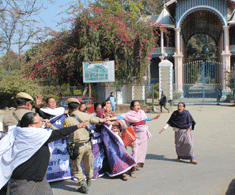
The Sangai Express (Imphal) reported that women from different corners of Manipur staged a demonstration on January 25, 2014 in front of the Western Kangla Gate to denounce Prime Minister Dr Manmohan Singh’s failure to keep his promise to replace Armed Forces Special Powers Act with a humane legislation.

Displaying placards and festoons inscribed ‘Remove AFSPA,’ ‘Save Sharmila,’ the demonstrators also raised slogans demanding the resignation of Prime Minister Manmohan Singh. Pandemonium erupted at the site when police personnel tried to seize the festoons from the agitating women.

Later, RK Radhyasana Devi, one of the protestors speaking to media persons, highlighted that the Prime Minister Dr Manmohan Singh, while handing over the historic Kangla Fort to the people on November 20, 2004, had assured the people of the State that AFSPA would be replaced with a more humane Act .

She pointed out that the promise Dr Manmohan Singh made a decade back has not been translated into action till now.

Strongly demanding that the AFSPA, 1958 should be repealed, Radhyasana further asserted that the movement of Meira Paibi organisations would go on until the Act is scrapped from the State.

In 2004, at the same historic Kangal Fort, Manipuri women had staged a militant nude protest to denounce AFSPA in the aftermath of the extra-judicial killing of Thangjam Manorama Devi by Assam Rifles troopers.

And meanwhile, Irom Sharmila, in the 14th year of her fast against AFSPA, continues to be held in isolation by the Indian state, a prisoner of conscience.


For the sake of Form

The Aam Admi Party it seems has now decided to hit back at critics by uploading videos on Youtube to defend the controversial actions of Somnath Bharti, its Law Minister in Delhi done purportedly ‘in public interest’. Bharti has been chastised even by AAP supporters for his vigilantism and for trying to force the Delhi police to raid the house of suspected sex and drug racketeers and who in fact ‘helped’, along with his followers to catch two of the fleeing women.

Eight videos have been uploaded. They, according to the party contain incriminating evidence to prove that sex and drug racketeers were very much active in that area. Reporting the videos The Times of India says “… some of the scenes are not so easy to judge. Two clips show an African national walking around naked in the area. In another, three women in a car are rubbing some substance in their hands. Yet another shows several condoms lying about a car.” .

We do indeed see an African national moving around naked in the video. This is supposed to prove the allegation by the party that drugs are being used as according to one AAP worker “Walking around naked like this is an after-effect of drugs and this is a regular occurrence in the area”. You can also see for yourself condoms lying in the car. Do you need any more evidence to prove that the occupants of the car were indeed prostitutes carrying condoms with them and luring men to indulge in sex? Why are these three women rubbing some substance in their hands or trying to hide something by putting on gloves? Continue reading For the sake of Form

The Politics of Raid Governance – Aam Aurat v. Khas Aurat: Pratiksha Baxi

Guest Post by PRATIKSHA BAXI

Following the terrible gang-rape of a Danish woman in Delhi, Chief Minister Mr Kejriwal castigating the police for dereliction of duty pronounced his theory about how rape tendencies form. We are told that rape tendencies flow from drug and sex rackets; and when police corruption sustains these rackets, rates of gangrape are bound to escalate. Rape in this formulation is not an expression of sexualized power or preferred and targetted male violence against women. Rather it is linked to a series of vices located in certain geographies, circuits, substances and bodies, which produce a specific form of sexual venality. And, the technique of “raid” is a privileged form of sexual governance.

To sustain the technique of raid (or sting operations) as the privileged form of governance to stem sexual violence, a certificatory genealogy is instituted. A leader of AAP recites his gender credentials by tracing raid governance to the “damini” protests and experiences of state violence during these anti–rape protests. Mallika Sarabhai’s gender credentials are now interrogated by citing her purported absence from the “damini” protests. Some of us who did not experience police violence during the protests are now vulnerable to the charge of faking our commitment to the anti–rape movement, since certification comes from one kind of participation in the “damini” protests. However, can the badge of being invested in the kind of transformative politics required to challenge rape culture be so easily earned? When men participate in anti–rape protests, we are expected to applaud them and not feel offended when they deride women like Mallika Sarabhai who risked their being to speak against rightist manifestations of sexual impunity and immunity in Gujarat. Continue reading The Politics of Raid Governance – Aam Aurat v. Khas Aurat: Pratiksha Baxi

सतत क्रान्ति की पैरोडी

पिछले कुछ समय से नागार्जुन और हरिशंकर परसाई की याद बेइंतहा सता रही है: भारतीय राजनीति के इस दौर का वर्णन करने के लिए हमें उनकी कलम की ज़रूरत थी !

क्रान्ति सतत चलने वाली प्रक्रिया है और असली विद्रोही वह है जो छह महीने बाद अपनी कुर्सी खुद उलट दे. आम आदमी पार्टी और दिल्ली सरकार के मुखिया ने केंद्र सरकार के खिलाफ़ बगावत की शुरुआत की,तो ऐसा ही लगा. दिल्ली के केंद्र में रेल भवन के पास दिल्ली की पूरी सरकार  अपने समर्थकों के साथ दस दिनों के धरने पर बैठ गए. उन्होंने धमकी दी कि वे राजपथ को लाखों लोगों से पाट देंगे और केंद्र सरकार की नींद हराम कर देंगे.किसान और सैनिक जब मिल जाएं तो क्रांति शुरू हो जाती है. इसकी पैरोडी करते हुए अरविंद ने दिल्ली के पुलिसवालों को वर्दी उतार कर धरने पर शामिल होने का आह्वान किया. कुछ लोगों को जयप्रकाश नारायण की याद आ गई. एक साथ लेनिन, लोहिया,क्रोपाटकिन और जयप्रकाश का तेज अरविंद केजरीवाल के रूप में पुंजीभूत हुआ. गांधी का आभा वलय अन्ना हजारे से हट कर अरविंद के माथे के पीछे पीछे तो तब ही लग गया था जब उनका भरपूर इस्तेमाल कर ठिकाने लगा दिया गया. क्या यह 2014 का भारतीय तहरीर चौक होने जा रहा है?

दिल्ली के मुख्य मंत्री ने एक बार फिर  आज़ादी की  नई लड़ाई की घोषणा की.यह दृश्य क्रांतिकारियों,समाजवादियों,अराजकतावादियों, सबके के लिए एक पुराने सपने के  पूरा होने जैसा ही था. एक पुरानी, दबी हुई इच्छा के पूरा होने का क्षण!यह आज़ादी झूठी है वाले नारे , वंदे मातरम और भारत माता का जयकार से रोमांचित होने का सुख!! Continue reading सतत क्रान्ति की पैरोडी

Kunan Poshpora – The Other Story : Shrimoyee Nandini Ghosh

This guest post by SHRIMOYEE NANDINI GHOSH is based on two essays about the men and women of Kunan Poshpora, that appeared in the Kashmir Reader dated 1 September 2013, and 13 January 2014

Information and updates about the campaign for justice and truth for the survivors of Mass Rape and Torture in Kunan Poshpora are available at https://www.facebook.com/KunanposhporaCampaign.

Beneath the horrors of the mass rape committed by  Indian troops in the twin villages that night in February 1991, lies the untold story of systematic torture of men, carried out by the same forces with the precision and deliberation of a planned military operation.

In June 2013, a Public Interest Litigation filed in the  Jammu and Kashmir High Court,   by fifty Srinagar based women, supported by human rights group Jammu and Kashmir Coalition of Civil society (JKCCS) had resulted in a Magisterial order for the  further investigations of the mass and gang rape by Indian army personnel of the women of Kunan, and neighbouring hamlet Poshpora, in Kupwara District of North Kashmir on the night of February 23rd-24th 1991. The police, it appears from the lack of any remotely investigative activities in the villages to have done little if anything, by way of following the court order in the last six months. On 14 September, 2013 they asked for and were granted an additional three months time for further investigations, without notice to the survivors who are legally represented in the case.

However, the closure report, which police had failed to file for twenty – two years, and which had been presented before the Magistrate of Kupwara just weeks before the Public Interest Litigation, in March 2013, had yielded several important previously unavailable official documents. Continue reading Kunan Poshpora – The Other Story : Shrimoyee Nandini Ghosh