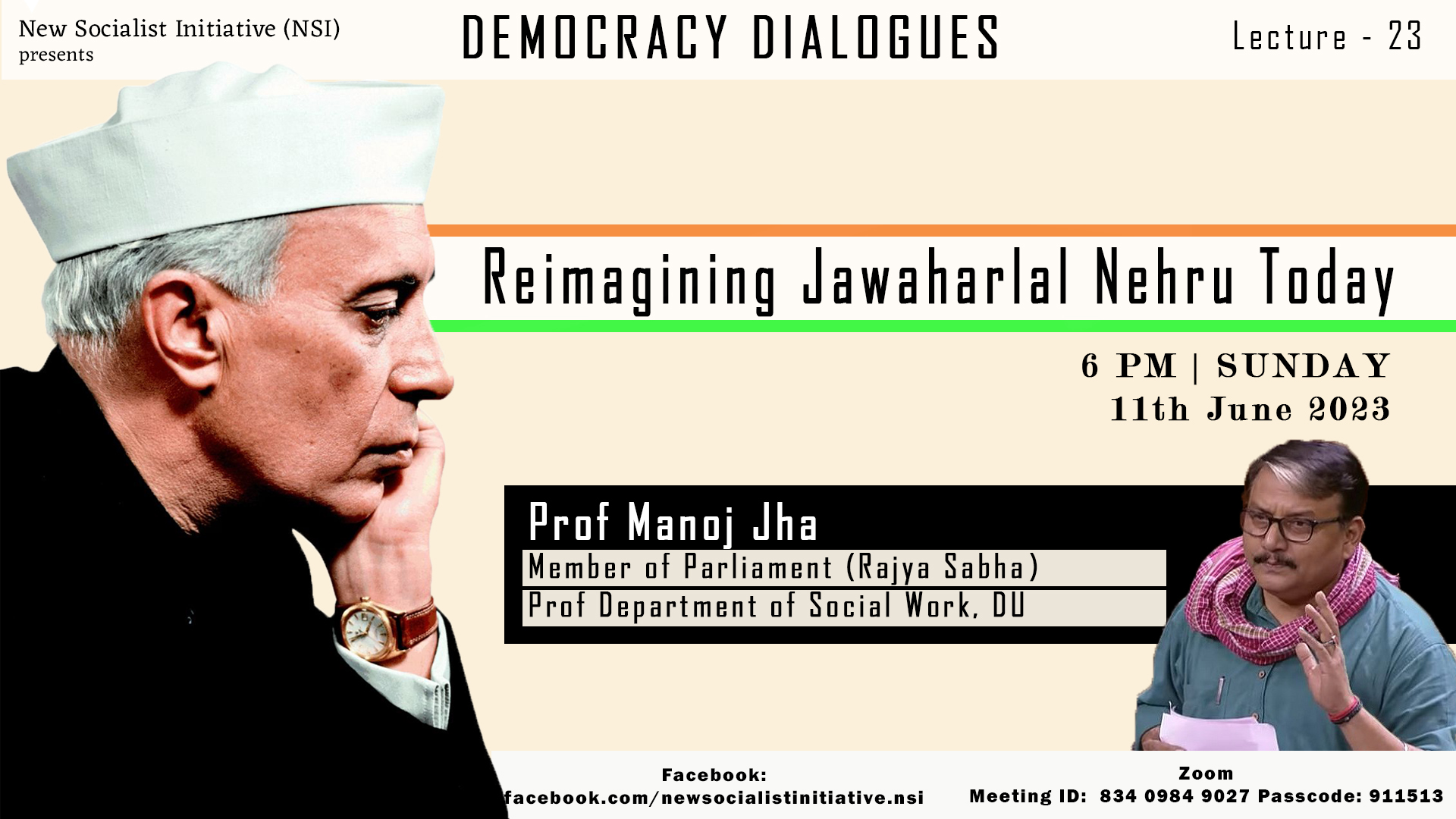
Prof Manoj Kumar Jha, who is a National Spokesperson of the Rashtriya Janata Dal, (RJD), and a Member of Parliament in Rajya Sabha ( upper house of the Parliament) who works as a Professor at the Department of Social Work, Delhi University, Delhi has kindly agreed to deliver the 23 nd lecture in the Democracy Dialogues Series , organised by New Socialist Initiative.
He will be speaking on ‘Reimagining Jawaharlal Nehru Today’ on Sunday, 11 th June, 2023 at 6 PM.
Reimagining Jawaharlal Nehru today would involve examining his legacy and contributions in the context of the present day. Nehru, the first Prime Minister of India, played a crucial role in shaping the country’s political, economic, and social landscape after its independence in 1947. While we reimagine today presuming he was here we shall have to look at our parliamentary democracy and the core policy issues which have undergone so much of change that he would disown. The idea is to speak about some of the critical concerns we face as a nation through the Nehruvian lens.
Speaker:
Prof Manoj K Jha, who is a National Spokesperson of the Rashtriya Janata Dal, (RJD), and a Member of Parliament in Rajya Sabha is a leading voice of the opposition.
A consistent votary of the idea of social justice and a strong opponent of the politics of majoritarian authoritarianism, his debates and interventions in the Upper House of the Parliament are appreciated across the political spectrum and are widely watched.
Prof Jha, is a very popular teacher in the Delhi University, was also head of the Department of Social Work, Delhi University , for a few years.
On the day that the Prime Minister was inaugurating a new Parliament house, democratic space was being crushed outside.
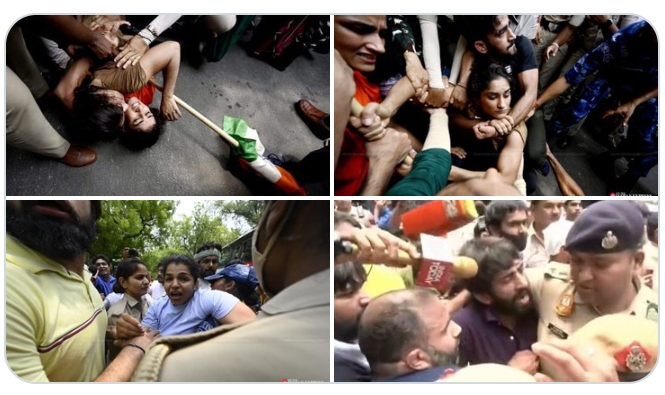
More than 1150 people including activists, lawyers, academics, former civil servants, artists and concerned citizens have released a statement condemning the brutal police action against the protesting wrestlers and those who had come out in support of their call from all over Delhi, Haryana and Uttar Pradesh for a Mahila Samman Mahapanchayat today.
We, concerned individuals, are absolutely horrified to see the violence unleashed by the government and police today, to suppress the powerful grassroots support for our brave wrestlers and their struggle against Wrestling Federation of India chief Brij Bhushan Sharan Singh, who stands accused of sexual harassment of women wrestlers stretching back over a decade. The wrestlers have been protesting since 18th of January, 2023. They had given a call to all women’s organisations, activists and all other civil society organisations to join a Mahila Samman Mahapanchayat outside the new parliament building today, i.e 28 May 2023.
Thousands of women from Delhi and nearby states responded to the call. Fearing the collective strength of Indian women – the police pre-emptively blocked all border roads, shut down proximal metro stations, and cordoned off roads. This is how scared a patriarchal State is of the sight of the women of India standing shoulder to shoulder with each other. Despite this crackdown, the government was unable to block the flow of solidarity; activists and concerned citizens found ways of trying to reach the protest site. Continue reading Dismantle the structures of sexual violence, NOT the protesters’ tent! Statement by concerned citizens→
For some time, we have known this in Kerala, and I have written about it too. But it is important to keep writing about it. Because the image of the benevolent state in Kerala conceals too much. In fact, a worrying Kerala Story is precisely that of a widening range of insecurities about Muslims, from outright Islamophobia to creeping everyday fears of Muslims.
History is a thin excuse for unrelenting majoritarianism in India and its neighbourhood
Recently, a senior advocate in Karachi was charged with blasphemy after another fellow lawyer complained about his having affixed ‘Syed’ to his name in an affidavit. This, supposedly, hurt the lawyer’s religious sentiments. The case is just one instance of the tremendous persecution the Ahmadiyya minority in Pakistan has faced since the eighties when the Benazir Bhutto regime declared it non-Muslim. Ever since, no Ahmadiyya can use Islamic symbols or names, such as Syed. Their persecution began with the notion that Islam has no space for another prophet, as the followers of Mirza Qadiani, founder of the sect, believed he was. That declaration brought the community into the spotlight of Pakistan’s blasphemy law, and their exclusion has continually expanded—from being denied space in public life, education, and employment, now they are even proceeded against for using certain names or titles.
The situation in India is sometimes no different. ( Read the complete article here)
Over 500 concerned citizens, democratic rights’ activists across movements, women’s groups, students and academics condemned the misuse of the Prevention of Money Laundering Act (PMLA) against scholars and activists, raising constitutional issues and asking for the government’s accountability.
We the undersigned women’s organisations and concerned individuals strongly condemn the continuous and repeated harassment of a number of women activists and intellectuals, by the Enforcement Directorate(ED), under the guise of an inquiry, in Delhi. This is a clear abuse of its extraordinary and draconian powers under the Prevention of Money Laundering Act (PMLA). As in the case of the Unlawful Activities Prevention Act (UAPA), there are increasing instances of the misuse of PMLA, especially against persons who are vocal critics of the government and its policies, and those who raise issues of the poor and oppressed sections of society. The ED is being used as an intimidation tool for political vendetta, where the process is the punishment for the detention of dissenters.
In the course of the last few months, several women scholars and activists have been summoned repeatedly, made to wait long hours, often interrogated without any woman officer present throughout, asked to furnish documents over and over again, in an ED investigation. In a clear case of evergreening the inquiry, the process has become endless. It is quickly turning into a fishing expedition, with all kinds of irrelevant documents and personal information being demanded, such as those about other family members, having no relevance to the inquiry whatsoever. Continue reading STOP THIS WITCH HUNT – DON’T MISUSE PMLA AGAINST SCHOLARS AND ACTIVISTS! Statement by concerned citizens→
Bebaak Collective (‘Voices of the Fearless’) was founded in 2013 as an informal association of grassroots activists to advocate for the rights of Muslim women and community. It is a platform for engaging with feminist thought and practice, human rights issues, and the anti-discrimination struggle. It has been working in Uttar Pradesh, Gujarat, Maharashtra, and Rajasthan. With the rising onslaught against marginalised communities, the Collective has evolved into an advocacy group that strongly adheres to constitutional values and believes that the rights and principles enshrined in our constitution are inalienable from every Indian citizen, irrespective of their caste, gender, sexuality or religion.
Relatives of a victim of the Delhi pogrom 2020 in mourning. Source: The Guardian
Foreword
Mental health and its socio-political determinants are beginning to emerge from a shroud of silence and stigma into public discourse. There are several possible reasons for this, the most visible being the pandemic and the many narratives of suffering it brought to the fore from among the most vulnerable sections of society. Even before the pandemic, the relationship between social disadvantage and the mental health of certain communities and groups (some more than others) has been studied in the Indian context. Some examples of these include the mental health of women, homeless persons, Dalit, Bahujan, and Adivasi communities, and queer and trans persons. However, the mental health of Indian Muslims has been severely underrepresented and almost invisible within the mental health or development literature in India. Continue reading Social Suffering in a World without Support – Report on the Mental Health of Indian Muslims: Bebaak Collective→
यह लेख डेक्कन हेरल्ड में लिखे गए लघु लेख का हिन्दी रूपान्तरण है।
रात के अंधेरे में महिला पहलवानों से दिल्ली पुलिस की हालिया हाथापाई के बाद उनका आँसुओं से भरा चेहरा दिखा। अंतर्राष्ट्रीय ख्याति प्राप्त यह महिला पहलवान सत्तारूढ़ पार्टी के सांसद और भारतीय कुश्ती संघ के अध्यक्ष द्वारा महिला पहलवानों के कथित यौन उत्पीड़न के खिलाफ लगातार विरोध प्रदर्शन कर रही हैं। पिछले कुछ महीनों में आरोपी सांसद के खिलाफ इन विरोध प्रदर्शनों का यह दूसरा दौर है। विडम्बना है कि सुप्रीम कोर्ट में मामला पहुँचने के बाद ही आरोपी के खिलाफ प्राथमिकी दर्ज हो पाई। आरोपी के खिलाफ लैंगिक अपराधों से बालकों का संरक्षण (पोक्सो) अधिनियम के तहत मामला दर्ज होने के बावजूद उसकी अभी तक गिरफ्तारी नहीं हुई है, और यहाँ तक कि वो अभी भी कुश्ती संघ के अध्यक्ष पद पर आसीन है। पहलवानों के यूँ सुबकते चेहरे, उनके अपमान और हताशा हमारे ज़मीर को भी झकझोरते हैं कि आखिर हमारे देश की क्या हालत हो रही है।
This post originally appeared on social media and refers to the on-going Jan Shakti exhibition at National Gallery of Modern Art (NGMA), Delhi, which according to its description, displayed “works of India’s top artists on themes covered in Mann Ki Baat such as Swachhata, water conservation, agriculture, space, India’s northeast, Nari Shakti, Yoga, and Ayurveda.”
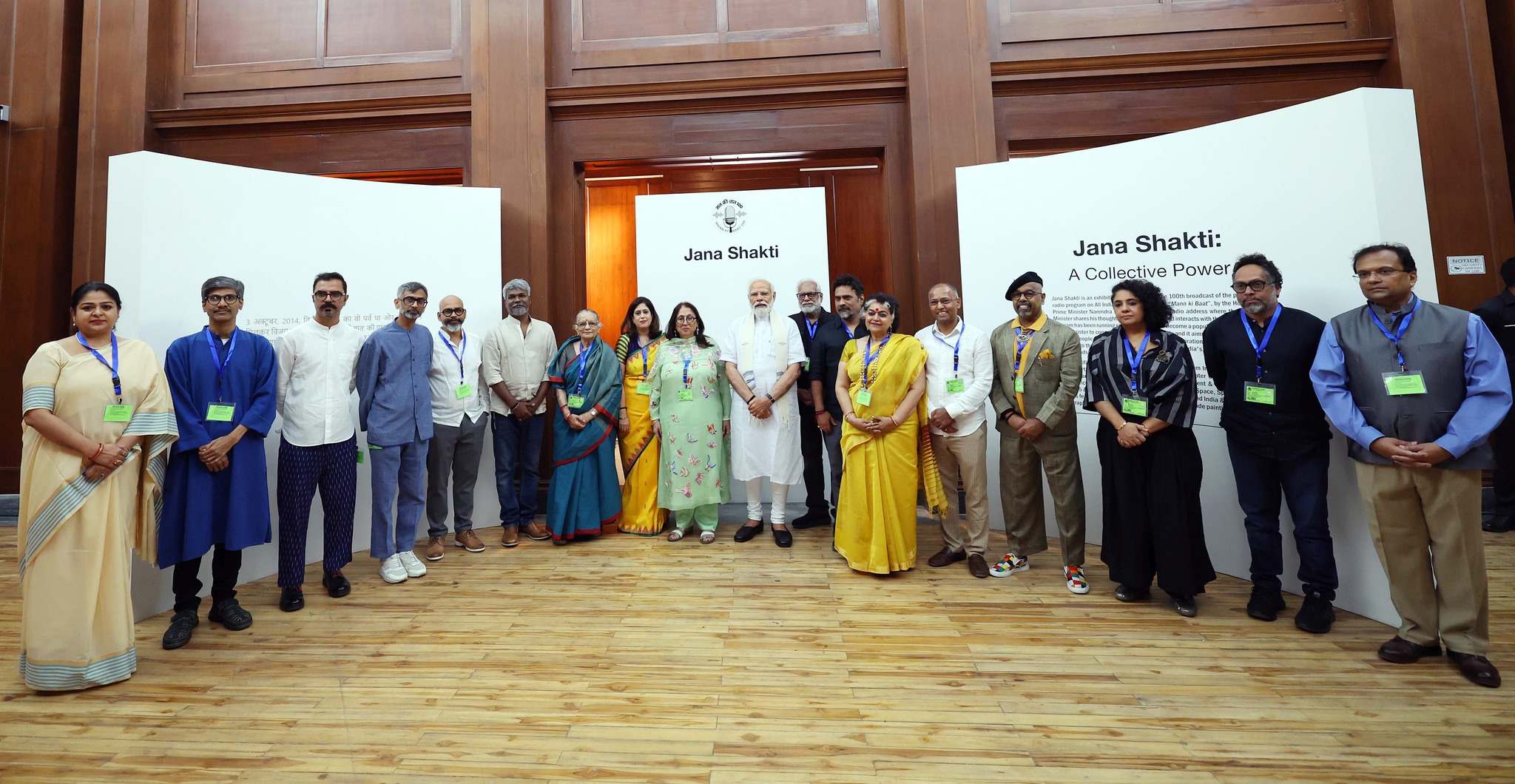
For some days now, certain videos and photos of PM Narendra Modi, the authoritarian Supreme Leader now ruling one-sixth of the world’s population, have been circulating on social media. He is seen visiting the new exhibition ‘Jan Shakti: A Collective Power’ at NGMA dedicated to his propagandist radio programme Mann Ki Baat.
About a week ago, an uproar, however scattered, erupted on social media when this exhibition, guest-curated by Alka Pande, was opened to the public since the occasion also witnessed the presence and participation of some of the celebrated personalities of the Indian artworld. To name some of them, since they would be recorded in history’s hall of shame – Atul Dodiya, Vibha Galhotra, Riyas Komu, Ashim Purkayastha, G.R. Iranna, Thukral and Tagra, Manjunath Kamath, Jagannath Panda and Kiran Nadar in her role as the “adviser” to the exhibition. Almost all of these luminaries and “top artists” (as it is reported in the media) again appeared when the PM visited the show, proudly posing for a photo with him.
New Delhi, May 14 (ANI): Prime Minister Narendra Modi poses for a photograph with a group while visiting Jana Shakti, an exhibition at the National Gallery of Modern Art in New Delhi on Sunday. (ANI Photo)
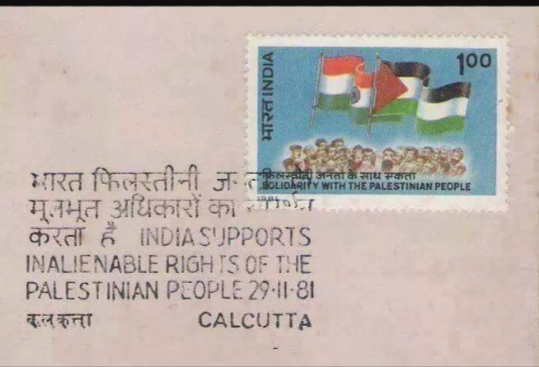
Yesterday, May 15, 2023 marked the 75th anniversary of Nakba or the dispossession of the people of Palestine by the Zionist state of Israel. This is the text of a talk delivered at an event organized by India Palestine Friendship Forum.
Stamp issued in 1981
In September 2012, I had the incredible good fortune to visit Palestine. We stayed in Ramallah, visited and interacted with colleagues at Birzeit University and spoke at a conference organized by Muwatin, a research institute based in Ramallah. We met a large number of inspiring people who pushed the frontiers of our minds, and we came away humbled and moved by the dignity of a people living through the brutal occupation of their lands by the Zionist state of Israel, with limitless courage and bubbling sense of humour intact. Continue reading 75th year of Nakba – In solidarity with the Palestinian struggle→
The list of people associated with Hindutva outfits caught in damning revelations keeps growing.
Recent revelations involving alleged espionage involving Prof Pradeep Kurulkar at the Defence Research and Development Organisation should have shaken up the establishment. After all, Kurulkar is said to have handled crucial projects related to India’s defence and reportedly was the lead designer or team leader for projects on missile launchers and subsonic cruise missiles.
Reports say Kurulkar was in contact, over WhatsApp, with a Pakistani Inter-Services Intelligence (ISI) agent late last year. His suspicious activities were reported to the police by DRDO, and in January, his laptop and two mobile phones were seized. The Maharashtra Anti-Terrorism Squad (ATS) is now handling the case. Kurulkar’s foreign trips are also under the scanner.
Such discoveries have long-term implications for India’s national security. Initial reports from ANI, a news agency known for its proximity to the ruling regime, did not mention Kurulkar’s name. The news agency did not initially mention his name in its tweets, though pictures of his face were circulating on social media and news outlets. The sequence of events left many wondering if the tweets deliberately concealed his name to create a doubt over his identity.
No doubt, Indian investigators will examine if the neighbouring country’s sleuths have penetrated India’s defence research sector and the extent to which Kurulkar has compromised India’s secrets. But it’s worth noting this case has not been handed over to the National Investigation Agency. Formed in the immediate aftermath of the 2008 Mumbai terrorist attack and supposedly more equipped and experienced to handle cases with cross-border ramifications, this agency has been busy filing plenty of cases—so, why not this one? ( Read the full article here)
[This post is a report on what went on in Jayanagar, a constituency in the southern parts of Bangalore, in the Vidhansabha Elections, May 2023]
Yesterday, 13 May, by 2.30 pm or so, the Jayanagar seat had gone in favour of Sowmya Reddy, Congress. It had been a very closely contested election with her rival CK Ramamurthy, BJP in close pursuit. Sowmya Reddy’s final lead, after 16 rounds, was 160 votes.
Flag 1: The Election Commission website was pretty up to date with all candidate results, but Sowmya Reddy’s results were very slow in coming. Her final result came online by around 6 pm while the counting was over, and she had gained her lead at 2.30 pm.
Another candidate stood from Jayanagar with a slight name variation – Sowmya A Reddy. She got 320 votes.
As Sowmya Reddy was leaving to collect her certificate, Ramamurthy also left the vote counting venue – SSMRV college. However, the Election Commission of India rules mandate that since the victory margin was lower than the number of postal ballots, a recount of postal ballots had become mandatory. When Sowmya Reddy was absent, Ramamurthy came back and requested for a recount of the postal ballot. Postal ballot is the term used for those votes which are cast by outstation voters and the pink form submitted by service personnel – police, officers, ambulance drivers and so on – who would be on duty during elections and can’t vote on election day. Their votes are recorded in advance. These votes are counted between 7.30 and 8 am, before strong rooms are opened and EVM vote count starts.
The movie called The Kerala Story is hate-speech against a whole people, but our courts are great upholders of free speech. Of course, unless people with the surname ‘Modi’ are said to have been defamed. As an observer of how the ‘love jihad’ agenda has unfolded in Kerala since more than over a decade now, I think we need an explanation of why the very idea, discredited by the state machinery itself and thrown out in effect by the Supreme Court in the Hadiya Case, has been used over and over again, like a hammer, to beat Kerala (hopefully into a shape acceptable to Hindutva).
यह लेख इंडियन एक्सप्रेस में मई दिवस 2023 पर लिखे गए लघु लेख का हिन्दी रूपान्तरण है।
वो दिन ज़रूर आएगा जब हमारी खामोशी उन आवाज़ों से ज्यादा ताकतवर होगी जिनको आज तुम दबा रहे हो।
अमर शहीद अगस्त स्पाइज़ का हेमार्केट शहीद स्मारक पर उद्धृत कथन, अनुवाद हमारा
हर दिन मैं खुद को यह याद दिलाता हूँ कि मेरा अंदरूनी और बाहरी जीवन मृत और जीवित लोगों के श्रम पर आधारित है, और जो मुझे मिला है और मिल रहा है उसको उसी मात्रा में देने के लिए मुझे पुरज़ोर मेहनत करनी होगी।
अल्बर्ट आइंस्टीन, द वर्ल्ड एज़ आई सी इट (दुनिया मेरी नज़र में), अनुवाद हमारा
मई दिवस 2023 के साथ भारत में मई दिवस मनाए जाने के 100 साल पूरे हुए हैं। सिंगारावेलु चेट्टियार, जो कि भारत के स्वतंत्रता आंदोलन की बड़ी शख़्सियतों और जाति-विरोधी आंदोलन से जुड़े शुरुआती कम्युनिस्ट नेताओं में से एक थे, उनको भारत में सबसे पहले मद्रास शहर में 1 मई, 1923 को मई दिवस मनाने का श्रेय दिया जाता है। सिंगारावेलु ने भारत में मई दिवस की शुरुआत कर कोशिश की कि भारतीय मजदूरों के संघर्षों को वैश्विक-स्तर के मज़दूरों के प्रतिरोध के साथ जोड़ा जाए। शिकागो में मई 1886 में मजदूरों की रैली से शुरू हुए मई दिवस की तीव्र तरंगें जो भारतीय तट तक 1923 में पहुँचीं, उस संवेग को आज भी दुनिया के विभिन्न हिस्सों में महसूस किया जा रहा है।
Someone just asked me why I would ‘still be soft on’ the Dalit Human Rights Movement — why I would speak at their meetings. For those who have not heard of them, the DHRM is a mass movement against casteist oppression in Kerala that fought very hard to break out of the liberal and statist imagination of dalit liberation — and continue to do so, despite having to face the most horrifying state violence.
B 32 to 44 is the title of a movie — it refers to the bra sizes of the protagonists of director and scriptwriter Sruthi Sharanyam’s debut film, which has been generating highly positive reviews in the Malayalam facebook world. It has also been highly-awaited after it received funding from the Ministry of Culture and the Kerala State Film Development Corporation.
Received via Maya John, the following statement was issued by over 250 historians and concerned scholars, protesting against the blatantly ideologically driven agenda of the present government in deleting chapters and sections of the school textbooks.
The recent decision of the National Council of Educational Research and Training (NCERT) to drop entire chapters from the history textbooks for class 12, as well as from other classes and to delete statements from other textbooks is a matter of deep concern. Using the period of the pandemic-cum-lockdowns to argue that there was a need to lighten the load of the curriculum, the NCERT initiated a contentious process of dropping topics like the history of the Mughal courts, the 2002 communal riots in Gujarat, the Emergency, mention of Dalit writers, the Naxalite movement, and the fight for equality from social science, history, and political science textbooks of classes 6 to 12. The new editions of these NCERT books have simply made the deletions the norm even when we are in a post-pandemic context in which school education has limped back to normalcy and is no longer in the online mode.
Today someone who is an absolute darling of the post-socialist oligarchy in Kerala and their army of hanger-ons told me, without a tinge of irony, with the most endearing innocence, that they were not celebrated at all in Kerala. That they were excluded from circles that praised and glorified the work of many other authors. It was most intriguing, to say the least. I think it reveals a lot about how the present dispensation manages intellectuals and minimises critical thinking.
You can be a rebel without any serious losses in present-day Kerala if you desist from any serious criticism of the establishment and its acolytes. You can spout feminism, dalit politics, espousals of the solidarity economy, liberal Muslim thought, queer thinking, soft Hindutva– literally anything except Islamism if you keep your mouth shut about the establishment and the post-socialist oligarchy, or at least limit yourself to weak, occasional noises. You can also present yourself in combinations of the above laced with hints of your slant towards the establishment and reap much success in classrooms and academic fora, and much applause on the social media. If you have connections with the Nair deep state and ‘deep intellectual elite’, you can pornify, sell, any kind of abuse of women.
Abstract: Indigenous and other local communities across India have had traditional systems of local governance as unwritten or sometimes written codes of conduct and decision making. Many such systems are still being followed in parallel with the panchayat systems, or getting re-invented by combining the modern forms of governance with the traditional ones, especially in the case of communities still practising traditional occupations and ways of life (forest-based, pastoral, fishing, and/or farming). There are, however, very few studies of these systems interacting with modern state institutions, their current or continuing relevance, and their role in achieving goals of justice, well-being, and ecological sustainability.
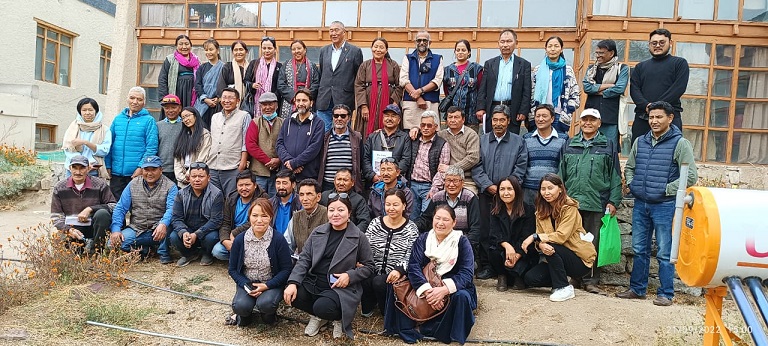
Goba meeting to discuss study results, Leh Aug 2022.
This study focuses on documenting the present status and relevance of the traditional governance system of Ladakhi villages, with a focus on the goba (or lambardar/nambardar). For this, the study also looked at the interface between the local/traditional and new/modern governance systems, viz. the goba with the panchayat, Ladakh Hill Council and UT Administration.
Keywords: traditional governance, goba, democracy, natural resources, indigenous knowledge, environment
Around two weeks back, just about a week after the ritual of Women’s Day celebrations in Thiruvananthapuram, a 49-year-old woman decided to go get herself some pain medication at 10 30 at night, after all home remedies failed against her persistent body ache. She lives in the beating heart of the city of Thiruvananthapuram in a rented house. This house is in a leading middle-class residential locality, full of houses, usually very quiet. She is , however, not a typical owner-resident. An employee at a local firm earning a very modest salary, she has lived alone for years in rented accommodation, raising her young daughter. The daughter is now a confident young woman who has worked for some years and now seeks to expand her career options. The rent takes up nearly half of her income, but mother and daughter have struggled together to protect each other.
The Delhi Durbar of 1911 has great significance in the history of India in terms of hosting King George V, along with the Queen and other guests. Undoubtedly, the entire occasion was recorded as a grand event and moreover, the decoration used on the way to Coronation Park to make it aesthetically beautiful, was magnificent. However, along with the preparations for the amplified royal visit, another incident that catches attention here is the hiding of an entire village, the ‘Dhakka village’.
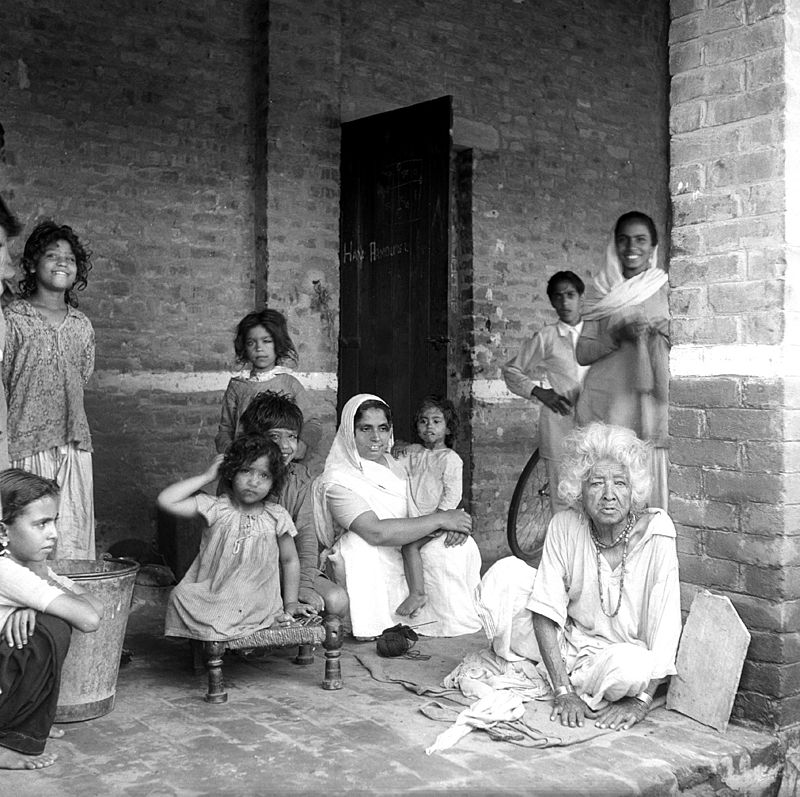
People living near Dhakka village, 1911 (see source below)
The villagers of Dhakka were asked to evacuate the area as their dwellings were not up to the beauty expectations of British officials. The Dhakka village then, represented a strong site of resistance, as the villagers in Dhakka refused to vacate the region for the King’s visit. Thus in response to the recalcitrance of the villagers, the British officials decided to hide the entire village by using huge cloth sheets.. And that is how the village got its name ‘Dhakka’ from the hindi word dhaka which means hidden. The incident portrays to what extent the colonial state could go to welcome its guests. It mulled relocating an entire village and finally covered it out of sight.
Despite frequent misgivings about universal claims of modern science and despite it being taken often as an accomplice of western imperialism, it is impossible for any culture or civilization to avoid science or to create a culturally distinct version of it. And yet, how does science seep into and reshape a culture would have as many answers as there are cultures. The example of the West is invariably taken as canonical wherein science appears as a key factor in triggering the Great Divergence catapulting Western Europe in pole position ahead of far advanced civilizations such as China or India. It is far more tractable to draw some approximately generalizable lessons from this example than to comprehensively answer the famous Needham Question about why the rest of the world missed out on the Scientific Revolution and the subsequent percolation, even if partial and fragmentary, of the cognitive values promoted by science into the layers of cultural values.
Yet, the fact remains that the cultures and the civilization on the Subcontinent are irreducibly distinct from the West and also from the rest of the world. It is not possible to draw out serviceable prescriptions just from the western example for cultivating science in the cultural soil of the Subcontinent. It will be necessary to cast a bird’s eye-view on the civilizational contours of this vast land to have some idea about what have been the obstacles in the past and what possible pathways to future are available in the present.
While the right-wing of the Hindutva kind seeks glory in ancient India and considers the arrival of Islam as the despoiler of a great civilization, the left-wing, both of the liberal and the leftist kinds, puts all the blame at the doors of colonialism. Both miss out, in their respective ways, a very large fact. The thickest layer of the mass cultural soil on the subcontinent was deposited during the millennium between the 7th and the 17th century and in this the Bhakti Movement played the most important role. If in Europe the theological debates and religious wars led to modern philosophy and modern science, in India the philosophical debates, such as in the Upanishads and between the Buddhists and the Sanatanis, led to devotional movements of mass religions and theologies.
After sketching out these broad contours I will conclude this talk by making some tentative suggestions about how to seek pathways to a future in which science can attain the status of a cultural ideal, which in turn may facilitate emergence of an Indian modernity worthy of a glorious civilization.
About the Speaker :
Ravi Sinha is an activist-scholar who has been associated with progressive movements for nearly four decades. Trained as a theoretical physicist, Dr. Ravi has a doctoral degree from MIT, Cambridge, USA. He worked as a physicist at University of Maryland, College Park, USA, at Physical Research Laboratory, Ahmedabad and at Gujarat University, Ahmedabad before resigning from the job to devote himself full time to organizing and theorizing. He is the principal author of the book, Globalization of Capital, published in 1997, co-founder of the Hindi journal, Sandhan, and one of the founders and a leading member of New Socialist Initiative.


 Stamp issued in 1981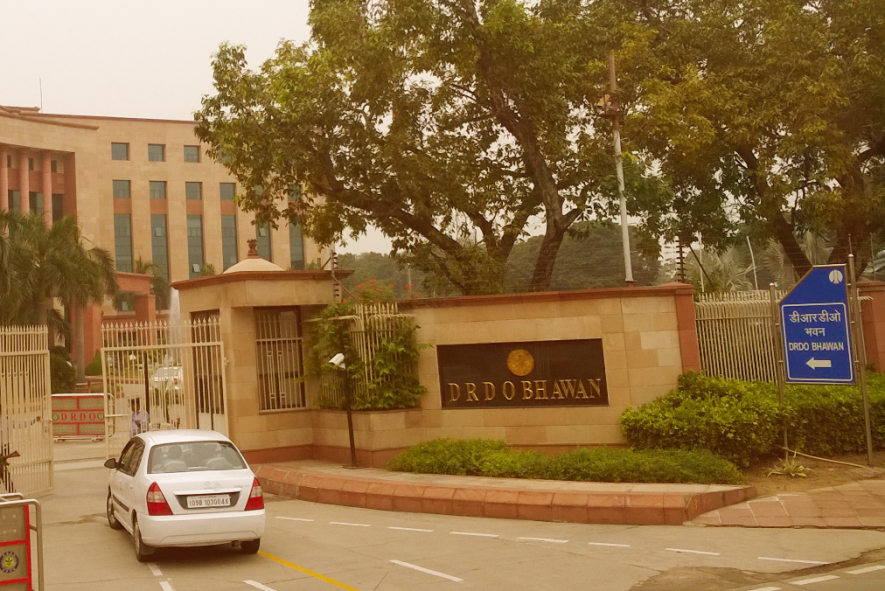


 KAFILA - COLLECTIVE EXPLORATIONS SINCE 2006