An Election in Sarvajan Samaj

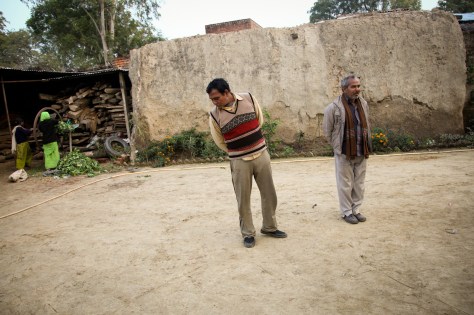
This photograph was taken by Salman Usmani in Ganguali village in Unnao near Lucknow, in early January. On the left is Prabhat Pandey and on the right, Ram Khilawan. Pandey is a Brahmin and Khilawan a Dalit. They’re the BSP’s men in this village, responsible for urging Brahmins and Dalits to vote for the BSP candidate, also a Brahmin. The photo was taken when I asked them to pose together. This is all the ‘brotherhood’ they could show before the camera.

Here’s my story on UP elections, seen through the prism of Brahmins and Dalits. Continue reading An Election in Sarvajan Samaj

A Quick Analysis of the Independence Day Speech by President Rajapaksa

“There is great chaos under heaven – the situation is excellent.” Mao Zedong quoted by Slavoj Zizek a year ago amidst the revolt against Mubarak in Egypt.

Given recent developments, I am jotting down a quick analysis of the positions, concerns and silences in President Mahinda Rajapaksa’s Independence Day speech today. The tone and substance of this speech is slightly different from the last few Independence Day speeches characterised by triumphalism and exuberance. The context of the speech is the mounting protests on the ground and increasing economic pressures.

The location of the speech in the historical city of Anuradhapura and the reference to Kebethigollawa in Anuradhapura District – the site of a horrific LTTE attack on a civilian bus in 2007 with tens of lives lost and scores injured which contributed to shifting the Sinhala public opinion fully behind the war effort – are attempts to remind the public of the horrors of war, the war victory and to mobilise Sinhala Buddhist nationalism. The solution, at the outset of the speech to all of Sri Lanka’s woes, is emphasised as the government’s “giant development works” as part of the march from “backwardness to modernity”.

Continue reading A Quick Analysis of the Independence Day Speech by President Rajapaksa

Stay Thirsty Stay Stupid

With due apologies to Steve Jobs, how does one begin to respond to this latest bit of inanity from Coca Cola?


The Place of Dissent in the Campus: Akshath Jitendranath

This is a guest post by AKSHATH JITENDRANATH, student at Symbiosis International University, Pune, where a screening of ‘Jahsn-e-Azadi’ by Sanjay Kak was cancelled under pressure from right-wing groups and the Pune Police.

The university campus is where nascent opinion moulds itself into ideological shape. Care must be taken to surround the student with ideologies of different shades. This is a prerequisite for any educational ideology that aspires to be holistic. Pursuant to this end the Symbiosis International University is guided by an ideology that reads, Vasudhaiva Kutumbakam, meaning the whole world is one family. This is a high ideal to be guided by.

However, the events that transpired over the last few days have left this vision a little blinded. Following threats received from the Akhila Bharati Vidyarthi Parishad  (ABVP henceforth), the Symbiosis College of Arts and Commerce have postponed indefinitely, ‘Voices of Kashmir’, a national symposium on Kashmir which was to be held with the support of the University Grants Commission. The ABVP’s major bone of contention was the screening of well known film maker Sanjay Kak’s film, Jashn-e-Azadi (This Is How We Celebrate Freedom). The ABVP claim that the film and the film maker represent an ideology that is anti-India. Further, they threatened violence if the film were to be screened. The administration of the Symbiosis International University, instead of being guided by their ideological vision, gave in to the ABVP threats. Continue reading The Place of Dissent in the Campus: Akshath Jitendranath

Aapka poora naam kya hai?

The cast in this short film: Sharma- Rajesh, Mishra- Nishant, Choudhury- Roshan, Dalit- Dinamani
Camera- Babita, Script and Direction- Dinamani (dina_bhim@yahoo.co.in). Special thanks to Anoop for making the office available for the shoot.

Letter from the Stinkcity of Thiruvananthapuram

Respected development tourists, leftists and scholars from the West who have been coming here seeking your heterotopia, welcome to the city of Thiruvananthapuram.

Yes, you are here to see that Kerala which gives you relief from the relentless decline of the left in your part of the world.You have been honouring us with such visits since the 1970s. We have been happy to oblige, cast and recast to suit your projections. When ‘social development’ was fashionable in the UN circles, Kerala was indeed the space where you found ‘social development’ thriving. But when ‘human development’, the theoretical and political provenances of which are quite different from those of ‘social development, became your preference, Kerala transmogrified itself most willingly into the paradise of ‘human development’. And then you came to be fascinated by ‘participatory development’, we diligently turned into the very fount of ‘participatory development’. Thank you very much for keeping us afloat in the imagination of Western left developmentalist intellectuals (though I do see that the oodles of ‘agency’ showered upon us by you may actually be your way of compensating for the shrinking of your own agency in the face of the triumphant march of neoliberal capitalism in your homelands) Continue reading Letter from the Stinkcity of Thiruvananthapuram

The untold stories of a political process

AP Photo by Altaf Qadri

Less than a month before the 2009 Lok Sabha elections, the wedding of a top Uttar Pradesh bureaucrat’s daughter at the Taj Hotel in Lucknow presented senior journalists invited from Delhi with an opportunity to interact with the state’s leading bureaucrats—who are, in Chief Minister Mayawati’s reign, more important than politicians. For a select few celebrity editors, there was even a rare durbar with Mayawati herself, who carefully arrived after the governor had left, presented flowers to the newly married, and proceeded to a barricaded enclosure to meet India’s opinionmakers. I don’t know what the conversation was like, but I saw the journalists’ lips move more than hers.

After the meeting was over, I asked one celebrity TV anchor what he thought the election results were going to look like. He said the Mayawati-led Bahujan Samaj Party (BSP) was very strong, and predicted she could win 50 of the 80 seats the party was contesting. The Delhi media’s awe of Mayawati was at a historic peak; they had taken her prime ministerial ambitions seriously. I told this studio journalist that the buzz in Lucknow was that the Congress could spring a surprise. “No chance,” he said. “They don’t have any organisation. Azharuddin is my friend and he called me to say he needs my help. Even a celebrity like Azharuddin is going to lose!” Read More…

उत्तर प्रदेश चुनाव 2012 और पसमांदा मुस्लिम समाज

This is the text of a pamphlet released by the PASMANDA INTELLECTUALS FORUM, Lucknow. It comes to us via Khalid Anis Ansari

पसमांदा समाज की मुख्य माँगें

हमने उत्तर प्रदेश विधान सभा चुनाव, 2012 के मद्देनज़र पसमांदा (दलित और पिछड़े) मुसलमानों   की पांच बड़ी मांगें तय की हैं. आइए, आगे बढ़ने से पहले हम इन मांगों पर नज़र डालें:

  1. पसमांदा मुसलमानों की उत्तर प्रदेश में 15% आबादी है. इस कारण सारी पार्टियां उनकी आबादी  के हिसाब से टिकट दें;
  2. सवर्ण (अशराफ) मुसलमानों को सर्वोच्च न्यायालय के मंडल (इंदिरा साहनी) फैसले (1992) के तहत आरक्षण की  परिधि से बाहर रखा जाये क्योंकि वह संविधान केअनुच्छेद 16 (4) और 15 (4) के तहत ‘सामाजिक और शैक्षिक’ तौर पर पिछड़े तबके नहीं माने जा सकते हैं;
  3. केन्द्र और उत्तर प्रदेश की ओबीसी लिस्ट को बिहार फार्मूले के तहत पिछड़ा वर्ग और अति-पिछड़ा वर्ग में विभाजित किया जाये और सारे पिछड़े मुसलमानों को सामानांतर रूप से पिछड़ी हिंदू जातियों के साथ अति-पिछड़ा श्रेणी में विधिवत शामिल किया जाये;
  4. दलित मुसलमानों / ईसाइयों को 1950 के राष्ट्रपति आदेश (पैरा 3) को रद्द कर के एससी लिस्ट में शामिल किया जाये;
  5. भूमंडलीकरण और नवउदारवादी आर्थिक नीतियों के चलते पसमांदा समाज के कारीगर/दस्तकार/मजदूर तबकों और लघु-उद्योग की बर्बादी को रोका जाए और उनको फिर से पटरी पर लाने वास्ते उचित नीतियां बनाई जाएँ.

Continue reading उत्तर प्रदेश चुनाव 2012 और पसमांदा मुस्लिम समाज

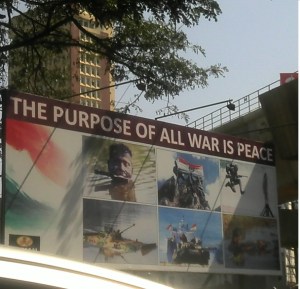
All I want is war and peace

This poster on M.G.Road in the heart of Bangalore, reminded me uncannily of the lines in the marvellous scene in the Mel Brooks film To Be Or Not To Be where he sings All I Want is Peace:

To the Students and Faculty of Symbiosis University on the Censors in their Midst

Dear Students, Dear Teachers, Dear Friends at Symbiosis University, Pune

You are faced with an extraordinary situation. A symposium on Kashmir that was to be held in your institution with the support of the University Grants Commission, has been cancelled, postponed (see update at the end of the post) following complaints by activists of the Akhil Bharatiya Vidyarthi Parishad (the student wing of the extreme right-wing militia that goes by the name of the RSS) against the proposed screening of a documentary film ‘Jashn-e-Azadi‘ (‘This is How We Celebrate Freedom’) by the well known filmmaker Sanjay Kak. These complaints, which could more accurately be called threats, have unfortunately received the tacit endorsement of senior police figures in Pune and seem to have met with the approval of your principal. (Thanks to The Hindu – see links above –  for the two balanced reports on this issue.) While the seminar may or may not be held (it stands ‘postponed’ as of now) the administration of Symbiosis have succumbed to the insistence of the right wing groups that Jashn-e-Azadi’s screening remain cancelled. Continue reading To the Students and Faculty of Symbiosis University on the Censors in their Midst

You can’t show light to those who have chosen darkness: The Case of Imam Bukhari

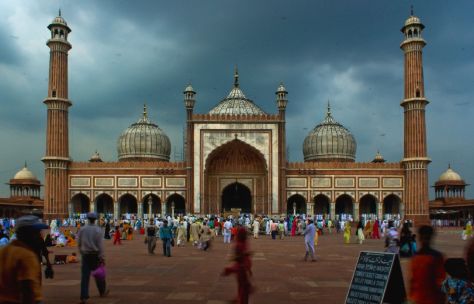
The Delhi Jama Masjid. Photo via Wikipedia.

The Imam of the Delhi Jama Masjid has issued a statement that calls upon the Muslim voters of Uttar Pradesh to vote for the Samajwadi Party of Mulayam Singh Yadav. A whole lot of poll experts are going to rejig their forecasts to factor in this new and hitherto unexpected development.

We would be told that this call is going to alter the political equations in UP in a very profound manner. We will be told that the Muslim electorate is going to shift to the SP and that this shift will create serious problems for the Bahujan Samaj Party in its bid for a comeback and for the Congress that is making serious efforts to emerge as Number Two.

The assumption behind these two assertions is that Muslims who voted for these parties in the last election are going to desert them now because of the statement issued by the Imam of Jama Masjid of Delhi.

Before the psephologists get down to business with their abacuses, their TINA factor analysis, their complex equations dealing with social demographics, voter fatigue,  identity markers and what have you, it might be useful for them to contemplate three questions: Continue reading You can’t show light to those who have chosen darkness: The Case of Imam Bukhari

How We Celebrate Freedom

The Hindu reports that a university in Pune has cancelled a planned screening of Sanjay Kak’s 2007 documentary film, Jashn-e-Azadi: How We Celebrate Freedom.

Speaking to The Hindu over telephone, Symbiosis College of Arts and Commerce principal Hrishikesh Soman stated that the ABVP had approached him on Friday, and that the college agreed to cancel the film screening “considering their [ABVP’s] emotions and feelings.” “I told them that the seminar is entirely academic, apolitical and non-religious. But the film has met with criticism from all corners. So we have decided to avoid unnecessary controversies and cancel the screening,” Mr. Soman said. “If people have a very strong reason to protest the film, then we should be tolerant enough,” he stated. [Link]

Shameful as this censorship is, it is a compliment to Sanjay Kak’s fabulous documentary film that the goons of the Akhil Bhartiya Vidyarthi Parishad don’t want people in Pune to see it. The truth about Kashmir must not be told. This is also an example of why the BJP props up its ‘minority morcha’ to oppose Salman Rushdie visiting Jaipur: they want the Congress and the ‘secularists’ and the Muslims to be seen as censor-happy so that they can get away with their own censorship.

Freedom of speech and expression in India, RIP.

Or, not.

Just as Satanic Verses freely circulates on the internet, you can also watch Jashn-e-Azadi online, for free.

Film synopsis:

Continue reading How We Celebrate Freedom

Why Kashmiri Pandits May Never Return to Kashmir: Raju Moza

Guest post by RAJU MOZA

It was in the month of January in 1990 that the onset of militancy in Kashmir resulted in the exodus of Kashmiri Pandits to Jammu, Delhi and elsewhere. Every year since then, January brings back the question of their return to their homes, in the press and increasingly on the internet.

There was something different about it this year. Several recent incidents have given the question of return a new impetus. Continue reading Why Kashmiri Pandits May Never Return to Kashmir: Raju Moza

Hindus offended by lack of offence: Sajan Venniyoor

Guest post by SAJAN VENNIYOOR

In the first few weeks of the year 2012, when members of the Muslim, Christian and Sikh communities were successively offended and humiliated, Hindus are feeling left out.

Even as the Hindu community was reeling under the refusal by a Russian court to ban the Hare Krishna version of the Bhagavad Gita, the year began well for Christians when Oscar-winning composer AR Rahman offended their sentiments by using the word ‘Hosanna’ in a song for Ekk Deewana Tha. The Catholic-Christian Secular Forum, which in the past has been shamefully humiliated by other films, many of which were not released in India, demanded the deletion of the H-word “claiming it is a sacred term for Christians and Jews and should be used only in prayer.” They admitted it was negligent on their part not to have taken offence when the song was released with the same hurtful lyrics in a Tamil film in 2010. Continue reading Hindus offended by lack of offence: Sajan Venniyoor

India, Pakistan and the Snow Leopard: Javed Naqi

Guest post by JAVED NAQI

Photo Credit: Flickr User Tambako the Jaguar

Amongst the lesser known casualties of the conflict between India and Pakistan is wild life. In times of war, we hear of the loss of life and property but seldom notice the huge impact on wildlife. Animals found in the vicinity of the disputed India-Pakistan border in Jammu and Kashmir are on the verge of extinction. One such is the snow leopard in the border district Kargil.

Kargil, a district in the state of Jammu and Kashmir is a remote, arid-cold and high altitude area. The region gained in prominence to the outer world after the Kargil War of 1999. Kargil serves as a suitable habitat for many endangered wildlife species like snow leopard, Tibetan wolf (Canis lupus langier), Himalayan brown bear (Ursus arctos isabellinus), Asiatic ibex (Capra ibex), Ladakh urial (Ovis vignei vignei), musk deer (Moschus spp.), pikas, and hares (Maheshwari et al 2010). A joint study by J&K Department of Wildlife Protection and WWF reports 16 direct and indirect evidence of Snow Leopard in Kargil and Drass (Maheshwari et al 2010). Continue reading India, Pakistan and the Snow Leopard: Javed Naqi

How India Makes E-books Easier to Ban than Books (And How We Can Change That): Pranesh Prakash

Without getting into questions of what should and should not be unlawful speech, this guest post by PRANESH PRAKASH chooses to take a look at how Indian law promotes arbitrary removal and blocking of websites, website content, and online services, and how it makes it much easier than getting offline printed speech removed.

Banning E-Books is Trivially Easy
E-Books Are Easier To Ban Than Books, And Safer
Contrary to what Mr. Sibal’s recent hand-wringing at objectionable online material might suggest, under Indian laws currently in force it is far easier to remove material from the Web, by many degrees of magnitude, than it is to ever get them removed from a bookstore or an art gallery. To get something from a bookstore or an art gallery one needs to collect a mob, organize collective outrage and threats of violence, and finally convince either the government or a magistrate that the material is illegal, thereby allowing the police to seize the books or stop the painting from being displayed. The fact of removal of the material will be noted in various records, whether in government records, court records, police records or in newspapers of record.

By contrast, to remove something from the Web, one needs to send an e-mail complaining about it to any of the string of ‘intermediaries’ that handle the content: the site itself, the web host for the site, the telecom companies that deliver the site to your computer/mobile, the web address (domain name) provider, the service used to share the link, etc. Under the ‘Intermediary Guidelines Rules’ that have been in operation since 11th April 2011, all such companies are required to ‘disable access’ to the complained-about content within thirty-six hours of the complaint. It is really that simple.
Continue reading How India Makes E-books Easier to Ban than Books (And How We Can Change That): Pranesh Prakash

In the name of sovereignty: APDP

This release comes from the ASSOCIATION OF PARENTS OF DISAPPEARED PERSONS, the Bund, Amira Kadal, Srinagar – 190001, Jammu and Kashmir

Press Statement, 25th January 2012: On 17th October 2011, Association of Parents of Disappeared Persons (APDP) submitted an application for information under Right to Information Act 2009 to the office of the Public Information Officer of State Department of Home. The application was regarding unmarked graves and mass graves in all the districts of Jammu and Kashmir. The State Home Department vide its letter no: Home/RTI/2011/1659 dated: 24th October 2011, transferred the application to the office of Director General of Police, Jammu & Kashmir. Later Director General of Police, Mr. Kuldeep Khoda sent communiqué vide no. legal/RTI/III/98/2011-5590-91 dated 10th December 2011 to the SSP CID Headquarters, asking him to furnish a detailed report on this issue.

Today, on 25th January 2012, we have received a response from the SSP CID Headquarters vide letter no: CID/GB/RTI/2011/8756-58, in which the CID Department has informed us that the information regarding the unmarked graves and mass graves in all the districts of Jammu and Kashmir cannot be shared as the disclosure of the information, according to Jammu and Kashmir Police would be “prejudicial to the maintenance of public peace and tranquility, as the anti-national elements may use the same for incitement of commission of offence in the state”. The SSP CID Headquarters further states, “In the present security scenario it is quite imminent that consequences of such a situation would be highly prejudicial to the sovereignty, integrity and security of the state”. Continue reading In the name of sovereignty: APDP

The process is the bloody punishment

Sec. 153A of the Indian Penal Code – that favored child of the religious right- provides for punishment of upto three years imprisonment for the promotion by words (spoken or written) of disharmony, feelings of enmity, hatred or ill will between religious communities. The punishment laid down in this section has to one of the most redundant penal sanctions in the law since in this case the process is the bloody punishment.

There is a similar redundancy in Sec. 295A of the IPC which provides that “Whoever, with deliberate and malicious intention of outraging the religious feelings of any class of citizens of India, by words, either spoken or written, or by signs or by visible representations or otherwise] insults or attempts to insult the religion or the religious beliefs of that class, shall be punished with imprisonment of either description for a term which may extend to three years, or with fine, or with both.

Continue reading The process is the bloody punishment

Some Questions for the Maharashtra ATS Chief: JTSA

This release comes from the JAMIA TEACHERS’ SOLIDARITY ASSOCIATION

The Maharashtra ATS claims to have cracked the 13/7 blasts case. Its chief has revealed in a press conference that Indian Mujahideen was behind the Mumbai blasts. And yet, the Ministry of Home Affairs remains far from impressed—indeed, it appears rather irritated. And the press, also unusually, has been circumspect about his revelations. The ATS Chief says that he did not want to call a press conference. But the rumours about Naquee’s IB links were threatening the credibility of the ATS. Such were his compulsions when he launched into a monologue about the ‘breakthrough’ his team—under his guidance of course—had achieved.

Despite his loud proclamations however, there are few who are willing to buy the ATS’ arguments. Here are some issues for the ATS Chief to mull over: Continue reading Some Questions for the Maharashtra ATS Chief: JTSA

SAHMAT invites Salman Rushdie to Delhi

This release comes from SAHMAT, the Safdar Hashmi Memorial Trust, Delhi

We have watched with dismay the unnecessary controversy which erupted over the presence of Salman Rushdie at the Jaipur Literary Festival. We strongly disapprove of the threats – real or perceived – issued against the participation of Rushdie. The state has once again succumbed to retrogressive forces using works of creative expression for their own narrow, partisan and divisive political agendas. SAHMAT has stood by Rushdie in the past, when we defied an unofficial ban on The Moor’s Last Sigh by readings on the street in Delhi in 1995. Rushdie has been a frequent visitor to India in the last few years with no problems being raised. Indeed, he visited us at SAHMAT and was serenaded by chance by some of the greatest singers of the Rajasthani Manganiyar tradition.

SAHMAT is issuing an open invitation to Salman Rushdie to come to Delhi to deliver a lecture or participate in a discussion on literature at any time of his choosing. We will host him under any circumstances along with an exhibition of the works of the late MF Husain, driven into forced exile by the similar retreat by the state in it’s cowardly unwillingness to stand up against communal politics.

SAHMAT
New Delhi

Confuse and deceive – Email interception in Kerala and the formula for political survival: Yaseen Ashraf

Guest post by YASEEN ASHRAFassociate editor of the Malayalam weekly, Madhyamam

An article by Viju V Nair in Madhyamam Weekly (issue 727, 23 January 2011) has raised the hackles of the Kerala Government and its political allies. Strange, because the report was about the excesses of the police intelligence, something which can be – and should be – investigated and corrected. The investigative report claimed that 268 email accounts were ordered by the Kerala state intelligence to be tapped, out of which a huge majority belong to Muslims. None of these persons has any previous criminal history. So it is not clear why they are put under the cyber scanner. Continue reading Confuse and deceive – Email interception in Kerala and the formula for political survival: Yaseen Ashraf

DISSENT, DEBATE, CREATE