Bhagat Singh and Bhagwati Charan Vohra on Terrorism

Let us read the young revolutionary in his own words,not mediated through ‘anti-national’ historians like Bipan Chandra. Does he regard some of the actions that he along with his co-revolutionries was planning and executing as acts of Terror or not? Terrorism, according to him is an essential stage of revolutionary struggle. Let us go to Bhagat Singh directly:

TERRORISM

THE REVOLUTIONARIES already see the advent of the revolution in the restlessnessof youth, in its desire to break free from the mental bondage and religious superstitionsthat hold them. As the youth will get more and more saturated with the psychology of revolution, it will come to have a clearer realization of national bondage and a growing,intense, unquenchable thirst for freedom. It will grow, this feeling of bondage, thisinsatiable desire for freedom, till, in their righteous anger, the infuriated youth will beginto kill the oppressors. Thus has terrorism been born in the country. It is a phase, a necessary, an inevitable phase of the revolution. Terrorism is not the complete revolution and the revolution is not complete without terrorism. This thesis can be supported by an analysis of any and every revolution in history. Terrorism instills fear in the hearts of the oppressors, it brings hopes of revenge and redemption to theoppressed masses, it gives courage and self-confidence to the wavering, it shatters the spell of the superiority of the ruling class and raises the status of the subject race in theeyes of the world, because it is the most convincing proof of a nation’s hunger for freedom. Here in India, as in other countries in the past, terrorism will develop into the revolution and the revolution into independence, social, political and economic.

(http://gpitta.blogspot.in/2009/08/philosophy-of-bomb-shaheed-bhagat-singh.html)

This portion has been taken from his famous essay  The Philosophy of The Bomb which was originally wtiten by Bhagwati Charan Vohra and given final shape by Bhagat Singh while he was in Jail. It was a response to Gandhi who had criticised the violent methods adpoted by the revolutionaries in his essay The Cult  Of The Bomb. It was distributed nation wide on 26 january, 1930 by The Hindustan Republican Socialist Association. It was wriiten as the menifesto of the organisation. Its Hindi version can be seen on page 241 of भगत सिंह के सम्पूर्ण दस्तावेज edited by Chaman Lal and published by Adhar Prakashan in 2004.


Summer of Rage: JNU Students Begin Fast Unto Death against HLEC Report

13083178_1763261193905640_250606241251585686_n

Spring has given way to the beginning of a turbulent summer. April, is a cruel month. Temperatures have risen, and so has the level of rage in university campuses. The JNU University Authorities (and their masters – in the Ministry of Human Resources Development, the Prime Minister’s Office and the RSS Citadels in Mahal, Nagpur and Jhandewalan, Delhi) thought that they could break the resolve of the students by enacting a series of harsh measures against them just before exams begin and the university term ends in summer vacations.

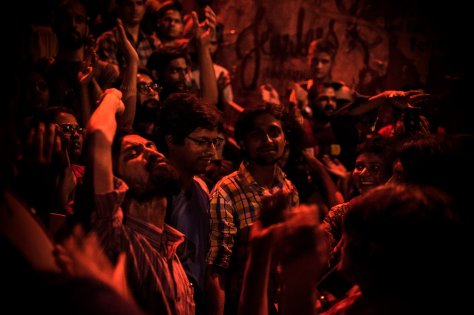
Chintu Kumari, Anirban Bhattacharya and other students give the call to protest against the HLEC and call for a Hunger Strike. Photo, Courtesy, Azhar Amim

13055719_10154616732485016_4978357478249045500_o

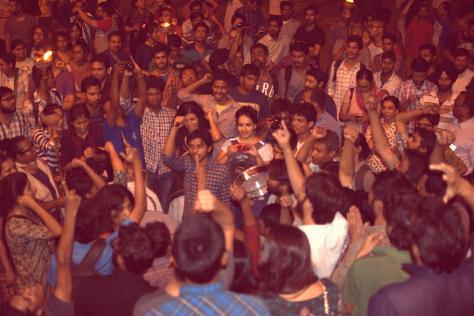
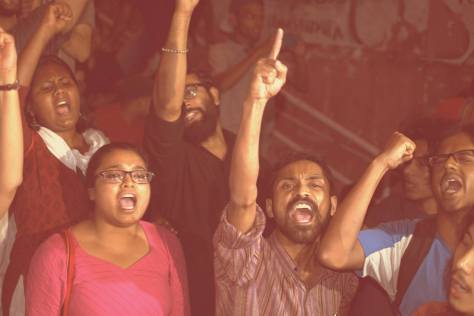
This is a time, they must have thought, when students will be busy with preparations, and the rising heat will discourage the kind of mass mobilizations that the campus has seen since February. Students in JNU resolved a few hours ago to prove them wrong, and decided to fight back . A massive gathering stood its ground at the Administrative Block, aptly re-christened, ‘Freedom Square’.

Rama Naga, Gen.Sec. JNUSU, (Centre) and JNU Students Calling for Indefinite Hunger Strike on April 27, 2016. Photo, Courtesy, Azhar Amim

They have decided that a batch of students will sit on indefinite hunger strike – a ‘fast unto death’ – until the JNU authorities roll back the draconian measures listed in the HLEC Report.

The 20 students who will be sitting in indefinite hunger strike at JNU.

There’s no looking back now. Whatever happens from now on wards, will be seen as a consequence of the cruel, evil mindset of the current regime, which truly treats the lives of the young as dispensable ballast. Its time to prove them wrong. This is a call that goes out to all students and teachers, and sensible individuals, not just in JNU, not just in Universities and Colleges all across India and all the territories administered by the Indian republic, but to everyone reading this post anywhere in the world, to stand by the courageous students of JNU. It is our responsibility to see that the JNU Authorities see reason and back down. If anything untoward happens to any student, the university authorities, and the regime backing them, will be clearly culpable.

Here is Umar Khalid, speaking just before commencing his Hunger Strike

Here is Chintu, former Gen. Sec. JNUSU, speaking at the Mashaal Juloos, (Torchlight Procession) just before beginning the Hunger Strike.

Listen to Kanhaiya Kumar, President of the JNUSU – restating the reasons for the continuation of the movement.

Thanks to the ‘We are JNU Media Group’ and the AISA Youtube Channel, for the videos.

Sanghis, Sex and University Students – What is it Really All About? Ayesha Kidwai

Guest Post by Ayesha Kidwai

[ The prurient fantasies contained in the ‘JNU Dossier’, produced by some right wing faculty members of JNU in or around October 2015, have been ‘outed’ by an excellent report by Ajoy Ashirwad Mahaprashasta in Wire.org. This comes exactly at the time when the JNU administration has shown its fangs by delivering a low blow by way of the measures outlined in the report of the ‘High Level Enquiry Committee’ appointed by the Vice Chancellor. An impartial examination of the HLEC document and the ‘Dossier’ in will reveal some startlingly resonant patterns. Clearly, the ‘Dossier’, which had been dismissed by the former Vice-Chanceller, Prof. Sopory, has been reincarnated at the express orders of the Nagpuri masters of the present dispensation. We are sharing below an excellent response to the ‘Dossier’ by Ayesha Kidwai, one of the professors – ‘named’ in the dossier. This is taken from Ayesha Kidwai’s status update on her Facebook Page.

For another take down of the ‘Dossier’ – see also – “Sex and sedition: What the JNU dossier tells us about the right-wing imagination” – in Scroll.in by Kavita Krishnan. Meanwhile, JNU Students have commenced on a ‘fast unto death’ in protest against the university administration’s senseless measures. Kafila]

Sanghi smut is in season again! For the authors of the Dirty Dossier, JNU nights are forever scented with musk, with couples draped on every bush, suitably fortified by free alcohol, thoughts of secession, and cash payments supplied by the Awesome Foursome. At its peak, the party can practically involve the whole university, because as per Shri Gyan Dev Ahuja’s estimates, the number of students frolicking this will be 7000 (3000 condom users X 2, plus 500 injectable walas X 2). (Assuming of course that the few hundred left over have gone to fieldwork, have exams, or are abstemious and/or abstinent in nature.)

Laugh as we may (and must) at these feverish imaginings, it’s also important to understand that the very notion of a free university challenges not only misogyny, but also the social apartheid produced by caste and exclusionary religion.

Continue reading Sanghis, Sex and University Students – What is it Really All About? Ayesha Kidwai

Do Not Speak of The Noose…

‘Festival rubs off scars’, claimed a newspaper report with picture of Muslim men distributing water and sweets to the Hindus celebrating Ram Navami. The place was Balu Math in Latehar. The scars were obviously of the murder of two Muslim men, one of them an adolescent by members of the local Gau Raksha Samiti.

‘Rub off your scars and do not complain’,Muslims are told after each incident of violence against them. Their insistence to talk about their wounds is seen as a sign of their grumbling nature, their love with their victimhood. Also a proof of their disaffection towards Hindus.

“…In the house of the hangman one should not speak of the noose, otherwise one might seem to harbour resentment.”,Theodore Adorno wrote while responding to criticism against his study of the sources of authoritarian personality in Germans in the post Hitler years. Continue reading Do Not Speak of The Noose…

Rise Up against the Proxy War on Students by the Modi Regime: Shehla Rashid

Guest Post by Shehla Rashid, (Vice President, Jawaharlal Nehru University Students’ Union)

Rise up against the proxy war on students by the Modi regime.

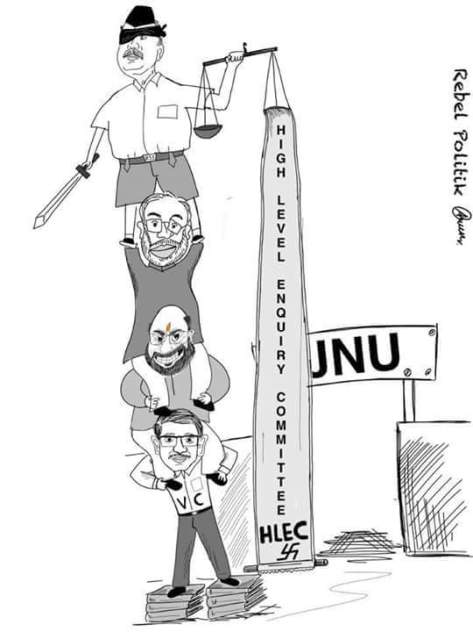
Cartoon by V. Arun Kumar

JNUSU rejects the report of the enquiry committee constituted by the Vice-Chancellor to look into the 9th of February incident. JNUSU also rejects its reports and any punishment handed out by it. The JNUSU and JNUTA had repeatedly asked the administration to democratise the enquiry committee, but this was not done.  Now, when the holidays are here, the VC has made public the punishments, after one and a half months of submission of the HLEC (High Level Enquiry Committee) report. Continue reading Rise Up against the Proxy War on Students by the Modi Regime: Shehla Rashid

Jayadeva Uyangoda on Ambedkar’s Legacy

Text of the talk delivered on April 22, 2016 at the Indian Cultural Centre, Colombo on the occasion of B. R. Ambedkar Commemoration.

Ambedkar’s Legacy: Critique of Religion, Quest for Social Justice and the Paradox of Constitutionalism

Jayadeva Uyangoda, Senior professor of Political Science, University of Colombo

Ambedkar

May I begin my talk this evening by thanking His Excellency Y. K. Sinha the Indian High Commissioner in Colombo for inviting me to deliver this lecture on B. R. Ambedkar? This event is part of a series of celebrations in connection with the 125th birth anniversary of Babasaheb Ambedkar, which fell on the 14th of April. I am afraid my talk may not celebrate great Ambedkar’s memory and legacy as such. It will only present some disjointed and hurriedly constructed thoughts about the life and legacy of this great son of South Asia.

Ambedkar’s name is well known in Sri Lanka. In Sinhalese society, the popular culture of which I am somewhat familiar with, Ambedkar is known as the leader of India’s Harijan communities. The word dalit is not in much use in Sinhalese society. The Gandhian neologism of harijan is better known. Ambedkar is respected as the Harijan leader who embraced Buddhism along with several thousands of his followers. Sinhalese Buddhists are particularly sympathetic to Ambedkar and his social reform movement. For them, Ambedkar’s project constituted a critique and a rejection of Hinduism. This is despite the fact that Buddhism has historically and in terms of elite as well as popular practices been closely interwoven with Hinduism. Quite independent of Ambedkar, Sri Lankan Buddhists have a somewhat ambivalent attitude towards Hinduism and Hindu traditions as well. It is almost like their ambivalence towards India in general, as some of their intellectuals and professionals seem to be inclined to demonstrate these days. Continue reading Jayadeva Uyangoda on Ambedkar’s Legacy

To the Puppets and Puppeteers – We Students Will Fight Back: Anirban

Guest Post by Anirban Bhattacharya 

To the puppets and their puppeteers…

Free speech cannot come with a price tag -10,000/- or 20,000/- or even a rupee!
Dissent cannot be evicted!
Ideas cannot be made out of bounds!
Reason cannot be rusticated!

Continue reading To the Puppets and Puppeteers – We Students Will Fight Back: Anirban

JNU High Level Committee Delivers a Low Blow – Students Unjustly Rusticated, Fined, Declared ‘Out of Bounds’

So, the High Level Enquiry Committee at JNU, set up under the watch of Jagadish Kumar, the recently appointed Vice Chancellor, has just delivered a low blow. A summary of its decisions (taken from the Facebook Wall of JNUSU Vice President, Shehla Rashid) meted out as the consequences of the events of February 9 and after is as follows :

Umar Khalid, rusticated for one semester + 20K fine.

Anirban, rusticated till 15 July & from 25 July, out of bounds for 5 years.

Another Kashmiri student rusticated for two semesters.

Ashutosh, former JNUSU President, removed from hostel for one year + fine.

Chintu, former JNUSU Gen Sec: 20K fine

Rama, current JNUSU Gen Sec: 20K fine

Anant, former JNUSU Vice-President: 20K fine

Aishwarya, current GSCASH representative: 20K fine.

Gargi, current JNUSU councillor: 20 K fine

Shveta Raj, current SL & CS Convener: 20 K fine

Kanhaiyya, current JNUSU President: 10K fine

Other organisers fined from 10K to 20K

Two ex students declared out of bounds from campus.

This is an administration, which, in obedience to its backers in the Ministry of Human Resource Development and the Government of India, that knows only one way of dealing with the students in its charge – and that is a replica of the vindictive path that eventually drove Rohith Vemula to his institutionally mandated death in Hyderabad University.

This is an administration that invited police to intervene in what was essentially a dispute between groups of students, at the instigation of right wing thugs. Continue reading JNU High Level Committee Delivers a Low Blow – Students Unjustly Rusticated, Fined, Declared ‘Out of Bounds’

हिंदुओं के खिलाफ क्यों लिखना?

“आप मुसलमानों के खिलाफ कभी कुछ क्यों नहीं लिखते?,यह सवाल अक्सर इस लेखक की तरह के कुछ लोगों से किया जाता है.इस प्रश्न में छिपा हुआ आरोप है और एक धारणा जिस पर यह पहला प्रश्न टिका हुआ है कि आप हिंदुओं के विरुद्ध लिखते हैं. इसका उत्तर कैसे दिया जाए?यह सच है कि अभी तक के लिखे की जांच करें तो प्रायः भारत में बहुसंख्यकवाद को लेकर ही चिंता या क्षोभ मिलेगा.इसके कारण उन संगठनों या व्यक्तियों की आलोचना भी मिलेगी जो इस बहुसंख्यकवाद के प्रतिनिधि  या प्रवक्ता हैं.क्या यह करना मुझ जैसे व्यक्ति के लिए स्वाभाविक है या होना चाहिए? भारत में बहुसंख्यकवाद हिंदू ही हो सकता है.कई हैं जो उनमें नहीं जो इस बहुसंख्यकवाद पर  बात करते वक्त तराजू के पलड़े बराबर करने के लिए ‘मुस्लिम सम्प्रदायवाद’की भी फौरन निंदा करना ज़रूरी समझें

नाम से मुझे हिंदू ही माना जाएगा, मैं चाहे जितना उसे मानने से इनकार करूँ. मेरी मित्र फराह नकवी ने एकबार मुझसे कहा था कि अगर फिरकावारना फसाद में फँसे तो तुम्हारा नाम तुम्हें हिंदू साबित करने के लिए काफी होगा और तुम्हारा भाग्य इससे तय   होगा कि तुम फँसे किनके बीच हो-हिंदुओं या मुसलमानों के. उस वक्त यह बहस कोई न करेगा कि मैं अभ्यासी हिंदू हूँ या नहीं,नास्तिक हूँ या संदेहवादी हूँ! Continue reading हिंदुओं के खिलाफ क्यों लिखना?

Media figures call for Release of Himal Editor Kanak Mani Dixit

New Delhi, April 23 — Editors and media figures as well as intellectuals and scholars from India, Nepal, Bangladesh, UK, US, Australia and Sri Lanka have called for the release of Himal editor and prominent Nepali journalist Kanak Mani Dixit who was arrested yesterday in Katmandu by anti-graft officials.

The following is the text of the statement:

It is with deep concern that we have learned of the arrest today of Kanak Mani Dixit, the widely respected founder-editor of Himal Media and a courageous voice for transparency, freedom of expression and democratic rights in Nepal and across South Asia. The charges are related to alleged corruption but Kanak Dixit says it is part of a vendetta pursued against him by people in Government.

We have known Kanak Dixit as a true professional, human rights defender and energetic journalist whose credentials are built on robust research and tremendous courage. Himal Media, a pioneer in South Asia journalism, has published Himal South Asia, Nepali Times and Himal Khabar Patrika (in the Nepali language). He has written extensively for international media including leading newspapers in India and is chairman of Sajha Yatayat, a state run transportation company, which he has been turning around from a loss-making entity. Continue reading Media figures call for Release of Himal Editor Kanak Mani Dixit

Statement of solidarity for HCU from students and faculty of University of Texas at Austin

An Ode To Women’s Struggle In Matoi: Shailza Sharma

Guest Post by SHAILZA SHARMA

In the remote corners of Sangrur district of Punjab, 20-something year old women got together during a village celebration of Ravidas Jayanti. These girls from Matoi village had one purpose that day, to declare the formation of their Ekta Club, a club formed with the objective of fighting for equal status, equal opportunities and most importantly, claiming a share in the village land by participating in the annual auction of Shamilat land.

Upon making this valiant declaration, they were bombarded with insults and mocked for demanding their rights. “Who are you to claim rights over land, you are just a bunch of Dalit girls! What will you even get out of owning a piece of land?”, people questioned. To this, the women replied, “It is a matter of legal right and our demands are legitimate claims for what belongs to us. In claiming our legal rights, we seek equal status, satisfaction and self respect”.

Out of this group of ten women were two sisters leading the struggle, Gurmeet Kaur and Sandeep Kaur. They had been at the forefront of formation of the Ekta Club and the fight for claiming Shamilat land.

The Punjab Village Common Lands Regulation Act, 1961 (the Punjab Act)

This was the scene in 2014, a day on which a few Dalit families led by this group of young women, stood up against the upper caste families and farmers of Matoi, to claim their share in the Shamilat land.

Under the Punjab Act, Shamilat land has been defined as inter alia the land used or reserved for the benefit of the village and community. Such land may be utilised for various purposes including constructing schools, drinking wells, roads etc. 30% of the Shamilat land is reserved for families from the Scheduled Castes, 10% for families from the Backward Classes and further 10% for dependants of army personnel killed in war after the independence of India (Reserved Land). Continue reading An Ode To Women’s Struggle In Matoi: Shailza Sharma

जी हाँ, हम राजनीति करते हैं : अनन्त प्रकाश नारायण

Guest Post by Anant Prakash Narayan

जे.एन.यू. में 9 फरवरी को एक घटना घटी. घटना क्या थी अब उसके बारे में बहुत सी चीजे स्पष्ट हो चुकी है. सरकार का दमन चला जिसके परिणामस्वरुप एक आन्दोलन चला. कहा ये जा रहा है कि आन्दोलन के कारण सरकार बैकफुट पर है. ये आन्दोलन अभी भी चल रहा है. जब ये मुद्दा पुरे देश में गरमाया जा रहा था  उस समय बहुत सारी चीजे डिबेट का हिस्सा बनी जैसे राष्ट्रवाद क्या है? अभिव्यक्ति की स्वतंत्रता (Right to Freedom of Speech and Expression) को कैसे देखा जाये? आज़ादी की सीमा क्या होगी? क्या टैक्स से पढने वाले स्टूडेंट्स को “इतना बोलना” शोभा देता है? क्या जब सीमा पर जवान मर रहे है तो “ये काम” किया जा सकता है? ये सारे मुद्दे बहुत ही जोर–शोर से सरकार के पक्ष से या फिर इसके उलट लोकतंत्र के पक्ष में बात रखने वालों की तरफ से भी की जा रही थी. लेकिन इसी बीच में एक खतरनाक अवधारणा सरकार के तरफ से बात रखने वाले और जाने अनजाने लोकतंत्र की तरफ से भी बात रखने वाले टी.वी. चैनलो, अखबारों, इंटेलेक्चुअल, राजनीतिज्ञों की तरफ से रखी जा रही थी. वो अवधारणा थी कि राजनीति बहुत बुरी चीज है और छात्र राजनीति तो बदतर. यहाँ तक कि हमारी पैरोकारी करने वाला पक्ष भी यह बार-बार साबित करने का प्रयास कर रहा था कि ये सामान्य से पढने लिखने वाले छात्र है इनका राजनीति से कोई मतलब नही है. ये लोग तो बस कभी कभी कुछ यू हीं करते रहते हैं. क्या अगर हमारे बारे में यह टैग लग जाता कि हम राजनीति करने वाले लोग है तो हमारे पक्ष से बात रखना इतना मुश्किल हो जाता. जबकि यह सर्वविदित है कि जिन कुछ छात्रो के नाम राजद्रोह के तहत लिए जा रहे है वे वामपंथ की सक्रिय राजनीति का हिस्सा है. आने वाले समय में हम आन्दोलन को किस हद तक जीतते है और आगे ले जा करके इसको इस फासिस्ट सरकार के लिए कितना खतरनाक बना पाते है ये अभी तय होना बाकी है लेकिन “मुख्याधारा” की राजनीति करने वाली पार्टियाँ, जिसको प्रोग्रेसिव छात्र-आन्दोलन ने हमेशा उनके जन –विरोधी रवैये के कारण चैलेंज दिया है, एक बार इस मौके को राजनीति, खासतौर से अगर छात्र करे तो, बहुत ही गलत चीज है इसको स्थापित करने में लगी हैं. छात्रों का काम काज सिर्फ पढना-लिखना है और इसके इतर वो अगर कोई और काम करते है तो वो अपनी “सीमा” लांघते है. बड़ी-बड़ी मल्टीनेशनल कंपनियों में छोटे-छोटे उम्र के कमाने वाले लोगों के साथ तुलना करके ये समझाने की कोशिश की गई कि आप जितनी कम उम्र में जितना ज्यादा कमा लेते है आप उतने ही सफल स्टूडेंट है. हम अभी लगभग बीस दिन के एक कैंपेन में थे. इस कैंपेन के तहत देश के विभिन्न हिस्सों खास तौर से उत्तर भारत के गाँवो और छोटे-छोटे कस्बो और कुछ शहरो में मेरा जाना हुआ. जिसमे जे. एन. यू. पर बात होती, भगत सिंह और डॉ. अम्बेडकर के विज़न पर बात होती. जब इन विषयों पर बात होती तो नैचुरली मोदी सरकार के ऊपर बात होती. उन कार्यक्रमों में कुछ ऐसे लोग भी मिलते जिनका कहना होता कि आप लोगों के साथ जो हुआ गलत हुआ लेकिन इस मैटर को लेकर अब आप लोग राजनीति कर रहे है. मोदी के खिलाफ आप लोग जो इतना बोल रहे है उससे अब आप लोग एक्सपोज हो गये है कि आप लोग राजनीति कर रहे है. क्या सच में राजनीति इतनी बुरी चीज है कि उससे स्टूडेंट्स को दूर रहना चाहिए? Continue reading जी हाँ, हम राजनीति करते हैं : अनन्त प्रकाश नारायण

Folk Singer Kovan Lampoons Jayalalitha’s Promise

Kovan, the Dalit-activist poet and singer and member of a revolutionary organisation PALA (People’s Arts And Literary Association), from Trichy district in Tamil Nadu, has been in the news lately. One of his anti-Jayalalitha songs earned him the ire of the state government, which slapped a Sedition case against him in December 2015.

In this video sent to us by Vinavu Thalam, Kovan lampoons Jayalalitha’s promise of “step by step prohibition” as “peg by peg de-addiction”!

Seduce the gullible voters with false promise/ File sedition cases against those who fight/ This is her game/ The game of a cheat/

In Chennai slang, “Bongu” means, a Cheat! She is the AMMA of all cheats!

Responding to the Challenges of Blue and Red – Reminiscences of a JNU-HCU Alumna: Shipra Nigam

This is a guest post by SHIPRA NIGAM

That the past few months have been cataclysmic is an understatement. Personal tragedies and political catastrophes have exploded within our most cherished spaces, and brought a churning in them.  What was truly transformative was the experience of both the emergence of broad solidarities against right-wing fascism, and of the reminders of multiple registers and contexts within them. These underline the need for multiple conversations to understand both our common struggles, as well as the contradictions within, and to renew a resolve for introspection through them as we move towards real ‘azaadi’.

There is of course an ongoing debate on this, and here I felt that some binaries being invoked in it are not very convincing, while others brought home stark truths that pose challenges to a patriarchal, majoritarian caste hindu ordering of society, within which we are all located at different levels of hierarchy, complicity, and engagement.

I have been part of both public universities under fire right now, and the present brings home the urgency of the dual task of defending the public university as a space for pushing the boundaries of critical thought, and confronting the very hierarchies and complicities with power that shape it. This is necessary even as processes of democratisation and affirmative action take root in public institutions . So these are some reminiscences from an alumna of both these public universities who has been wrestling with articulations and complexities which lie beyond institutional labels or binaries. Continue reading Responding to the Challenges of Blue and Red – Reminiscences of a JNU-HCU Alumna: Shipra Nigam

Kashmir IG Police Refuses to Speak with Handwara Minor Girl: JKCCS

Guest Post by Jammu & Kashmir Coalition  of Civil Society

Since last 3 days, JKCCS has been approaching the Inspector General (IG) of JK Police, Javed Geelani for a meeting in connection with the illegal detention of the minor girl and her family. Yesterday evening the Handwara minor girl spoke to JKCCS team on phone. She and her family informed that against their will the police has shifted them to a stranger’s house 15 kms from Handwara town. After detailed discussion JKCCS proposed her to call the IGP Kashmir and Chairperson of the State Commission for Women, Nayeema Mehjoor directly to inform them about her ordeal in the illegal police detention, her demand for free movement and an immediate access to her lawyers. 
The minor girl called the IG several times but only once he picked up the phone. After she identified herself, the IG cancelled the call. JKCCS team called DIG Ghulam Hassan Bhat and requested him to inform the IG that the minor girl wants to talk to him urgently. We were assured that the IG will speak to the girl. 

Immediately after that the police personnel went inside the house where the girl is detained and threatened her to not call the IG Kashmir, Javed Geelani.

The minor girl was able to speak to Nayeema Mehjoor and gave her detailed statement and requested her to facilitate her conversation with IGP Javed Geelani. Ms. Mehjoor promised to help.

The minor girl and her family wanted to communicate to the highest police officials that the police should stop her illegal detention and allow her to meet her lawyers so that she can herself alongwith her family proactively contribute in the legal struggle. 

‘Swacch Bharat Abhiyan invisibilises the linkage of Caste and Sanitation and glamourises broom among Scavenging Communities’ – Bezwada Wilson

In Conversation with Bezwada Wilson, National Convener of Safai Karmachari Andolan

The 125 day Bhim Yatra which started from Dibrugarh and traveresed 30 states and 500 districts to reach Delhi is now over.  As everybody knows it culminated in a big rally coupled with people’s hearing where families of those victims who died while cleaning sewers and septic tanks shared their plight at the hands of state as well as civil society. The call of this Bhim Yatra raised by Safai Karmacharis – ‘Stop Killing Us’ – would could keep reverberating for quite some time. (https://kafila.org/2016/04/14/bhim-yatra-so-that-there-are-no-more-killings/)

Here follows an interview with Bezwada Wilson, National Convener of Safai Karmachari Andolan

 How do you see the impact of  ‘Bhim Yatra’ ?

As far as those people who are still condemned to do scavenging is concerned, the 125 day Bhim Yatra has made two significant impacts :

– It has made people aware that a new act (2013 act) has come into existence for elimination of manual scavenging and they should make use of it for their liberation.

– Second significant impact is that people are realising that we should not do this work, we should leave this work altogether. Babasaheb’s teachings that depressed classes should leave all such professions which are stigmatised and which further help stigmatise them has reached broader cross sections of people engaged in cleaning and scavenging. The slogan ‘ Leave the Broom, Take the Pen’ is slowly reverberating across people especially the younger ones. Continue reading ‘Swacch Bharat Abhiyan invisibilises the linkage of Caste and Sanitation and glamourises broom among Scavenging Communities’ – Bezwada Wilson

The Difference between What They Tell Us and What We Know: Shehla Rashid

Guest Post by Shehla Rashid. Based on a Status Update on her Facebook Page.

They tell us that the military is meant for fighting the “terrorists”; But most of the time, it is the civilians who are killed.

They tell us that “special powers” for the army are necessary for national unity; But the army only teaches us how to hate India.

They say the University is anti-national because it wants to break India; But it’s the University that teaches us to love Indians.

Then, who is anti-national? Those who teach us how to hate India, or those who teach us how to love Indians?

Yes, we see the difference between India and Indians; India is at war with Indians throughout India.

I wish the Indian state could also see the difference between Kashmir, which it claims as its own, and Kashmiris who belong to no one; They claim to love Kashmir but hate and kill Kashmiris.

Continue reading The Difference between What They Tell Us and What We Know: Shehla Rashid

Guggenheim Breaks Off Negotiations with Gulf Labor: Statement from Gulf Labor Coalition

This is a statement issued by the Gulf Labor Coalition

Guggenheim Breaks Off Negotiations with Gulf Labor


On April 13, 2016, Guggenheim Board of Trustees unilaterally severed negotiations with the Gulf Labor Coalition (GLC). In a conference call, the Guggenheim[1] informed GLC that they will no longer meet with us, nor listen to our proposals about the living and working conditions of the workers who are and will be building museums in Abu Dhabi.

On April 17, 2016, Richard Armstrong, Director of the Guggenheim Museum, sent an email to artists, art critics, curators, and museum directors all over the world describing GLC as a group that “continues to shift its demands,” is “continuing to spread mistruths,” and uses “deliberate falsehoods.”[2] He insisted that no work had begun on the Abu Dhabi site, a recurring claim that GLC has already challenged.[3]

Since the announcement of the artist boycott of Guggenheim Abu Dhabi in 2011, GLC has published research reports, analyzed each Pricewaterhouse Cooper (PwC) monitoring report, invited NGOs and labor organizations (e.g., ILO, HRW, ITUC) to join discussions, and initiated multiple meetings with Guggenheim.[4] In response to all this work by GLC, statements made by the museum made it clear that the Guggenheim was never serious about dialogue with artist groups towards fair labor standards Continue reading Guggenheim Breaks Off Negotiations with Gulf Labor: Statement from Gulf Labor Coalition

शाकाहार, मांसाहार और बुद्धि का अधिकार

टाइम्स ऑफ़ इंडिया ने लखनऊ में भीमराव आंबेडकर की जयंती के अवसर पर लखनऊ में हुए एक कार्यक्रम में प्रोफ़ेसर कांचा इलैया के वक्तव्य की रिपोर्ट प्रकाशित की है.रिपोर्ट के मुताबिक़ उन्होंने कहा कि शाकाहार राष्ट्र विरोधी है: “मेरा राष्ट्र गोमांस खाने से शुरू होता है.दुर्भाग्यवश, हमने गोमांस खाना छोड़ दिया और इस कारण हमारे दिमाग अब बढ़ नहीं रहे हैं.” आगे उन्होंने कहा कि शाकाहार राष्ट्र को नष्ट कर देगा. शाकाहारी राष्ट्रवाद  के सहारे  हम चीन, कोरिया,जापान और अमरीका से प्रतियोगिता नहीं कर सकते जो पूरी तरह गोमांसाहारी हैं.

यह वक्तव्य आक्रामक है और उस समय के लिहाज से साहसी कहा जा सकता है जब गोमांस रखने और खाने के नाम पर लोगों को मारा जा रहा हो. अखबार ने बताया कि इस बयान पर काफी तालियाँ मिलीं.रिपोर्ट ने इसके साथ यह बताना ज़रूरी समझा कि  श्रोताओं में अच्छी संख्या दलितों की थी. Continue reading शाकाहार, मांसाहार और बुद्धि का अधिकार

Suicide of a Worker: Shankar Gopalakrishnan and Trepan Singh Chauhan

Guest post by SHANKAR GOPALAKRISHNAN and TREPAN SINGH CHAUHAN

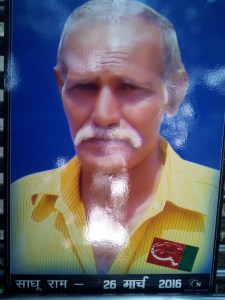
On April 11th, a memorial meeting was held at Gandhi Park, Dehradun. You probably haven’t heard of Sadhuram, the person for whom it was held. Thousands of people have indeed heard of him. But it reflects the divided world we live in – the world that Sadhuram fought to change – that it’s very unlikely that you are one of them.

Sadhu Ram
Sadhu Ram

Sadhuram was a Dalit, a mason and a resident of Jakhan, Dehradun. He was also the vice president of the Uttarakhand Nav Nirman Mazdoor Sangh, a union of unorganised sector workers. To the daily wage workers of Jakhan, he was a daily presence at the mazdoor chowk, the place where people stand for work in the morning; some of them affectionately referred to him as “mantri-ji.” Late on the night of March 26th, Sadhuram committed suicide.

Why did he do it? That question has many partial answers. On December 5th, 2014, his wife Geeta Devi died of kidney failure. Geeta was not one to give up easily; her death came after a long battle against a painful disease and the extortions of private doctors. That very night, Sadhuram’s younger son, Ravi, lay down on the tracks outside Dehradun station and committed suicide. Sadhuram was left an angry, saddened man, having lost the two most important people in his life. His remaining son cared little for either the union or Sadhuram. They had frequent fights, and his son often beat him. Nor was that the only atrocity in Sadhuram’s life. After Ravi’s death, he was entitled to Rs. 50,000 in compensation under the Building Workers’ Act; that 50,000 might have meant the difference between continuing abuse and independence. But for an entire year the Labour Department sat on the application, notwithstanding at least twenty meetings and even a personal direction from the CM.

Continue reading Suicide of a Worker: Shankar Gopalakrishnan and Trepan Singh Chauhan

DISSENT, DEBATE, CREATE