A short film on the handloom weavers of Barabanki, UP, by KABIR KIDWAI
Kabir Kidwai is a student and independent film-maker. You can see his other work on his YouTube channel.
A short film on the handloom weavers of Barabanki, UP, by KABIR KIDWAI
Kabir Kidwai is a student and independent film-maker. You can see his other work on his YouTube channel.
Statement Condemning the murder of Gulnaz Khatun and demanding a speedy investigation
We the undersigned feminist groups, activists and individuals are deeply anguished at the killing of a 20-year-old poor Muslim girl, Gulnaz in a village in Bihar‘s Vaishali district. The young girl, an economic support to the family and about to be married was killed after her stalkers poured kerosene oil on her and burnt her alive on 30 October 2020. The girl was admitted in a nearby hospital with 75 percent burns and later moved to Patna Medical College. In her video statement when she was in excruciating pain, she clearly identified the three attackers. She succumbed to her injuries on 15th November 2020. The case has made hardly any progress. There is very limited coverage about the case in electronic Media and print media. According to the reports one accused has been arrested and police is still looking for the other two.. There are also reports that the family of victim is being harassed by the accused. Continue reading Statement condemning the murder of Gulnaz Khatun
Guest post by ABHIK CHIMNI
The Citizenship Amendment Act, 2019 (CAA) is a legislation which along with the National Register of Citizens (NRC) gives rise to a legal regime which is not consistent with the tenets of the Indian Constitution.
The CCA/NRC violates the basic structure of the Indian Constitution, primarily the equality clause and the principle of secularism embedded within the constitutional framework.
I further argue that Fundamental Rights are in fact dissenting rights.
The Indian Constitution – A story in three parts
The Constitution can be broadly divided into three parts.
The first accounts for protection of individual liberty through the fundamental rights chapter stipulated in Part III of the Constitution.
The second seeks to create independent institutions such as the constitutional courts, the Election Commission, the Comptroller Auditor General and the Governor’s office etc.
Guest Post by PRAMOD RANJAN
Translated from the original Hindi by Ekta News and Features
It is said that had the spread of the Novel Coronavirus not been contained by imposing lockdowns, by now, it would have consumed a substantial chunk of the human residents of the earth. But this claim requires closer examination.
Lockdown killed lakhs of persons the world over and its after-effects have ruined the economies of scores of low- and middle-income countries like India. Crores of persons have been condemned to a life of poverty and misery.
What is going to change
Offices and educational institutions were a gift of modern age. By bringing human minds together, the places of work and the centres of education not only scripted a new chapter in the development of the human race but also brought diverse communities on common platforms. It is almost certain that in the post-Covid world, schools and offices would not exist as we know them today.[1] A new law for bringing about changes in educational institutions has come into force in India.[2] Labour laws have been almost abolished and companies have been given the licence to exploit the workers.[3] Not only manual labourers but white-collar workers, too, would be caught in this web of exploitation and mental turmoil[4]. The rights of journalists and media employees, related to their service conditions and salary and allowances, have been withdrawn through changes in the law.[5]
There is also a real danger that globalization (the spurt in commercial and business activities at the global level around the 1990s) would be reversed. This will spell disaster for the economies of the developing countries. In India and many other countries, the poor could join the middle-income group only due to globalization[6]. Continue reading Post Covid world and Bahujan: Pramod Ranjan
This review has been prepared by a voluntary citizens’ collective of academics and activists, anchored by Karwan-e-Mohabbat, Anhad and Muslim Women’s Forum.
The review is based on a PDF of the ‘book’, Delhi Riots 2020: The Untold Story by Monika Arora, Sonali Chitalkar and Prerna Malhotra, which went viral after the original publishers (Bloomsbury India) withdrew. The PDF was widely circulated on social media by the book’s supporters, who believed its message must be spread far and wide. At the virtual book launch, BJP leader and Chief Guest, Kapil Mishra, tweeted “The book is public now”.
The review, titled Sifting Evidence, given below, is largely in tabular form, which makes for a quick read.
The book Delhi Riots 2020 was originally a fact-finding report by a group called GIA (Group of Intellectuals and Academicians), which was submitted to the Home Ministry on March 11th, 2020. A version of it was accepted for publication by Bloomsbury India. BJP leader Kapil Mishra, whose hate speeches allegedly triggered the riots in February 2020, was a guest of honour at the book launch event held on August 22, 2020. On the day of the launch, Bloomsbury India decided to withdraw publication.
The authors claimed their freedom of expression was violated. But the facts are clear – there was no call to ban the Delhi Riots 2020 book. Established and reputable publishers get their reputation because they fact-check, and stay away from publishing material that may amount to libel. Other publishers may not care, and therefore do not achieve that reputation. Continue reading Sifting Evidence – A review of “Delhi Riots 2020: The Untold Story”: Karwan-e-Mohabbat, Anhad and Muslim Women’s Forum
Statement of solidarity from JU alumni
As alumni of Jadavpur University (JU), we condemn the casteist abuses hurled against a renowned professor of History at Jadavpur University, Dr. Maroona Murmu, because of her identity as an Adivasi.
The remarks were made in response to Dr. Murmu’s comment that an academic year was not more important than a student’s life and that in-person examination during the ongoing deadly coronavirus pandemic was not a good idea. This was admittedly a reasonable stand in face of the government’s decision to hold exams during the Covid-19 outbreak. In response, she received casteist abuses from an undergraduate student who called her out on social media as a “worthless, undeserving idiot” (“jogyotaheen opodartho” in Bengali). It questioned both her scholarly credibility and her right to speak out on any aspect of academic life (the security and well-being of students during a contagious disease outbreak, for instance). The student then went on to “remind” Dr. Murmu of her identity as an Adivasi Santhal and her inferior position in the caste hierarchy that made her unworthy of any consideration. This was followed by over 1800 trolls and rebukes. It is continuing. Continue reading Jadavpur alumni in solidarity with Dr. Maroona Murmu in face of casteist/racist violence in Indian academia
Statement issued by JNUTA, representing the voices of JNU faculty
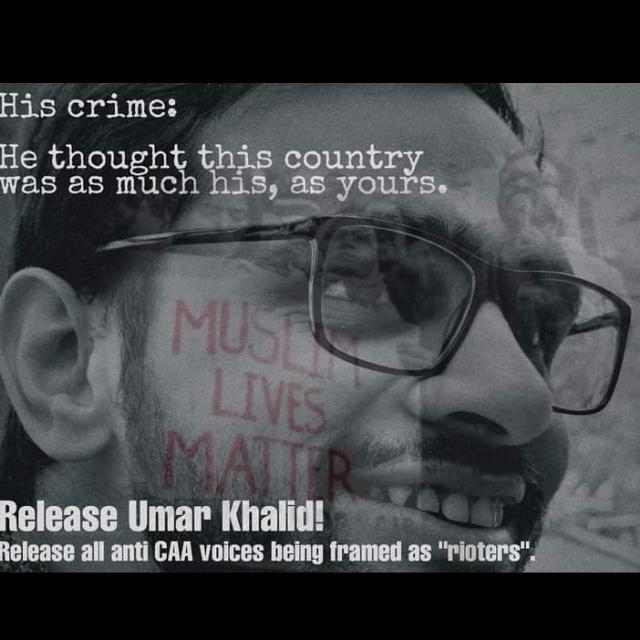
The JNUTA condemns the arrest by the Special Cell of the Delhi Police of former JNU student, Umar Khalid, under the draconian UAPA. This is yet another instance of the never ending witch hunt being conducted by the Delhi Police in the name of inquiring into the February 2020 riots in Delhi, an inquiry with which Umar Khalid had been voluntary cooperating. The JNUTA notes that Umar Khalid had also been one of those specially targeted during the vicious slander campaign unleashed against JNU in February 2016 and had then been charged with ‘sedition’. That smear campaign fuelled by sections of the media had put his life in danger and in 2018 he fortuitously survived a murderous attack against him. Since then he was supposed to be under the ‘protection’ of the Police and yet he is accused of having been part of a ‘conspiracy’ for instigating the violence in North-East Delhi. It is clear, therefore, that his safety is at risk even when he is in custody and not just because of the Covid-19 pandemic.
Continue reading JNU Teachers Association condemns the arrest of Umar Khalid
Delhi Police continues its motivated “enquiry” into the systematic and planned violence in NE Delhi in February 2020, framing through fake “disclosure statements” and “confessions”, students, teachers, film makers, activists and other citizens who peacefully protested the unconstitutional CAA.
In this context, reports in the media yesterday stated that Delhi Police have filed a supplementary chargesheet naming, among others, Apoorvanand, Professor of Hindi at Delhi University, well known academic, fellow Kafila collective member and a relentless defender of democracy, which is under severe threat from this regime.
The following statement has been issued by him in response.
Statement by Prof Apoorvanand
It has been brought to my notice that a supplementary Chargesheet filed in connection with FIR 50/2020 has certain disclosure statements by accused in custody, that mention my name, together with that of Rahul Roy, Umar Khalid, Jayati Ghosh , Sita Ram Yechuri and Yogendra Yadav. These names are mentioned in uncorroborated statements attributed to accused who are in custody, where it is claimed that they provided support in organising the anti- CAA protests. Continue reading Delhi Police inquiry into Delhi violence 2020: Statement by Prof Apoorvanand
Guest post by DIPANJALI DEKA
I recently finished watching Sursamalaya’s “Folk Stories” on Youtube, a documentary series made during the lockdown.
“Folk Stories” depicts the art and life of folk artists from many lesser known genres of Assam. It has released one season as of now and is amply promising, for many reasons. One of them is the accessibility offered, in short crisp episodes, to the social and cultural landscape of Assam beyond the genres of Bihu, Borgeet and Sattriya popularly known to the mainstream.
In the first episode, we meet Mehu Bora from Golaghat who builds traditional instruments like tokari (stringed instrument), dotara (stringed instrument), bahi (flute), pepa (hornpipe) etc.
Sur Samalaya Resource Centre for Arts was established in 1990 by renowned folk artist Dijen Gogoi. What began with a small workshop on instrument-making, later took off to train many local youth in producing almost 100 indigenous musical instruments belonging to various communities of North East India. The Research and Documentation cell of Sursamalaya looks into research, publication and documentation on indigenous cultures, under the ambit of which the series “Folk Stories” has come into fruition. Continue reading Sursamalaya’s Documentary Series “Folk Stories” – Assam Beyond Bihu, Borgeet and Sattriya: Dipanjali Deka
You can see the English translation by Radwa Ashour of the original poem in Arabic by the Palestinian poet Mourid Barghouti , after this translation into Hindustani by AYESHA KIDWAI
The Roadmap Creeps in the Page of My Notebook by Arpita Singh
सब चंगा सी
मैं अपने आप को देखता हूँ:
सब चंगा सी.
अच्छा ही तो दिखता हूँ,
और कुछ लड़कियों को तो,
मेरे पक्के बाल भी भा जाएं;
मेरा चश्मा सुड़ौल है,
शरीर का तापमान ठीक ३७ डिग्री.
इस्त्री-की हुई कमीज़ है मेरी, और मेरे जुते काटते नहीं.
सब चंगा सी. Continue reading सब चंगा सी: मुरीद बरघूती/अनुवाद: आयेशा किदवई
This study of the National Education Policy 2020, apart from my own analysis, draws on extensive commentary on the final document and its earlier drafts, by education policy experts and teachers, including my own union, JNU Teachers’ Association, which undertook a detailed critique of the Draft NEP 2019. This needs to be said because neither educationists nor academics were consulted in the process of making the initial policy, nor were states, despite the fact that education is a concurrent subject. We begin therefore with the procedure of finalizing the NEP 2020.
No consultative process
All previous education policies have undergone massive consultation processes, as Niraja Gopal Jayal outlines, but not this one. At the press conference announcing the policy, Gopal Jayal points out, it was claimed that an “unprecedented collaborative, inclusive, and highly participatory consultation process” was conducted, but it is clear from the single slide that was shown, that states were not consulted at all.
Continue reading NEP 2020 – elitist and corporatized education under Hindu Rashtra
DELHI POLICE – WE, THE CITIZENS OF INDIA, OBJECT TO THE MANNER OF THE DELHI RIOTS PROBE
RESTORE PUBLIC FAITH IN YOUR INVESTIGATION
Stop coercing ‘confessional’ statements to manufacture evidence
Stop falsely implicating people, including Umar Khalid
Stop wrongly invoking UAPA to give the colour of conspiracy against the state
Over 1000 citizens from all walks of life including, filmmaker Aparna Sen; former Culture Secretary culture Jawahar Sircar; Historian Ramchandra Guha; former Chairperson, Delhi Minority Commission Dr. Zafarul-Islam Khan; Former Governor, Margaret Alva; Academics – Zoya Hasan, Partha Chatterjee, Jayati Ghosh, Poonam Batra, Sucharita Sen; former senior civil servants – Wajahat Habibullah, Madhu Bhaduri, Deb Mukherjee, Amitabha Pande, Sundar Burra, Aditi Mehta; feminists and trans rights activists – Meera Sanghamitra, Vani Subramanian, Chayanika Shah, Hasina Khan; Journalists – Vidya Subrahmaniam, Geeta Seshu, Manoj Mitta, Anjali Mody, Antara Dev Sen, Priyanka Borpujari; political leaders, Brinda Karat, Annie Raja, Kavita Krishnan; Artists Kiran Sehgal, Shuddabrata Sengupta & Writer Aruna Vasudev; Social activists – Magsasay Awardees Aruna Roy and Sandeep Pandey; Democratic rights activists Jagdeep Chhokar, Henri Tiphane, Teesta Setalvad, John Dayal, Lara Jesani; Former Chief of Naval Staff, Admiral Ramdas; Scientist, Amitabha Basu, along with scores of others – have issued an urgent statement, strongly objecting to the manner in which Delhi Police has been conducting the probe into the riots cases, and calling on them to restore the public’s faith in the investigation.
Citing strong evidence of coerced ‘confessional’ statements and manufactured evidence, the signatories have sought assurances from the Delhi Police Commissionerate that these practices will be stopped, and have urged them to conduct a fair and impartial investigation to book the real culprits of the riots.
We are alarmed by the news that on Sept 1, 2020, Umar Khalid sent a letter to the Delhi Police Commissioner, Shri SN Shrivastava, with shocking evidence of the Delhi Police manufacturing evidence against him, through extorted statements. The letter reveals that a young man was interrogated by the Delhi Police (Special Cell) and a false confession against Umar Khalid, related to Delhi riots, was extracted and videotaped. The young man was threatened that he would be arrested under UAPA if he refused. He submitted to the coercion for he was scared, and yet his conscience allowed him to speak up about what had transpired.
On October 16th the Climate Justice Charter will be taken to South Africa’s national parliament, together with the climate science future document, with the demand it be adopted as per section 234 of the South African constitution, which provides for charters to be adopted. All political parties will be invited to a debate on the Charter and will be asked to champion its adoption, based on the current consensus climate science which highlights that South Africa and Southern Africa are heating at twice the global average.
The South African Food Sovereignty Campaign and allies have been leading the building of a mass based climate justice movement for the past six years, during the worst drought in the history of the country. Their mass driven resistance has included a hunger tribunal, drought speak outs, a national bread march, food sovereignty festivals, the development of their own Food Sovereignty Act which they took to parliament and several government departments, protest action against food corporations, the media, the stock exchange and the second largest carbon emitter in the country called SASOL. In the context of 2019 deep dialogues were held with drought affected communities, the media, labour unions, children/youth and social and environmental justice organisations. All this work of resistance, dialogue and learning produced a draft climate justice charter, out of a national conference in November 2019. Since then the document has received online input, including from a children/youth led online assembly on June 16th and then finally the document was launched on August 28th.
We in India can learn from, build on and connect to such initiatives globally, especially from the global South.
Here is the full text of the South African Climate Justice Charter Continue reading South Africa’s Climate Justice Charter
You can see the English translation by Radwa Ashour of the original poem in Arabic by the Palestinian poet Mourid Barghouti , after this translation into Hindustani by AYESHA KIDWAI

“The Death of King Dasharatha, the Father of Rama”, Folio from a Ramayana ca. 1605. Courtesy the Metropolitan Museum of Modern Art
ऐसे मरना भी ठीक है, अपने बिस्तर में
साफ़ तकिया पर सर रखे
अपने दोस्तों के बीच.
ऐसे मरना भी तो ठीक है,
चाहे एक बार ही सही,
हाथ सीने पर बांधे हुए,
खाली, बेरौनक़,
बिन एक भी खरौंच के,
बिन बेड़ियों के,
बिन बैनर उठाये,
बिन याचिका दिए. Continue reading यह भी तो ठीक है : मुरीद बरघूती/अनुवाद: आयेशा किदवई
This post is jointly written by NIVEDITA MENON & ADITYA NIGAM
Bloomsbury India has withdrawn the book Delhi Riots 2020 in the face of massive outrage at its publication. While we commend Bloomsbury’s decision to withdraw, we also note that its statement explaining this act ends with the the following sentence:
‘Bloomsbury India strongly supports freedom of speech but also has a deep sense of responsibility towards society.’
The implication here is clear for those who want to see it. The publication of the book was a matter of ‘freedom of speech’, while its withdrawal comes from a ‘deep sense of responsibility towards society’.
At the outset let us state that we do not question the publication of books with which we do not agree, because intellectual and political differences of opinion, and the freedom to express these are the life blood of a democracy. We have not at any point questioned other publications by Bloomsbury, or by other publishing houses, that express views that support the current regime (which has consistently throttled such freedom of expression, and by whom many of us personally are under serious attack). Nor have we raised objections to the flood of hastily turned out books by many publishers that produce intellectually unsustainable arguments that bolster the politics of the anti-constitutional, Brahminical Hindu Rashtra.
So let us spell out what is reprehensible about Delhi Riots 2020 and why it should not have been published in the first place.
Guest Post by PRATIKSHA BAXI
In May 2020, the Ministry of Home Affairs constituted a Committee to recommend reforms in criminal laws in India with NLU Delhi. The National Level Committee for Reforms in Criminal Laws (henceforth, the NLUD Committee) is to review and recommend changes to the Indian Penal Code, Criminal Procedure Code and the Indian Evidence Act in 90 odd days. On 26 June 2020, responses were solicited from experts on ‘questionnaires highlighting issues in the Indian Penal Code, Code of Criminal Procedure and Indian Evidence Act’ for which experts were invited to register. The Committee has uploaded a questionnaire, extended time for experts to reply and announced concessional consultation with non-experts. 68 Bare Acts, and 89 Law Commission Reports, along with some links and some op-eds by committee members are uploaded on the website, as resources for experts. The Open Consultation can be accessed for a period of two months starting from 17 July 2020 to 16 September 2020. This process is virtual since the process of reviewing and revising criminal law is being performed during a pandemic.
Continue reading Muscular Law Reform in Times of a Pandemic: Pratiksha Baxi
Artist Sarita Pandey
This report is republished from The Polis Project
On the afternoon of 23 February 2020, communal violence broke out in Gokulpuri, a neighborhood in North-East Delhi. From there, it quickly spread to several other areas — including Seelapur, Shivpuri, and Jafrabad — raging on for four days before the situation was finally brought under control. In all, 53 people were murdered, a majority of them Muslim. Hundreds of families, mostly Muslim, were also displaced from their homes and are yet to return as it is still too dangerous. The attacks coincided with Donald Trump’s diplomatic visit to New Delhi on 24 February. This coincidence is one reason why the violence received widespread international media coverage. While large sections of the Indian domestic media have framed the violence as a “communal riot,” it is fairer to describe the events as a state-abetted pogrom against the Muslim community, that was not adequately protected — and, in some cases, was actively attacked — by the Delhi Police.
Time and again the Police have ignored mounting communal tensions, turned a blind eye to the gathering of arms by Hindu nationalist groups, and — once violence is unleashed — abandoned Muslims to their fate. Police complicity in anti-Muslim violence is an old story in India. Since Independence, countless enquiry commissions have indicted the Police for their partisan handling of sectarian conflict. Time and again the Police have ignored mounting communal tensions, turned a blind eye to the gathering of arms by Hindu nationalist groups, and — once violence is unleashed — abandoned Muslims to their fate. This cycle of violence and impunity is one major reason Hindu terror has not been stamped out in India. Yeh andar ki baat hai / police hamaare saath hai, (It’s an internal secret/ the Police are with us) as Hindu mobs chanted during the 2002 Gujarat pogrom. Continue reading Manufacturing Evidence – How the Police is framing and arresting constitutional rights defenders in India: The Polis Project
You can see the English translation by Radwa Ashour of the original poem in Arabic by the Palestinian poet Mourid Barghouti , after this translation into Hindustani by AYESHA KIDWAI
एक अनोखी रात
उसकी उंगली दरवाज़े की घंटी को बस छूनेवाली है
दरवाज़ा, बहुत ही आहिस्ता आहिस्ता,
खुलता है.
वो अंदर आता है.
अपने कमरे में जाता है.
है तो, यहां:
उसकी तस्वीर, उसके नन्हे से पलंग के बराबर
उसका स्कूल का बस्ता, अँधेरे में,
जागता हुआ.
अपने आप को सोते हुए देखता है
दो ख़्वाबों के दरमियाँ, दो झंडों के.
वो सभी दरवाज़ों को खटखटाता है
— खटखटाने वाला था. पर नहीं.
सब उठ जाते हैं:
“लौट आया!”
“ख़ुदा कसम, लौट आया!,” चिल्लाते हैं
पर उनके शोर से कोई आवाज़ नहीं मचती.
बाहें फैलाते हैं मोहम्मद को समेटने के लिए
पर उनके हाथ उसके कन्धों तक पहुंचते नहीं. Continue reading एक अनोखी रात: मुरीद बरघूती/अनुवाद: आयेशा किदवई
We stand firmly with Apoorvanand, our friend and fellow member of the Kafila collective, as we do with all those being interrogated and framed by Delhi Police for the violence in Delhi. We also stand with all political prisoners of this fascist regime.
Before you read the statement below, endorsed by over a thousand people from different parts of India, take a look at this detailed expose of how the Delhi Police is trying desperately to cook up a conspiracy theory that will leave the actual planners and executors of the anti Muslim pogrom in Delhi in January, to roam free, while arresting and intimidating hundreds of people who peacefully and non-violently protested the unconstitutional CAA. Ajoy Ashirwad Mahaprashasta carefully dissects the anti CAA Whatsapp groups out of which the Delhi Police is trying to concoct a bizarre narrative, in The Wire.

STATEMENT
On August 3, 2020 the Special Branch of the Delhi Police called in Prof. Apoorvanand, well-known writer, public speaker and Professor of Hindi at Delhi University, where he spent 5 hours, for an interrogation in connection with the Northeast Delhi riots. The police have seized his phone. This comes close on the heels of the interrogation of many other intellectuals and activists.
A day when authorities feel free to haul in the nation’s leading public voices to police stations, merely because they speak against the policies and ideology of the ruling government, is a day we must all be deeply concerned. Also, a day when we must overcome all fear, to stand up for each individual’s right to disagree, dissent, and thereby deepen our democracy. For this democracy today faces its most serious crisis since independence, far more critical than Indira Gandhi’s Emergency 45 years ago. As concerned citizens who love and value our democracy, and our country, we must speak out before it is too late and all voices of freedom are silenced forever.
Guest Post by RANJANA PADHI & LAXMI MURTHY
There is no cure for mortality, yet there is a lingering sadness and a sense of loss at the passing away of a fellow-traveler, a saheli and a comrade. Any reflection of such lives becomes a reflection of the times. The times when we as women, and as feminist collectives, dared to go against the grain. The early years of the women’s movement were vastly different from the present reality where much is taken for granted and often celebrated ahistorically as individual achievement. The struggles of the 1980s made strident inroads into challenging the bastions of patriarchy in the form of collective resistance. Making that vital link in what is a virtually unknown history for an entire generation of young women might help to make sense of the present. Because Kalpana was active to the end, commenting – and raving – even about recent events, through the lens of a sharp feminist politics.
Kalpana Mehta, 67, a feminist activist of the autonomous women’s movement in India, breathed her last on May 27, 2020 at her residence in Indore, Madhya Pradesh. Kalpana was diagnosed of the neuron disease called Amyotrophic lateral sclerosis (ALS) in mid 2017. She gradually lost speech as well as mobility. Even then, she was tuned in to all events through the daily newspaper and communicated her thoughts and ideas through the application Tobii with friends who visited her during this time. Remaining engaged with news and sharing her political concerns and reflections helped her bravely cope with the symptoms of ALS. Also, her characteristic humor and witty rebukes directed at the powers that be were intact to her last breath. Continue reading Writing about Kalpana, writing about the times: Ranjana Padhi & Laxmi Murthy