Category Archives: Bad ideas

Degrees of Self-Deception: Rama Srinivasan

Guest post by RAMA SRINIVASAN
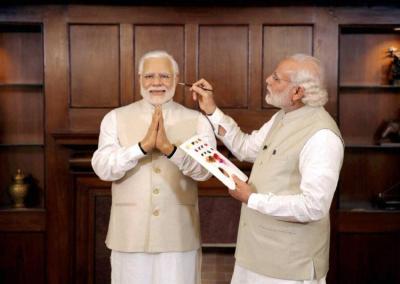
Modi and his double, image courtesy, IndiaTV news

As the crisis of fake degrees blows over I want to be the one to ask the naïve question: Why would Narendra Modi lie? I know it is a naïve question because lies are the most banal political strategy ever. There is a man in US today who repeatedly states that he will make the Mexican government pay for a beautiful, great wall on the border of US and Mexico and people believe him with a degree of sincerity that is frightening. In 2014, at least 31 percent of eligible Indian voters believed in Modi’s promises of development and some of them still do. There may be some who, at the end of the five years, actually believe that Modi has delivered on those promises. But such lies are different. My question is simply: why would he lie on an affidavit which functions as a legally-binding oath?

In his previous election affidavit filed for 2012 Gujarat elections he had left the spouse’s name column empty but following ‘strict legal advice’ he agreed to mention his wife’s name on the affidavit filed for Lok Sabha elections. Technically he had withheld information in previous affidavits which amounts to a legal offence since he had not filed his papers to ‘the best of his knowledge’ but this is not the same as actively lying as it now turns out could be the case with his educational qualifications. Legal experts will determine what is tantamount to punishable crime but if Modi did have legal counsel, who advised him to “come clean on the marriage” as this Times of India article states, why would he continue to provide inaccurate information on other aspects of life?

One speculative answer could be that he knew he was being closely watched as he made his bid for the PM’s post and that his papers would be scrutinised and compared with previous drafts. So it made sense to remain consistent with some of the information even though he had obviously been cornered on the question of his marital status. And yet, as the story of how Modi came to acknowledge the existence of his wife Jashodaben proves, if he had to reveal inconsistencies in previous records, 2014 would have been the best time to do this. No amount of exposés could have hurt the man at that time – his bhakt army, on and offline, on Twitter, were efficiently managing the show and could provide a useful media spin/misdirection to take the focus away from the affidavit that declared to the world that Jashodaben’s repeated claims regarding her marriage and abandonment were not unfounded. Even as the Gujarat Congress urged the state Election Commission, unsuccessfully, to reject his application on the grounds that he had not provided information regarding his spouse’s assets or PAN card number, Modi cruised to victory since his deliberate inconsistencies seem to matter very little to voters.

At that point Modi, indeed, seemed invincible. He was giving explosive speeches and deftly avoiding uncomfortable questions from journalists. In an interview with Rajdeep Sardesai, Modi replied to an indirect question on 2002 with this classic deflection tactic: “My best wishes are with you, Rajdeep Sardesai. You have been living off this issue for the last 10 years … I have heard that those who curse Modi get Rajya Sabha seats or Padma awards. So you have my best wishes to continue this campaign (against Modi) and reach Rajya Sabha or win Padma awards with help of your friends.” What was apparent in the interview is now widely acknowledged as the process of constructing a larger-than-life image, where the man referred to himself in third person. Continue reading Degrees of Self-Deception: Rama Srinivasan →
But She was a Law Student …


In a way that is perhaps unprecedented, today, a very large number of Malayalis feel connected to each other by a veritable tsunami of pain. No wonder perhaps, because the veils of our complacency have been ripped off too thoroughly. The immediate context is the gruesome murder of a young Dalit student in central Kerala, in the tiny, rickety squatter-shack that was her home, in full daylight.

At a single stroke, the incident fully exposed the dimensions of social exclusion in contemporary Kerala. Hers was an all-woman family among families deemed ‘properly gendered’, they were lower caste people trapped and isolated among upper and middle caste families, they were the working-class poor without property in an area full of propertied domestic-oriented bourgeois and petty-bourgeois families. Oppressed in all these ways, they were invisible to the state and the political parties. They possessed no form of capital that would have allowed them upward mobility. Yet, the young woman struggled on and reached the law college.

‘But she went to college’, some ask, ‘how could she have been so helpless?’

Read the rest of the article here 


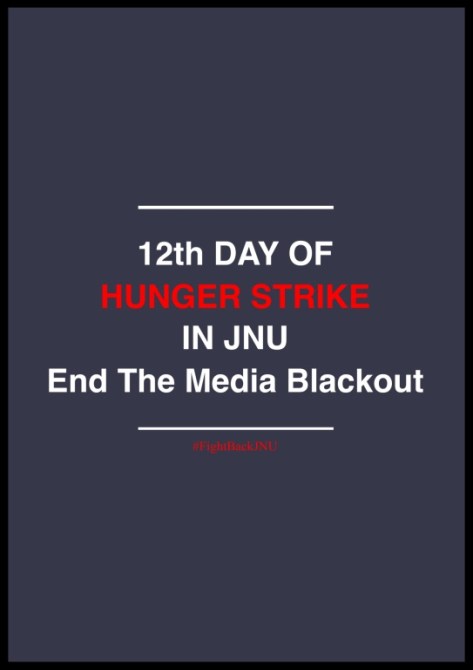
JNU Hunger Strike Day 12 : Game On – Students 1, Media, Authorities 0

The JNU Students’ Hunger Strike Enters Day 12. Ketone counts go up, Weight goes down, Morale stays miles high. Media fatigue shows that crusading news anchors are no match to hunger striking students when it comes to stamina, and, may we say, courage. The university authorities, the JNU VC and his gang, the government, the RSS-ABVP, remain what they are – losers.

(Images taken, with thanks, from the ‘We are JNU‘ Facebook Page, and the ‘Mothers Stand with JNU‘ Facebook Page.)

This slideshow requires JavaScript.

MEANWHILE, RADIOSILENCE CONTINUES (BESIDES RAVISH KUMAR’S SHOW) ON MAINSTREAM MEDIA

13177661_10153973732855546_8091436192653453340_n

This slideshow requires JavaScript.

बंगाल क्या पार्टी-समाज ही रहेगा?

दुर्जय मंडल ने कल अपना वोट डाला.सर फटा होने के बावजूद वे मतदान केंद्र पर गए. सर कोई गिरने या टकराने से नहीं फूटा या फटा था. उन्हें वोट देने से रोकने के लिए उनपर हमला किया गया था. वे हल्दिया के गोपालपुर में रहते हैं और ठेके पर मजदूरी करते हैं.

लेकिन उनकी बड़ी पहचान यह है कि वे सीपीएम की ट्रेड यूनियन सीटू के सदस्य हैं .बल्कि कहें, एकमात्र पहचान. इसीलिए उन्हें शासक दल तृणमूल के लोगों ने धमकाया था कि वोट न दें. लेकिन मतदान की पिछली रात उन्होेंने मतदान केंद्र पर जाने का अपना इरादा जाहिर किया. इसकी सजा उन्हें फौरन दी गई. Continue reading बंगाल क्या पार्टी-समाज ही रहेगा? →

17 Faces of Hunger for Justice – Day 6 of the Indefinite Hunger Strike at JNU: ‘We Are JNU’

Guest Post by ‘We Are JNU‘

At the end of the 6th day of the Indefinite Hunger Strike by JNU Students, the ‘We Are JNU‘ Facebook Page uploaded a gallery of portraits of the 17 students on Hunger Strike, together with details of their medical conditions. We are sharing this post on Kafila in solidarity

This slideshow requires JavaScript.

‘Radical’ Critics and KaBodyscapes

What does it mean to dissent in a world in which everyone claims to be a dissenter? What does it take to build a critical vantage-point, one that is not merely the easy pastime of fault-finding, when we all seem to already know what will be truly critical? Ever since the oppositional energy generated against Hindutva fascism in and through the Kiss of Love campaigns dissipated into the rival folds of the Human and the Anti-Human in Kerala, these questions have troubled me. The prospect of being sucked into one side of such a binary formation is terrifying enough to scare one away from  engaging with either side; but worse is the pain that follows the realization that the unique moment of hope – the hope that the diverse groups that populate the anti-Hindutva civil society may well be able to form a bond of trust, however tentative and fragile, more than merely strategic connections – is well and truly in the past. Both sides have indulged in belligerent and damaging caricaturing of each other’s positions, as if the annihilation of the other was the very condition of the survival of the one. Continue reading ‘Radical’ Critics and KaBodyscapes →

Bhagat Singh and Bhagwati Charan Vohra on Terrorism

Let us read the young revolutionary in his own words,not mediated through ‘anti-national’ historians like Bipan Chandra. Does he regard some of the actions that he along with his co-revolutionries was planning and executing as acts of Terror or not? Terrorism, according to him is an essential stage of revolutionary struggle. Let us go to Bhagat Singh directly:

TERRORISM

THE REVOLUTIONARIES already see the advent of the revolution in the restlessnessof youth, in its desire to break free from the mental bondage and religious superstitionsthat hold them. As the youth will get more and more saturated with the psychology of revolution, it will come to have a clearer realization of national bondage and a growing,intense, unquenchable thirst for freedom. It will grow, this feeling of bondage, thisinsatiable desire for freedom, till, in their righteous anger, the infuriated youth will beginto kill the oppressors. Thus has terrorism been born in the country. It is a phase, a necessary, an inevitable phase of the revolution. Terrorism is not the complete revolution and the revolution is not complete without terrorism. This thesis can be supported by an analysis of any and every revolution in history. Terrorism instills fear in the hearts of the oppressors, it brings hopes of revenge and redemption to theoppressed masses, it gives courage and self-confidence to the wavering, it shatters the spell of the superiority of the ruling class and raises the status of the subject race in theeyes of the world, because it is the most convincing proof of a nation’s hunger for freedom. Here in India, as in other countries in the past, terrorism will develop into the revolution and the revolution into independence, social, political and economic.

(http://gpitta.blogspot.in/2009/08/philosophy-of-bomb-shaheed-bhagat-singh.html)

This portion has been taken from his famous essay  The Philosophy of The Bomb which was originally wtiten by Bhagwati Charan Vohra and given final shape by Bhagat Singh while he was in Jail. It was a response to Gandhi who had criticised the violent methods adpoted by the revolutionaries in his essay The Cult  Of The Bomb. It was distributed nation wide on 26 january, 1930 by The Hindustan Republican Socialist Association. It was wriiten as the menifesto of the organisation. Its Hindi version can be seen on page 241 of भगत सिंह के सम्पूर्ण दस्तावेज edited by Chaman Lal and published by Adhar Prakashan in 2004.


Summer of Rage: JNU Students Begin Fast Unto Death against HLEC Report

13083178_1763261193905640_250606241251585686_n

Spring has given way to the beginning of a turbulent summer. April, is a cruel month. Temperatures have risen, and so has the level of rage in university campuses. The JNU University Authorities (and their masters – in the Ministry of Human Resources Development, the Prime Minister’s Office and the RSS Citadels in Mahal, Nagpur and Jhandewalan, Delhi) thought that they could break the resolve of the students by enacting a series of harsh measures against them just before exams begin and the university term ends in summer vacations.

Chintu Kumari, Anirban Bhattacharya and other students give the call to protest against the HLEC and call for a Hunger Strike. Photo, Courtesy, Azhar Amim

13055719_10154616732485016_4978357478249045500_o

This is a time, they must have thought, when students will be busy with preparations, and the rising heat will discourage the kind of mass mobilizations that the campus has seen since February. Students in JNU resolved a few hours ago to prove them wrong, and decided to fight back . A massive gathering stood its ground at the Administrative Block, aptly re-christened, ‘Freedom Square’.

Rama Naga, Gen.Sec. JNUSU, (Centre) and JNU Students Calling for Indefinite Hunger Strike on April 27, 2016. Photo, Courtesy, Azhar Amim

They have decided that a batch of students will sit on indefinite hunger strike – a ‘fast unto death’ – until the JNU authorities roll back the draconian measures listed in the HLEC Report.

The 20 students who will be sitting in indefinite hunger strike at JNU.

There’s no looking back now. Whatever happens from now on wards, will be seen as a consequence of the cruel, evil mindset of the current regime, which truly treats the lives of the young as dispensable ballast. Its time to prove them wrong. This is a call that goes out to all students and teachers, and sensible individuals, not just in JNU, not just in Universities and Colleges all across India and all the territories administered by the Indian republic, but to everyone reading this post anywhere in the world, to stand by the courageous students of JNU. It is our responsibility to see that the JNU Authorities see reason and back down. If anything untoward happens to any student, the university authorities, and the regime backing them, will be clearly culpable.

Here is Umar Khalid, speaking just before commencing his Hunger Strike

Here is Chintu, former Gen. Sec. JNUSU, speaking at the Mashaal Juloos, (Torchlight Procession) just before beginning the Hunger Strike.

Listen to Kanhaiya Kumar, President of the JNUSU – restating the reasons for the continuation of the movement.

Thanks to the ‘We are JNU Media Group’ and the AISA Youtube Channel, for the videos.

Sanghis, Sex and University Students – What is it Really All About? Ayesha Kidwai

Guest Post by Ayesha Kidwai

[ The prurient fantasies contained in the ‘JNU Dossier’, produced by some right wing faculty members of JNU in or around October 2015, have been ‘outed’ by an excellent report by Ajoy Ashirwad Mahaprashasta in Wire.org. This comes exactly at the time when the JNU administration has shown its fangs by delivering a low blow by way of the measures outlined in the report of the ‘High Level Enquiry Committee’ appointed by the Vice Chancellor. An impartial examination of the HLEC document and the ‘Dossier’ in will reveal some startlingly resonant patterns. Clearly, the ‘Dossier’, which had been dismissed by the former Vice-Chanceller, Prof. Sopory, has been reincarnated at the express orders of the Nagpuri masters of the present dispensation. We are sharing below an excellent response to the ‘Dossier’ by Ayesha Kidwai, one of the professors – ‘named’ in the dossier. This is taken from Ayesha Kidwai’s status update on her Facebook Page.

For another take down of the ‘Dossier’ – see also – “Sex and sedition: What the JNU dossier tells us about the right-wing imagination” – in Scroll.in by Kavita Krishnan. Meanwhile, JNU Students have commenced on a ‘fast unto death’ in protest against the university administration’s senseless measures. Kafila]

Sanghi smut is in season again! For the authors of the Dirty Dossier, JNU nights are forever scented with musk, with couples draped on every bush, suitably fortified by free alcohol, thoughts of secession, and cash payments supplied by the Awesome Foursome. At its peak, the party can practically involve the whole university, because as per Shri Gyan Dev Ahuja’s estimates, the number of students frolicking this will be 7000 (3000 condom users X 2, plus 500 injectable walas X 2). (Assuming of course that the few hundred left over have gone to fieldwork, have exams, or are abstemious and/or abstinent in nature.)

Laugh as we may (and must) at these feverish imaginings, it’s also important to understand that the very notion of a free university challenges not only misogyny, but also the social apartheid produced by caste and exclusionary religion.

Continue reading Sanghis, Sex and University Students – What is it Really All About? Ayesha Kidwai →

Do Not Speak of The Noose…

‘Festival rubs off scars’, claimed a newspaper report with picture of Muslim men distributing water and sweets to the Hindus celebrating Ram Navami. The place was Balu Math in Latehar. The scars were obviously of the murder of two Muslim men, one of them an adolescent by members of the local Gau Raksha Samiti.

‘Rub off your scars and do not complain’,Muslims are told after each incident of violence against them. Their insistence to talk about their wounds is seen as a sign of their grumbling nature, their love with their victimhood. Also a proof of their disaffection towards Hindus.

“…In the house of the hangman one should not speak of the noose, otherwise one might seem to harbour resentment.”,Theodore Adorno wrote while responding to criticism against his study of the sources of authoritarian personality in Germans in the post Hitler years. Continue reading Do Not Speak of The Noose… →

Jayadeva Uyangoda on Ambedkar’s Legacy

Text of the talk delivered on April 22, 2016 at the Indian Cultural Centre, Colombo on the occasion of B. R. Ambedkar Commemoration.

Ambedkar’s Legacy: Critique of Religion, Quest for Social Justice and the Paradox of Constitutionalism

Jayadeva Uyangoda, Senior professor of Political Science, University of Colombo

Ambedkar

May I begin my talk this evening by thanking His Excellency Y. K. Sinha the Indian High Commissioner in Colombo for inviting me to deliver this lecture on B. R. Ambedkar? This event is part of a series of celebrations in connection with the 125th birth anniversary of Babasaheb Ambedkar, which fell on the 14th of April. I am afraid my talk may not celebrate great Ambedkar’s memory and legacy as such. It will only present some disjointed and hurriedly constructed thoughts about the life and legacy of this great son of South Asia.

Ambedkar’s name is well known in Sri Lanka. In Sinhalese society, the popular culture of which I am somewhat familiar with, Ambedkar is known as the leader of India’s Harijan communities. The word dalit is not in much use in Sinhalese society. The Gandhian neologism of harijan is better known. Ambedkar is respected as the Harijan leader who embraced Buddhism along with several thousands of his followers. Sinhalese Buddhists are particularly sympathetic to Ambedkar and his social reform movement. For them, Ambedkar’s project constituted a critique and a rejection of Hinduism. This is despite the fact that Buddhism has historically and in terms of elite as well as popular practices been closely interwoven with Hinduism. Quite independent of Ambedkar, Sri Lankan Buddhists have a somewhat ambivalent attitude towards Hinduism and Hindu traditions as well. It is almost like their ambivalence towards India in general, as some of their intellectuals and professionals seem to be inclined to demonstrate these days. Continue reading Jayadeva Uyangoda on Ambedkar’s Legacy →

To the Puppets and Puppeteers – We Students Will Fight Back: Anirban

Guest Post by Anirban Bhattacharya 

To the puppets and their puppeteers…

Free speech cannot come with a price tag -10,000/- or 20,000/- or even a rupee!
Dissent cannot be evicted!
Ideas cannot be made out of bounds!
Reason cannot be rusticated!

Continue reading To the Puppets and Puppeteers – We Students Will Fight Back: Anirban →

JNU High Level Committee Delivers a Low Blow – Students Unjustly Rusticated, Fined, Declared ‘Out of Bounds’

So, the High Level Enquiry Committee at JNU, set up under the watch of Jagadish Kumar, the recently appointed Vice Chancellor, has just delivered a low blow. A summary of its decisions (taken from the Facebook Wall of JNUSU Vice President, Shehla Rashid) meted out as the consequences of the events of February 9 and after is as follows :

Umar Khalid, rusticated for one semester + 20K fine.

Anirban, rusticated till 15 July & from 25 July, out of bounds for 5 years.

Another Kashmiri student rusticated for two semesters.

Ashutosh, former JNUSU President, removed from hostel for one year + fine.

Chintu, former JNUSU Gen Sec: 20K fine

Rama, current JNUSU Gen Sec: 20K fine

Anant, former JNUSU Vice-President: 20K fine

Aishwarya, current GSCASH representative: 20K fine.

Gargi, current JNUSU councillor: 20 K fine

Shveta Raj, current SL & CS Convener: 20 K fine

Kanhaiyya, current JNUSU President: 10K fine

Other organisers fined from 10K to 20K

Two ex students declared out of bounds from campus.

This is an administration, which, in obedience to its backers in the Ministry of Human Resource Development and the Government of India, that knows only one way of dealing with the students in its charge – and that is a replica of the vindictive path that eventually drove Rohith Vemula to his institutionally mandated death in Hyderabad University.

This is an administration that invited police to intervene in what was essentially a dispute between groups of students, at the instigation of right wing thugs. Continue reading JNU High Level Committee Delivers a Low Blow – Students Unjustly Rusticated, Fined, Declared ‘Out of Bounds’ →

हिंदुओं के खिलाफ क्यों लिखना?

“आप मुसलमानों के खिलाफ कभी कुछ क्यों नहीं लिखते?,यह सवाल अक्सर इस लेखक की तरह के कुछ लोगों से किया जाता है.इस प्रश्न में छिपा हुआ आरोप है और एक धारणा जिस पर यह पहला प्रश्न टिका हुआ है कि आप हिंदुओं के विरुद्ध लिखते हैं. इसका उत्तर कैसे दिया जाए?यह सच है कि अभी तक के लिखे की जांच करें तो प्रायः भारत में बहुसंख्यकवाद को लेकर ही चिंता या क्षोभ मिलेगा.इसके कारण उन संगठनों या व्यक्तियों की आलोचना भी मिलेगी जो इस बहुसंख्यकवाद के प्रतिनिधि  या प्रवक्ता हैं.क्या यह करना मुझ जैसे व्यक्ति के लिए स्वाभाविक है या होना चाहिए? भारत में बहुसंख्यकवाद हिंदू ही हो सकता है.कई हैं जो उनमें नहीं जो इस बहुसंख्यकवाद पर  बात करते वक्त तराजू के पलड़े बराबर करने के लिए ‘मुस्लिम सम्प्रदायवाद’की भी फौरन निंदा करना ज़रूरी समझें

नाम से मुझे हिंदू ही माना जाएगा, मैं चाहे जितना उसे मानने से इनकार करूँ. मेरी मित्र फराह नकवी ने एकबार मुझसे कहा था कि अगर फिरकावारना फसाद में फँसे तो तुम्हारा नाम तुम्हें हिंदू साबित करने के लिए काफी होगा और तुम्हारा भाग्य इससे तय   होगा कि तुम फँसे किनके बीच हो-हिंदुओं या मुसलमानों के. उस वक्त यह बहस कोई न करेगा कि मैं अभ्यासी हिंदू हूँ या नहीं,नास्तिक हूँ या संदेहवादी हूँ! Continue reading हिंदुओं के खिलाफ क्यों लिखना? →

Media figures call for Release of Himal Editor Kanak Mani Dixit

New Delhi, April 23 — Editors and media figures as well as intellectuals and scholars from India, Nepal, Bangladesh, UK, US, Australia and Sri Lanka have called for the release of Himal editor and prominent Nepali journalist Kanak Mani Dixit who was arrested yesterday in Katmandu by anti-graft officials.

The following is the text of the statement:

It is with deep concern that we have learned of the arrest today of Kanak Mani Dixit, the widely respected founder-editor of Himal Media and a courageous voice for transparency, freedom of expression and democratic rights in Nepal and across South Asia. The charges are related to alleged corruption but Kanak Dixit says it is part of a vendetta pursued against him by people in Government.

We have known Kanak Dixit as a true professional, human rights defender and energetic journalist whose credentials are built on robust research and tremendous courage. Himal Media, a pioneer in South Asia journalism, has published Himal South Asia, Nepali Times and Himal Khabar Patrika (in the Nepali language). He has written extensively for international media including leading newspapers in India and is chairman of Sajha Yatayat, a state run transportation company, which he has been turning around from a loss-making entity. Continue reading Media figures call for Release of Himal Editor Kanak Mani Dixit →

Kashmir IG Police Refuses to Speak with Handwara Minor Girl: JKCCS

Guest Post by Jammu & Kashmir Coalition  of Civil Society

Since last 3 days, JKCCS has been approaching the Inspector General (IG) of JK Police, Javed Geelani for a meeting in connection with the illegal detention of the minor girl and her family. Yesterday evening the Handwara minor girl spoke to JKCCS team on phone. She and her family informed that against their will the police has shifted them to a stranger’s house 15 kms from Handwara town. After detailed discussion JKCCS proposed her to call the IGP Kashmir and Chairperson of the State Commission for Women, Nayeema Mehjoor directly to inform them about her ordeal in the illegal police detention, her demand for free movement and an immediate access to her lawyers. 
The minor girl called the IG several times but only once he picked up the phone. After she identified herself, the IG cancelled the call. JKCCS team called DIG Ghulam Hassan Bhat and requested him to inform the IG that the minor girl wants to talk to him urgently. We were assured that the IG will speak to the girl. 

Immediately after that the police personnel went inside the house where the girl is detained and threatened her to not call the IG Kashmir, Javed Geelani.

The minor girl was able to speak to Nayeema Mehjoor and gave her detailed statement and requested her to facilitate her conversation with IGP Javed Geelani. Ms. Mehjoor promised to help.

The minor girl and her family wanted to communicate to the highest police officials that the police should stop her illegal detention and allow her to meet her lawyers so that she can herself alongwith her family proactively contribute in the legal struggle. 

‘Swacch Bharat Abhiyan invisibilises the linkage of Caste and Sanitation and glamourises broom among Scavenging Communities’ – Bezwada Wilson

In Conversation with Bezwada Wilson, National Convener of Safai Karmachari Andolan

The 125 day Bhim Yatra which started from Dibrugarh and traveresed 30 states and 500 districts to reach Delhi is now over.  As everybody knows it culminated in a big rally coupled with people’s hearing where families of those victims who died while cleaning sewers and septic tanks shared their plight at the hands of state as well as civil society. The call of this Bhim Yatra raised by Safai Karmacharis – ‘Stop Killing Us’ – would could keep reverberating for quite some time. (https://kafila.org/2016/04/14/bhim-yatra-so-that-there-are-no-more-killings/)

Here follows an interview with Bezwada Wilson, National Convener of Safai Karmachari Andolan

 How do you see the impact of  ‘Bhim Yatra’ ?

As far as those people who are still condemned to do scavenging is concerned, the 125 day Bhim Yatra has made two significant impacts :

– It has made people aware that a new act (2013 act) has come into existence for elimination of manual scavenging and they should make use of it for their liberation.

– Second significant impact is that people are realising that we should not do this work, we should leave this work altogether. Babasaheb’s teachings that depressed classes should leave all such professions which are stigmatised and which further help stigmatise them has reached broader cross sections of people engaged in cleaning and scavenging. The slogan ‘ Leave the Broom, Take the Pen’ is slowly reverberating across people especially the younger ones. Continue reading ‘Swacch Bharat Abhiyan invisibilises the linkage of Caste and Sanitation and glamourises broom among Scavenging Communities’ – Bezwada Wilson →

शाकाहार, मांसाहार और बुद्धि का अधिकार

टाइम्स ऑफ़ इंडिया ने लखनऊ में भीमराव आंबेडकर की जयंती के अवसर पर लखनऊ में हुए एक कार्यक्रम में प्रोफ़ेसर कांचा इलैया के वक्तव्य की रिपोर्ट प्रकाशित की है.रिपोर्ट के मुताबिक़ उन्होंने कहा कि शाकाहार राष्ट्र विरोधी है: “मेरा राष्ट्र गोमांस खाने से शुरू होता है.दुर्भाग्यवश, हमने गोमांस खाना छोड़ दिया और इस कारण हमारे दिमाग अब बढ़ नहीं रहे हैं.” आगे उन्होंने कहा कि शाकाहार राष्ट्र को नष्ट कर देगा. शाकाहारी राष्ट्रवाद  के सहारे  हम चीन, कोरिया,जापान और अमरीका से प्रतियोगिता नहीं कर सकते जो पूरी तरह गोमांसाहारी हैं.

यह वक्तव्य आक्रामक है और उस समय के लिहाज से साहसी कहा जा सकता है जब गोमांस रखने और खाने के नाम पर लोगों को मारा जा रहा हो. अखबार ने बताया कि इस बयान पर काफी तालियाँ मिलीं.रिपोर्ट ने इसके साथ यह बताना ज़रूरी समझा कि  श्रोताओं में अच्छी संख्या दलितों की थी. Continue reading शाकाहार, मांसाहार और बुद्धि का अधिकार →

Statement of Solidarity with Hyderabad Central University from Columbia University, New York

This is a statement of March 29, 2016 from students, faculty and affiliates of Columbia University. We publish it below with apologies for the delay.

We, students, faculty and affiliates of Columbia University, strongly condemn the violation and atrocities brought upon the students and faculty of the Hyderabad Central University (HCU) on March 22, 2016. Since Professor Appa Rao Podile was on leave and under investigation for the institutional murder of Rohith Vemula, his return to the campus to resume duties as the Vice Chancellor was unacceptable. The students justifiably organized a peaceful protest in the campus that day. The institutional responses to that, by the University authorities, the Andhra and Telangana police force, Rapid Action Force personnel, the media, and the members of the Akhil Bharatiya Vidyarthi Parishad (ABVP) on campus, were outrageous, inhuman, and fascist. The University authorities, instructed by Prof Podile, shut down the Internet connection, dining hall and drinking water facilities in retaliation to the peaceful student protest. The Andhra and Telangana police force lathi-charged students and faculty, violently beat up and severely injured them, molested and threatened to rape female students, targeted Muslims and Dalits, abused them verbally, and eventually arrested 24 students and 3 faculty. The ABVP members resorted to violence and aggressive sloganeering from the very beginning of the students’ peaceful protest and also attacked and injured them. The mainstream media has been ignoring these atrocious events at a Central university campus and has decidedly turned away from its responsibility and its accountability to the public. This is ironic, at the very least, when some of the news anchors just last month were so focused on fabricating stories of “terrorist” and “anti-national” activities at the Jawaharlal Nehru University, Delhi. The media ultimately failed to demonize the students then. Now, yet again, the media is unabashedly siding with the authoritarian regime of corporate and state power; this time by ignoring the brutality of the police and the HCU authorities.

We strongly condemn

–       the fascist abuse of power by the University authorities, who decided to deprive the students of basic facilities as ‘revenge’ for the peaceful demonstration

–      the violence, the targeting and the brutality of the police force

–   the irresponsibility of the media for not reporting this on prime time and for effectively siding with the tyrannical regime in power

–       the atrocities unleashed by the casteist, capitalist, Hindu fundamentalist government and its affiliates, especially ABVP.

Continue reading Statement of Solidarity with Hyderabad Central University from Columbia University, New York →

हम कौन थे,क्या हो गए हैं, और क्या होंगेअभी….

(यह टिप्पणी पहले कैचन्यूज़ हिन्दी पर इस रूप में प्रकाशित हो चुकी है:http://hindi.catchnews.com/india/dg-vanzara-what-we-were-what-we-are-what-we-ll-become-1460646292.html)

पाकिस्तान का विरोध करते करते-करते हम कब उसकी शक्ल में ढल गए,पता ही नहीं चला.सबसे ताज़ा उदाहरण गुजरात के प्रख्यात पुलिस अधिकारी दह्याजी गोबरजी वनजारा के जमानत मिलने के बाद गुजरात वापसी पर उनके ज़बरदस्त स्वागत और खुद उनके तलवार-नृत्य का है. इस खबर से कुछ लोगों को पाकिस्तान में सलमान तासीर के कातिल मुमताज कादिर की फाँसी के बाद उसके जनाजे पर उमड़ी हजारों की भीड़ याद आ गई.

कादिर ने सलमान तासीर को इसलिए मार डाला था कि उनकी नज़र में तासीर ने इस्लाम और मुहम्मद साहब की शान में गुस्ताखी की थी.तासीर का कसूर यह था उन्होंने पाकिस्तान के ईश-निंदा क़ानून की आलोचना की थी और एक ईसाई औरत आसिया बीबी के पक्ष में बात की थी जिस पर ईश निंदा का आरोप था.इसके बाद कादिर ने तासीर को , जिनका वह अंगरक्षक था, गोलियों से भून डाला.

कादिर गिरफ्तार हुआ, उस पर मुकदमा चला जो खासा डरावना और नाटकीय था.कादिर को फाँसी की सजा सुनाने वाले न्यायाधीश ने फैसला सुनाते ही देश छोड़ दिया.उस अदालत पर पहले हमला भी हुआ.कादिर की एक तरह से पूजा होने लगी और जेल में वह एक धर्मोपदेशक बन गया.

कादिर की इस भयंकर लोकप्रियता के बावजूद पाकिस्तान ने उसे न सिर्फ फांसी की सजा सुनाई बल्कि फांसी दे भी दी. इस सजा का हम सैद्धांतिक आधार पर विरोध कर सकते हैं,लेकिन इससे कम से कम यह जाहिर होता है कि पाकिस्तान अपने क़ानून के पालन को लेकर गंभीर है और अपराध को नतीजे तक पहुंचाता है.इसके पहले भी पाकिस्तान में कादिर की तरह के और लोगों को भी सजा दी गयी है. Continue reading हम कौन थे,क्या हो गए हैं, और क्या होंगेअभी…. →

Bhim Yatra .. so that there are no more killings

Protestors set fire to containers representing septic tanks cleaning which manual scavengers have and continue to lose their lives even today ( Photo Courtesy : http://www.youthkiawaaz.com)

Rarely does Jantar-Mantar, the place in the heart of Delhi, gets ‘enlivened’ with people who share very similar type of tragedy – one should say man made tragedy.The culmination of 125 day Bhim Yatra – led by Safai Karmchari Aandolan – which had started from Dibrugarh in the North East on 10 th December and had traversed around 500 districts and 30 states, proved to be one such occasion. (13 th April 2016)

The big public meeting organised at Jantar Mantar, attended by hundreds of safai karmcharis from different parts of the country and many individuals, activists who are sympathetic to their cause, was just another way to celebrate Dr Ambedkar’s 125 th birth anniversary, a day earlier. Special focus of the Yatra was on deaths in sewers and septic tanks and the key slogan was ‘Stop Killing us in Dry Latrines, Sewers and Septic tanks’. In fact, most of the people who were sitting on the podium belonged to such families only, who had lost their near-dear ones in cleaning sewer or septic tanks. Continue reading Bhim Yatra .. so that there are no more killings →