Statement by New Socialist Initiative
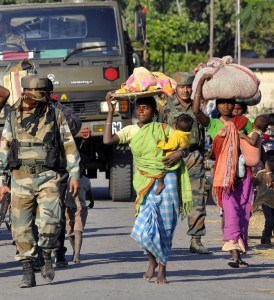
Once again, and very soon after the last instance of mass killings and displacement, another series of bloodshed and violence has rocked Bodoland Territorial Autonomous Districts (BTAD) – Assam. On 21st December 2014, two suspected militants of the National Democratic Front of Bodoland- Songbijit Faction (NDFB-S) were killed by the security forces in an alleged cold blooded encounter in the Chirang district of BTAD-Assam. In retaliation, on 23rd December, armed militants of NDFB-S attacked Adivasi villages in Kokrajhar, Chirang and Sonitpur districts. Since then it has resulted in the death of 81 people – 73 Adivasis including many women and children as well as 3 Adivasis killed in police firing on protestors. As a mode of retaliation Adivasi mobs killed at least 8 Bodo civilians. Since 23rd December, the entire BTAD and adjoining areas like Sonitpur district have been extremely volatile and under curfew. On 25th December, the Home Minister Mr. Rajnath Singh, in a meeting with the top security top brass, which was also attended by the Assam chief minister Mr Tarun Gogoi, declared Government of India’s resolve to fight terrorism and reportedly asked the security and intelligence apparati to ensure the elimination of the top leadership of NDFB-S within the next six months. Around 50 additional companies of paramilitary forces are being sent to Assam. The Army has also reportedly launched major operations in the Assam-Arunachal border region, in search of the NDFB-S militants.
The NDFB-S massacre of Adivasi civilians is not a pre-modern tribal savagery. In fact such violence is justified by notions of exclusive ethnic-homelands and nations, and their corollaries like aspiration for spatial homogenization and monopolization of resources by particular communities. The Northeast of the country is home to many armed mobilisations against the domination of Indian state that are driven by an ethnic conception of political community in a contiguous territory. The Bodos of the Assam valley started an armed movement for Bodoland in 1980s against their marginalisation by the dominant non-tribal Assamese. Following the time tested carrot and stick policy, the Government of India managed to win over a faction of the armed groups in exchange for internal autonomy under the Sixth Schedule of the Constitution. The BTAD was formed in 2003. Curiously, even while the majority of citizens under the BTAD area identify themselves as non-Bodos the distribution of seats under the BTAD agreement is so designed that Bodos enjoy majority in the elected body. While a faction of the Bodo leadership settled to run the BTAD, the seeds were sown for inter-ethnic clashes and violence. Continue reading Harvest of Innocent Blood – The Democracy Deficit in Bodoland, Assam: New Socialist Initiative