Category Archives: Everyday Life

UAPA – A Video Dossier: Media Collective, Arun Ferreira &Vernon Gonsalves

Video by Media Collective, Article by Arun Ferreira and Vernon Fernandes

Fifty Years of Unreasonable Restrictions

Arun Ferreira & Vernon Gonsalves 

Soon after its adoption, the Constitution of India was amended in 1951. At the time several progressive judgements[i] by the Judiciary held that laws which curb fundamental rights are essentially unconstitutional and fundamental freedoms could only be curbed in the most extreme of cases. The First Amendment, countered this by amending Article 19 to add the word ‘reasonable’ before restrictions and to add ‘public order’ as being one more ground for abridging Fundamental Rights.

The evolution of UAPA[ii] has to be seen in the background of this gradual but steady constriction of Article 19 which guarantees the fundamental freedoms of expression, assembly, association, etc. Continue reading UAPA – A Video Dossier: Media Collective, Arun Ferreira &Vernon Gonsalves

Sterilization Death Camps in Bilaspur: An Open Letter to the Chhattisgarh Chief Minister by Concerned Citizens

[ This is a letter addressed to Raman Singh, the Chief Minister of Chhattisgarh by several concerned individuals and organizations regarding the impunity with which medical guidelines are put aside by professionals who enjoy the patronage and protection of the state government.]

We, the 138 undersigned individuals and organizations working across the country on health and women’s rights are shocked and dismayed that the case against surgeon Dr. R. K. Gupta has been dismissed by the Hon’ble High Court on grounds that “the alleged act committed by the petitioner was while acting in discharge of his official duty and admittedly no previous sanction was obtained before initiating prosecution case against him”.

The Anita Jha Judicial Enquiry Commission report has clearly pointed out that “It is evident from the facts that in the camps organized on 8.11.2014 and 10.11.2014 there was a breach in the important necessities hence the standard operating procedure were not followed. As a result of which the symptoms of infections were found in post operative female beneficiaries“. It further states that “On the background of deliberation of investigation point number 1 to 3, investigation committee has found following persons Guilty/responsible, functionary, during 08 and 10 November, 2014:- 4.1 For not following standard procedures and for medical negligence by immediate functionary Block Medical Officer, Takhatpur…………….and surgeon who conducted surgery in tubectomy camp at Sakri and Gaurella ( Surgeries were completed by the same surgeon in the both camps)”.

Continue reading Sterilization Death Camps in Bilaspur: An Open Letter to the Chhattisgarh Chief Minister by Concerned Citizens

“Karenge politics, karenge pyar” – New slogan and new politics: Baidik Bhattacharya

Guest post by BAIDIK BHATTACHARYA

[While the media worked overtime to present the developments in Ramjas College and Delhi University as a clash between two student organizations and two political formations, Baidik Bhattacharya here reflects on the new kinds of politics, rooted in the everyday and in love, that found expression in the University.- AN]

On 28 February, 2017, thousands of students and teachers of Delhi University and other academic institutions of the NCR region marched across the North Campus, protesting against the recent acts of vandalism and violence at Ramjas College. As the march progressed through the winding roads, touching various colleges and departments of the university, feisty students raised several slogans to oppose the perpetrators of such violence, the student organization of the RSS—the Akhil Bharatiya Vidyarthi Parishad or ABVP. Some of these slogans were well-known, some predictable, but some were really creative. I want to briefly discuss one such creative slogan, and its implications: “Karenge politics karenge pyar, ABVP hoshiyar.” Chanted primarily by groups of women and queer activists, this innovative rendering of one’s rights across the university campuses captured some of the pressing issues that have surfaced in the last couple of years in student politics.

Continue reading “Karenge politics, karenge pyar” – New slogan and new politics: Baidik Bhattacharya

A Tale of Two and a Half Marches – Two for Azadi and a Half for Ghulami.

[Videos of song by Shehla Rashid and of speeches by Nivedita Menon, Kavita Krishnan, Umar Khalid and Jignesh Mevani, courtesy, Samim Asgor Ali]

February gives way to March and spring returns to Delhi. And what a spring it is. The right wing thugs of the ABVP choose the wrong time to attack, once again. They must really get themselves a better astrologer, or at least a better class of charlatan who can tell them if there ever is a right time to stage their goon show. I suspect there isn’t.

Spring in DU - Fight Back DU
Spring in DU – Fight Back DU

Continue reading A Tale of Two and a Half Marches – Two for Azadi and a Half for Ghulami.

Rain and Revulsion: Prasanta Chakravarty

This is a GUEST POST by Prasanta Chakravarty

“Slime is the agony of water.”

~ Jean Paul Sartre, Being and Nothingness


The Birth of Revulsion – Pranabendu Dasgupta

No certainty where each would go —
Suddenly the descent of a cloudburst, rain.
We stood, each where we were,
And stared at one another.
It is not good to be so close
“Revulsion is born” – someone had said

“Revulsion, revulsion, revulsion.”
Then, lighting a cigarette, some man
Muttered abuse at another next to him.
Like an abstract painting, spiralling like a gyre,
In a wee space
We slowly fragmented, dispersed.
Had it not rained, though,
We would have stepped out together.
Perhaps to the cinema, tasting a woman’s
Half-exposed breast with the eye,
Then laughing out loud,
We could head for the maidan!
Someone maybe would sing; someone
Would say, “I am alive”.

But it rained.

(Krittibas, Sharad Sankhya,  1386)

 ঘৃণার জন্ম

প্রনবেন্দু দাশগুপ্ত

কোথায় কে যাবে ঠিক নেই —
হঠাৎ দুদ্দাড় ক ‘রে বৃষ্টি নেমে এলো।
যেখানে ছিলাম, ঠিক সেইখানে থেকে
আমরা পরস্পরের দিকে তাকিয়ে রইলাম।

এত কাছাকাছি থাকা খুব ভালো নয়।
” ঘৃণার জন্ম হয় ” –কে যেন বললো
” ঘৃণা, ঘৃণা, ঘৃণা। ”
তারপর সিগ্রেট ধরিয়ে, আরো একজন
খুব ফিশফিশ ক ‘রে
পাশের লোককে গাল দিলো।
বিমূর্ত ছবির মতো তালগোল পাকিয়ে পাকিয়ে
ছোট্ট জায়গা জূড়ে
আমরা ক্রমশ ভেঙে, ছড়িয়ে পড়লাম।

বৃষ্টি না নামলে কিন্তু
আমরা একসঙ্গে বেরিয়ে পড়তাম।
হয়তো সিনেমা গিয়ে,রমণীর আধ -খোলা স্তন
চোখ দিয়ে চেখে
তারপর, হো হো ক ‘রে হেসে
ময়দানের দিক যাওয়া যেতো !
কেউ হয়তো গান গাইতো ; কেউ হয়তো
বলতো “বেঁচে আছি “।

কিন্তু বৃষ্টি নেমেছিলো।।

(কৃত্তিবাস, শারদ সংখ্যা ১৩৮৬)

Continue reading Rain and Revulsion: Prasanta Chakravarty

In Solidarity with Adivasis in Bastar, Human Rights Defenders and Bela Bhatia in Bastar: Concerned Students in TISS, Mumbai

Guest Post by CONCERNED STUDENTS OF TATA INSTITUTE OF SOCIAL SCIENCES, MUMBAI

We, the concerned students of Tata Institute of Social Sciences (TISS), Mumbai condemn the continuing state repression of adivasis and recent attack on human rights activist Bela Bhatia in Bastar, Chhattisgarh.

On the 23rd of January, 2017, a group of 30-odd men attacked Bela where they barged into her house in Parpa, near Jagdalpur violently and threatened to burn the building down if she did not leave immediately. The mob also attacked her landlords and their children, threatening them with dire consequences if Bela was not evicted immediately. Despite Bela’s assurances that she would leave, the mob continued to be belligerent, in the presence of the police, and the Sarpanch. The mob has been identified with the right-wing vigilante group Action Group for National Integrity (AGNI). Continue reading In Solidarity with Adivasis in Bastar, Human Rights Defenders and Bela Bhatia in Bastar: Concerned Students in TISS, Mumbai

[Watch] Marching with the Bhim Army!


This October, a colleague and I tracked a group of young Dalits fighting caste atrocities in Uttar Pradesh. The documentary posted above is one part of an extended multimedia project. See the entire project here: https://www.thequint.com/quintlab/ambedkar-dalit-army-fights-caste-atrocities-in-uttar-pradesh/

Didi, I Want to Learn the Harmonium and Roam Around Freely: Samhita Barooah

Guest post by SAMHITA BAROOAH

During a visit to the Kishori Mandal at Apne Aap Women Worldwide’s Uttari Rampur Centre in Forbesganj I met some lovely girls. They stayed in the community near the red light area. They were eager to learn new things. They asked me my story of life, “Didi aapki kahani sunao? Aapne kaise yaha tak sangharsh kiya?” I was again very surprised to encounter the subversion of queries. I should have been the one to ask those questions to the girls, but they wanted to know more about me. Perceptual understanding is a perspective rooted in feminist standpoint theory which could apply to any context from the onlooker’s context. For the young girls from the Red Light Area in Forbesganj, I was trapped in some realities which connected me to them. That was why she asked me to share my story of struggle. When I said education enabled me to survive the world around me, they laughed and said that was not their story. They said, “For us we have to get married as soon as we are 18 years old but sometimes even earlier. We just want to enjoy our freedom now in this centre till we get married. After that we do not know what holds true for us.” As women whether we are in the Nat community of Bihar or we are in the liberated spaces of North East India, our identities get defined by our marriage, cultural practices and socialisation. Unbound freedom for women seems to be a misnomer which should be forbidden for women as the evolved souls say.

Continue reading Didi, I Want to Learn the Harmonium and Roam Around Freely: Samhita Barooah

Dangal and the Phogat Sisters – A Tale of Many Struggles: Praveen Verma

Guest post by PRAVEEN VERMA

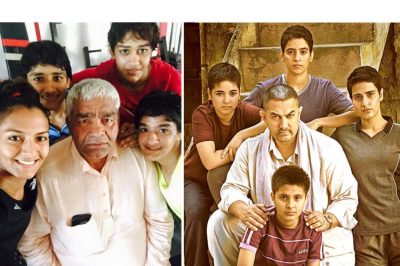
1-phogats-and-film

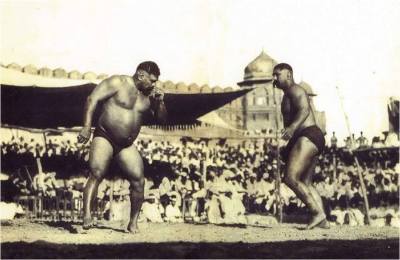
Dangal literally means the Indian style wrestling competition for male pahalwans (wrestlers). Dangal has been an important form of entertainment for ages, especially in rural (north and west) India. Dangals act in many ways. It works to settle the personal score between different Akharas and pahalwans. It’s a place where honour, reputation and social status are on stakes and personal and political rivalries are fought out, or settled. For example, one of the most important dangals used to happen every Sunday at Eidgahi Maidan, Jama Masjid in Delhi, till very recently. Itwari dangal, as it was fondly called, was the place where pahalwan like Gama, Imam Baksh, Chandgiram used to come and show their talent in front of thousands of wrestling lovers. I remember whenever I used to come to Delhi, I always wanted to win the bout at Eidgahi Maidan, as it meant a lot to win at Eidgahi maidan rather than any other place!

Gama Pahalwan at Eidgahi

As it was strictly meant for male pahalwans, women were not even allowed to watch them fighting, let alone participating. Something similar to Khap Panchayats, where women still are not welcome. Women are the fairly latecomers in wrestling arena and yet not so welcome. In this context to make a film on the emergence and development of women wrestling in India itself is a fascinating idea.

Dangal, the movie is based on a true story of Mahavir and his firebrand daughters and their ‘quietly’ active mother. It is an important movie to watch for many reasons. Firstly, it portrays a father who wanted his daughters to pursue something (wrestling) which was un-imaginable in those days. It reveals what it took for the first generation of women wrestlers to break those masculine stereotypes and depicts the overall impression of wrestling in the realm of sports culture in India. There are so many moments in the film to cheer about, to get goosebumps (at least I got many). Writing review is an unknown territory for me but there is a personal reason to taking to this venture of writing.  The release of this film forced me to say something which, as a former wrestler for almost ten years, is still left with me. Continue reading Dangal and the Phogat Sisters – A Tale of Many Struggles: Praveen Verma

Corrupt Notes – the Black Comedy of Tragic Error: R Srivatsan

Guest post by R. SRIVATSAN

Reflections on the many paradoxes of the demonetization process: the schizophrenia of the BJP, the desire of the well to do, the baffling sacrifice of the have nots, the faults and fault lines that propagate through our society in crisis.

Narendra Modi and Arun Jaitley, in their brilliant strategy to kill black money through the withdrawal of currency, show no basic understanding of what the term ‘black money’ signifies.  Prabhat Patnaik has recently argued there is no such thing as black money – there is only a black economy.  However, one aspect of the black economy is the refusal to pay taxes and instead hoard wealth in the form of currency that is not recorded in bank deposits.  Another is the payment of bribes with untraceable currency to authorities and politicians who use their position of leverage as personal property on which they charge a rent for use. Both these uses of black money as corruption have a common lineage. In both cases, corruption is the failure of categories that were supposed to have been water-tight.  A) “All income is taxable” B) “Public servants are true servants of the people”

But first, here is an attempt to shake our convictions that the refusal to pay taxes is a moral evil.  To do so, let me take the example of a Hollywood film, Stranger than Fiction (2006).  The plot of this film, which has a quite complex fantasy storyline, baits the viewer’s desire through the emerging love interest between an IRS auditor Harold Crick and his investigative target Ana Pascal, who runs a bakery.  Ana is a conscientious objector against taxation. She argues that she openly defies taxation since she doesn’t support the hegemonic objectives of the USA which spends most of its revenue income on weapons of war and destruction.  Ana is thus the beautiful and charming face of morally upright conscientious objection which masks the libertarian hatred for a state that taxes more than minimally.  As Robert Nozick asserted long ago such taxation is seen as thievery, against the sacred right to private property.  Ana’s position thus also masks the refusal to redistribute wealth through welfare. As a viewer, I found it extremely difficult to think of Ana as an evil person.  She was the most charming free-spirit I had encountered on celluloid (well, on a TV screen) for a long time. The objective of this sub-plot of film criticism is to help the reader shed the ready moral judgement that not paying taxes is a universal crime and a sin against society, so that it becomes possible to examine exactly what the complex nature of the act that constitutes tax evasion is. Continue reading Corrupt Notes – the Black Comedy of Tragic Error: R Srivatsan

On Barak Valley Bandh on 16th December, 2016 – Some Nascent Observations: Arunima Chakraborty

This is a Guest Post by ARUNIMA CHAKRABORTY

Let’s begin with the usual: by ruing over Indian mainstream media’s overlooking of what could have been treated as more newsworthy. Today, that is, 16th of December, 2016 witnessed a bandh in southern Assam’s Barak valley protesting against the statement by the union minister of state for railways, Rajen Gohain that ‘Bengali…should be withdrawn from Barak valley as official language’ since ‘there cannot be two official languages’.[1] And a simple, layman-like google-news search reveals that there are just three entries on the issue/event.

This piece is aimed not at joining the state Congress and the local SUCI(Socialist Unity Centre of India) cadres who are decrying comment by Gohain, the union minister and a senior BJP leader in Assam but rather at attempting a delineation of the ominous portents which it seems to have unleashed. And of course, to trace the genealogy of the statement.

First of all, a rather facile fact: Mr. Gohain’s observation that there cannot be two official languages clashes with article 345 of the Indian constitution which allows for the adoption of one or more official languages by any state of the Indian union. Article 347 also allows for respecting the desire of a significant section of a populace of a state for the usage of a language of their choice.[2] A couple of months ago, while visiting Assam, I watched, or rather listened, on an Assamese news channel, a shrill voice issuing a caveat to its viewers, “…barak upatyakat asomiya bhasha nokoya hoiche”. ‘Assamese is no longer spoken in the Barak valley’. Anybody remotely familiar with the history of the region could have retorted back with the question, when was Assamese ever spoken in the region?

Continue reading On Barak Valley Bandh on 16th December, 2016 – Some Nascent Observations: Arunima Chakraborty

डिजिटल दुनिया के देशभक्त सैनिक और औसत आदमी : मनीष राज

Guest post by MANISH RAJ

चारों तरफ देशभक्ति का खुमार चढ़ा देख मैं सोच में पड़ गया. क्या मैं भी देखभक्त कहलाने लायक हूँ? क्या मेरे अन्दर भी देशभक्ति के वे सभी गुण मौजूद हैं जो एक भारतवासी में होने चाहिएं? इस सवाल का जवाब जानने के लिए पहले मुझे देशभक्ति के मायने समझने होंगे. आखिर देशभक्ति किसे कहते हैं?

सबसे पहले मैंने इस शब्द के शाब्दिक अर्थ पर गौर किया. देशभक्ति यानि देश की भक्ति. लेकिन भक्ति तो भगवान् की होती है न जी, जिसका गुणगान करना मोक्ष का मार्ग माना जाता है. या फिर उन बाबाओं की, जिनके एक आशीर्वाद, एक अंगूठी या एक ताबीज़ से आपका धंधा चल निकलता है, आपके बच्चों की शादियाँ हो जाती है और सारी बीमारियाँ ठीक हो जाती है. वैसे आजकल भक्ति शब्द अलग-अलग नामों से बहुत फैशन में है. एक समूह दुसरे समूह को किसी व्यक्ति विशेष का भक्त बता रहा है, तो वहीँ दूसरा समूह पहले समूह को पुरानी धारणाओं से ग्रसित और किसी दूसरे व्यक्ति का चमचा बता रहा है. सूचना के लिए बता दूं कि मैं अपनी गिनती इन दोनों समूहों में नहीं करता. इन दोनों में खचाखच भीड़ है, और भीड़ में मेरा दम घुटने लगता है.

शब्दों में उलझ गया तो फिर सोचा कि व्यस्तता से भरे आधुनिक जीवन में शब्दों की तितलियों के पीछे दौड़ने का क्या लाभ. इसलिए व्यावहारिक होते हुए मैंने देशभक्ति के प्रमाणिक सबूत तलाशना शुरू किया. देशभक्त किन्हें माना जाता है और उनमें क्या गुण होते हैं? Continue reading डिजिटल दुनिया के देशभक्त सैनिक और औसत आदमी : मनीष राज

Buying into Demonetisation- the Popular Ideological Receptors of Creeping Fascism: Sanjay Kumar

Guest Post by SANJAY KUMAR

The withdrawal of eighty six percent of currency notes by the Modi government has been an administrative fiasco. It is clear that little economic thought, and only a political urge has gone into the exercise. Informal sector of the economy, which accounts for 80% of the employment and 40% of the national output, has suffered short to medium term damage. All cash dependent transactions, wages, wholesale and retail trade, agricultural purchase and sale, are at a crawl. Workers are not getting wages, factories are closing, mandis are empty. Crores of young and old working people are spending hours in queues at banks and ATMs to withdraw their own money now gone scarce.  Press reports count more than eighty deaths. Parliament of the country is in a limbo, because the prime minister thinks it below his worth to reply to charges by the opposition party MPs. While ordinary people are suffering, the Nero like rulers are trumpeting the arrival of the nirvana of a cash less economy as the answer to India’s economic ills.

Even while Mr Modi’s government is solely responsible for this needless and widespread suffering, it would be naive to expect an automatic popular backlash against it. The politics of the ruling party does not fit into the patronage or identity driven models of its competitors. Its closest template is fascist politics, which  is a very particular kind of authoritarianism. What distinguishes a fascist regime from other modern authoritarian regimes like military dictatorships is the popular support it is able to garner for its policies and depredations. This is achieved by carefully working upon popular anxieties, prejudices, desires and fears, and refashioning them as grounds for aggression against selected minorities, and a belief in an imminent deliverance under the personalised rule of a leader. Continue reading Buying into Demonetisation- the Popular Ideological Receptors of Creeping Fascism: Sanjay Kumar

Infantilization of Women in Punjab’s Left: Nikita Azad

Guest post by NIKITA AZAD

It would be an understatement to say that apart from sexualization of young girls, society infantilizes women on a regular basis. Whether in domestic sphere where men decide what is best for the family and women, or office where men consider their women counterparts as less intelligent and inferior, such infantilization manifests itself in various forms and at various places. A similar trend can be observed in movies where men are usually portrayed as saviors whereas women are depicted as young ‘girls’ waiting to be saved. American TV serials from I Love Lucy onwards have routinely infantilized women, and contemporary Hindi soap operas too, represent and treat women as children to be taken care of by their families and husbands/lovers. Such an approach towards women not only reduces their value and identity as thinking, rational human beings, but it also provides men and the patriarchal structure an argument to justify their control over women. It strengthens the general belief that women are inferior, not only biologically but also mentally, and thus, it perpetuates male intellectual hegemony.

In recent times, many white-collar women employees and actresses have spoken against wage gap and workplace discrimination prevalent in their respective fields, which is as much a result of infantilization of women as it is that of gender discrimination. The work done by a woman, however good, is considered inferior as compared to that done by a man, based on the ground that women are more sensitive, emotional, and child-like; and are thus, there are more possibilities of their committing mistakes. Women feminists and non-feminists, who opine on social media on gender discrimination, are often seen as ones who are easily offended and are emotionally immature. Their responses are treated with sexism than with any serious arguments; the reactions are usually perceived as ‘angry’. Their Face Book and twitter accounts are filled with sexually abusive messages and their opinions are seen as having zero or less value when compared to their men counterparts. A good example would be a recent experiment done by a couple on Twitter, whereby a man and a woman, working for the same organization, The Washington Post, published two articles on similar issues but the responses they received were shockingly different. While the man’s inbox was crowded with racist comments, the woman’s inbox was filled with sexist and degrading names that the man could not bring himself to repeat on his post on Twitter.

While the consequences of the sexist practice of infantilization of women have been widely discussed in feminist circles, a study of its presence in otherwise democratic and progressive circles remains absent. Continue reading Infantilization of Women in Punjab’s Left: Nikita Azad

Memories of a Machine, or the Machine of Memory?


Watching the much-debated ten-minute-film ‘Memories of a Machine’, which has been accused of justifying paedophilia, I remembered this woman:

I met her, a young woman professional working at Technopark, Thiruvananthapuram – where else, in these days, but in the queue in front of an ATM . In response to my grumbling, she told me that she had never experienced any kind of power in her whole life.  She had not even been affected by demonetisation much, she insisted. ‘True, I couldn’t pay the dhobi and the ironing-man, but those were minor inconveniences,’ she quipped cheerily, quite convinced, of course, that the predicament of these two people, definitely as much professionals’ as her, was none of her concern. Indeed, her constant effort was to cheer people in the queue with her don’t-worry-be-happy body-language with which she slipped and slid between acting and sounding like a grown woman and chirping and giggling like a teenager or child. She was attracted to the BJP, she said, because she needed some ‘philosophy’ in her life, to balance the heavy workload she carried in her workplace. As far I could see, her life was such that the philosophy-lesson she would find useful could have been obtained from something as commonplace as a treadmill – start slow, peak up, take regular dips, continue for a spell sufficiently long, stretch after the workout. In other words, her life seemed to be just one long workout, with no indication of when it would end or yield result. But just the feeling that she was on her way was enough to make her cheery to the point of being silly. Continue reading Memories of a Machine, or the Machine of Memory?

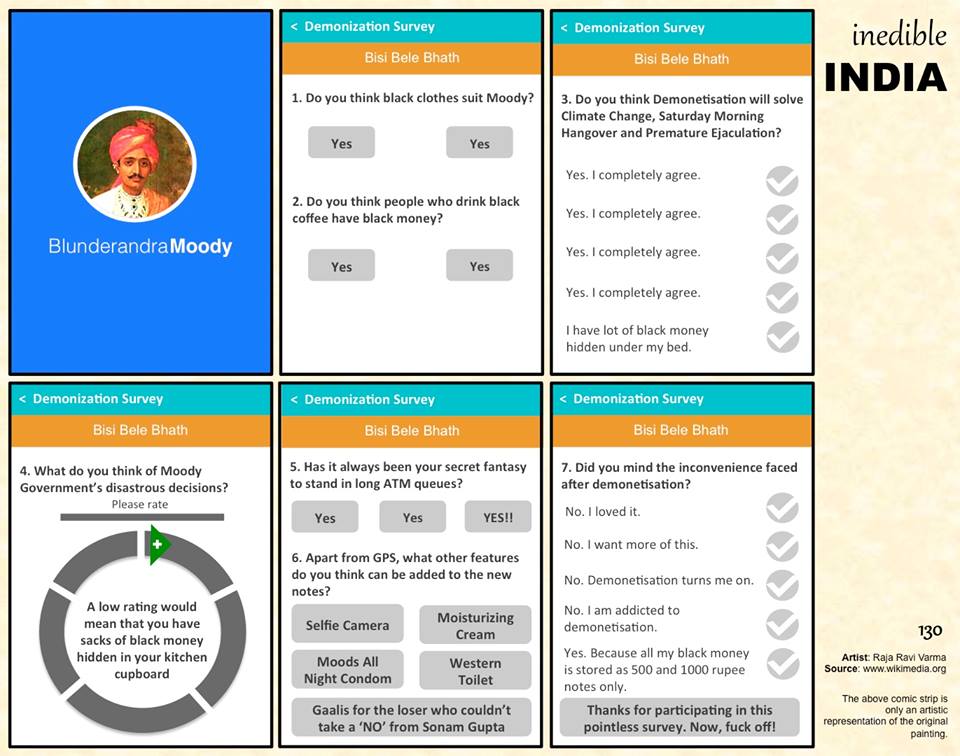
Inedible India on the NaMo App “Survey” on Demonetization

The PMO claimed that more than 93 per cent of the five lakh people who participated in a survey on Narendra Modi App have supported demonetization.

The loaded structure of the survey, the questions to which you can only “agree” or “partially agree”, with no option to “disagree”; all of it is typical of this utterly corrupt and dishonest government which holds the people of India in contempt.

The most powerful response to this government is to mock it.

Take this, Namo!

From Inedible India

15171078_1154465077940674_7199912734542558618_n

Alchemies of Art and Resistance in Kashmir

Bertolt Brecht, was to write

“In the dark times

Will there also be singing?

Yes, there will also be singing.

About the dark times.”

Violence, persistent and unending, creates an alternative reality, a festering, perverted, horrible, surreal reality. Violence, unending and unrelenting erases all memories of times past, Memories of times when another reality existed, It is this alternative reality that begins to redefine imagery, ideas, sensibilities and begins to creates a new grotesque discourse, a discourse in which the ugly face of fear and death becomes the normative. I’ll give you one example of how this works. Continue reading Alchemies of Art and Resistance in Kashmir

Welfare Shocks are not “Inconveniences”

I want to make one thing clear. There is a difference in between “short-term inconvenience” or pain or difficulty, however you want to call it, and a welfare shock.

Take a very simple empiric: 80% of families in India that are above the poverty line in one year but fall below it in another, do so because of one illness, to one family member, in one year. Let that sink in please: one, one, one. That’s it. (see Aniruddh Krishna’s excellent ‘One Illness Away‘ to read more). This is the reality of the vulnerability of what is so dismissively called the “cash economy.” You can replace illness with wedding or funeral and the story still holds. Welfare shocks, as they are called, break cycles of very tenuous security and small economic gains, pushing families back into cycles of debt and depleted savings. They do it because we don’t have enough public welfare protections to guard against small risks and life events – domestic savings are the only floor.

The thing about demonetisation done in this way, where no planning accounts for the “short-term” contraction of the cash economy in a place where 60-80% of workers work informally, half get paid in cash, and one in every five of them work in cash on daily/weekly wages (see RBI, NSS data, or the NCEUS report on the unorganised sector), then you aren’t pushing a “short-term inconvenience,” you risk causing a welfare shock.

Continue reading Welfare Shocks are not “Inconveniences”

Demonetization, ‘Financial Inclusion’ and the Great ‘Unbanked’

A Prologue

There is a lot of talk these days about ‘exclusion’ – which is almost unquestioningly assumed to be a bad thing. The corollary to this understanding of exclusion is that all inclusion is necessarily good. One hears a lot about ‘financial inclusion’ these days,  which truth be told, makes me shudder. There is thus a lot of angst expressed these days, especially by the rich and powerful, over the ‘financial exclusion’ of the masses. Here is the basic argument (read the full article, disowned by the edit department, here):

Inclusive growth would mean that all sections of society benefit from economic prosperity. A key metric for inclusion is ‘financial inclusion’ i.e. the access to banking services and affordable financial products such as bank accounts, loans, and deposits for all individuals and businesses. When the poorest of the poor have access to credit and savings facilities, this translates to their financial security. They can grow larger businesses, manage consumption and household expenses better and plan for shocks. The standard of living improves and poverty falls, allowing people to contribute more to the economy as well.

Remember, however, before we proceed:

(i) That in 1997, the Asian financial crisis that wiped out the hard earned life-savings of millions of people, in one fell swoop, was an instance of financial inclusion.

(ii) That it was the banks that were fully responsible for the crises across the USA and Europe, 2008 onward. That the Occupy Wall Street movement was basically a movement against the  robbery of ordinary people’s money saved in banks by the banks, who on top of everything wanted to be bailed out with tax payers’ money.

(iii) That very recently Iceland has had to jail 26 bankers responsible for the 2008 financial crisis, “for crimes ranging from insider trading to fraud, money laundering, misleading markets, breach of duties and lying to the authorities”.

(iv) That one of the major reasons India escaped the worst effects of that crisis was because effectively 70 percent of its population still lies outside the banking and financial sector. Of course, the other important difference with the Western capitalist economies was that India’s banks were still largely in the public sector. In other words, banks do not only do what they and the economists say they do. Banks play with the hard-earned savings of the relatively poor, often simply handing handing them over to predator corporations and then writing off!

The Demonetization Gamble

A lot has already been said by now on the Modi government’s decision to demonetize Rs 500 and Rs 1000 notes. Economists and economic analysts from the Left-wing Prabhat Patnaik to others like  World Bank Chief Economist and former advisor to the Indian government, Kaushik Basu and journalist Swaminathan Aiyar have expressed serious doubts about both the rationale and feasibility of the move.  The point has been effectively made by them and others like Arvind Kejriwal (who have been centrally concerned with the issue of corruption and ‘black money’ for a long time now), that this measure does not touch the real big players in the game of black and unaccounted money. Big corporate sharks don’t need to go the ‘black money’ route because government policy itself is written by them and everything they do is made ‘legal’ either in advance, or retrospectively, because the government is in their pockets. Of course illegal activities even at those high levels often go on nevertheless, because the power-corporate elite has become so used to the idea that nothing really matters in this country – that everything they want is theirs. And in any case, the real big money lies deposited in Swiss banks or in circulation elsewhere, in other forms. Continue reading Demonetization, ‘Financial Inclusion’ and the Great ‘Unbanked’

The Anatomy of a Disappearance: Shehla Rashid

Guest Post by Shehla Rashid. Videos by Haider Saif and Samim Asgor Ali

Students Gathering in a Vigil for Najeeb Ahmed at JNU


Think of the person closest to you, and the place that they hold in your daily life, the bittersweet memories that they create each day in your life, the daily fights and the moments of affection. At times, you fight and simply want to go away from one another, seeking a temporary calm from each other’s absence. You resolve never to call him/her again, or to speak to her/him anymore. However, by the time dusk falls, you realise the emptiness of your time without them, and you make a phone call, speaking reservedly, trying not to sound desperate or sappy. You tell them that you are coming home, and ask whether you need them to get anything- as if that were the reason for the phone call. This person could be you sister, your partner, or your best friend. Continue reading The Anatomy of a Disappearance: Shehla Rashid

2 Weeks No #JusticeForNajeeb – A Few Thoughts on Yesterday’s March and the Way Forward: Shehla Rashid

Guest Post by Shehla Rashid.

Video and Photo Inputs from Naushad MK, Samim Asgor Ali and Amit Kumar

[ This post was written shortly after JNU students gathered in front of Vasant Vihar Police Station to articulate their concern and anger at the lax attitude taken so far by the Delhi Police and other concerned authorities in relation to the disappearance of Najeeb Ahmed almost two weeks ago. In this text, (originally uploaded as a note on Facebook and then sent to us to be posted at Kafila) Shehla Rashid, thinks aloud about what has happened so far and looks ahead at the possible way forward for the students of JNU and their supporters to focus on making sure that Najeeb Ahmed, wherever he is, returns safe and sound to the JNU campus. We hope that it will be widely read, and discussed to evolve strategies for the evolving future of the campaign to give justice to Najeeb. Kafila]

Shehla Rashid and Others Being Confronted by Delhi Police at the Vasant Vihar Chakka Jam on Oc. 26, 2016


First of all, I’d like to express my gratitude to all the students who joined the Chakka Jam at Vasant Vihar police station, where the ACP refused to even accept the paper with our demands and, instead, ordered a lathi-charge on us. Students marched as one and stayed together till the end, despite all differences, for one goal- justice for Najeeb, and his safe return to campus life. I salute this spirit of JNU students. Having said that, I must say that we need to do more. Students need to come out in even greater numbers, as the attack on us is of immense magnitude.

Continue reading 2 Weeks No #JusticeForNajeeb – A Few Thoughts on Yesterday’s March and the Way Forward: Shehla Rashid