Category Archives: Right watch

Three Photographs, Six Bodies: The Politics of Lynching in Twos: Megha Anwer

This is a guest post by MEGHA ANWER


file-19-1458409803749044900
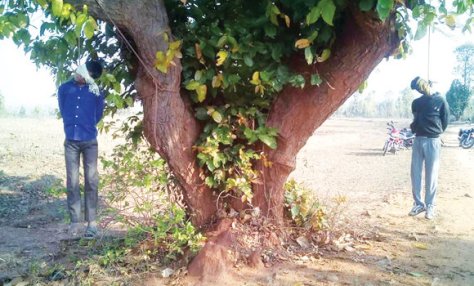
Mazlum Ansari and Imteyaz Khan, Jharkhand 2016.


The recent spate of vigilante attacks in India has lent a new, nearly domestic familiarity to the word “lynching”. This, though, is more than just a shift in language: the nation’s visual archive itself seems be shifting, towards instatement of a new normal. Inside just a year the “lynching photograph” has moved center-stage, filling mainstream news reportage and social media newsfeeds. The imagistic vocabulary of lynching has thus taken on a touch of mundane inevitability in caste and communal violence.

It began in March 2015, with the lynching of Syed Arif Khan in Dimapur, Nagaland. A couple of months later two teenage Dalit girls were raped, strangled and left hanging from a mango tree in Katra village in Uttar Pradesh. Then, on 28 September 2015, Mohammad Akhlaq was bludgeoned to death by a mob in his home near Dadri in what went on to gain spurious notoriety as a “beef-eating incident”. The following March, continuing with the logical rhythm of a scheduled sequel, the cattle herder Mazlum Ansari and his 14-year-old nephew Imteyaz Khan were lynched and hanged from a tree in Jharkhand. Most recently (on May 22) M. T. Oliva, a Congolese citizen, was beaten to death in the national capital of Delhi. This is an incomplete list: it includes only those incidents that resulted in fatalities. In the same timeframe there have been at least a dozen other cases in which the victims somehow survived the end-stage public shaming, torment and lurid physical violence, in short the ordeal of a completed lynching.

There is no lynching without its spectators. Continue reading Three Photographs, Six Bodies: The Politics of Lynching in Twos: Megha Anwer

Ambedkar Cannot be Adopted or Appropriated by Hindutva: K Satyanarayana

Transcript and translation of lecture  by Prof. K.SATYANARAYANA, speaking at the launch of book, Ambedkar Can Neither Be Adopted Nor Appropriated by The Hindutva Elements. The book, authored by Bojja Tharakkam, K. Satyanarayana, K. Laxminarayana and K. Y. Ratnam. It was launched in Hyderabad in July last year and is a reply to RSS’ Organiser special edition on Ambedkar. The text and video of the original Telugu lecture received by us via DALIT CAMERA.

All the friends who gave me this opportunity, to the many Ambedkarites present in this hall and to the very senior members, activists and intellectuals, I thank you all. After Anand Teltumbde has spoken, there isn’t much left to speak because he covered all the information in this book and also described completely about a lot of aspects about Maharashtra, about Ambedkar’s like and his work. Therefore there might not be much new information in my speech, but while writing this book, the distortions they made, or the attempts of RSS in relation to Ambedkar, as there is a need for historical context, I will speak about some of those issues. Firstly what Respected Mr. Tarakam has said is, to read some of the names of essays in the Organiser as the book is not available to everybody. When this book Organiser came out, generally RSS-BJP, when they talk about Ambedkar or about Babri-masjid, what we think is that they speak lies, false words, and mistruths and therefore there isn’t any danger as nobody will believe in their load of rubbish and lies. We think that way and if people understand the lies and if they don’t follow those words, there is no danger, but with this same type of propaganda, they completely changed the normal common-sense of the people and today Modi, as a K.D (drawn from an old colonial police/ legal category, it has become a Telugu expression that suggests a person with undesirable traits), as our brother has sung, is sitting in power.

Continue reading Ambedkar Cannot be Adopted or Appropriated by Hindutva: K Satyanarayana

Response on the Suspension of Registration under the FC(Regulation) Act, 2010 : Lawyers Collective

Guest Post by Lawyers Collective

The Lawyers Collective condemns the blatant attempt  of the government of India to victimize the organization and its office bearers India Jaisng and Anand Grover .This is noting but a gross misuse of the FCRA Act which is being used to suppress any form  of dissent . it is far too well know that both Anand Grover and Indira Jaising have represented several persons in their professional capacity as lawyers is several cases against the government and the functionaries including  the President of the BJP party ,  Amit Shah  protesting his discharge in the Sorabudin murder case . The lawyers collective intends to challenge the order as   unconstitutional and required to be set aside . 

The order/show cause notice is a malafide act and an act of vindictiveness on the part of the Government. This is being done because of the cases that Lawyers Collective (‘LC’) and its Trustees, Ms. Indira Jaising and Mr. Anand Grover, are involved in, including but are not limited to Sanjiv Bhatt, Yakub Memon and Priya Pillai. The aim is to destroy the credibility of LC by leaking it to the media, before even serving it on LC. LC till today has not received the order purportedly issued on 31st May, 2016, though it is available to the press. Continue reading Response on the Suspension of Registration under the FC(Regulation) Act, 2010 : Lawyers Collective

In the Name of Fidel – The Left Reads the Mandate: Vipin Kumar Chirakkara

This is a guest post by VIPIN KUMAR CHIRAKKARA

Party has two faces: V.S. Achuthanandan (centre) with Pinarayi Vijayan (left)
Party has two faces: V.S. Achuthanandan (centre) with Pinarayi Vijayan (left) Photo and Caption Courtesy – Indian Express.

In his address to the media in Thiruvananthapuram after the Left won the mandate in Kerala, Sitaram Yechury announced two positions to be given to two leaders of his own party who had successfully contested the elections from there.  One is that of the leader of the legislative party of the CPI-M, or effectively the chief ministership of Kerala.  That went to Pinarayi Vijayan.  The other one went to V.S. Achuthanandan.  He is made the Fidel Castro of Kerala.  Yechury, the embattled general secretary of the party who is also known to be closer to VS than to Vijayan, elaborated on the function of the second position since, seemingly, he felt that people could develop doubts about the implication of this honour, if not an anxiety whether the left victory in a single assembly election is turning Kerala into Cuba.  He clarified that VS will be an inspirational symbol providing advice and direction to the new government, and added that the veteran leader could not head the government due to his advanced age and poor health.  Yechury was, of course, flanked by the state secretary of the party Kodiyeri Balakrishnan and VS himself.  The suspense thriller of this election thus had the curtain fall, with an anti-climactic scene of unity.

It would deprive us of a unique opportunity to know another meaning of the mandate if we ignore how Yechury has read it.  He interpreted the mandate in the same address to the media that was held in Kerala’s capital.  He had a special reading to offer us, indeed different from what we all would ordinarily imagine.  His reading is distinguished from ours by its methodology itself.  He does not look at the assembly elections with reference to states where elections have taken place now. According to him, elections took place in 820 seats.  He took out his cell phone and provided the statistics of the results.  The BJP could win only in 64 assembly seats, the Congress in 115 whereas the Left has been victorious in 124.  He said that this was “the absolute ground reality”.  He assured us, the anxious beings, further that this reality implied no such threat as the return of the saffron.  When a journalist mentioned to him the victory of the Trinamool Congress that had won above 210 seats in West Bengal, he said he had in mind only the national parties.  So, we are expected to understand if we haven’t yet, that the Left’s is indeed an impressive performance as a national party!

Continue reading In the Name of Fidel – The Left Reads the Mandate: Vipin Kumar Chirakkara

Modiversary – Mera Desh Badal Raha Hai! Really

It was late mid-eighties when we use to do streetplays in Varanasi as part of our activities as a left student group – which called itself ‘Gatividhi Vichar Manch’ in Banaras Hindu University. One such plays was titled Desh ko Aage Badhao. The 5-7 minute play was part of a compilation of many other plays brought out possibly by Jana Natya Manch. We must have done hundreds of shows of the other play Raja Ka Baja – which was about the dire state of education and employment.

The theme of this short play Desh ko Aage Badhao was rather crisp. It showed a Netaji/leader in white clothes telling people gathered around him how the ‘nation is progressing’. When the innocent people ask for details, then he starts listing out his personal achivements and the wealth he has acquired through all these years of ‘serving the masses’. The tagline was Arrey Murkhon, dekho desh kaise aage badh raha hai‘ ( You fools, look how the nation is progressing)

The end scence showed people coming together, getting organised and slowly pushing the Netaji. When the terrified Netaji use to ask Arrey Murkhon, yeh kya kar rahe ho. (What are you doing idiots). The awakened people use to answer in unison Netaji, desh ko aage badha rahe hain ( We are pushing the nation forward).

I was reminded of this short play when TV started showing the ad how the nation is changing and how it is progressing with a tagline Mera Desh Badal Raha Hai, Aage Badh Raha Hai. ( How my nation is changing, and advancing) focussing itself on two years of Modi government at the centre. Continue reading Modiversary – Mera Desh Badal Raha Hai! Really

Congratulations on the Completion of Two Years of Government: Reaction of JNU student, Bihu Chamadia

Guest Post by BIHU CHAMADIA

Congratulations on the completion of two years of government. But I just want to ask a simple one line question. Completion of two years but at what cost? At the cost of increase in the number of farmer suicides, at the cost of creating war-like situations in educational institutions, at the cost of acting as a catalyst of widening the gap between hindu-muslim, at the cost of increasing imports and decreasing exports. Celebration on such a large scale because of course it is the first ever government in the history of the world to complete 2 years of governance ! With on-going crisis in the country BJP spends 1000 crores on a programme for this celebration. We would have no problem if this money was yours but sadly it’s not its ours. So now to all the tax payers who had problem with JNU raising its voice I ask you have you people become blind and deaf or are suffering from amnesia and forgot how to read and write.

Well, you speak well Mr Modi but the problem is that you only speak. You and your whole cabinet knows that each and every student of these educational institutes can give you people a befitting reply to all your one liners but we choose not to. People laugh at what your ministers says and say what a fool but I have a completely opposite view. You people are not fool you people are smart, very smart indeed.  Your every policy and every one liner can have a nice reply. Continue reading Congratulations on the Completion of Two Years of Government: Reaction of JNU student, Bihu Chamadia

Statement of Solidarity with Kancha Ilaiah

[The following is a statement in support of scholar-activist Prof  Kancha Ilaiah, who is under attack from a number  of Hindutva organizations and  against whom the Hyderabad police recently registered a case for ‘hurting religious sentiments’. The tendency to  resort to police cases, in order to stifle any criticism of Hindutva and the regime has assumed menacing proportions, against which we stand  firmly with Kancha Ilaiah. Those who wish to add their names to the statement and express solidarity may do so by adding them as comments.]

We, the undersigned, strongly condemn the continued harassment, attacks on and intimidation of Prof Kancha Ilaiah at the hands of various Brahmin / brahminical organizations, police and the state administration of Telengana for his political writings and views.  We also hold responsible for this intimidatory environment, the Telugu media that reportedly published distorted and misleading reports of Prof Ilaiah’s speech.

While speaking at the Centre of Indian Trade Unions, a wing of the Communist Party of India (Marxist) on May 14, 2016, at Vijayawada (Amaravathi), Prof. Ilaiah had  said: “The Brahmins as a community have not contributed anything to the production process of the Indian nation. Even now their role in the basic human survival based productive activity is not there. On the contrary, they constructed a spiritual theory that repeatedly tells people that production is pollution.” Continue reading Statement of Solidarity with Kancha Ilaiah

Condemn the Attack on Kancha Ilaiah for asking, ‘Is God a democrat?’

[We at Kafila condemn the repeated  attacks on scholar activist Professor Kancha Ilaiah by the Hindu Right and  the recent case registered against him by the Hyderabad police. According to a Times of India report, Ilaiah had on May 14 delivered a lecture in Vijayawada in a programme entitled `Nationalism and Divergent Views’ organised by CITU where he reportedly criticised Hindu gods and scriptures, according to the police. Following this an advocate filed a private petition in the court of the XI Metropolitan Magistrate court, Ranga Reddy , requesting to register an FIR under relevant sections of IPC. The court directed cops to register a case under sections 295 A (deliberate and malicious acts, intended to outrage religious feelings of any class by insulting its religion or religious beliefs),153 A (promoting enmity between different groups on grounds of religion) and 298 (uttering, words, etc. with deliberate intent to wound the religious feelings of any person) of IPC.”

Earlier, last year the  VHP had initiated a campaign against him which was followed by the filing of a case against him by the Hyderabad police. That was in relation to an article Kancha Ilaiah had written, asking ‘Is God a Democrat?’ The story by Ajaz Ashraf from Scroll.in linked below refers to last year’s case but due to an inadvertent mix-up, was initially extracted by us as the one in the eye of the current controversy. The error is seriously regretted and we thank one of our readers for pointing this out. The Times of India report linked to above gives refers to the speech that is currently in the eye of the storm.

Professor Ilaiah has now himself described the current attacks on him in this piece in Scroll.in, where he signs his article as Kancha Ilaiah Shepherd, recalling his caste name (translated into English, in order to mark his distance from the brahmans).

The attacks on  Professor Ilaiah are totally unacceptable. We have all read and long admired his writings. Many of us have hugely benefited and learnt a lot from them. The time has come for us to collectively put our heads together and fight this menace of Hindutva, which after hurting every living being’s dignity and sentiments, has now begun claim to be the perpetual and universal victim. Dalits today cannot speak of the indignities and oppression that they have suffered at the hands of the Hindus – even that has become a matter of ‘hurt sentiments’. The response has to be worked out politically and intellectually so that the law is not repeatedly turned into a surrogate of Hindutva politics.]

The Hyderabad police have registered a case against renowned social scientist Kancha Ilaiah, after Vishwa Hindu Parishad activists complained that an opinion piece he wrote in the Telugu newspaper Andhra Jyothi had hurt their religious sentiments.

They filed their complaint at Hyderabad’s Sultan Bazar Station was filed on May 9, the day Ilaiah’s article titled Devudu Prajasamya Vada Kada? (Is God a democrat?) was published.

VHP activists Pagudakula Balaswamy, Thirupathi Naik and two others accused Ilaiah of comparing Hinduism with Islam and Christianity, insulting Hindu Gods by comparing them to mortals, mocking their worship, and for attempting to trigger clashes between upper and lower classes (by which they presumably meant castes).

On the basis of their complaint, Inspector P. Shiva Shankar Rao wrote a letter to the Senior Assistant Public Prosecutor, who advised the police to register a case under Section 153 (A) and Section 295 (A), which empower the authorities to act against people who commit deliberate and malicious acts aiming at outraging religious sentiment and spreading enmity between groups.

Case under investigation

The public prosecutor’s legal opinion led to a case being filed on May 15 against Ilaiah, the management of the Andhra Jyothi newspaper, its editor and publisher. The case is currently under investigation, at the completion of which a decision will be taken to whether to chargesheet them.

A police officer at the station told Scroll that Ilaiah is in the habit of articulating provocative views in his articles, which can and do hurt the sentiments of people. “Why does he have to make comments against practices which are dear to people?” the officer said, declining to give his name.

Read the full article here

Sahmat statement on intimidation and threats to scholars and activists

Guest Post : Sahmat statement on intimidation and threats to scholars and activists who investigated human rights abuses in Chhattisgarh

Date 24.5.2016

We strongly condemn the Chhattisgarh government and its police force for using intimidation and threats of a criminal case against academics and political activists investigating human rights abuses in the southern parts of the state, especially Bastar and Dantewada. A fact finding team consisting of Prof. Archana Prasad, Jawaharlal Nehru University (JNU), Prof. Nandini Sundar, Delhi University (DU) and Vineet Tiwari, researcher at CPI’s Joshi-Adhikari Institute recently visited the area for 5 days between 12-16 May 2016. They were accompanied by Sanjay Parate, Chhattisgarh State Secretary CPI-M.

After the visit the team was accused of spreading dissent against security agencies and supporting the ’Maoists’. The statement by the state home minister Ram Sewak Paikra in the Times of India reportedly calling the three reputed Delhi based academicians ‘anti-nationals’ and ‘Maoist’ is part of a recent and explicit trend to stifle the freedom of expression and movement through a state crackdown on political dissent. The threat of an FIR and further harassment looms large. The local contacts, escorts and villagers who hosted the team are being harassed and intimidated by the Police in order to fabricate evidence and ensure that they help no other study team in the future.

The Press Release by the team clearly indicts both the Chhattisgarh state and Maoist violence and reveals how ordinary Adivasis, struggling for a dignified existence and protesting against the violation of basic rights have little space to voice genuine grievances.

This is the latest in a long line of actions to criminalize dissent, free expression and movement, and stifle fair reportage of events which have become hallmarks of the Chhattisgarh government.

We appeal to all democrats to condemn this brazen attempt at intimidation by the State and its Security Agencies.

Bishnupriya Dutt, (JNU)
Ranjani Mazumdar, (JNU)
Surinder Jodhka, JNU)
Neeladri Bhattacharyya, (JNU)
Jaivir Singh, (JNU)
Vivek Kumar, (JNU)
Sachidanand Sinha, (JNU)

Continue reading Sahmat statement on intimidation and threats to scholars and activists

कुल्हाडी की छाया में उम्मीद

‘शब्द हिरासत में हैं और हत्यारे खुलेआम घुम रहे हैं’

( Photo Courtesy : freethinker.co.uk, Martyr Rajib Haider who was killed by the Islamists on 15 th February 2013)

आम दिनों में ऐसे बयानों पर कोई गौर नहीं करता, मगर एक ऐसे समय में जबकि आप के कई साथी इस्लामिस्टों के हाथों मारे गए हों और उनके द्वारा जारी हिट लिस्ट में आप का नाम भी शुमार हो और उधर अपने आप को सेक्युलर कहलानेवाली सरकार भी  इन आततायियों के खिलाफ सख्त कदम उठाएगी ऐसी कोई उम्मीद नहीं दिखती तो, उस पृष्ठ भूमि में तीन ब्लागर्स द्वारा अपना नाम लेकर जारी किया गया एक बयान विद्रोह की आवाज़ को नए सिरेसे बुलन्द करना है। (http://sacw.net/article12741.html)

कुल्हाडी की छाया में उम्मीद’ यही शीर्षक है उस पत्र का जो बांगलादेश के युवा ब्लॉगर और लेखक आरिफ जेबतिक ने लिखा है। सरकार की समझौतापरस्ती की आलोचना करते हुए वह लिखते हैं कि ‘जब किसी नागरिक की हत्या होती है और राज्य की प्राथमिकता होती है कि पहले यह पता किया जाए कि उसने लिखा क्या न कि हत्यारों को पकड़ा जाए, तब स्पष्ट होता है कि इन ब्लागर्स के हत्यारों को पकड़ने में सरकार की कितनी दिलचस्पी है।’ ‘मेरे विचार चुपचाप रोते हैं’ शीर्षक से एक अन्य पत्र मारूफ रोसूल ने भी लिखा है जो लेखक हैं और ‘मुक्तो मोना’ (Mukto Mona ) नामक ब्लॉग के लिए नियमित लिखते हैं। वह लिखते हैं कि बुनियादपरस्त लोग पूरी दुनिया में उत्पात मचाए हुए हैं, अभिव्यक्ति की स्वतंत्रता, मुक्त चिंतन सभी खतरे में है और इसलिए यह संघर्ष अनथक जारी रहना चाहिए, इसके पहले कि यह शैतानी ताकतें हमारी स्वतंत्रता में एक और कील न ठोंक दे।’ तीसरा पत्र जानेमाने ब्लागर एवं कार्यकर्ता इमरान सरकार ने लिखा है जो ‘बांगलादेश ब्लागर्स एण्ड आनलाइन एक्टिविस्ट नेटवर्क‘ के अग्रणी हैं तथा, ‘गणजागरण मंच‘ जैसे सेक्युलर आन्दोलन के प्रवक्ता हैं। इमरान सरकार लिखते हैं कि ‘शब्द हिरासत में हैं और हत्यारे खुलेआम घुम रहे हैं।’ ..हत्यारे मुक्त चिन्तन के रास्ते में एक के बाद एक बैरिकेड खड़े कर रहे हैं। एक एक सहयोद्धा की मौत के साथ उनके शोक में निकले जुलसों में लोगों की तादाद बढ़ रही है और सरकार हत्यारों को पकड़ने के बजाय ब्लागर्स के लेखन पर ही सवाल खड़ा कर रही है और सूचना एवं सम्प्रेषण टेक्नोलोजी की धारा 57 का इस्तेमाल करते हुए ब्लागर्स को ही गिरफतार कर रही है।’ Continue reading कुल्हाडी की छाया में उम्मीद

माँ, तुझे सलाम! कविता कृष्णन

अतिथि पोस्ट : कविता कृष्णन

“Scout,” said Atticus, “nigger-lover is just one of those terms that don’t mean anything—like snot-nose. It’s hard to explain—ignorant, trashy people use it when they think somebody’s favoring Negroes over and above themselves. It’s slipped into usage with some people like ourselves, when they want a common, ugly term to label somebody.”

“You aren’t really a nigger-lover, then, are you?”

“I certainly am. I do my best to love everybody… I’m hard put, sometimes—baby, it’s never an insult to be called what somebody thinks is a bad name. It just shows you how poor that person is, it doesn’t hurt you.” (To Kill A Mockingbird, Chapter 11)

‘Now, there is a long and honourable tradition in the gay community and it has stood us in good stead for a very long time. When somebody calls you a name – you take it. And you own it.’ (Pride, 2014)

‘टू किल अ मॉकिंगबर्ड’ उपन्यास 1950 के दशक के अमेरिका के दक्षिणी राज्यों में नस्लवाद की कहानी है. उसमें एक वकील जिनका नाम एटिकस है, एक काले नस्ल के आदमी की पैरवी करते हैं जिस पर बलात्कार का गलत आरोप लगाया गया है. एटिकस की 8 साल की बेटी स्कौट कहती है की गाँव के लोग कह रहे हैं कि मेरे पिताजी ‘हब्शी-प्रेमी’ है. वह पूछती है कि इसका क्या अर्थ है, सुनकर लगता है कोई गाली है, जैसे किसी ने मुझे ‘बन्दर’ कहा हो, पर इसका क्या मतलब है?

Continue reading माँ, तुझे सलाम! कविता कृष्णन

Why exoneration of Sadhvi Pragya should worry everyone who stands for justice

Why exoneration of Sadhvi Pragya should worry everyone who stands for justice

There are a few photographs which the bigwigs of the Hindutva Brigade/Sangh Parivar would like to be erased from public memory. One such photograph shows Sadhvi Pragya, an ex-member of the ABVP, sitting with Shivraj Singh Chouhan, Chief Minister of Madhya Pradesh, Rajnath Singh and few others. As it was later revealed they had gathered to console the widow of a BJP leader from MP, who had just died.

Public memory is very short but one can stretch it a bit to recollect the tremendous consternation in BJP/RSS circles when Sadhvi Pragya was arrested by the Anti Terrorist Squad led by the legendary police office Hemant Karkare on 23 October, 2008 for her alleged role in the 2008 Malegaon bomb blast. This photograph had suddenly gone viral when there were denials by many leaders of the saffron brigade that they had never met her.

Now that the NIA, the federal agency established by the government to combat terror in India, has given a ‘clean chit’ to Sadhvi Pragya and few of her accomplices, should one expect that all those photographs showing her proximity to various leaders of the saffron establishment would be prominently exhibited? It must be remembered that leaders of BJP have even claimed that it was an act of “treason” to arrest her.

(Read the remaining article here : http://www.catchnews.com/politics-news/why-exoneration-of-sadhvi-pragya-should-worry-everyone-who-stands-for-justice-1463399413.html)

Who will Educate the Educators? Reflections on JNU today: Janaki Nair

Guest Post by JANAKI NAIR

 In an interview to the journal Frontline on February 16, 2016, just 11 days before he took over one of India’s most prestigious universities, Prof Jagadesh Kumar had this to say:

I am a defender of free expression of thought in a democratic set-up and students are free to question me or challenge my views. I believe in constructive criticism, and as long as it is done peacefully and within the boundaries of the law, there is no problem.

Declaring his  two top priorities, of which one was the redressal of  infrastructural shortcomings, he desired

to improve the learning environment by making it more student-centric. Some of the faculty are great researchers, but they do not have much understanding of teaching. What I want to do requires cooperation from faculty members.

These words, which Prof Kumar has thus far not refuted or denied, should be recalled today, more than three months after his takeover, the  most tumultous months the University has ever known.  It is too early to judge the VC on his infrastructure  promise, as some of us continue to make  bone rattling journeys on cycles over  the most rutted roads on the campus.  Continue reading Who will Educate the Educators? Reflections on JNU today: Janaki Nair

बेहद पोंगापंथी और जातिवादी हैं प्रवासी भारतीय

आम धारणा है कि एक भारतीय विदेश की सरजमीन पर पैर रखते ही जेंटलमैन बन जाता है। वह सभ्यता के नए मूल्यों से परिचित होता है, अपने देश की तमाम रूढ़ियों से नाता तोड़ लेता है और सही मायने में एक आधुनिक व्यक्ति बन जाता है। यह बात एक हद तक ही सही है। कुछ लोगों में भले ही परिवर्तन आ जाता हो पर एक बड़े हिस्से पर शायद उल्टा ही असर होता है। भारत के बाहर जहां-जहां भारतीय बसे हैं, वहां उन्होंने न केवल जाति आधारित संगठनों, संस्थाओं की स्थापना की है बल्कि वहां भी वे निम्न कही जानेवाली जातियों के साथ खुल्लमखुल्ला भेदभाव करने में संकोच नहीं करते। लेकिन उनके चरित्र के दोहरेपन का आलम यह है कि वे चाहते हैं कि ये बातें ढकी-छुपी रहें। वहां के लोग यह सब न जानें।

आजकल अमेरिका के एक बड़े राज्य कैलिफॉर्निया की पाठ्यपुस्तकों में संशोधन चल रहा है। यह एक रूटीन प्रोसेस है जिसके तहत सिलेबस में नए विषय या तथ्य शामिल किए जाते हैं। इस क्रम में वहां सिलेबस में हिंदुओं के बारे में भी कुछ सूचनाएं शामिल की जा रही हैं। लेकिन इस पर विवाद हो गया है कि जानकारियों को किस रूप में रखा जाए। भारतीयों का एक तबका चाहता है कि प्राचीन तथ्यों को नए सिरे से लिखा जाए और हिंदू समाज में मौजूद वर्ण व्यवस्था या छुआछूत की बात को साफ गोल कर दिया जाए। अमेरिका में रह रही दलित ऐक्टिविस्ट थेनमोझि सुंदरराजन ने पिछले दिनों ‘द हफिंग्टन पोस्ट’ में इस संबंध में एक लेख लिखा है जिसके मुताबिक प्रवासी भारतीयों के एक हिस्से में सक्रिय ‘धर्मा सिविलाइजेशन फाउंडेशन’ की तरफ से दलील दी जा रही है कि हिंदुओं में जाति एवं पुरुष सत्ता का जिक्र किया जाएगा तो इससे हिंदू बच्चे ‘हीन भावना’ से ग्रस्त हो जाएंगे। यह उनकी ‘प्रताड़ना’ का सबब बन सकता है, लिहाजा इस उल्लेख को टाल दिया जाए।

सुंदरराजन बताती हैं कि ऊपरी तौर पर आकर्षक लगने वाली यह दलील सच्चाई पर पर्दा डालने जैसी है क्योंकि वही तर्क नस्लवाद के संदर्भ में भी इस्तेमाल किया जा सकता है और किताबों से उसकी चर्चा भी गायब की जा सकती है। लेकिन इन कोशिशों का विरोध भी हो रहा है। विभिन्न धर्मों व नस्लों से जुड़े संगठनों ने एकजुट होकर पाठ्यपुस्तकों में ऐसे हेरफेर की मुहिम पर आपत्ति जताई है। उनका कहना है कि दक्षिण एशिया के इस हिस्से में जातिगत और धार्मिक असहिष्णुता या संस्थागत भेदभाव के प्रसंग को गायब करना न सिर्फ इतिहास को नकारने जैसा है बल्कि यह गैर लोकतांत्रिक भी है। Continue reading बेहद पोंगापंथी और जातिवादी हैं प्रवासी भारतीय

The HLEC and the Aporias of ‘Committeed’ Enquiries: Rina Ramdev and Debaditya Bhattacharya

This is a guest post by Rina Ramdev and Debaditya Bhattacharya

Students of JNU have been on an indefinite hunger-strike for over 15 days now, and the administration’s only official response so far had been the Vice Chancellor’s May 4 statement invoking the vocabulary of the ‘lawful’ and the ‘constitutional’ — in ambivalences closer to threat than appeal. The subsequent May 10 Academic Council meeting has been historic, both for its 53 members’ overwhelming denunciation of the HLEC report, as also for the indelible image of a fleeing VC now forever etched in campus folklore. Further, the Delhi High Court’s stay on the fine imposed upon one of the students lends hope for similar stays with the remaining beleaguered students’ cases. The VC has consequently been referring to the enquiry mandate as being sub-judice, only to grant it an interim legitimacy that may symbolically defeat the stridency of student resistance. Letters have been sent out to the parents of striking students, in an attempt to re-route intimidation and pressure through other non-official means of paternalism. Given the conditions of duress being thus created, until the HLEC’s report is revoked in entirety, there is every reason to believe that the administration’s vindictive punitive designs will leech into the future of university freedoms and campus democracy irreversibly.

Continue reading The HLEC and the Aporias of ‘Committeed’ Enquiries: Rina Ramdev and Debaditya Bhattacharya

Degrees of Self-Deception: Rama Srinivasan

Guest post by RAMA SRINIVASAN

Modi and his double, image courtesy, IndiaTV news

As the crisis of fake degrees blows over I want to be the one to ask the naïve question: Why would Narendra Modi lie? I know it is a naïve question because lies are the most banal political strategy ever. There is a man in US today who repeatedly states that he will make the Mexican government pay for a beautiful, great wall on the border of US and Mexico and people believe him with a degree of sincerity that is frightening. In 2014, at least 31 percent of eligible Indian voters believed in Modi’s promises of development and some of them still do. There may be some who, at the end of the five years, actually believe that Modi has delivered on those promises. But such lies are different. My question is simply: why would he lie on an affidavit which functions as a legally-binding oath?

In his previous election affidavit filed for 2012 Gujarat elections he had left the spouse’s name column empty but following ‘strict legal advice’ he agreed to mention his wife’s name on the affidavit filed for Lok Sabha elections. Technically he had withheld information in previous affidavits which amounts to a legal offence since he had not filed his papers to ‘the best of his knowledge’ but this is not the same as actively lying as it now turns out could be the case with his educational qualifications. Legal experts will determine what is tantamount to punishable crime but if Modi did have legal counsel, who advised him to “come clean on the marriage” as this Times of India article states, why would he continue to provide inaccurate information on other aspects of life?

One speculative answer could be that he knew he was being closely watched as he made his bid for the PM’s post and that his papers would be scrutinised and compared with previous drafts. So it made sense to remain consistent with some of the information even though he had obviously been cornered on the question of his marital status. And yet, as the story of how Modi came to acknowledge the existence of his wife Jashodaben proves, if he had to reveal inconsistencies in previous records, 2014 would have been the best time to do this. No amount of exposés could have hurt the man at that time – his bhakt army, on and offline, on Twitter, were efficiently managing the show and could provide a useful media spin/misdirection to take the focus away from the affidavit that declared to the world that Jashodaben’s repeated claims regarding her marriage and abandonment were not unfounded. Even as the Gujarat Congress urged the state Election Commission, unsuccessfully, to reject his application on the grounds that he had not provided information regarding his spouse’s assets or PAN card number, Modi cruised to victory since his deliberate inconsistencies seem to matter very little to voters.

At that point Modi, indeed, seemed invincible. He was giving explosive speeches and deftly avoiding uncomfortable questions from journalists. In an interview with Rajdeep Sardesai, Modi replied to an indirect question on 2002 with this classic deflection tactic: “My best wishes are with you, Rajdeep Sardesai. You have been living off this issue for the last 10 years … I have heard that those who curse Modi get Rajya Sabha seats or Padma awards. So you have my best wishes to continue this campaign (against Modi) and reach Rajya Sabha or win Padma awards with help of your friends.” What was apparent in the interview is now widely acknowledged as the process of constructing a larger-than-life image, where the man referred to himself in third person. Continue reading Degrees of Self-Deception: Rama Srinivasan

But She was a Law Student …


In a way that is perhaps unprecedented, today, a very large number of Malayalis feel connected to each other by a veritable tsunami of pain. No wonder perhaps, because the veils of our complacency have been ripped off too thoroughly. The immediate context is the gruesome murder of a young Dalit student in central Kerala, in the tiny, rickety squatter-shack that was her home, in full daylight.

At a single stroke, the incident fully exposed the dimensions of social exclusion in contemporary Kerala. Hers was an all-woman family among families deemed ‘properly gendered’, they were lower caste people trapped and isolated among upper and middle caste families, they were the working-class poor without property in an area full of propertied domestic-oriented bourgeois and petty-bourgeois families. Oppressed in all these ways, they were invisible to the state and the political parties. They possessed no form of capital that would have allowed them upward mobility. Yet, the young woman struggled on and reached the law college.

‘But she went to college’, some ask, ‘how could she have been so helpless?’

Read the rest of the article here 


#FightBackJNU through the lens of Fayaz Ahmad

Photo Essay by FAYAZ AHMAD, JNU student on indefinite hunger strike

Untitled

March against the biased and unjust HLEC Report, culminating in hunger strike

Untitled 2

Continue reading #FightBackJNU through the lens of Fayaz Ahmad

Where are we heading? A Bangladeshi feminist’s reflections: Khushi Kabir

Guest Post by KHUSHI KABIR

Very soon after Professor Rezaul Karim Siddque of Rajshahi Univeristy was hacked to death in the morning of April 23, 2016, I wrote my feelings, my frustrations, my concerns and my fears. From all the information we received, Professor Karim appeared to be a quiet man, a man who was of a peaceful nature, a lover of music and a committed teacher.  As is the case with most Bangalis, he loved music.  Cultural activities were in his bloodstream.  He tried to, or did set up a cultural hub in his home, where he lived, not too far from the University where he taught.  He was not a declared atheist, nor a blogger, not even an armchair or facebook activist.  Not one of the usual argumentative Bangalis, the usual picture of the intellectual.  Not one of those who were in the frontlines of activism, not a talk show star, not one who wrote long opinions and editorials about the state of affairs of the country.  Why would he be killed?

We read from the reports that we get from all the different forms of media that exists, that he was what I often describe as the typical example of a citizen of this land, the kind of people I grew up with, secular in his thinking by encouraging culture, music, playing his favourite sitar, reading books, yet sensitive and responsive to the practice of religion of the people he lived amongst, his family perhaps, certainly his neighbours.  We heard of his large donations to the building of the local mosque as a proof of this perception.  His daughter has been very vehement in stating that he was a believer.  I find it very telling on our current state of affairs that we have to insist that we are all believers.  Why should it matter?  A murder is a murder and a gruesome murder has to be taken in all seriousness no matter what one’s beliefs are or where one stands.  We all grew up learning to sing, dance, play an instrument, and write poetry, recite etc.  Where else do we find that recitation is considered a part of cultural practice, a part of the performing arts?  Was his fault that he embodied this very nature of the Bangali? Was he murdered so brutally simply to be used as an example of what not to be?  Was he simply targeted because he embodied the very spirit of 1952, of 1971 in the quiet nature of his being?

Continue reading Where are we heading? A Bangladeshi feminist’s reflections: Khushi Kabir

The JNU administration now faces a crisis of credibility: Ayesha Kidwai

AYESHA KIDWAI in scroll.in

students on hunger strike

The indefinite hunger strike by 17 Jawaharlal Nehru University students has been continuing since April 28, with university teachers and students also showing their solidarity by joining as relay hunger strikers.

Despite the searing heat and failing health of many – including Chintu Kumari, Umar Khalid and Kanhaiya Kumar – the declaration by the Vice Chancellor of JNU that a hunger strike is an “unlawful activity” has only fuelled the strikers’ determination. Although over a hundred teachers met the Vice Chancellor and his team (as he likes to call them) in a bid to break the deadlock, no progress has been made because the JNU administration seems to believe that the fight here is one about the quantum of punishment.

Such is the chasm that separates the current JNU administration’s understanding of what the law is and what justice actually demands that the law has become something of a fugitive in JNU these past few months. The extremely obstinate, vengeful and motivated enquiry proceedings anddisciplinary action over the February 9 event have so perverted university procedures and institutions that the entire JNU administration now faces a crisis of credibility.

Continue reading The JNU administration now faces a crisis of credibility: Ayesha Kidwai

North East Students’ Forum JNU Protests the defamation of JNU by “Dossier”

North East Students’ Forum JNU organized a protest march on May 4, demanding strong action against teachers who are involved in preparing the “internal dossier”. The dossier was also burnt by NESF at Administration Block – Freedom Square – JNU.

Some images from the march

9c5fc67a-b629-47d0-b7fe-4ae8c0c53695

ab266cdb-324a-48f9-af0f-56f6759b997a

NESF 8

DISSENT, DEBATE, CREATE