To Elphinstone Road

When a system is forced to run at four to six times its capacity for years on end, it doesn’t break – it was always broken. Elphinstone Road is the story of almost all urban infrastructure in our cities. It’s a template. It’s a warning. It’s our history, our everyday, and our future. It’s horrifying. It’s utterly banal.

When only death can make you think of repair, maintenance, upkeep, and expansion, then the everydayness of our infrastructure is a state of violence. When that death will still not make you change the way you manage that infrastructure, that violence is a siege, and we have Stockholm Syndrome. Not resilience, but a hostage situation.

The real challenge to us – all of us, in all our locations – is to realise the deep insufficiency of our anger if it is anger just at death. Anger is needed as much at the way we live, not just the ways in which we shouldn’t die.

Continue reading To Elphinstone Road

Petition to President of India, Visitor of BHU from Alumni of the University

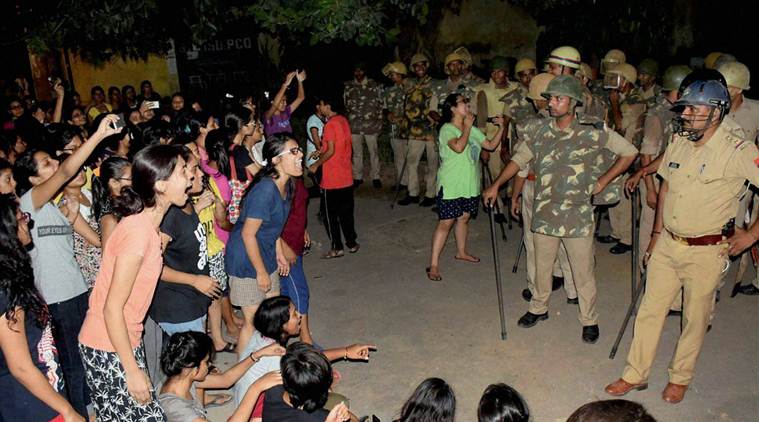
BHU, Banaras Hindu University, BHU violence, BHU lathicharge, bhu female students protest, BHU lathicharge, Benaras Hindu University, yogi adityanath, bhu students beaten, indian express newsTo

The President of India

Visitor

Banaras Hindu University

Sub : On recent agonising developments in Banaras Hindu University

Dear Sir

We alumni of Banaras Hindu University would like to convey to you our sense of concern about the recent developments at our alma mater namely Banaras Hindu University. Developments which have brought forward the issue of safety and security of girl students on the campus and administrations callous attitude towards it. Continue reading Petition to President of India, Visitor of BHU from Alumni of the University

Cutting the nose to spite the face?

It looks like the CPM’s enmity towards the Muslim organizations is such that they do not mind sacrificing women’s human rights and reinforcing the patriarchal family just to teach them a lesson. So they are happy to stick with the Sanghi understanding of conversion as necessarily forced in some way, ideological or physical. Media One broke news yesterday about a Sanghi torture camp for Hindu women who marry Christians or Muslims concealed as a yoga center. A woman incarcerated there for marrying a Christian managed to escape and complain to the police. Sixty-five women were reportedly incarcerated there when she was an inmate (a later report, after the place was shut down today on the order of the High Court, said 22 women and 23 men were allegedly for reconversion) . The reconversion therapy includes physical assault and threats. This 28-year-old woman married a Christian man without converting and her family seems to have initially accepted it. However, she was taken to this yoga cum counseling center by her own family without her consent and they left her there to the mercy of the criminals who ran the place.  She also confirms that a  young woman, Athira from Kasaragod, who had chosen to convert to Islam on her own who recently ‘returned’ to ‘Sanatana dharma’ with much fanfare, was in this place for twenty-two days and that she had continued to insist on her preference for Islam.

This place is in Tripunithura, in the heart of urban Kerala quite near the High Court at Ernakulam, which damned Hadiya’s right to choose her faith and a partner. Apparently, it is the Sanghi gang from this place who visited Hadiya at her father’s house. Here is the story:

https://youtu.be/ea-rJmuba8I

So it appears that the Sangh is clearly seeking to reverse what is an outcome of long-term social processes shaped by increasing access to higher education for most social groups in Kerala. Women entered higher education here in larger numbers in the 1980s and Muslims, men and women, since the 1990s till now. The expansion of the media and cellphones is such that young people are not influenced solely by their parents or community. In other words, there is a greater livelihood of women and men choosing partners actors communities. Even sensible people here whisper about how zealous Muslims are about conversion away from Islam but the discourse of Hindu tolerance is so pervasive that it lets concentration camp proliferate in secret. The response of the CPM participant is truly revealing — indeed, this is cutting the nose to spite the face. Whatever be their position about welfare and economic development, the CPM in Kerala seems appallingly on the side of the Hindutva security state. And the questions this raises for the fabled autonomy of women here that the CPM ideologues never ceases to claim credit for, are huge.

This is probably the calculation of utility that underlies the chilling indifference/ outright contempt of the CPM leadership towards the plight of the Muslims:  the average CPM and CPI supporter is the middle-caste ex-avarna middle-aged male of the middle or lower middle class. This gentleman’s  preferences are such that his utility is maximised by staying with the organized dominant left in matters related to securing public resources to private ends (because the mobilization for that, given Kerala’s demographics and history needs to be necessarily by a multi-community mix) and by sticking to community/caste organizations for family matters. This choice has always been detrimental to women’s personal rights, particularly personal choices. The community/caste organizations of the 20th century are becoming more of economic institutions than social — and they manage the vast community assets once secured from governments for public ends now securing mainly the interests of the community elite. The social, however, is undergoing rapid transformation, and indeed, sections of the young now even dare to define the social for themselves. Into this gap steps the Sangh, desperate to make an entry, now that their efforts to secure the ex-avarnas have failed (because of their own irremediable casteism). The above-mentioned gentleman finds it prudent to use their services in making sure that the young stay under his patriarchal thumb. Especially young women, for they have nobody to really defend their rights. Thus arise the thriving if silent business of reconversion, well-protected from public view by the pervasive Islamophobia of the Right and Left, believers and rationalists. Also remember that in a post-demographic society, children are few and they are more akin to trophies that future labour for the family. The dominant left sees that as long as they don’t disturb this gentleman’s efforts to secure his patriarchal authority through whatever means, however violent, crude, and abhorrent to democracy they may be, they retain influence. In other words, the tattered influence of the dominant left — no longer hegemonic — endures through, among other things, looking away from the social and the familial as hierarchical institutions and the abuses. This is why a sexual attack on a film actor elicits a huge response from the feminist supporters of the CPM, while the unlawful confinement of a far less privileged young woman is largely ignored or supported ‘personally’.  The dominant left leadership reasons this to be its best strategy, since it loses nothing by letting the Sanghis handle family affairs. The presence of the Sangh works well for it too, since very many Muslims and Christians, who are sizeable in demographic and economic terms, will turn to it for protection from the Sangh!!  This strategy has worked hitherto, and the sole risk lies in the gentleman ceasing to remain a Rational Agent and joining the ranks of the Indo-Gangetic barbarians, essentially irrational in the Kerala context (I keep urging them to leave for Haryana in pursuit of what must be their choices if they choose to become such barbarians). But this has been largely limited to the upper caste Hindus and some sections of elite Christians who regret the loss of traditional power and hope that the Sangh will restore it. They are not the growing power, demographically or economically. Meanwhile, the effete rationalists generate a ‘secularised’ Islamophobia that serves as a neutral-sounding justification for the government’s inactivity.

There are very few moments in which I have felt so lonely. Almost everyone I know seems to be a player, a rational agent, in this game, either participating or creating justifications for the strategy or participating by simply looking away and remaining silent. But this loneliness is so much more dignified — and indeed, more human. I stand with the six young women who braved the Sangh and the police trying to reach Hadiya; I condemn those who serve up her father’s sickening sentimental patriarchal shit in the public in a way that renders them vulnerable. Hadiya’s father who had not the slightest compunction in approaching the High Court and painting his own daughter a potential terrorist such that her entire life promises to be hell (even if she escapes his confinement), is showered with sympathy by our critical intellects for being a poor worried father. Meanwhile, a radical student who claims to be on Hadiya’s side flings abuse on me for wearing a sleeveless blouse, for leaving my hair untied – she does not even notice that her tirade is so like a Brahmanical patriarch’s diatribe against the well-known signs of Kali — immodest women with their hair open — such missiles seem convenient for all, radical Ambedkarites even, to use against those they dislike.  The only silver lining in this mess is that it reveals with unprecedented and astounding clarity,  the enormous risks, dangers, and material losses ahead of anyone who wants to remain human, and not what is substitutable with Artificial Intelligence. And that in order to be popular, you must swim with some tide or the other.  But I’d rather be human than popular, still.

Shame on all of you — AIDWA leaders, Brinda Karat, M S Josephine, C K Asha, Geeta Nazir, Sreemathi teacher, Shylaja teacher — all of you women adherents of the CPM and CPI. If Hadiya dies in that horrible hell, her blood is on your hands. Her rights are already dead and you have done precious little.

 

BJP, In Search Of An Icon: Is Deendayal Upadhyay Party’s Mahatma Gandhi?

Tomorrow, the capital will see the culmination of the year-long birth centenary celebrations of Bharatiya Jana Sangh leader Pandit Deendayal Upadhayay
BJP, In Search Of An Icon: Is Deendayal Upadhyay Party's Mahatma Gandhi?

‘Nirastapadapeshe Erandopi Drumayate !’ – Sanskrit Proverb

(In a treeless country even castor counts for a big tree)
( Quoted in EPW ”An Occasion for the RSS”, GPD)

Come September 25 and the capital would see the culmination of the year-long birth centenary celebrations of Bharatiya Jana Sangh leader Pandit Deendayal Upadhayay . The year gone by had witnessed flurry of activities around Deendayal Upadhyay supposedly to project him as one of the ‘makers of modern India’. Exactly a year ago Prime Minister Modi had shared a piece of his mind at a public meeting in Kozhikode wherein he had specifically put Deendayal Upadhyaya in the same category as Mahatma Gandhi and Lohia who had “[i]nfluenced and shaped Indian political thought in the last century”.

Read the full article here

Judicial Ghar Wapsi : Update on the Hadiya Case

If there is one thing, besides the pervasive Islamophobia in Kerala in both the Left and Right, that the Hadiya case reveals, it is the deeply entrenched commitment to patriarchy everywhere — on the Right, Left, the radical civil society, wherever. Continue reading Judicial Ghar Wapsi : Update on the Hadiya Case

Are We Heading towards a Nuclear Winter? A Theoretical Framework: Rameez Raja

Guest post by RAMEEZ RAJA

The discovery of nuclear energy or radioactivity in 1930s and 1940s by the scientists in a sense murdered the true spirit of science. After the bombings by the United States over Japan in 1945, physicists and nuclear scientists practically got to know about the massive amount of energy a nuclear explosion can release. At around the same time, scientists started experimenting to harness nuclear energy for generating electricity as well. However, after the destruction caused by atomic explosions in Japan, Albert Einstein changed his stance towards using nuclear energy after witnessing the horrifying episode in human history. Along with him, many other nuclear scientists and bomb designers like Ted Taylor, John Gofman, Michio Kaku turned anti-nuclear activists after studying about the harmful effects nuclear radiation can cause.

Kennette Benedict, a senior advisor to Bulletin of the Atomic Scientists argued that the three communities which benefit by supporting nuclear warheads are “weapons scientists and engineers, private military contractors, and the government nuclear weapon bureaucracy.” Some realists and neo-realists like Hans Morgenthau (Politics Among Nations), Kenneth Waltz (Theory of International Politics) and John Mearsheimer (The Tragedy of Great Power Politics) championed the deterrence theory for avoiding major wars. Surprisingly, the nuclear hawks feel proud of their nuclear achievements and development, despite the fact that nukes failed to provide them with total security and also that nuclear energy is not a cheap source for generating electricity as reported by physicist, M. V. Ramana in his book The Power of Promise.  Continue reading Are We Heading towards a Nuclear Winter? A Theoretical Framework: Rameez Raja

Time for Akhara ‘certified’ Babas?

For a law against Superstition at the National Level

miraculous-powers

( Image Courtesy : http://antisuperstition.org/faith-in-time-of-rationality/)

These are really ‘bure din‘ for the spiritual gurus of India.

While the likes of Ram Rahim, Asaram Bapus and Rampal are cooling their heels behind bars for their not so spiritual acts, Sant Swami Bhimanand Ji Maharaj Chitrakoot Wale who is also known as “Ichadaari Baba” among his followers has also joined them for running a high profile sex racket.

It was unprecedented in recent history that Odisha had witnessed mass movements targeting many such Babas/spiritual gurus which had compelled the state government to arrest few of them. In fact the judiciary had also expressed grave concern over such Babas masquerading as spiritual leaders, robbing innocent followers of money and leading a “licentious life”.(https://www.telegraphindia.com/1160528/jsp/odisha/story_88018.jsp) Continue reading Time for Akhara ‘certified’ Babas?

Against the De-politicization of Mental Health- Harassment is Not a Myth: Simple Rajrah

Guest post by SIMPLE RAJRAH

This article is written in response to the article Activism as a blue whale challenge by Manu Joseph that first appeared in Livemint.

“Our love is constructed. Our beliefs colored. Our originality valid through artificial art. It has become truly difficult to love without getting hurt”

Dalit Scholar Rohith Vemula, who was institutionally murdered.

Often academic interests die a quiet death due to crassly political reasons but they die yet again, due to non-recognition and to their relentless reduction to the apolitical. Much as there must be emphasis on seeking solutions to the troubles that humanity is facing, it cannot be ignored that reducing the ‘root’ cause of everything to the realm of ‘apolitical’ can be academically simplistic and politically dangerous.  And why must there be an obsession with relegating everything to the ‘apolitical’ domain? Why do journalists who continually work within political systems still consider depression to be something external to the sphere of politics? Why must there be academicians who discount historicity and complexity by equating violence with counter violence? And why, similarly, must there be politicians who condemn violence on ‘both sides’? Because, even a simple reading of the political should reveal its association with power, challenge its centralization, and more importantly the show up the invisibilization that generates hegemony.

Continue reading Against the De-politicization of Mental Health- Harassment is Not a Myth: Simple Rajrah

Statement Against Genocide and Deportation of Rohingya Muslims

Violence is sweeping Myanmar and in a short span of two weeks lakhs of ethnic Rohingya refugees have fled to Bangladesh and thousands have lost their lives. Satellite data shows, large parts of the Rakhine state, home to most of the Burmese Rohingya population have been set on fire, and murders, rape, arson, loot and forced displacement of the Rohingya population is taking place on a scale, that should be alarming for all humanity. Even the UN secretary general has called out to Mayanmar to end violence against the Rohingya and Nobel laureate Desmond Tutu has urged Mayanmar state Councillor Aung San Suu Kyi to speak out against the persecution of the Rohingya. The tragedy facing the Rohingya is of an unprecedented scale and needs to be addressed with a sense of utmost urgency.

As Indian citizens, we need to break the silence on ethnic violence against the Rohingya and the unconstitutional proposed deportation of a wide and long-residing Rohingya community from India, to certain death that awaits them in Myanmar. The Rohingyas have been living as a peaceful refugee community in various parts of India since the 1970s, with no criminal records or history of crime. Let us not be a part of this genocide. Let us stand up for justice and humanity, and raise our voice against the killings, displacement and deportation of the Rohingya!

Continue reading Statement Against Genocide and Deportation of Rohingya Muslims

In the Forbidden Land of Iran – the past, survival and imperial nostalgia: Inshah Malik

Guest post by Inshah Malik
Iran is politically and economically isolated and in that isolation, to call it an experiment of nation building is misleading, but nevertheless, it is an on-going exercise. Under the crippling sanctions, the party is still on!

I don’t have the usual agenda to visit Iran. I’m not an intrepid western traveler barging into the forbidden land, to explore my political other. My two year journey within Iran is a certain sojourn necessitated by my consistent desire to unravel the personal and political meaning of my existence. As a Kashmiri scholar burdened by a political inheritance of the prolonged Kashmir conflict, I seek to unearth the connection between Kashmir and Iran. This connection, as I understand now, is not simply political, in that both places are Muslim dominated, but more spiritual. It is in the erasure and random references to Kashmir in Farsi through which I attempt to understand the crisis of a Muslim consciousness entwined with the political domination of an imperial world order.

I encounter Kashmir as a meaningful reference in the poetry of Iran’s national poet, Hafiz Continue reading In the Forbidden Land of Iran – the past, survival and imperial nostalgia: Inshah Malik

In Which Swaminathan Iyer McDonaldises the Tribals and Serves Other Junk Food : Shripad Dharmadhikary and Nandini Oza

Guest Post by SHRIPAD DHARMADHIKARY AND NANDINI OZA

Reposted from Manthan

What can one expect when one is faced with a blog by “India’s leading economic journalist” which is titled “Most of the ousted tribals are flourishing and loving it”? That there will be a large helping of fries on the side? That it will taste great but is really junk? In all of these expectations, one is not disappointed.

First, a little background. The leading economic journalist is Swaminathan Iyer, who along with a colleague carried out a survey of some tribals ousted by the Sardar Sarovar Narmada dam, comparing their situation with those left behind in the hilly areas near the river, and others in the hilly areas but near a mining project. On 10th Sept 2017, Iyer wrote a blog titled “Why many tribals don’t mind being ousted” based on his study. In a matter of just two days, Iyer has come out with a second blog based on the same study on the same topic. One wonders why. But then, again, one may not wonder, for the Sardar Sarovar has become an important topic with the Prime Minister scheduled to dedicate to the nation the dam on 17th Sept 2017.

The first blog was a classic case of misinterpretation of data, hiding the more important issues, and conclusions not supported by research findings, as we showed in our response. We showed that the tribals do mind being ousted. Now Iyer has written another blog on the matter, which skirts the issues we had raised in our response and omits some crucial survey findings given in the earlier blog, but still tries to show the Sardar Sarovar rehabilitation program as being successful.

Continue reading In Which Swaminathan Iyer McDonaldises the Tribals and Serves Other Junk Food : Shripad Dharmadhikary and Nandini Oza

Poo’, poo’ Dilip and his Valiant Knights

Poo’ poo’ Dilip is an effect of the discourse on the Malayalam cine actor Dilip , who is facing trial for his alleged involvement in the conspiracy behind the despicable attack on a young woman actor in Kochi in February 2017.  Now, as his next bail plea (thrice refused) draws near, there seems to be a concerted effort to produce public sympathy for the jailed actor – which has produced its own discourse, much to the distaste of those who feel that the wronged actor, and not the one accused of wrong-doing, needs to be supported. Poo'(r) Poo'(r) Dilip is a direct (and feminist) translation of the funny distortion of the piece of sentimental shit going around social media on his behalf – Dilip paavamaa, eda (Dilip is a nice guy, bro). Continue reading Poo’, poo’ Dilip and his Valiant Knights

Why tribals do mind being ousted by dams: Shripad Dharmadhikary and Nandini Oza

SHRIPAD DHARMADHIKARY and NANDINI OZA write a stinging response to Swaminathan Anklesaria Iyer’s unsupported claims in Times of India about how much tribals love being ousted for big dams. The newspaper did not care to publish this rebuttal so the authors posted this on Dharmadhikary’s blog and also in the comments section to Iyer’s article.

We reproduce Dharmadhikary and Oza’s original response in full below from Manthan.

However, here is an update from Shripad:

I put my comment in brief, within the allowed 3000 characters, yesterday in the Comments section. Today, it’s gone.

Then, a friend brought to my notice that Swaminathan has written a completely new version of the blog and put it out yesterday. Wonder if he is in the habit of writing different versions of the same blog within a matter of two days! https://blogs.timesofindia.indiatimes.com/Swaminomics/most-of-the-ousted-tribals-are-flourishing-and-loving-it-thank-you-activists/

Have yet to read the new version of his bog properly (am out since early morning), but it appears that he has rewritten it in a way that tries to skirt the response we had given. Now I am planning to write another response to the new blog….but can only do it tomorrow as busy with meetings today.

And now, Dharmadhikary and Oza’s original response in Manthan:

SA Iyers’s piece in Times of India dated 10 Sept 2017, “Why many tribals don’t mind being ousted by dams”, examining the condition of some of the oustees of Sardar Sarovar Narmada dam is a classic case of misinterpretation of data, hiding the more important issues, and conclusions not supported by research findings. Indeed, a proper reading of the article itself shows that unlike Iyer’s assertion, his own figures show that tribals do mind being ousted. Some important points are given below.

Iyer claims that their “surveys showed, unambiguously, the resettled villagers were better off than their former neighbours in semi-evacuated villages.” In support, among the figures given from their survey, they point out that comparing the resettled with their former neighbours who remain in the original areas, the access to drinking water was 45% against 33%, to PHCs was 37% versus 12% and to hospitals 14% versus 3%. Given that the oustees were resettled between 25-30 years ago, and that the Sardar Sardar project has poured in hundreds of crores of rupees for resettlement, these figures don’t speak of oustees being better off, but indeed, point to the pathetic case of the oustees.

Continue reading Why tribals do mind being ousted by dams: Shripad Dharmadhikary and Nandini Oza

Delhi University’s Students Union Elections and the Discreet Charm of Exceptionalism: Rina Ramdev

This is a guest post by RINA RAMDEV


Public discourse on Delhi University’s staging of student union elections typically picks the ubiquitary narratives of money, muscle power and its floutings of Lyngdoh guidelines, year after clamorous year. College campuses, arterial roads and their flooding by posters, both in excess of their expenditure limit (Rs 5000 per candidate) and their prescribed nature (printed, as against handmade), as also the prohibited yet brazen processioneering of SUV armies, are experiences annually played out in tedious familiarity. Mainly configured as a contest between the NSUI and the ABVP (even as the AISA has in its recent resurgence, negotiated a space for Left politics beyond the two party dominance), the Presidential wins and panel sweeps are usually congruent with the dips and surges experienced by their parent political party on the national stage. Continue reading Delhi University’s Students Union Elections and the Discreet Charm of Exceptionalism: Rina Ramdev

Take back our government – BJP’s Electoral Bonds and Corporate Control: Bharat Sarkar Bachao Committee

Received from Bharat Sarkar Bachao Committee, Delhi

Sign Petition Against the BJP’s Electoral Bonds – An Open Door for Corporates to Control Our Government

Sign petition here

हिंदी के लिए नीचे देखें

In this year’s budget session of Parliament, the Modi government quietly introduced a new provision in the Finance Act that throws open the door for corporates to purchase our government – and for the BJP to get huge unaccounted funds.

The new instrument is called an “electoral bond.” An electoral bond is just a piece of paper, worth a certain amount of money, that can be purchased from a notified bank and given to a registered political party. The party can then cash the bond and get the money.

But – and this is the key – all laws and regulations have been changed to prevent anyone from knowing who purchased the bond and who encashed it. The Income Tax Act has been amended to state that the political party is not required to disclose who gave them the money. The Companies Act has been amended to say that a company can give any amount of money to political parties, and it does not have to disclose who it donated to (earlier, companies could only donate up to 7.5% of their profits and had to make the recipients public). The bank is not required to disclose who purchased the bond.

The only institution who will know which company gave money to which political party is the bank – and, therefore, the party in charge of the Finance Ministry, namely the BJP. The government claims they want to “protect donors from harassment”. But, of course, the ruling party at the Centre will know about donors using electoral bonds, and it can and will harass them if they donate to the opposition.

In short, electoral bonds are just a giant, open funding channel for corporate cash to flow to the BJP.

They are also a perfect route for money laundering. Once money is put into an electoral bond it is untraceable. Sources that preferred to remain anonymous in the RBI have effectively pointed this out – noting that bearer bonds are just another form of cash.

Multiple institutions have already opposed the bonds. The opposition in the Rajya Sabha voted to reject money bonds, but using the ‘money bill’ provisions of the Constitution, the BJP overruled them by a vote of the majority in the Lok Sabha. The Election Commission has called electoral bonds a “retrograde step”. The outgoing Chief Election Commissioner, Naseem Zaidi, has said the “public has a right to know who is making donations” and that “electoral bonds will rob poll funding of transparency.”

In 2002, when directing candidates to disclose their assets when standing for elections, the Supreme Court had said that voters’ right to know is “fundamental and basic for the survival of democracy”. Electoral bonds are not just one more bad policy. They are a direct threat to the foundations of Indian democracy. We face the prospect of corporates not only influencing policy through the back door, but of effectively purchasing the government through the front door. It is vital for people to raise voices against this ‘reform’ before it is too late.

Hindi petition follows.

Continue reading Take back our government – BJP’s Electoral Bonds and Corporate Control: Bharat Sarkar Bachao Committee

Sad at Killing of My Ambedkarite Elder Sister Gauri Lankesh, says Chandrashekhar of Bhim Army, as Govt Moves to Slap NSA on BA Activists

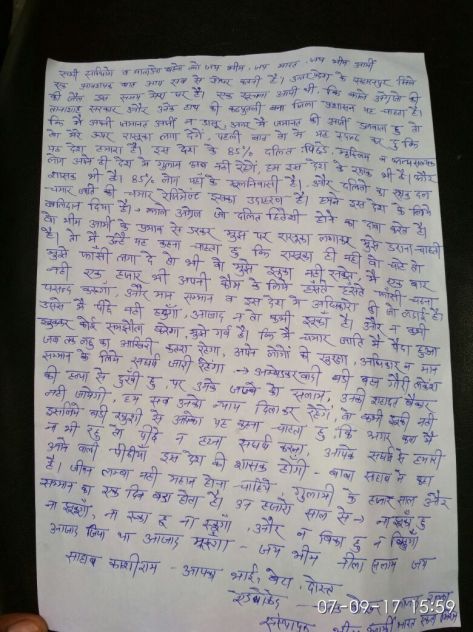
This is an amazing moment. From what we at the Committee for the Defense of Bhim Army have gathered, and from Chandrashekhar’s own letter from Saharanpur District Jail (see below), the administration is moving to slap charges under the National Security Act on Chandrashekhar and other activists. However, while expressing his resolve to fight on, Chandrashekhar also makes it clear in this letter (the facsimile and the text below) that he is equally concerned and saddened at the killing of Gauri Lankesh. He refers to her as his ‘Ambedkarite elder sister’ and pledges to carry forward the struggle to get her justice as well. This is how different dots in the struggle get connected. This is how new nodes of thinking and doing politics emerge. Right now, for us however, the struggle, for the legal defense of Chandrashekhar and other Bhim Army activists is paramount. They want to crush the movement in its infancy and we must ensure it can grow and carry on its struggle for liberation from the yoke of Hinduism and Hindutva.
It is worth placing on record here that when the formation of the Committtee for the Defense of Bhim Army was announced, Gauri had got it touch and expressed her wish to be on the Committee. Unfortunately, that was not to be. But we are sure that this is perhaps the best tribute we can offer to Gauri – carry on the fight for the defense of Bhim Army!
Chandrashekhar’s letter from jail
सभी साथियों व माताओं बहनों को जय भीम जय भारत, जय भीम आर्मी,
 एक आवश्यक बात आप सब से शेयर करनी है उत्तर प्रदेश के सहारनपुर जिले की जेल इस समय मेरा घर है. एक सूचना आई थी की काले अंग्रेजों की तानाशाह सरकार और उनके हाथ की कठपुतली बना जिला प्रशासन यह चाहता है कि मैं अपनी जमानत अर्जी ना डालू अगर मैं जमानत की अर्जी डलवाता हूं तो वो मेरे ऊपर रासुका लगा देंगे.
पहली बात तो मैं यह स्पष्ट कर दूं कि यह देश हमारा है इस देश के 85 % दलित पिछड़े मुस्लिम वह अल्पसंख्या लोग अपने ही देश में गुलाम अब नहीं रहेंगे हम इस देश के Rakshak भी है और शासक भी है 85 % लोग यहां के मूल निवासी है और दलितों का रक्षक दल चमार जाति की चमार रेजिमेंट इनका उदाहरण है हमने इस देश के लिए बलिदान दिया है काले अंग्रेज जो दलित विदेशी होने का दावा करते हैं वह भीम आर्मी के प्रभाव से डरकर मुझ पर रासुका लगाकर मुझे डराना चाहते हैं तो मैं उन्हें यह कहना चाहता हूं कि रासुका ही नहीं वह चाहे तो मुझे फांसी लगा दे तो भी वह मुझे झुका नहीं सकते.
मैं एक बार नहीं एक हजार बार भी अपनी कौम के लिए हंसते हंसते फांसी चढ़ना पसन्द करुगा और मान-सम्मान वे इस देश में अधिकारों की जो लड़ाई है उसे पीछे नहीं हटूंगा. आजाद न तो कभी झुका है और ना कभी झुक  कर कोई समझौता करेगा मुझे गर्व है कि मैं चमार जाति में पैदा हुआ जब तक लहू का आखरी करता रहेगा अपने लोगों की सुरक्षा अधिकार वह मान सम्मान के लिए संघर्ष जारी रहेगा ।।
अंबेडकरवादी बड़ी  बहन गौरी लंकेश की हत्या से दुखी हूं पर इनके जज्बे को सलाम उनकी शहादत बेकार नहीं जाएगी हम सब उनको न्याय दिलाकर रहेंगे वो कभी झुकी नहीं इसलिए बड़ी खुशी से आपको यह कहना चाहता हूं कि अगर कल मैं ना भी रहूं तो पीछे न हटना संघर्ष करना आपके संघर्ष से हमारे आने वाली पीढ़ियां इस देश की शासक होगी बाबा साहब ने कहा जीवन लंबा नहीं महान होना चाहिए गुलामी और सम्मान का एक दिन बड़ा होता है उन हजारों साल से ना झुका हु  ना झुका गा ना रुका हु ना रुकू गा और ना बिका हु ना बिकुगा आजाद जिया था आजाद मरूँगा  जय भीम नीला सलाम जय साहब कांशीराम ।
       आपका भाई बेटा दोस्त
*(एडवोकेट चंद्रशेखर आजाद रावण संस्थापक भीम आर्मी भारत मिशन)*

पाकिस्तान का वर्तमान अब भारत का भविष्य नज़र आने लगा है

शब्द और विचार हर किस्म के कठमुल्लों को बहुत डराते हैं. विचारों से आतंकित लोगों ने अब शब्दों और विचारों के ख़िलाफ़ बंदूक उठा ली है.

New Delhi: Demonstrators hold placards with the picture of journalist Gauri Lankesh during a 'Not In My Name' protest at Jantar Mantar in New Delhi on Thursday. PTI Photo(PTI9_7_2017_000157B)

Gauri, you are more than a memory

You are a direction

For a world that should not be!

– K P Sasi

1
कुछ लोग जीते जी किवदंती बन जाते हैं. कन्नड़ भाषा के अग्रणी हस्ताक्षर पी लंकेश (जन्म 8 मार्च, 1935) ऐसे ही शख़्सियतों में शुमार किए जा सकते हैं. समाजवादी आंदोलन से ताउम्र सम्बद्ध रहे लंकेश, जो कुछ समय तक अंग्रेज़ी के प्रोफेसर भी रहे.

आज भी उनकी अपनी साप्ताहिक पत्रिका ‘लंकेश पत्रिके’ के लिए याद किए जाते हैं, जो उत्पीड़ितों, दलितों, स्त्रियों और समाज में हाशिये के तबकों का एक मंच बनी थी, जिसने कन्नड़ भाषा में आज सक्रिय कई नाम जोड़े, जो उसूल के तहत विज्ञापन नहीं लेती थी और एक समय था जब उसकी खपत हज़ारों में थी और उसके पाठकों की संख्या लाखों में.

लंकेश के बारे में मालूम है कि 25 जनवरी, 2000 को अपने साप्ताहिक का संपादकीय लिख कर सोने चले गए तो फिर जगे ही नहीं. कर्नाटक का समूचा विचारजगत स्तब्ध था. इसे विचित्र संयोग कहा जाना चाहिए कि दिल का दौरा पड़ने से हुई उनकी मौत के सत्रह साल आठ महीने और दस दिन बाद महज कर्नाटक ही नहीं, पूरे देश का विचारजगत स्तब्ध है, जब उनकी बड़ी बेटी गौरी लंकेश की मौत की ख़बर लोगों ने सुनी है, जो हत्यारों की गोलियों का शिकार हुईं.

( Read the full text of the article here : http://thewirehindi.com/18088/gauri-lankesh-murder-fundamentalist-dissent/)


The Need to Integrate the Sciences for an Integral Society: Vikas Bajpai

Guest post by VIKAS BAJPAI

There couldn’t be a more opportune time than the present moment in India’s history for an impassioned cry for science to arise from the scientific community in the country. On the 9th of August 2017 scientists from across India carried out the ‘March for Science’ in twenty six cities with the plea addressed to the Prime Minister of the country demanding that:

the Government to uphold Article 51A of the Constitution and to restrain the attempts that run counter to the development of scientific temper, human values and spirit of inquiry enshrined in the Constitution (Organizing Committees of the India March for Science in different cities, 2017).

It was further stated:

Science is not a set of beliefs. Science tries to understand the laws governing the material world and society following a well-established methodology where nothing is accepted without evidence. Thus science has created a body of knowledge that has been tested by practice, which provides the basis for advancement of society. That is why it is now an established canon of governance that all decisions that impact people’s lives should be based, not on personal beliefs, but on scientific evidence (ibid).

Within days, Avijit Pathak, a sociologist teaching at Delhi’s Jawaharlal Nehru University wrote his piece, the ‘Hubris of Science’ in The Indian Express as a rejoinder to this ‘March for Science’.

Continue reading The Need to Integrate the Sciences for an Integral Society: Vikas Bajpai

Indian State, Society and ‘Public’ Through the Lens of Panchkula Killings : Sanjay Kumar

Guest Post by Sanjay Kumar

Nearly forty people were killed last Friday (25th August) during public disturbances at Panchkula in Haryana after the CBI court verdict in the rape case of Gurmeet Ram-Rahim. Surprisingly, even though these people died in public, till Tuesday, little information was available on how were they killed. The burning, arson and assault by followers of Ram-Rahim hogged the attention of media, state administration and judiciary. Yet, a deafening silence reined on the cause of death of forty people! It is as if the media, state administration, and judiciary, had implicitly assumed that people  indulging in arson after conviction of a rapist deserve to be killed any way. Continue reading Indian State, Society and ‘Public’ Through the Lens of Panchkula Killings : Sanjay Kumar

Literature and Silence: Prasanta Chakravarty

Guest post by PRASANTA CHAKRAVARTY

“Then is Now. The star you steer by is gone, its tremulous thread spun in the hurricane spider floss on my cheek.”
~ Basil Bunting, Briggflatts


“He who writes the work is set aside; he who has written it is dismissed. He who is dismissed, moreover, doesn’t know it. This ignorance preserves him.”
~Maurice Blanchot, The Space of Literature


“Blanchot is even greater waste of time than Proust,” Georges Poulet had famously remarked. Poulet was hinting at the grandeur of wasted time. A ruthless negativity, a rigorous retreat must take on all forms of reparation and facile optimism of human agency. Unconcern must be at the front and centre of our concern. The work of art is. Nothing more. The very idea of elucidation—to dwell upon the actual object that a writer has to offer us—is aesthetically vulgar and politically reactionary. A deep futility marks all perfection. A creation, like Eurydice when Orpheus looks at her, must disappear. The work is remote from itself. It is the incapacity to stop feeling what is not there to be felt.

All quests are echoes. Foreign to presence. Any presence. Quests grasp us rather. But they exclude the writer. He is stupefied. He is idled out of his own work—hence he must go back to work, tirelessly. The lucidity of his insomniac regression keeps on emerging infernally in what we call art. Write he must. But only and solely by being on the verge of his ruinous look back.

Continue reading Literature and Silence: Prasanta Chakravarty

Politics of Convenience and the Anti-Defection Law: Anmolam and Farheen Ahmad

Guest post by ANMOLAM and FARHEEN AHMAD


The ghar-wapsi of Mr. Nitish Kumar and the rupture of the grand alliance in a ‘not-so-grand’ manner came as a major surprise to all. Political pundits have expressed much on it with views ranging from ‘credibility crisis and convenient conscience’ to ‘the anti corruption crusade’. Without getting into debate pertaining to the socio-political ramification of the step taken by Mr Kumar and the political perception generated in this regard, what interests us is the legal framework dealing with the issue. Although, there does not seem to exist definite legal provisions addressing the issue, the closest legislation in this regard is ‘Anti defection’ law. But for specific reasons, the anti-defection law does not seem to provide a remedy in such instances of ‘de facto defections’. Continue reading Politics of Convenience and the Anti-Defection Law: Anmolam and Farheen Ahmad

DISSENT, DEBATE, CREATE