The arrest of yet another alleged bomb-maker with right-wing links should lead to action at last.
When Crimes shoot up, they become invisible.
When pain becomes unbearable, cries are no longer heard.’
—Bertolt Brecht
Can the provocations of a cabinet minister, who openly raises controversial slogans, be considered a “breach of peace” or are they merely attempts to “gauge people’s mood”, as the minister would have us believe? For more than a month, plenty of controversial slogans have been raised on the streets of India. People are being instigated to “kill the traitors to the country” by members of the ruling dispensation, who are issuing open threats in public as the masses are getting angrier against the CAA, NRC and the NPR.
As expected, till date, either no action has been taken by the law and order machinery or there is only an expectation of perfunctory action. This new normal is symptomatic of the rapid erosion of the rule of law in the country. A new normal wherein the chief minister of a state has no qualms in talking of taking “revenge” against protesters while his state’s police unleash unjustified violence on protesters and bystanders alike. Each of their tactics has, for this reason, received widespread condemnation. Even though the strong-arm tactics of the state are failing to pass the test of logic or reasonableness, there is still no change in the ruling dispensation’s attitude.
(A series of protests have been held in Netherlands against CAA by the Indian diaspora since last few days. There was a protest at International Court of Justice ( ICJ) based in Hague on 30 th December. It was the fifth protest in last ten days. Pasted below a statement issued on the occasion.)
Statement for Press Release: ICJ Protest
In light of the recent events in India, a group of Indian diaspora residing in the Netherlands, deeply disturbed by the turn of events have decided to protest against the Government of India before the Peace Palace. The protest is directed against the enactment of Citizenship (Amendment) Act, 2019 (“Act”) followed by gross perpetration of human rights violation against its citizens by the Government of India. Continue reading Statement Issued by ‘Netherlands against CAA’ (Citizenship Amendment Act)→
BJP’s poll promise of Bharat Ratna for Savarkar, who inspired a wide spectrum of fanatic individuals and violent organisations, shows the moral vacuousness of the Hindutva project
“The curious fact is that as we move into the 21st century, historians have become central to politics. We historians are the monopoly suppliers of the past. The only way to modify the past that does not sooner or later go through historians is by destroying the past….Mythology is taking over from knowledge”.
It was in the wee hours of dawn of the 21st century that renowned scholar and historian, Eric Hobsbawm, had talked about the process of “destroying the past” to “modify” it or how “mythology is replacing knowledge” in his speech at Columbia University in New York City.
Much water has flown down the Ganges, the Rheins, the Yangtzes of the world and as we stand at the cusp of the third decade of the 21st century, one realises that how this process — both literally and metaphorically — has advanced to different corners of the globe.
With the ascent of Hindutva supremacist forces in polity and society in this part of the world, perhaps this process has reached its extreme, so much so that every other saffronite seems to have gathered enough confidence to claim legitimacy to any weird thing. The news that the Bharatiya Janata Party (BJP), in its election manifesto (for the Maharashtra Assembly) has promised that it would confer Bharat Ratna, the country’ topmost honour, on VD Savarkar if voted to power, should be seen in this light.
Review of ‘Malevolent Republic : A Short History of New India’ by K. S. Komireddi
‘The idea of a peace-loving, nonviolent India exists, persists, as part of a selectively constructed and assiduously cultivated national self-image in the midst of a society pervaded by social and political violence…’ argued Prof Upinder Singh, in her well-researched voluminous book ‘ Political Violence in Ancient India’ which had appeared around two years back. She had also added that pioneers of independence struggle were instrumental in creating this ‘[m]yth of non-violence in ancient India which obscures a troubled, complex heritage.’
‘Malevolent Republic’ – A Short Hisotry of New India’ by K. S. Komireddi – a commentator, critic and journalist who has written for leading western publications, reminds one of this debate. The book tries to chronicle the trajectory of post-independence India from Nehru to Modi – and does not shy away from raising uncomfortable questions which demand broader contemplation as well as deep soul searching.
Hindutva’s Second Coming by Subhash Gatade; published by Media House, Delhi; 2019; pages: 272; Rs 395 (US $ 18).
The return of Modi to power with a huge margin in this 2019 election is a clear verdict for the Hindutva plank. Why and how it happened leave us, the secular billions, to ponder about the reality and its aftermath. And at that juncture Subhas Gatade’s 272-page analysis titled ‘Hindutva’s Second Coming’ gives us something concrete to think over once again. This in-depth study with rich academic perception is a commendable work, bereft of jargons and convoluted expressions, often found in books written from a high pedestal which goes beyond the mental reach of lay readers. Precisely for this reason the author needs to be specially acclaimed for bringing out facts at one place based on notes and references which are so far scattered in divergent historical materials. It serves as a Reader for millions who are combating communalism and distortion of history at the grassroot level.
This election verdict will have vital ramifications for democracy’s onward journey for decades together, and silencing and further invisibilisation of religious minorities would be its logical outcome.
“The crisis consists precisely in the fact that the old is dying and the new cannot be born; in this interregnum a great variety of morbid symptoms appear.” — – Gramsci
A journalist friends’ prophesy has finally come true.
The day India launched ‘surgical strikes’ across the border supposedly to avenge the Pulwama terror attack, this friend immediately sent a message on a WhatsApp group that Narendra Modi has ensured himself a second term. He stood his ground despite few heated exchanges on the group from Left leaning friends.
In the coming days, this not so expected debacle of the secular camp and the surge of the Hindutva Supremacist camp in newer areas and communities would be further analysed/debated/discussed from various angles. It will be debated why despite the caution expressed by the likes of Amartya Sen, who had concluded how India has taken “a quantum jump in wrong direction since 2014”; how despite being cautioned by leading scholars, intellectuals, scientists of our times that the very idea of India is at stake in the elections, the people in general did not pay any heed to their appeals and have resolved to continue the journey with a renewed frenzy in the same direction or have fully supposedly embraced this idea of ‘New India’ jettisoning the old one. Remember, not only has the Bharatiya Janata Party (BJP) been able to garner more seats than last time but its vote share has also increased more than 5%.
To such a degree has Religion fuelled conflict, complicated politics, retarded social development and impaired human relations across the world, that one is often tempted to propose that Religion is innately an enemy of Humanity, if not indeed of itself a crime against Humanity … it is time that the world adopted a position that refuses to countenance Religion as an acceptable justification for, excuse or extenuation of – crimes against Humanity.
-Wole Soyinka
A modern critique of Sacred Books of any religion — which are worshipped by its followers — is an act which is full of dilemmas.
What should one say if they have references about burning of infidels, permitting a man to marry many women, instructing the rulers to cut somebody’s tongue or pour hot lead into somebody’s ears if s/he sings/listens to religious hymns, ordering a particular section of its devotees to be kept aloof even from places of worship or spotting a ‘divine figure’ engaged in abusing one’s own daughter or harassing women.
Should a critical intellectual just look the other way, pretending that s/he does not see, decide to keep quiet or rationalise such acts to further re-ensure her/his faith or say few things, albeit in a mild tone, that such acts do not match modern values?
And what should a modern state — which claims to be not based on faith — do in such a case? Facilitate flourishing of such critiques or allow faith merchants/fanatics of different shades to criminalise such acts taking recourse to its own statue books.
Going by the track record of past four years of Narendra Modi’s government, the only definitive political narrative today is that of the ruling party, characterized by its brand ideological vehemence/ aggression and paralleled by corresponding ideological ennui in the opposition camp. The fact that there is an astronomical rise in hate crimes against Muslims, Dalits, Women and other minorities, silently supported by large numbers of people, underlines the onset of an ideology, conceptualized by the caste Hindus and institutionalized as Rashtriya SwayamSevak Sangh (RSS).
The electoral success of BJP – the political wing of RSS – only points to a reality which is the logical outcome of the political processes, wherein the Hindu right has been handled with the customary albatross of secularism around all of our necks – defying the social reality of India. In a predominantly caste society, secularism tends to obfuscates real social cleavages and gives preeminence to an idea shaped by the literate elites. That is not to say there is something inherently misplaced with the idea of secularism in this country. Certainly not! On the contrary, it is the dishonesty and the utter insincerity of the India’s political class for whom the politics of secularism remains a mere means to claim political power. Nothing wrong with that too, as long as, this means was directed to its logical end of making an India actually secular. Alas, India’s attempt at constructing a sincere secular society have been halfhearted at its best and nonexistent at its worst, regardless of the secular nostalgia that some people – very sincere and honest people – find themselves attached to.
New Socialist Initiative Condemns Hindutva Engineered and Inspired Atrocities on Dalits
Hardly a day passes without headline news of some or another atrocity on Dalits. On 24 May, a Dalit man in the Ahmedabad district was beaten and his house attacked by a gang of socalled ‘upper’ caste men after he had attached Sinh to his name on his facebook post. On 21 May a dalit ragpicker was beaten to death in a Rajkot factory. Atrocities on Dalits are occurring in the midst of a public ideological environment against them. On 26 May news came of a private school in Delhi asking 8th class students to write a note on how reservations help undeserving and unqualified people for their summer vacation homework. According to National Crime Record Bureau reports for recent years, between 10 to 15 thousand cases of crimes are reported under the Prevention of Atrocities act every year; an average of 35 crimes per day. Many times more crimes actually go unreported. In 2016 Indian courts had over 45 thousand cases under this act. Out of the 4048 cases decided, conviction occurred in 659 cases only. That is, five out of six cases of atrocity against Dalits did not result in any punishment. The number of attacks against one of the weakest and the poorest sections of the society, and the abysmal rate of conviction would put any civilized society to shame, but India chugs along. Continue reading Statement on Atrocities on Dalits : New Socialist Initiative→
The ancient Indian parable of blind men and the elephant, popularized in modern times by John Godfrey Saxe’s nineteenth century poem, has often been deployed in philosophical discourses about the nature of reality and its relationship to sense perception. It has served as a useful metaphor in many an argument about empiricist epistemology, moral relativism, cultural plurality, even religious tolerance. No such usage is intended here. My purpose in starting out with the parable is mostly methodological – how does one put together a vision of the beast based on necessarily partial observations of it. Continue reading To Gain a View of the Elephant – India, History, Modernity, and Marx : Ravi Sinha→
On 30 January 2018, retired civil servants and veterans of the armed forces jointly organised a conclave on ‘Hinduism and Hindutva’ at the Indian Social Institute, New Delhi. The conclave attended by over hundred participants, emphasized the need to rescue both Hinduism and the Indian Constitution from the clutches of the political project that calls itself Hindutva, and which has nothing to do with religion as such. The participants at the conclave sought to make a plea for saving Hinduism without making any concessions to the monstrosity of caste oppression, which in the spirit of many earlier reformers, they rejected.
This conclave followed an earlier one on ‘A Fractured Polity: The
Relevance of Gandhi Today’ organised on 10 October 2017, which had been
addressed by Justice A P Shah, Mrinal Pande and Ramachandra Guha. The
speeches are available on YouTube (Justice A.P. Shah, Mrinal Pande,
Ramachandra Guha). These civil servants and veterans have also raised severe
concerns about the present situation in a series of open letters over the last few
months: on vigilantism and hyper-nationalism; the suspicious death of Justice
Loya; and violence and discrimination against minorities in India. (See: Retired
Civil Servants open letter – 10 June 2017, Armed Forces Veterans open letter –
30 July 2017, Retired Civil Servants Letter 02 December 2017 – Enquiry into
Judge Loya’s death, Armed Forces Veterans letter to Supreme Court & Bombay
High Court on Judge Loya’s death, Retired Civil Servants open letter – 28 January
2018). Continue reading Defend Constitutional Values, Save Hinduism from Hindtuva: For Civil Servants and Armed Forces Veterans→
I went to Maharashtra as I along with other activists and intellectuals were invited to come there. I along with others was a guest there. And I would remember fondly the love and support that I received in Pune and Mumbai. I would remember the resilience and enthusiasm of the people I met and their resoluteness to fight Manuvaad and centuries old casteist tyranny. I would remember the immense inspiration that I felt, when we paid homage to Jyotiba Phule and Savitribai Phule in Phule-wada, Pune. And, No I will not let two days of media trials by a few TV anchors, who are more of professional howlers, spoil these wonderful memories. I will not let their criminal cacophony and mindless vilification of me, Jignesh & others shadow my beautiful memories of Maharashtra.
The state of Maharashtra as well as the rest of the country is at a critical juncture today. On the one hand are forces in power who want to push our country back to many centuries and on the other are people who are resisting this Neo-Peshwahi, the casteist-communal-fascist regime of BJP-RSS. In my speech at Elgar Parishaad on 31st December 2017, I had said that the year 2018 is going to be a very challenging one. The last 3 and half years of the Modi Sarkar has exposed the BJP’s jumlas of Ache Din and Vikas as hollow, bitter and brutal lies.
As the General Elections of 2019 approach, BJP/RSS will now resort to creating civil strife amongst the people, polarising them on the basis of caste and religion and unleashing attacks on muslims and Dalits. The developments over the last few days vindicate me, a little too soon. Several regions of Maharashtra are in the midst of an acute agrarian distress. Both Marathas and Dalits are victims of this agrarian crisis that has been precipitated by the policies of both Modi and Fadnavis. The BJP/RSS regime has no resolution to offer to the farmers of Maharashtra. Therefore, unleashing attacks on Dalits through their hoodlums and portraying it as a caste clash between Dalits & Marathas will remain their only strategy. Continue reading Statement about the attacks on Dalits in Bhima Koregaon & the Subsequent developments in Maharashtra : Umar Khalid→
It was probably late sixties or early seventies – when a gentleman called P N Oak started appearing in Marathi magazines peddling his weird theories about well known monuments in and outside India. An article which made lot of news then was centred around Taj Mahal where it was claimed that it was ‘Tejo Maha Aalay’ or hindu god Shiva’s abode. It tried to establish through various ‘explanations’ that a Shiva Temple was destroyed to build Taj Mahal and if we dig deep we can find ‘remnants’ of the earlier structure. Mr Vinay Katiyar’s latest advice to Uttar Pradesh Chief Minister Yogi Adityanath that he “should go into the Taj Mahal and see the Hindu signs inside it” reminded one of P N Oak. Continue reading Taj Mahal as Tej Mahal – Once again “There is a Bee in the Bonnet”→
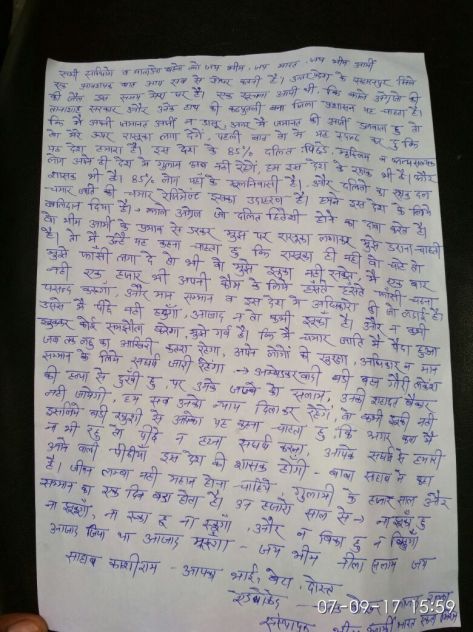
This is an amazing moment. From what we at the Committee for the Defense of Bhim Army have gathered, and from Chandrashekhar’s own letter from Saharanpur District Jail (see below), the administration is moving to slap charges under the National Security Act on Chandrashekhar and other activists. However, while expressing his resolve to fight on, Chandrashekhar also makes it clear in this letter (the facsimile and the text below) that he is equally concerned and saddened at the killing of Gauri Lankesh. He refers to her as his ‘Ambedkarite elder sister’ and pledges to carry forward the struggle to get her justice as well. This is how different dots in the struggle get connected. This is how new nodes of thinking and doing politics emerge. Right now, for us however, the struggle, for the legal defense of Chandrashekhar and other Bhim Army activists is paramount. They want to crush the movement in its infancy and we must ensure it can grow and carry on its struggle for liberation from the yoke of Hinduism and Hindutva.
It is worth placing on record here that when the formation of the Committtee for the Defense of Bhim Army was announced, Gauri had got it touch and expressed her wish to be on the Committee. Unfortunately, that was not to be. But we are sure that this is perhaps the best tribute we can offer to Gauri – carry on the fight for the defense of Bhim Army!
Chandrashekhar’s letter from jail
सभी साथियों व माताओं बहनों को जय भीम जय भारत, जय भीम आर्मी,
एक आवश्यक बात आप सब से शेयर करनी है उत्तर प्रदेश के सहारनपुर जिले की जेल इस समय मेरा घर है. एक सूचना आई थी की काले अंग्रेजों की तानाशाह सरकार और उनके हाथ की कठपुतली बना जिला प्रशासन यह चाहता है कि मैं अपनी जमानत अर्जी ना डालू अगर मैं जमानत की अर्जी डलवाता हूं तो वो मेरे ऊपर रासुका लगा देंगे.
पहली बात तो मैं यह स्पष्ट कर दूं कि यह देश हमारा है इस देश के 85 % दलित पिछड़े मुस्लिम वह अल्पसंख्या लोग अपने ही देश में गुलाम अब नहीं रहेंगे हम इस देश के Rakshak भी है और शासक भी है 85 % लोग यहां के मूल निवासी है और दलितों का रक्षक दल चमार जाति की चमार रेजिमेंट इनका उदाहरण है हमने इस देश के लिए बलिदान दिया है काले अंग्रेज जो दलित विदेशी होने का दावा करते हैं वह भीम आर्मी के प्रभाव से डरकर मुझ पर रासुका लगाकर मुझे डराना चाहते हैं तो मैं उन्हें यह कहना चाहता हूं कि रासुका ही नहीं वह चाहे तो मुझे फांसी लगा दे तो भी वह मुझे झुका नहीं सकते.
मैं एक बार नहीं एक हजार बार भी अपनी कौम के लिए हंसते हंसते फांसी चढ़ना पसन्द करुगा और मान-सम्मान वे इस देश में अधिकारों की जो लड़ाई है उसे पीछे नहीं हटूंगा. आजाद न तो कभी झुका है और ना कभी झुक कर कोई समझौता करेगा मुझे गर्व है कि मैं चमार जाति में पैदा हुआ जब तक लहू का आखरी करता रहेगा अपने लोगों की सुरक्षा अधिकार वह मान सम्मान के लिए संघर्ष जारी रहेगा ।।
अंबेडकरवादी बड़ी बहन गौरी लंकेश की हत्या से दुखी हूं पर इनके जज्बे को सलाम उनकी शहादत बेकार नहीं जाएगी हम सब उनको न्याय दिलाकर रहेंगे वो कभी झुकी नहीं इसलिए बड़ी खुशी से आपको यह कहना चाहता हूं कि अगर कल मैं ना भी रहूं तो पीछे न हटना संघर्ष करना आपके संघर्ष से हमारे आने वाली पीढ़ियां इस देश की शासक होगी बाबा साहब ने कहा जीवन लंबा नहीं महान होना चाहिए गुलामी और सम्मान का एक दिन बड़ा होता है उन हजारों साल से ना झुका हु ना झुका गा ना रुका हु ना रुकू गा और ना बिका हु ना बिकुगा आजाद जिया था आजाद मरूँगा जय भीम नीला सलाम जय साहब कांशीराम ।
आपका भाई बेटा दोस्त
*(एडवोकेट चंद्रशेखर आजाद रावण संस्थापक भीम आर्मी भारत मिशन)*
Present day Hindus are probably the strongest opponents of Marxism. They are horrified at its doctrine of class-struggle. But they forget that India has been not merely the land of class struggle but she has been the land of class wars. – B. R. Ambedkar, Philosophy of Hinduism.
I often find myself in a bind over whether or not to respond to supposed RSS ideologues, given that they simply trade in lies and hatred with the supreme arrogance of ignorance. One such is the upcoming star on the RSS horizon, a gentleman called Rakesh Sinha, who like the rest of his pack (led by the supreme leader) is currently engaged in a cheap attack on the outgoing Vice-President, Hamid Ansari. His piece in the Indian Express today (linked above) is an instance of a combination of all these things. So, why should one bother about such a character? Why take him and his discourse seriously? Well, someone had better respond because, because, for one thing they are in power, and are going to teach generations of students that valorous ‘Hindus’ like Maharana Pratap won all the wars, though by some magic, ‘Muslims’ continued to rule for about 8 centuries! For another, there are enough gullible types who really think these people ‘have a point of view’, which should be debated.
As we have repeatedly seen, their ‘having a point of view’ has nothing to do with debate. It is to be enforced by gangs of gorakshaks, anti-romeo squads, hoodlums deciding what will or will not be taught in universities and schools, what will be written, how people should dress and love – and when nothing works, ‘win’ a ‘debate’ like Arun Jaitley claimed they did, by simply arresting the opponents and slapping sedition charges on them. Given this, I do not really address, in person, the ideologue, Rakesh Sinha, who has now made it a fine art to pick up some phrases from the toolkit of what is understood as ‘postmodernism’ by many. Wasn’t it postmodernism, one can hear them say, that said all viewpoints are equally valid and ‘everything goes’? Wasn’t it postmodernism that challenged the hegemony of Western thought, its logocentrism, its Rationalism (with a capital R) from within that very tradition? Wasn’t it postmodernism again, that by decentering West’s logocentrism, actually gave these RSS-type creatures the gumption to claim that their utterly unsubstantiated viewpoint about the past too was as valid as that of historians who struggled with evidence, painstakingly putting together texts, artefacts and procedures of dating in order to produce a plausible account of the past?
[ A month ago from yesterday, a teenager called Junaid was lynched and murdered on a train in Haryana. Sabiha Farhat writes in the wake of visiting his house and meeting his family. The news cycles may have moved on to other stories, but we need to keep remembering Junaid, and why he was killed. – Kafila]
Once upon a time there was a 15 year old boy called Hamid, who went shopping on the day of Eid with his Eidi . A few days ago there was Junaid who went shopping on the eve of Eid. Premchand’s Hamid was an orphan and lived with his grandmother in extreme poverty. Junaid lived surrounded with love of his brothers, a sister, a doting mother, father and friends. Instead of the old, decrepit house of Hamid, Junaid’s house has two rooms, it is not falling apart but it’s size and unplastered walls, do speak about the economic condition of his family.
As we approached Khandawli, Junaid’s village in Ballabhgarh a fear gripped me. I did not have the courage to walk upto the house. Junaid was brutally murdered on 22nd and here I was on 25th. It was too soon, my mind said. I should have let Eid pass. But how could I have prepared Sewai in my house when a mother like myself had lost a young, healthy, happy child to hindutva fanatics? I am a mother, I was angry and ashamed at home. And here, standing outside Junaid’s door, I was weak and helpless. Useless too.
It was summer of 1985 when we were visiting New Delhi, the national capital of India to attend a wedding in the family. I had a long hair back then and was aged 15. Both me and my uncle who were wearing turbans like other Sikh men were waiting at a bus stand for the next bus to go to our relatives. As soon as the bus arrived and we were about to climb in after other waiting passengers, the door was slammed on us. When my uncle protested, the conductor shouted that there is no seat inside. Even as we pointed out at some empty seats, the answer was – “we have told you there is no seat.” Before we could argue the bus sped away.
My life has revolved around the concept of God. I have been a Muslim, a theist, an agnostic and an atheist in all types of phases of my life. I am sure, I am still just growing and my perceptions will mature as I grow. My Muslim identity slowly faded when I picked Dawkins and Ayaan Hirsi Ali in my late teens. To put it simply I was a perpetually angry Muslim. Angry at Islam, angry at Wahabism, angry at imposed patriarchy in Islam. I believed religion was so bad for the world, so unscientific. And so I wrote and I discussed with my fellow Hindu friends. They opened their hearts out. A lot of them told me how Muslims were always cruel and misogynistic. And they told me how I was different to see the truth. I felt a sense of moral superiority, I felt I was so unbiased and rational that I could see faults in my own religion. Continue reading A Non-believing Muslim’s Experience of Islamophobia→
These are tough times for muslims in India. But now that I look back and shed my ‘liberal’ prejudices – muslims were never acceptable as ‘who they were’ in Indian society. I had always blamed my mother for not giving me proper lunch box to carry to school. But the truth is that even in class 5, no student ate from my tiffin and gradually I started going to the play field in recess rather than enjoying a meal under the big Peepal tree. After that I took tiffin only when I prepared it myself, that was class 11 & 12. But even then the girls would hardly eat from my lunch box. We did sit together but no one touched my food. Was I the Untouchable?
The following, necessarily brief, reflections have been sparked off by two recent posts on Kafila – one by Biju Mathew published on 16 April, and the other by CP Geevan, published today. These reflections should not be seen as a response to the positions taken by Biju and/ or Geevan; they are, in fact, more in the way of addressing the central question raised by Biju Mathew’s piece – that of despondency and pessimism that has followed the UP elections and more importantly, the stealthy manner in which Adityanath was installed as the chief minister in the state. Stealthy, because after all, it was amply clear even to the decision makers in BJP, from the very beginning that if they had entered the election campaign with Adityanath as the chief ministerial face, it might have yielded very different results. It was too big a risk to be undertaken.The real stroke of Modi-fascist genius lay precisely in keeping not just the electorate but also the organizational machinery in the dark and turning it into an advantage.
As it happens, despite the sharpness of Geevan’s comments, my sense, on reading the two pieces, is that there isn’t really as great a divergence on most issues as might appear at first sight.
The following is a response to the piece by Biju Mathew on Kafila, underlining the need for single-minded focus and keep the feet firmly on political realities
Given the exuberant optimism that Biju Mathew evokes in these dark days, many of us afflicted by malignant pessimism should not have many reasons to complain or pick holes in this view of looking back and foreseeing the way forward. On the face of it, this article does gladden one’s heart and spirit! However, imagining larger than life attributes to struggles and spells of resistance can be very misleading. In a way, with a rather benevolent interpretation, one cannot quarrel with Biju’s contention that nobody needs to wait for some political party to lead the resistances against the far-right takeover or start the process of breaking the ‘wave’. There is no hesitation in agreeing with the proposition that instead of waiting, which carries the risk of waiting indefinitely, it is imperative that each individual who is appalled at the turn of events must contribute urgently to building ‘innovative and locally responsive actions’. Well, inaction is certainly not an option. Act we must – in the face of the frightening likelihood of the saffron brigade unleashing a horrific civil war and engineering mass killings. There are no quarrels as to the primary intent of the article – that it is a call to shed excessive pessimism, end despondency, and take steps towards politically meaningful actions. Nevertheless, it will be a big mistake to imply that the process of banishing the gloom need not extend to the political rivals of the Hindutva nationalist parties. Continue reading Thinking Past the BJP Victory in UP – Response to Biju Mathew: C.P. Geevan→





 KAFILA - COLLECTIVE EXPLORATIONS SINCE 2006