
By now everyone knows what the Sanghis, probably not just outside Kerala, but also inside, have been up to when others were battling the deluge, saving lives, working round the clock to organize relief: making Lord Ayappan look like a stupid brat (or, actually, painting him in their likeness), spreading idiotic claims that only the rich were affected, or that the Christians/Muslims/commies/everyone who isn’t a Hindutva bigot, are responsible for this catastrophe, and circulating fake photos, from relief work in Gujarat or somewhere else as RSS relief work for Kerala. Really, how we wish we could persuade them all to migrate to the Hindi heartland where ecological disasters are unheard of and will never ever be! Continue reading A List of Little-Knowledge Theories about Kerala in the Wake of this Disaster
Category Archives: Bad ideas
A letter to Sanghiannan in the wake of our common woe
[Before you read this post, you might want to read KR Meera’s brilliant portrait of the average Malayali middle-class Sangh supporter, in her story Sanghiannan, which I translated as ‘My Brother Sanghi’, published by Juggernaut at : https://www.juggernaut.in/books/088d472b19d745d29492560654250e15 . I recommend this also because she sketches beautifully the spirit of deep compassion that inheres in the thought of Sreenarayana Guru, who tried to imagine the faith outside the brahmanical framework of caste. This will help you to get a sense of that section of Malayali middle class I address here.]

Continue reading A letter to Sanghiannan in the wake of our common woe
Beware of Poisoning-Eating Maggots in Flood-Hit Kerala
In Malayalam, the usual way of referring to virulence that feeds on negative experience is paashaanathil krmi — or the maggot that is fattened by poison, instead of getting killed by it. Over the past few days, many of us have lived completely on the edge, bereft of sleep or ease, tossing about in a seemingly-unending nightmare, as the rain, floods, and landslides uproot not just our physical world, but the very culture of smugness and complacency that took over our deepest selves over the past twenty years or so. Continue reading Beware of Poisoning-Eating Maggots in Flood-Hit Kerala
Fascinating Manu
It is easy to see the linkages between Manu, Nietzsche, Hitler and the worldview of Hindutva supremacism
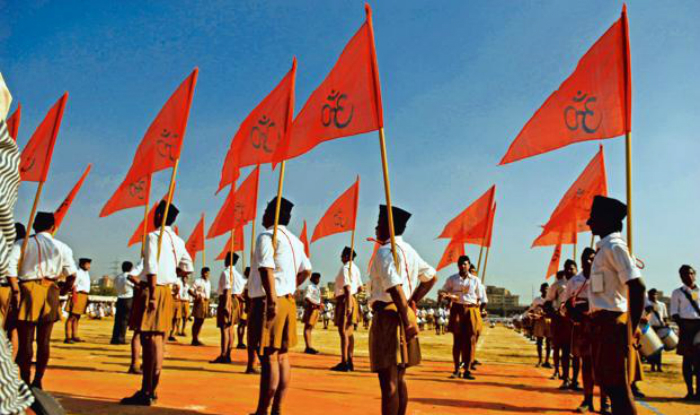
Manu and his ‘magnum opus’ Manusmriti keeps hogging headlines in the 21st century as well.
Thanks to the fascination it still holds among the Hindutva supremacists of various kinds even around seventy years after the promulgation of Constitution, which in the words of Dr Ambedkar, had “ended the rule by Manu”.
The latest to join the ‘mission glorification’ of Manusmritihappens to be another stalwart from the Hindutva brigade, called Sambhaji Bhide, the leader of Shivpratishthan Sangathan, who also happens to be an accused in the Bhima Koregaon case. Addressing his followers known as dharkaris (believers of violence) – as opposed to varkaris(who go to Pandharpur from Pune on foot), he exhorted them to disseminate Hindu religion and form Hindu Nation. He also added how ‘Manusmriti was superior to the teachings of saints Dnyaneshwar and Tukaram’.
( Read the full article here : https://newsclick.in/fascinating-manu)
Who feeds whom? Reflections on the Left responses to the Abhimanyu murder case
The recent murder of an SFI activist, Abhimanyu, at the Maharajah’s College, Ernakulam, allegedly by activists of another student organization, the Campus Front, has once again triggered a series of intense campaigns against the Popular Front of India (PFI), which is accused of having terror links, even with the ISIS. This last claim has become commonsense almost impossible to contest.
Continue reading Who feeds whom? Reflections on the Left responses to the Abhimanyu murder case
അഭിമന്യുവധം ഉയർത്തുന്ന കാതലായ പ്രശ്നം
സത്യം പറഞ്ഞാൽ അഭിമന്യു എന്ന വിദ്യാർത്ഥിയുടെ ഞെട്ടിക്കുന്ന കൊലപാതകത്തിനു ശേഷം ആ ചെറുപ്പക്കാരൻറെ മാതാവിൻറെ വിലാപം മാത്രമാണ് ഇപ്പോഴും മുഴങ്ങിക്കേൾക്കുന്നത്. ആ ശബ്ദം മനസ്സിൽ നിന്ന് മായുന്നതേയില്ല.
“Selfless Patriot” – In Search of the Real Shyama Prasad Mukherjee
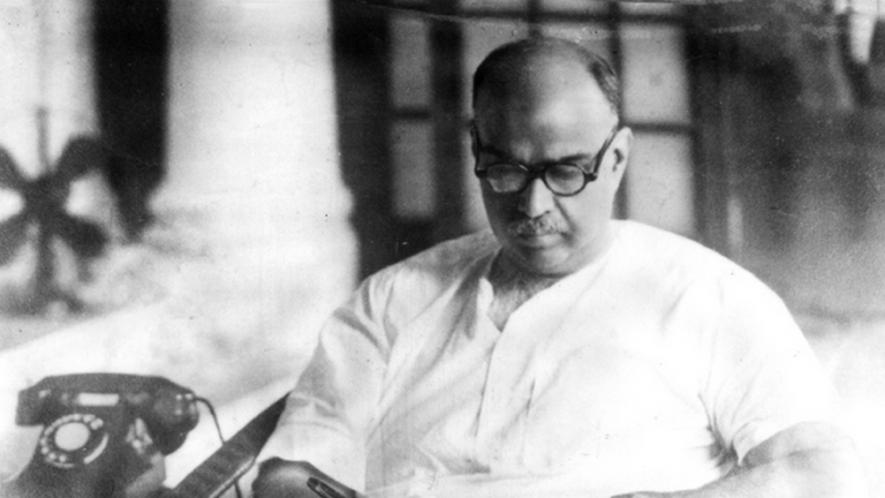
“It has been said with good reason that the Jana Sangh resulted from a combination of a partyless leader, Syama Prasad Mookerjee, and a leaderless party, the RSS”.
(The Jana Sangh: A Biography of an Indian Political Party, by Craig Baxter p. 54)
1.
In Search of the “Selfless Patriot”
An untimely death of a political leader — whose career is just blossoming — is always a loss to the party they belong to, the ideology they espouse, or the cause(s) they pursue. It also leaves the field open for political pundits of different shades to make all sorts of speculations, or to involve themselves in endless deliberations about what would have been the future of the formation if the said person hadn’t died.
The death of Shyama Prasad Mukherjee (06 July 1901 – 23 June 1953), founder of Bharatiya Jana Sangh (precursor to the BJP), at the relatively young age of 52 years, can be considered one such loss for the project he had undertaken. One cannot stop thinking about how the party he helped found after resigning from Hindu Mahasabha would have developed had he remained alive. His differences with the Hindu Mahasabha, which he even led in 1944, were political in nature, and stemmed from the considered opinion that it abandoned its exclusivist character.
However, to his legatees, who are always bothered very little by the nuances and niceties, he is a leader who provides them a fig leaf to counter the criticism that they had played no role in freedom struggle, or had no place in the comprehensive list of ‘makers of modern India’. Their ascension to the citadel of power has provided them with ample opportunity to project him as a key figure in the ‘Making of India’. (https://thewire.in/politics/search-syama-prasad-mookerjee-true-patriot)
In addition to that, by repeatedly claiming that ‘history failed to serve justice to Mukherjee,’ they are able to easily target Jawaharlal Nehru, the first Prime Minister of India, who played the key role in institutionalising democracy after the assassination of Mahatma Gandhi and early demise of Sardar Patel, and was aware that any leeway to Hindu Supremacist ideology would lead India into becoming a mirror image of Pakistan — a Hindu Pakistan.
( Read the full article here : https://newsclick.in/selfless-patriot)
Statement of Jadavpur University Alumni Against University Decision to Scrap Entrance Examinations
Following is a statement of Jadavpur University alumni on the current controversy around the scrapping of the entrance examination by the university authorities.
There is also a Change.org petition that has been put up for those wanting to sign. Over 5075 people have signed the petition at last count.
We, the alumni of Jadavpur University, unequivocally condemn the decision of the authorities to not conduct entrance examinations for admission to the university’s Bachelor of Arts programme.
Several departments of the Jadavpur Arts Faculty annually conduct their own entrance examinations. For the last forty years, teachers have carefully prepared question papers and rigorously evaluated the answers in order to admit the candidates that they deem fit. The tradition of the entrance examination, in which thousands of students participate every year, has ensured that the Faculty of Arts continues its legacy of academic excellence. No weightage is given to Board examination marks because the Boards’ prescribed methods of arts education and evaluation simply do not match those of tertiary education in the humanities. The entrance examinations test students for their interest in literature, history, philosophy and arts, their ability to think independently about texts, and their commitment to understanding the world around them using the skills of reasoning and speculation, the theoretical and methodological capital furnished by the humanities.
The entrance examination has enabled these departments to gain talented students year after year. Many of us would have never made it to the top-ranked Arts departments in the country had we been judged solely on the basis of our marks in school-leaving examinations. Admissions based on Board exam scores would have never enabled students from varied cultural, class and economic backgrounds to be trained in the humanities by the best minds in the country. The rich and diverse professional accomplishments of Jadavpur University alumni – in art, academia, film, entrepreneurship, publishing, writing, advertising and many other fields – constitute a further testament to the success of these departments in scouting and honing talent. First-person accounts of how the erstwhile admissions process created equality of opportunity and access for students from across a range of social and educational backgrounds have poured in from Jadavpur alumni since yesterday (3/7/2018). (To read personal testimonials and opinion pieces from faculty, alumni, staff and current students regarding the significance of the admission process, visit https://juforadmissiontest.wordpress.com/)
The admission test is a time-tested process which has ensured academic excellence in the Faculty of Arts and brought glory to the university. To tamper with this process is to threaten the very core of the humanities – to attack free thinking, liberty, and equality of opportunity. It directly undermines the dreams and hopes of the 17,000-odd students who have applied to Jadavpur University this year. Among these 17,000, there must be brilliant young minds that couldn’t obtain 90% or more in the Board examinations. Their merit cannot be reliably boxed into multiple-choice questions. There must be, in those 17,000, young people who do not seek conventional careers, or if they do, wish to combine them with independent thinking, exploring and lifelong learning.
To stop the admission test is to kill the dreams of anyone who does not participate in the mad rat race of public examinations. It is an attack on the community of scholars, researchers, teachers, alumni, students, and staff who have carefully built up the university and its reputation over the years. To stop the admission test is to tear into the very fabric of the university – its tradition and its history. We must recall that Jadavpur University was set up as an alternative to the education imparted by the erstwhile rulers of India, the British. It has always been home to those who dare to defy norms.
The larger implications of this administrative decision concern the scope and function of higher education in this country. Do we, as a nation, wish to create a more homogenised and technocratic culture that rewards learning by rote, or do we wish to invest in greater autonomy for centres of excellence? Difference and dissent are what all democracies should aspire to; they are the touchstones of any free and open society, and any administration that encourages these tendencies signals its confidence in itself and hope for the future. What we are seeing here is, accidentally or not, congruent with a larger attempt to fundamentally redefine the idea of higher education, to increase administrative interference in universities large and small, more and less prominent (similar conflicts are playing out in JNU, to cite just one example) and to condemn generations of young people to the backwaters of real learning, thought and creativity.
As concerned alumni, we strongly condemn the decision of the authorities to take away independent admission tests from the Faculty of Arts. We demand an immediate revocation of this order, which irrationally, pointlessly, and appallingly undertakes to disrupt a fair and successful admission process. This disruption will impact the futures of countless students, and reduce the entry-point of tertiary education in the humanities to a lottery.
We stand in solidarity with the protesting teachers, students and staff of Jadavpur University. Continue reading Statement of Jadavpur University Alumni Against University Decision to Scrap Entrance Examinations
US scholars of South Asia should boycott Indian Ministers and Officials Attacking Academic Freedom: Nandini Sundar
Kafila had earlier published a letter to Association of Asian Studies (AAS) protesting the exclusion of Pakistani scholars from its conference in Delhi, because the Government of India refused visas to them.
Nandini Sundar, in an article in The Wire, explores the complex ramifications of this issue and urges a more consistent position from scholars that would recognize and resist a) the manner in which the Indian state and Indian capital are embroiled in South Asia studies in the US academy and b) the travel ban in the US that equally excludes scholars from seven countries from participating in academic conferences held in the US.
Regarding the US travel ban, there was an international call in early 2017 for an academic boycott of international conferences held in the US, which I had supported, and renew my support to, after the recent Supreme Court decision upholding the travel ban.
And now read Nandini Sundar in The Wire:
As an India-based scholar, as someone who is not a member of the Association for Asian Studies (AAS), which is primarily located in the US though it has 7,000 members worldwide, and someone who had no plans of attending the AAS-in-Asia conference in Delhi (July 4-8, 2018), the boycott call against the AAS-in-Asia is not something that would ordinarily bother me.
The boycott call arose out of the government of India’s refusal to allow Pakistani scholars to attend the AAS meeting; and the AAS’s failure to take a strong public stand against this and inform its members in a timely fashion so that they could make their own choices about whether to attend while Pakistani scholars were being denied. 649 scholars protested against what appeared to be the AAS’s and the local host, Ashoka University’s quiescence in an unacceptable restriction on academic freedom. I was one of them, even though my primary anger was with the government of India, and not with the AAS. However, feeling that this was not enough, over 200 of the signatories have also decided to boycott the conference, arguing that the AAS should have had the courage to cancel the conference altogether rather than submit to the ban.
CONTINUE READING THIS ARTICLE HERE.
The Monks Who Spew Hate
Why Jailing of Gnanasara Did Not Become News in This Part of Asia
“Ordered disorder, planned caprice, And dehumanised humanity…”
– Bertolt Brecht in The Exception and the Rule (quoted in The Sunday Leader)
“I have done my duty towards the country,” Gnanasara told reporters as he boarded the bus taking him to prison. Why should I regret?”
Rarely does Sri Lanka convict Buddhist monks.
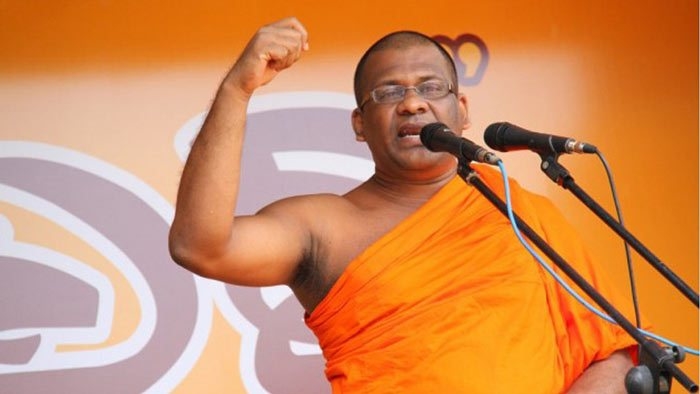
But few days back a court in Sri Lanka made history when it convicted Galagoda Aththe Gnanasara, the controversial leader of Bodu Bala Sena (Buddhist Power Force) who is referred to as ‘Thero’, The Venerable, and sent him to jail. Scores of his followers, mainly Buddhist monks, were reciting Buddhist prayers when he was being arrested and packed in to the police vehicle.
Reports tell us that Sri Lanka is still facing mini-turmoil over this conviction.
Marches were organised in different cities of Sri Lanka demanding that President pardons him using his special powers. Protesters have also asked that this revered monk should not be forced to wear jail uniform and be allowed to wear saffron robes only.
For people outside Sri Lanka, it would be rather difficult to understand why a Buddhist monk has suddenly become such a polarising figure in the society there.
( Read the full article here : https://newsclick.in/monks-who-spew-hate)
The Man Who Once Sold Tea Later ‘Sold’ Dreams
This is not the story of a man who once sold tea and later ‘sold’ dreams to a people and managed to reach top echelons of power in the biggest democracy in the world.
This is not the story of this man and his rise from the margins of a organisation which is called the biggest cultural organisation in the world nor it is revisiting stories of ‘bravery and fearlessness of his childhood’ (https://www.news18.com/news/buzz/bal-narendra-in-pics-comic-book-shows-fearless-young-narendra-modi-saving-drowning-boy-taking-on-crocodiles-bullies-676841.html) which can marvel a bollywood film or his alleged wanderings in the Himalayas in search of a guru or to fulfill his spiritual quest.
This is also not a recap of the role played by an international PR agency which was appointed by him á decade back to “seek professional and rare expertise” in reaching out to broadest mass of people with a fresh message.
This is also not to revisit this man’s thoughts which find mention in his book which compare the work of cleaning an ‘experience in spirituality.'(https://www.countercurrents.org/gatade010313.htm)
This is also not the story of this man who abandoned his legally married wife merely few months after their union and this is no exercise in telling you that he never went back to enquire about her nor he took initiative to formalise the separation.
This is also not to repeat the fact ad nauseum that he never disclosed his marital status to the outside world so much so that even one of his own deputies – who had worked with him for more than two decades – did not have any clarity over this aspect of his life. (https://www.ndtv.com/india-news/he-is-ram-for-me-pm-modis-wife-corrects-anandiben-patels-on-marital-status-1870700?pfrom=home-trending). Lesser mortals like us would remain baffled why the silence continued to reign all these years.
May be he suffered from selective amnesia for a long duration in his life or was supposedly so engrossed in the work that he considered working for the ‘nation’ that he even forgot to mention it to others. May be the organisation with which he worked frowned upon any such union and he desisted from sharing the news.
This is also not to share with you that when the need arose and he was expected to put the matters straight he supposedly faced Hamlet’s paradox about his being married or not married and preferred to remain ambiguous.This is no comment on those people who could question this ambiguity, who were in seats of power, also preferred to look the other way or maintained silence.
This is also not to tell you that when he toured the country mobilising people to march on the citadels of power – to break the monopoly of the dynasts – he had no qualms in maintaining an ambiguity about his own life. And this style still continues. In fact, once he even told the people that “he is basically a ‘faqir’, a man of god, with no worldly attachment or possession and that it would not take him a moment to leave his office and go away.” (https://www.nationalheraldindia.com/opinion/narendra-modi-his-speeches-and-politics-the-art-of-public-speaking)
This is no attempt to tell you that few years back his selective amnesia or his ambiguity vis-a-vis his marital status was finally over and he formally acknowledged that he was ‘married’.
This is also not to tell you that for all those people who looked at him as a ‘messiah’ – who adored him – who voted for him in overwheling numbes, who supported him ; did not complain at all even when they came to know that he had been very selective with his words while describing his marital status.
This is also not a comment on the immense tolerance level of the people, that they preferred to nod their head even when one of his deputy frankly admitted that one of his key promises to win over people was merely a ‘jumla’.
This little note has nothing to add to all these things and many more which are available in public domain.
May be later day historians would be able to throw light on them better or sit in a judgement. May be they would able to say whether he was really the ‘visionary statesman’ India waited or was a modern day reincarnation of a medieval king who had decreed to shift India’s capital without larger consultation.
This just to tell you that the woman he abandoned
- who waited for him all the decades of his life
- who just yearned that she at least has a glimpse of his vast house where he is supposedly guarded by hundreds of security people
- whose application for passport was rejected as she has no marriage certificate (http://www.thehindu.com/news/national/no-passport-for-narendra-modis-wife-as-she-has-no-marriage-certificate/article7855384.ece)
- who suffered silently all these years for no fault of hers and continued to live with her brother’s family
This woman still worships him as a god. (https://www.ndtv.com/india-news/he-is-ram-for-me-pm-modis-wife-corrects-anandiben-patels-on-marital-status-1870700?pfrom=home-trending)
Do not know why ?…
Do not know why ?…
Do not know why ?
Statement from Tata Institute of Social Sciences (TISS) Students, Alumni, Faculty and Staff on arbitrary arrests of academics and activists
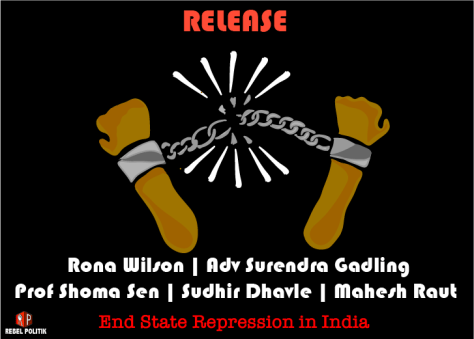
Statement from Tata Institute of Social Sciences (TISS) Students, Alumni, Faculty and Staff
We, the undersigned students, alumni, faculty, staff and other members of the TISS community stand with Mahesh Raut and the four other activists who have been arrested unfairly and demand their immediate and unconditional release.
On the morning of June 6th, 2018, the Pune Police investigating the Bhima Koregaon case arrested Mr. Mahesh Raut. Mahesh is an alumnus of TISS, a former fellow at the prestigious Prime Minister’s Rural Development Programme (PMRD) and an anti-displacement activist working with gram sabhas on implementation of laws like PESA (Panchayat Extension
to Scheduled Areas) and FRA (Forest Rights Act). He was arrested from Nagpur, where he had been staying for his ongoing medical treatment. On the same day, the premises of Mr. Sudhir Dhawale, Dalit activist and editor of Marathi magazine Vidrohi, Professor Shoma Sen, Head of the English literature department at Nagpur University, Advocate Surendra Gadling, general secretary of Indian Association of People’s Lawyers (IAPL), and Mr. Rona Wilson, secretary of the Committee for Release of Political Prisoners (CRPP) were raided and they were arrested too. Even as the police informed that they were being picked up in connection to the Bhima Koregaon case, the media started releasing news about them being ‘top urban Maoist
operatives’. Continue reading Statement from Tata Institute of Social Sciences (TISS) Students, Alumni, Faculty and Staff on arbitrary arrests of academics and activists
Statement on Atrocities on Dalits : New Socialist Initiative
Guest Post by New Socialist Initiative
New Socialist Initiative Condemns Hindutva Engineered and Inspired Atrocities on Dalits
Hardly a day passes without headline news of some or another atrocity on Dalits. On 24 May, a Dalit man in the Ahmedabad district was beaten and his house attacked by a gang of socalled ‘upper’ caste men after he had attached Sinh to his name on his facebook post. On 21 May a dalit ragpicker was beaten to death in a Rajkot factory. Atrocities on Dalits are occurring in the midst of a public ideological environment against them. On 26 May news came of a private school in Delhi asking 8th class students to write a note on how reservations help undeserving and unqualified people for their summer vacation homework. According to National Crime Record Bureau reports for recent years, between 10 to 15 thousand cases of crimes are reported under the Prevention of Atrocities act every year; an average of 35 crimes per day. Many times more crimes actually go unreported. In 2016 Indian courts had over 45 thousand cases under this act. Out of the 4048 cases decided, conviction occurred in 659 cases only. That is, five out of six cases of atrocity against Dalits did not result in any punishment. The number of attacks against one of the weakest and the poorest sections of the society, and the abysmal rate of conviction would put any civilized society to shame, but India chugs along. Continue reading Statement on Atrocities on Dalits : New Socialist Initiative
The Karnataka Moment and the Search for a ‘Bonapartist’ Figure – Looking at 2019
There are enough reasons for for the upbeat and celebratory mood in the anti-BJP-RSS camp following the resignation of BS Yeddyurappa even before the floor test. After all, for once, the game plan of the Modi-Shah duo fell flat, thanks in no small measure, to the Supreme Court’s intervention in directing that the floor test be done by 19 May, knocking down the (RSS) Governor’s initial provision of 15 days to the government to prove its majority. In a manner of speaking, we escaped just by the skin of our teeth.
Both the parties concerned – the Congress and the Janata Dal (S) – were on tenterhooks throughout and the surreal accounts of the high drama of the past three days read like they could be about the nether worlds of crime and mafias. Offers to buy off MLAs with money ranging from Rs 5 crores and a ministry to Rs 100 crores have openly been alleged but these were the relatively minor matters. Congress and JD (S) MLAs were not allowed to leave Bengaluru as their chartered flights were ‘denied permission’. [An MLA, in fact told the Times of India, in the same report linked here that by manipulating resources, the BJP had ‘caged us’ in the state]. Their security cover was withdrawn. The management of the resort in Kochi (another state, not even ruled by the BJP) they had booked into by the Central leadership, actually backed out stating that they were under tremendous pressure. Then began the trip by road to Hyderabad, where eventually, it was the Telengana police that ensured their safety. Stories of individual MLAs, either being offered with withdrawal of pending cases or being threatened with harassment with new ones have also been doing the rounds. And for those who have been following what has been happening to the AAP MLAs in Delhi, nothing of this should be unbelievable.
Continue reading The Karnataka Moment and the Search for a ‘Bonapartist’ Figure – Looking at 2019
Against the Yawning Jaws of Hell: Protest Against Hate on 23 April
After the Modi government came to power, citizens of this country have seen gate after gate of Hell — the Narakas — open relentlessly to suck them in mercilessly or condemn them to be helpless spectators to unspeakable acts of injustice and violence. We have by now crossed the Arbudanaraka and the Nirarbudanaraka many times; the ordeal of having to watch evil unfold in the attacks on people in the name of what they eat, how they love, what they speak, who they pray to, which caste they were born into, what gender was assigned to them at birth — the list is growing day by day. We seem to be reduced to waiting endlessly at the doorsteps of police stations, courts, morgues, nearly overpowered by the stench of power and majoritarian hubris, fighting to stay conscious, waiting for the dead, broken, defiled, or dismembered bodies of our kin, our friends, neighbours, people. For instance, can one ever forget how we stood in sheer anxiety outside the Supreme Court, truly like souls awaiting judgment at the gates of Vaikuntam, reduced to droplets of pure worry? Those of us who fought for Hadiya’s rights can hardly forget.
Continue reading Against the Yawning Jaws of Hell: Protest Against Hate on 23 April
ज़ुबां पर आंबेडकर, दिल में मनु

एससी/एसटी एक्ट को कमज़ोर करने के ख़िलाफ़ बुलाए गए भारत बंद का दृश्य. (फोटो: पीटीआई)
2 अप्रैल का ऐतिहासिक भारत बंद लंबे समय तक याद किया जाएगा. जब बिना किसी बड़ी पार्टी के आह्वान के लाखों लाख दलित एवं वंचित भारत की सड़कों पर उतरें और उन्होंने अपने संघर्ष एवं अपने जज्बे से एक नई नजीर कायम की.
आजादी के सत्तर सालों में यह पहला मौका था कि किसी अदालती आदेश ने ऐसी व्यापक प्रतिक्रिया को जन्म दिया था. ध्यान रहे कि इस आंदोलन के दौरान हिंसा हुई और चंद निरपराधों की जानें गईं, उसे कहीं से भी उचित नहीं कहा जा सकता!
मगर क्या इसी वजह से व्यापक जनाक्रोश की इस अभिव्यक्ति ने उजागर किए सवालों की अहमियत कम हो जाती है? निश्चित ही नहीं!
वैसे इन तथ्यों की पड़ताल करना भी समीचीन होगा कि (जैसा कि कई स्वतंत्र विश्लेषणों में स्पष्ट किया गया है) कई स्थानों पर इस हिंसा के पीछे दक्षिणपंथी संगठनों एवं उनके कारिंदों का हाथ था, जो दलित उभार को कुचलना चाहते थे तथा साथ ही साथ उसे बदनाम करना चाहते थे. ( Click here for the full article :http://thewirehindi.com/39182/sc-st-act-dalit-agitation-narendra-modi-government/)
[Statement] In solidarity with students and faculty at JNU
The following statement has been signed by students and faculty from universities across the world. You may sign on by adding your name in the comments section.
In solidarity with the School of Arts and Aesthetics, JNU
We, the undersigned students and faculty members in art history, cinema studies, and other concerned academic departments across the world, are writing in protest against the recent removal of Prof. Kavita Singh from her position as Dean of the School of Arts and Aesthetics (SAA) at Jawaharlal Nehru University (JNU) in New Delhi. This represents a serious attack on academic freedom, a blatant disregard for due process, and a worrying precedent being set by the University’s Vice Chancellor to silence and repress reasoned, principled dissent and disagreement. As students and scholars who have learned a great deal from Prof. Singh’s scholarship and benefited from the cutting-edge research fostered at SAA, we stand in solidarity with its students and faculty as they strike to protect the school’s autonomy from the brazenly undemocratic acts being carried out by the current Vice Chancellor.
Continue reading [Statement] In solidarity with students and faculty at JNU
Breastfeeling, not Breastfeeding
The raging controversy over the cover of a breastfeeding woman looking up with no shame about her exposed breast has, quite expectedly, sent conservative fools in Kerala into a raving frenzy. The case against the model and the conservative breast-beating going on now must be dismissed summarily as useless bullshit.
However, I must say that I had very mixed feelings about the cover and the defense offered for it by many. For many arguing in its defense seem to be saying that all one needs is gratefulness for the effort to open up the issue and the space gained, and all else raised isn’t really worth the trouble. Even this intelligent piece in the Ladies Finger slides into such complacency.
If you ask me, this cover is not of a woman breastfeeding, but of one who is declaring her determination to be comfortable while breastfeeding, thereby reinforcing her commitment to breastfeed her baby. I think this difference is important. Breastfeeding is a very intimate act; it is highly physical. If the mother and child are well, happy, and don’t have issues that may make this feel like a chore or hard to do, then it is very highly pleasurable too. As a woman who has breastfed continuously for 9 years with just a short break of a few months during my second pregnancy, I can say this: breastfeeding is also ‘breastfeeling’, so your attention is on the act, and you really don’t want to focus on anything else, especially irritating stares. It is as pleasurable as lovemaking. Many years later (my daughters are 25 and 20 this year), when I remember the act, my nipples rise, tingling. Breastfeeding was also play time, when the little one played with her mum’s breast with her tiny fingers feeling and squeezing it; and my younger one was especially playful, twisting her tiny body in sheer pleasure, and sometimes, remaining still and then naughtily sinking her little tooth into the nipple, rolling her eyes up to check the reaction from her mum! So when we traveled, I always carried a big, opaque duppatta with which I made a ‘tent’ over our heads that covered us completely. We would be sitting in a corner seat in the train, and having fun, she sitting on my lap (and later the tent would be big enough for the three of us, myself, my six-year-old, and one-year-old, the former listening to a story, and the latter happily suckling). We would sing, tickle, do what not. Demanding the freedom to breastfeed without being too bothered about modesty and in public without anyone staring, for me, then, is demanding the right to such intimate pleasure in public. In that sense, this should have been one of the afterlives of Kerala’s Kiss of Love protests.

However, the sartorial codes of the model make me feel very disconcerted. Sharanya Gopinathan, in the above piece, argues that Grihalakshmi caters to largely savarna women probably. But no, savarna women are not the demographic majority, and they are possibly not the dominant section in the magazine’s readership. But savarna culture is pervasive in Kerala, cutting across caste and faith, and the cover clearly panders to it. The model’s huge sindoor — mark you, wearing the sindoor is a very recent import from the north to Kerala, the demure-looking sari, and the girl-next-door look was probably calculated to make up for the exposure of the breast. So we have a young woman who announces through her sindoor that she is married — legally and customarily penetrated, to adopt a Foucaldian way with words — and modestly dressed, that she belongs to the elite, evident in her professionally-groomed looks, and also tells the world that she is determined to breastfeed no matter how much the lechs stare. Intended or not, it brings to the mind too readily the dream-girl of the Hindutva modernist vanguard: the educated woman, maybe even a corporate professional, with looks that fit that environment, who is determined to mother well and indeed stay close to her biological ‘essence’, and of course whose maternity has not been allowed to affect her slim body and maidenly-looking breasts. The idea, I think, was to say that such a woman can and should be brave enough to fend off irritating stares — but it backfired with the conservatives, apparently, who are not ready to concede any quarter. Breastfeed she must, remember her womanhood, she must, look pretty and stay slim she must — and demand no open breastfeeding.
When will we see the image of a woman you see in the bus stops every day in Kerala, harried, sweaty, with her budget-beauty parlour looks and less-than-chic sartorial choices sitting in a bus shelter perhaps and immersed in feeding her infant, her not-perfect breasts bulging out un-prettily, caring nothing at all for what the world thinks? She can of course be imagined as staring back defiantly, but the glow of pleasure is what should animate her being and fill her with courage. Normination to be a good biological woman and mother. Not the developmentalist commitment to produce healthy babies. What ultimately counts is the space of intimacy between a mother and her child, which is physical, which involves pleasure — and we need to demand that women should be able to create it everywhere.
And why on earth are we waiting for Grihalakshmi to lead? Thankfully, third wave feminism in Kerala is devoid of prudishness and values pleasure — and among our third gen we have a great many artists — poets, painters, photographers, of many genders! We should be able to assert that what is at stake is breastfeeling, not just breastfeeding. Let us reduce ourselves to neither those who sneak in a litany to biological motherhood through their seemingly radical cover, nor with those who want to see nothing but physical nourishment in breastfeeding.
ECR Devoid of Orange is Still a Deterring Passport: V J Varghese
This is a guest post by V J VARGHESE
The aborted move of giving the Emigration Check Required (ECR) passports a distinct look by orange-jacketing them was arguably driven by reasons of administrative expediency. Though unexplained officially, the aim was to ensure discreet and dedicated handling of the large number of ECR passport-holders emigrating from India for overseas work. Had the colour code been carried through, the orange passport holders would have been relegated practically to an inferior citizenship not just at overseas but also through the multiple stages of emigration at home and in transit. The ill-thought colour-bracketing would also have nearly stigmatized the most vulnerable section of Indian passport-holders through contravening ‘special’ treatment at multifarious levels. Continue reading ECR Devoid of Orange is Still a Deterring Passport: V J Varghese
Civil Disobedience under Democracy: The Case of Boycott of Centralised Compulsory Attendance in JNU: Tejal Khanna
Guest post by TEJAL KHANNA
It is often advised that civil disobedience in the form of breaking a law must not be practiced under a democracy. It is because democracy by giving the space for open discussion prevents a situation wherein people are compelled to think of civil disobedience. Moreover, if citizens develop faith in civil disobedience then that only undermines the rule of law. Such an act doesn’t strengthen democracy but rather helps in diminishing its ethos. People must be discouraged to break laws because in a democracy, it is they who elect their representatives through free and fair elections. These representatives then make laws to which open disobedience must not be practiced. Citizens can also vote for change of leadership in the subsequent election cycle, if they feel their representatives have been incompetent. However, while these provisions fulfil the conditions of a well functioning procedural democracy, what recourse do citizens have, when their representatives don’t act in the interest of the governed continuously but function in an autocratic manner? What if laws are made without following the spirit of democracy? Does that really result in making a substantive democracy?
The Crisis in JNU – Calling out the Administration : Parnal Chirmuley
Guest Post by Parnal Chirmuley
This is the complete version of the edited text published as “Learning Without Regimentation: On Compulsory Attendance” published in The Hindu on February 19, 2018
It may, at first glance, seem odd that students of the Jawaharlal Nehru University, New Delhi, are pouring out in the thousands in angry protest against the administration’s move to enforce compuslory attendance. A leading national daily even misrepresents the boycott of this move by students and faculty as a struggle for the ‘right to not attend classes’, suggesting that they are angry over a triviality, which it is not. It is yet another assault by the present University admnistration against proven academic practices that choose not to infantilise students, and rely more on active learning and participation than on mere physical presence. It has been one among other important practices that has set this university apart. The nuances, therefore, of the anger among the students and faculty of JNU need to be fleshed out.
Continue reading The Crisis in JNU – Calling out the Administration : Parnal Chirmuley

