What can one expect when one is faced with a blog by “India’s leading economic journalist” which is titled “Most of the ousted tribals are flourishing and loving it”? That there will be a large helping of fries on the side? That it will taste great but is really junk? In all of these expectations, one is not disappointed.
First, a little background. The leading economic journalist is Swaminathan Iyer, who along with a colleague carried out a survey of some tribals ousted by the Sardar Sarovar Narmada dam, comparing their situation with those left behind in the hilly areas near the river, and others in the hilly areas but near a mining project. On 10th Sept 2017, Iyer wrote a blog titled “Why many tribals don’t mind being ousted” based on his study. In a matter of just two days, Iyer has come out with a second blog based on the same study on the same topic. One wonders why. But then, again, one may not wonder, for the Sardar Sarovar has become an important topic with the Prime Minister scheduled to dedicate to the nation the dam on 17th Sept 2017.
The first blog was a classic case of misinterpretation of data, hiding the more important issues, and conclusions not supported by research findings, as we showed in our response. We showed that the tribals do mind being ousted. Now Iyer has written another blog on the matter, which skirts the issues we had raised in our response and omits some crucial survey findings given in the earlier blog, but still tries to show the Sardar Sarovar rehabilitation program as being successful.
In this year’s budget session of Parliament, the Modi government quietly introduced a new provision in the Finance Act that throws open the door for corporates to purchase our government – and for the BJP to get huge unaccounted funds.
The new instrument is called an “electoral bond.” An electoral bond is just a piece of paper, worth a certain amount of money, that can be purchased from a notified bank and given to a registered political party. The party can then cash the bond and get the money.
The only institution who will know which company gave money to which political party is the bank – and, therefore, the party in charge of the Finance Ministry, namely the BJP. The government claims they want to “protect donors from harassment”. But, of course, the ruling party at the Centre will know about donors using electoral bonds, and it can and will harass them if they donate to the opposition.
In short, electoral bonds are just a giant, open funding channel for corporate cash to flow to the BJP.
In 2002, when directing candidates to disclose their assets when standing for elections, the Supreme Court had said that voters’ right to know is “fundamental and basic for the survival of democracy”. Electoral bonds are not just one more bad policy. They are a direct threat to the foundations of Indian democracy. We face the prospect of corporates not only influencing policy through the back door, but of effectively purchasing the government through the front door. It is vital for people to raise voices against this ‘reform’ before it is too late.
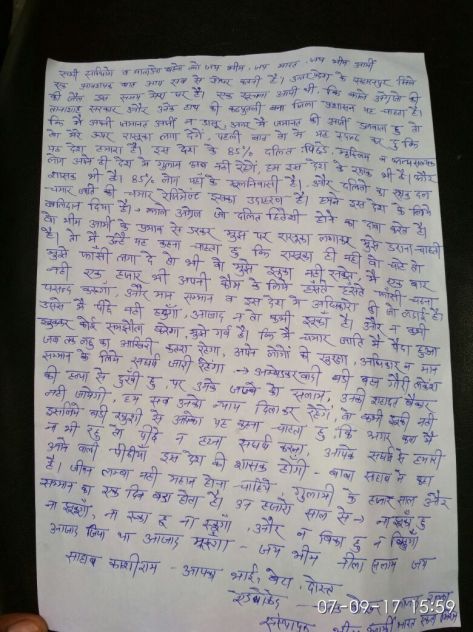
This is an amazing moment. From what we at the Committee for the Defense of Bhim Army have gathered, and from Chandrashekhar’s own letter from Saharanpur District Jail (see below), the administration is moving to slap charges under the National Security Act on Chandrashekhar and other activists. However, while expressing his resolve to fight on, Chandrashekhar also makes it clear in this letter (the facsimile and the text below) that he is equally concerned and saddened at the killing of Gauri Lankesh. He refers to her as his ‘Ambedkarite elder sister’ and pledges to carry forward the struggle to get her justice as well. This is how different dots in the struggle get connected. This is how new nodes of thinking and doing politics emerge. Right now, for us however, the struggle, for the legal defense of Chandrashekhar and other Bhim Army activists is paramount. They want to crush the movement in its infancy and we must ensure it can grow and carry on its struggle for liberation from the yoke of Hinduism and Hindutva.
It is worth placing on record here that when the formation of the Committtee for the Defense of Bhim Army was announced, Gauri had got it touch and expressed her wish to be on the Committee. Unfortunately, that was not to be. But we are sure that this is perhaps the best tribute we can offer to Gauri – carry on the fight for the defense of Bhim Army!
Chandrashekhar’s letter from jail
सभी साथियों व माताओं बहनों को जय भीम जय भारत, जय भीम आर्मी,
एक आवश्यक बात आप सब से शेयर करनी है उत्तर प्रदेश के सहारनपुर जिले की जेल इस समय मेरा घर है. एक सूचना आई थी की काले अंग्रेजों की तानाशाह सरकार और उनके हाथ की कठपुतली बना जिला प्रशासन यह चाहता है कि मैं अपनी जमानत अर्जी ना डालू अगर मैं जमानत की अर्जी डलवाता हूं तो वो मेरे ऊपर रासुका लगा देंगे.
पहली बात तो मैं यह स्पष्ट कर दूं कि यह देश हमारा है इस देश के 85 % दलित पिछड़े मुस्लिम वह अल्पसंख्या लोग अपने ही देश में गुलाम अब नहीं रहेंगे हम इस देश के Rakshak भी है और शासक भी है 85 % लोग यहां के मूल निवासी है और दलितों का रक्षक दल चमार जाति की चमार रेजिमेंट इनका उदाहरण है हमने इस देश के लिए बलिदान दिया है काले अंग्रेज जो दलित विदेशी होने का दावा करते हैं वह भीम आर्मी के प्रभाव से डरकर मुझ पर रासुका लगाकर मुझे डराना चाहते हैं तो मैं उन्हें यह कहना चाहता हूं कि रासुका ही नहीं वह चाहे तो मुझे फांसी लगा दे तो भी वह मुझे झुका नहीं सकते.
मैं एक बार नहीं एक हजार बार भी अपनी कौम के लिए हंसते हंसते फांसी चढ़ना पसन्द करुगा और मान-सम्मान वे इस देश में अधिकारों की जो लड़ाई है उसे पीछे नहीं हटूंगा. आजाद न तो कभी झुका है और ना कभी झुक कर कोई समझौता करेगा मुझे गर्व है कि मैं चमार जाति में पैदा हुआ जब तक लहू का आखरी करता रहेगा अपने लोगों की सुरक्षा अधिकार वह मान सम्मान के लिए संघर्ष जारी रहेगा ।।
अंबेडकरवादी बड़ी बहन गौरी लंकेश की हत्या से दुखी हूं पर इनके जज्बे को सलाम उनकी शहादत बेकार नहीं जाएगी हम सब उनको न्याय दिलाकर रहेंगे वो कभी झुकी नहीं इसलिए बड़ी खुशी से आपको यह कहना चाहता हूं कि अगर कल मैं ना भी रहूं तो पीछे न हटना संघर्ष करना आपके संघर्ष से हमारे आने वाली पीढ़ियां इस देश की शासक होगी बाबा साहब ने कहा जीवन लंबा नहीं महान होना चाहिए गुलामी और सम्मान का एक दिन बड़ा होता है उन हजारों साल से ना झुका हु ना झुका गा ना रुका हु ना रुकू गा और ना बिका हु ना बिकुगा आजाद जिया था आजाद मरूँगा जय भीम नीला सलाम जय साहब कांशीराम ।
आपका भाई बेटा दोस्त
*(एडवोकेट चंद्रशेखर आजाद रावण संस्थापक भीम आर्मी भारत मिशन)*
The ghar-wapsi of Mr. Nitish Kumar and the rupture of the grand alliance in a ‘not-so-grand’ manner came as a major surprise to all. Political pundits have expressed much on it with views ranging from ‘credibility crisis and convenient conscience’ to ‘the anti corruption crusade’. Without getting into debate pertaining to the socio-political ramification of the step taken by Mr Kumar and the political perception generated in this regard, what interests us is the legal framework dealing with the issue. Although, there does not seem to exist definite legal provisions addressing the issue, the closest legislation in this regard is ‘Anti defection’ law. But for specific reasons, the anti-defection law does not seem to provide a remedy in such instances of ‘de facto defections’. Continue reading Politics of Convenience and the Anti-Defection Law: Anmolam and Farheen Ahmad→
Guest post by PINJRA TOD, a Delhi-based collective of students fighting to “Break the Cages” of women denied the rights of adult citizens by the restrictive and patriarchal rules of women’s hostels.
Your Lordship,
We write to you, to bring to your notice a recent judgement of the Kerala High Court which has annulled a consensual marriage of an adult Muslim woman. The judgement also makes many other remarks which can completely undermine any claim for equal citizenship for women and are violative of their fundamental and constitutional rights. Hadiya is a young woman, 24 years of age who has went on record to say that she willingly converted to Islam. Her parents have since approached the court twice asserting that she has converted to Islam under external force, demanding that she return to living with them. In their second petition to the Kerala High Court they also raised the allegation that she would be transported outside the country and demanded the court’s intervention.
During the proceedings of the second petition, Hadiya contracted a marriage with a Muslim man according to Islamic rites and rituals and stated her full consent in the marriage. The Kerala High Court has finally annulled the marriage and forced Hadiya into the custody of her father. She has not even been allowed a phone and has been denied any contact with the rest of the world beside her parents, in effect putting her under house arrest for no proven crime committed by her. Policemen guard her every day and just beyond stand RSS cadre further ensuring that their prize catch finds no exit from the situation.
सुप्रीम कोर्ट के द्वारा निजता के अधिकार संबंधी फैसले ने निजी बनाम सार्वजनिक, व्यक्ति बनाम समाज, सरकार बनाम नागरिक के द्वैत को फिर बहस के केंद्र में ला दिया है।ऐसा समाज जहां गली-मोहल्लों व गांव-देहातों में निजी जानकारी छिपाने की कोई धारणा न तो रही है, न उसका सम्मान रहा है, उसी समाज में बड़े कारपोरेशन, सरकारी तंत्र व राज्य ने जब निजी जानकारियों का दुरुपयोग करना आरंभ किया तो गहरी प्रतिक्रिया हुई। इसका मनोवैज्ञानिक कारण यह है कि राज्य व बड़े कारपोरेशन्स समाज के लिए ‘बाहरी शक्ति’ के रूप में रहे हैं। वे पराए, अजनबी और अनजान तत्व हैं जो मनुष्य की निजी सूचना जुटा रहे हैं। उनके बाहरी शक्ति और विशाल संरचना होने के बोध ने निजी जानकारी के मुद्दें पर लोगों को उद्वेलित कर दिया। आधार कार्ड, सोशल साइट्स, सरकारी स्कीम आदि कई चीजें ऐसी रही हैं, जिनका सहारा लेकर नागरिकों की निजी जानकारियों मे बड़े पैमाने पर सेंध लगाई जा रही है और उन जानकारियों को निहित स्वार्थ वाले बेचेहरा व अज्ञात समूहों में शेयर किया जा रहा है। ऐसे माहौल में सुप्रीम कोर्ट का ‘राइट टु प्राइवेसी’ को स्वीकृति देते हुए यह कहना काफी मायने रखता है कि अनुच्छेद 21 के तहत जीने के अधिकार की सार्थकता तभी है जब व्यक्ति की गरिमा और निजता की भी रक्षा की जाए। व्यक्ति को यह पता हो कि उसकी निजी जानकारियां किसे, कब और क्यों दी जा रही हैं। कानून या राज्य के पास निजता को समाप्त करने के मकसद से देश का विकास, प्रशासनिक मजबूरी या डेटा-कलेक्शन की जरूरत का तर्क देने का विकल्प नहीं है।कोर्ट ने अपने फैसले में ‘सेक्सुअल ओरियंटेशन’ के बारे में टिप्पणी करते हुए इसे भी निजता के दायरे में रखा है। Continue reading हिंदुत्व और निजता का अधिकार : वैभव सिंह→
This is to let you know how the events presently unfolding in Dharmakshetra- kurukshetra (or at least its vicinity) are making even me, a lapsed sudrathy from Kerala, more and more creative about convincing your masters in Delhi that Hindutva fanatics in Kerala are no less worthy of kind consideration than their own home-grown fanatics. Actually, is this not the time you should be making a splash? Alas, despite your earnest efforts, these days, the Kerala police (and even your arch-enemies in Kerala, though they seem to be a bit less enthusiastic these days), take all the credit of minority-bashing and gender-criminalising. And the best you can do is go home to home telling Hindu women to cover up etc. and shout at Muslim groups doing the same, accusing them of nearly the same acts.
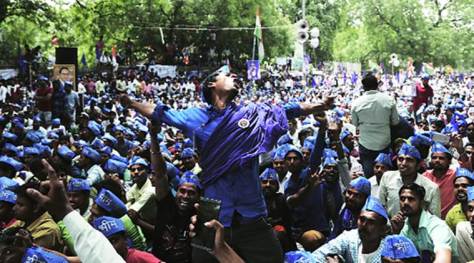
Even as the state government’s repression on Bhim Army continues, most of its leaders still in jail and some forced to leave Saharanpur, a committee has been formed for the defense of Bhim Army. (For background information, please see the ‘Note on Bhim Army’, appended at the end of this post, which carries links to informative videos as well). A group of activists and committed lawyers have been following up the legal struggle practically at their own expense – which at the moment involves getting the arrested activists, including the founder-President Chandrashekhar out of bail as the topmost priority. Some of the activists have started getting bail many still remain, including just ordinary people simply picked up by the people and framed by the police as Bhim Army activists.
However, getting the jailed activists out on bail is simply the first step in a long battle. The deliberate campaign of vilification that has been going on about Bhim Army has tried to paint the organization as ‘antinational’ and ‘instigators of violence’ who apparently have ‘Naxalite’ connections. Even though none of this could be substantiated and thus brought by the police into their charges against the jailed activists, the campaign of demonization has nevertheless continued through some sections of the media. Needless to say, such misleading campaign is meant to incite popular feelings against such groups who have been working mainly for education and self respect among the Dalit population in their area. Such a campaign of vilification cannot but affect the chances of wining the legal battle as well. It also ends up driving people who may have initially been sympathetic to their cause by sowing doubts about them in the popular mind.
It is with this concern in mind that a large number of citizens from different walks of life have come together to form the Committee for the Defense of Bhim Army, in order to mobilize all possible support for the embattled activists.
The Committee for the Defense of Bhim Army has been constituted comprising the following members from different walks of life:
Coordinators: Pradeep Narwal and Sanjeev Mathur
Treasurers: Presenjit Gautam and Nakul Singh Sawhney
Anand Teltumbde, Civil rights thinker and activist, Mumbai
Jignesh Mewani, Rashtriya Dalit Adhikar Manch
Kancha Ilaiah, Political scientist, thinker and writer, Hyderabad
Chandrabhan Prasad, Dalit thinker
Radhika Ramaseshan, Senior journalist with Business Standard
Harsh Mander, Human rights activist and Director, Centre for Equity Studies, Delhi
Syeda Hamid, Former member, Planning Commission
Om Thanvi, Senior journalist, former editor, Jansatta
Sambhaji Bhagat, Cultural activist, Maharashtra
Meera Velayudhan, Academic, Centre for Development Studies, Trivandrum
Martin Macwan, Social activist, Gujarat
Ratan Lal, Academic, Hindu College, Delhi University
Sachin Mali, Cultural activist
Sheetal Sathe, Cultural activist
S.R Darapuri , Former IPS officer, social activist
Colin Gonzalves, Lawyer
Anand Patwardhan, Film maker
Anil Chamadia, Journalist
Subhash Gatade, Writer and social activist
Akram Hassan, Social activist, Shamli
Surender, Dalit youth activist, Delhi University
N. Sukumar, Academic, Delhi University
Rehana Adib, Social activist, Saharanpur
Banojyotsna Lahiri, Academic and independent researcher
Mohammad Zeeshan Ayyub, Actor
Amar Singh, SC/ST Trade Union, Delhi University
Dr. Mahesh Chandra, Bhim Army
Sanjay Tegwal, Bhim Army
Zakia Soman, Bharatiya Muslim Mahila Andolan
Presenjit Gautam, Jati Todo Manch, Ghaziabad
Pradeep Narwal, Dalit youth activist, Jawaharlal Nehru University
Saroj Giri, Academic, Delhi University
Tushar Parmar, IRS
Sanjeev Mathur, Journalist
Nakul Singh Sawhney, Film maker
Praveen Verma, Research scholar, Delhi University
Aditya Nigam, Academic, Centre for the Study of Developing Societies, Delhi
Present day Hindus are probably the strongest opponents of Marxism. They are horrified at its doctrine of class-struggle. But they forget that India has been not merely the land of class struggle but she has been the land of class wars. – B. R. Ambedkar, Philosophy of Hinduism.
I often find myself in a bind over whether or not to respond to supposed RSS ideologues, given that they simply trade in lies and hatred with the supreme arrogance of ignorance. One such is the upcoming star on the RSS horizon, a gentleman called Rakesh Sinha, who like the rest of his pack (led by the supreme leader) is currently engaged in a cheap attack on the outgoing Vice-President, Hamid Ansari. His piece in the Indian Express today (linked above) is an instance of a combination of all these things. So, why should one bother about such a character? Why take him and his discourse seriously? Well, someone had better respond because, because, for one thing they are in power, and are going to teach generations of students that valorous ‘Hindus’ like Maharana Pratap won all the wars, though by some magic, ‘Muslims’ continued to rule for about 8 centuries! For another, there are enough gullible types who really think these people ‘have a point of view’, which should be debated.
As we have repeatedly seen, their ‘having a point of view’ has nothing to do with debate. It is to be enforced by gangs of gorakshaks, anti-romeo squads, hoodlums deciding what will or will not be taught in universities and schools, what will be written, how people should dress and love – and when nothing works, ‘win’ a ‘debate’ like Arun Jaitley claimed they did, by simply arresting the opponents and slapping sedition charges on them. Given this, I do not really address, in person, the ideologue, Rakesh Sinha, who has now made it a fine art to pick up some phrases from the toolkit of what is understood as ‘postmodernism’ by many. Wasn’t it postmodernism, one can hear them say, that said all viewpoints are equally valid and ‘everything goes’? Wasn’t it postmodernism that challenged the hegemony of Western thought, its logocentrism, its Rationalism (with a capital R) from within that very tradition? Wasn’t it postmodernism again, that by decentering West’s logocentrism, actually gave these RSS-type creatures the gumption to claim that their utterly unsubstantiated viewpoint about the past too was as valid as that of historians who struggled with evidence, painstakingly putting together texts, artefacts and procedures of dating in order to produce a plausible account of the past?
The prime minister of India Narendra Modi’s cheap hindutvavaadi jibes in his farewell address to vice president Hamid Ansari were better suited to Republic TV or The Organiser, but under Modi’s regime, parliament is pretty much run like an RSS shakha, and Modi himself seems no different from Arnab Goswami.
Said Modi in parliament to the distinguished out-going vice president:
Aapke karyakaal ka bahut saara hissa West Asia se juda raha hai. Usi dayere mein zindagi ke bahut varsh aapke gaye, usi mahaul mein, usi soch mein, aise logon ke beech mein rahe. Wahan se retire hone ke baad bhi jyadatar kaam wohi raha aapka; Minorities Commission ho yah Aligarh Muslim University ho, zyadatar dayara aapka wohi raha.
A version of this piece appeared yesterday in The Wire
“I would like to thank Huddersfield University for enabling me to have a sabbatical semester to work on this revised edition and for providing such a supportive environment. Thanks to many of the students on my Women, Power and Society module for their hard work and enthusiasm.”
That is the dedication in a book by British scholar and teacher Valerie Bryson – a text I often use for teaching at a college in Delhi University. Evidently, Bryson found her teaching and research lives complementing each other beautifully, as have thousands of university and college teachers who have had the luck to have what she calls a “supportive” professional and academic environment. What are the elements of this support? A sabbatical semester or year every once in a while, ready research facilities within the college premises or nearby, and an opportunity to formulate teaching courses that ally with your research focus. With these elements in place, both teaching and research benefit dramatically.
Until recently, college teachers in this country had the first two conditions. They were given in their entire careers – say from the age of 26 or 27 when one normally began teaching at a college to the age of 65 – three years of paid study leave to pursue or finish their PhDs (with the usual conditions and caveats including a strict bond that they signed with college promising to return the three years’ pay if the PhD remained incomplete, or if they resigned upon return to the institution) and a further two years of (until recently, paid and now invariably unpaid or “extraordinary”) leave to take a break from teaching and pursue a postdoctoral or visiting fellowship at a research institute.
From the night of July 11 when Zohra Bibi did not return home to the evening of July 16 when union minister Mahesh Sharma, member of parliament for Gautam Budh Nagar, UP met with residents of Mahagun Moderne, much has transpired. Promptly after the minister’s assurances of ‘justice’ and even retribution to the flat-owners, the settlement of tin walled shacks in which Zohra Bibi and other workers like her lived with their families was demolished the next day. Many of the ‘facts’ of the matter remain disputed – while Zohra Bibi maintains that she neither admitted to the theft of cash nor hid in the basement of the building, the allegation that her employers Harshu and Mitul Sethi harassed and detained her, confiscating her mobile phone is denied by them. Meanwhile, thirteen men, a majority of them Bengali Muslims from West Bengal, arrested from the workers’ settlement are denied bail on the charge of attempted murder on the might of three FIRs filed by residents of Mahagun Moderne and languish in judicial custody. The Noida police are yet to commence any investigation of the Sethis as required by the FIR filed by Zohra Bibi and her husband Abdul Sattar. What does this language of the riot, of murderous mobs with which residents of the swanky apartment complex took to social media with #MaldainNoida accomplish? As security cards, required by domestic and other workers to enter the gated community, were revoked for 80-odd workers under the cry of ‘ban the Bangladeshi maid’, the bogey of the illegal Bangladeshi immigrant reared its ugly head. Continue reading Under the sign of security – Why the bogey of ‘the illegal Bangladeshi immigrant’ is so powerful across urban Indian homes: Sahana Ghosh & Rimple Mehta→
भारत खुद को भले किसी महान प्राचीन ज्ञान-परंपरा का वारिस समझता हो पर उसके विश्वविद्यालयों की दशा चंद चमकदार अपवादों के बावजूद खस्ताहाल है। उच्चशिक्षा की हालत किसी मरणासन्न नदी जैसी है जिसपर पुल तो बहुत बड़ा बन गया है पर पानी सूखता जा रहा है। भारत अपने साथ ही यह झूठ बोल रहा है कि वह ज्ञान या ज्ञानियों का आदर करता है, जबकि सचाई इसके विपरीत है। आधुनिक युग में भारत ने जितना ज्ञान की अवहेलना और अनादर किया है, उतना शायद ही किसी देश ने किया होगा। हर तिमाही-छमाही आने वाली रिपोर्ट्स हमें शर्मिंदा करती हैं कि संसार के सर्वोच्च 100 विश्वविद्यालयों में भारत के किसी विश्वविद्यालय को नहीं रखा जा सका। पूरा शिक्षा-जगत डिग्रियों की खरीदफरोख्त में लगे विचित्र किस्म के अराजक और अपराधिक सौदेबाजियों से भरे बाजार में बदलता जा रहा है। यहां अपराधी, दलाल और कलंकित नेता अपने काले धन व डिजिटल मनी की समन्वित ताकत लेकर उतर पड़े हैं और हर तरह की कीमत की एवज में कागजी शिक्षा बेचने लगे हैं। इस बाजार में ‘नालेज’ और ‘डिग्री’ का संबंध छिन्नभिन्न हो चुका है। कमाल की बात यह है कि यह स्थिति हमें चिंतित नहीं करती।
दूसरी ओर, उच्चशिक्षा अभी भी समाज की नब्बे फीसदी आबादी के लिए सपने सरीखी है। उच्चशिक्षा में जीईआर यानी दाखिले के अनुपात की गणना 18-23 आयुवर्ग के छात्रों को ध्यान में रखकर की जाती है और अभी भी भारत में केवल दस फीसदी लोग उच्चशिक्षा के संस्थानों के दरवाजे तक पहुंच पाते हैं। इसमें भी दलित व गरीब मुस्लिमों की हालत बेहद खराब है। दलितों में दो फीसदी से भी कम लोग उच्चशिक्षा प्राप्त कर पाते हैं तो मुस्लिमों में यह आंकड़ा केवल 2.1 फीसदी का है। भारत की ग्रामीण आबादी में केवल दो फीसदी लोग ही उच्च माध्यमिक शिक्षा के पार जा पाते हैं। ये आंकड़े भारत में उच्चशिक्षा की आम लोगों तक पहुंच की भयावह तस्वीर को प्रस्तुत करते हैं और दिखाते हैं कि हम जिन संस्थानों, बड़े कालेजों-विश्वविद्यालयों आदि को भारत के विकास के प्रमाण के रूप में पेश करने की इच्छा रखते हैं, वे देश की नब्बे फीसदी आबादी से बहुत दूर रहे हैं। Continue reading विश्वविद्यालय, अंध राष्ट्रवाद और देशभक्ति : वैभव सिंह→
Following the bizarre idea, earlier mooted by retired army officials, now taken up by the Vice Chancellor of JNU, to install a tank on university campus, ostensibly to instill nationalism in the university community, the JNUTA has issued the following statement:
The JNUTA is amused by the JNU VC’s earnest desire that a tank be rolled onto JNU campus. It is surprising that Prof. Jagadesh Kumar can only be inspired to patriotism upon beholding instruments of war. This seems to be only a personal affliction, since the rest of the JNU community does not need these visual aids to feel love and concern for this land, its environment and all its peoples, whether in the armed services or elsewhere.
The JNUTA also hopes that the JNU VC will understand that developing what he believes is the correct affective attachment towards the Indian Army is not part of his job description. JNU cannot be made into a theatre of war. His statutory role is one of “maintaining and promoting the efficiency and good order of the University” and of upholding the JNU Act and Statutes.The full statement can be read here.
Red FM’s RJ Malishka features in a peppy video that went viral, mocking Mumbai’s Municipal Corporation (BMC) for the dismal lack of civic amenities and the havoc the rains can wreak in the city. In a lively parody of the popular Marathi folk song Sonu Tuza Mazyavar Bharosa Nahi Kay (Sonu, Don’t you Trust me?), she sang cheekily, Sonu, don’t you trust BMC?
Potholes, traffic jams, slow trains, all the woes of the Mumbaikar in the fabled rains of Western India.
Guest Post by Madhura Balasubramaniam and Padmapriya Govindarajan
On July 1, 2017 a gathering of citizens congregated at the Valluvar Kottam monument in Chennai, India, in solidarity with the spate of demonstrations across the nation condemning the rise in instances of mob lynching and violence that disproportionately targeted Dalit and Muslim citizens for beef consumption. The protests were triggered by the murder of 16 year old Junaid Khan by a train mob. Since July 28, peaceful citizen gatherings have joined a wave that attempts to call out government silence, and thereby perceived tacit complicity, regarding the actions ofGau Rakshaks and other vigilante mobs that engage in lynching with a strongly communal or casteist skew. They have been collectively termed as #NotInMyName protests, alluding to the argument that these murders occurred in the name of the cow and in the name of Hinduism. Continue reading #BreakTheSilence – Chennai against mob lynching: Madhura Balasubramaniam and Padmapriya Govindarajan→
Bhupendra Singh Chudasama, Education minister of Gujarat and his colleague Atmaram Paramar, who handles the Social Justice Ministry, were in the news sometime back- albeit for wrong reasons. A video went viral which showed them participating in a felicitation ceremony of exorcists in Botad. They were also seen watching how a couple of the exorcists were beating themselves with metal chains to live music near the stage.
Perhaps it did not matter to them that the Constitution frowns upon such activities and Article 51A (h) of the Indian constitution clearly says that it shall be a fundamental duty of all citizens “to develop the scientific temper, humanism and the spirit of inquiry and reform.” Neighbouring state Maharashtra has even enacted a law (The Maharashtra Prevention and Eradication of Human Sacrifice and other Inhuman, Evil and Aghori Practices and Black Magic Act, 2013) to rein in all such activities and it criminalises practices related to black magic, human sacrifices, use of magic remedies to cure ailments and other such acts which exploit people’s superstitions. And it was a culmination of a prolonged movement led by activists led by Dr Dabholkar – who even faced martyrdom for his activities. Continue reading Promoting Superstition – Everything Official About It !→
On 22 June 2017 fifteen-year old Hafiz Junaid was stabbed to death on a Mathura-bound train from New Delhi. He was traveling home for Eid with his brothers and two friends. A dispute over seats resulted in a group of men repeatedly assaulting and stabbing Junaid and his companions. The assailants flung their bodies onto the Asoti railway platform. A crowd gathered. At some point an ambulance was called and two bodies were taken away. Junaid is dead. His companions are in critical condition. While one person has been arrested the police investigations are running into a wall of social opacity since they have been unable to find a single eye-witness to the incident. Of the 200 hundred strong crowd that assembled on Asoti railway platform on Thursday evening, the police cannot find one person who can say what they saw. The police cannot find a witness because something very peculiar seems to have happened to those present at Junaid’s death. A report by Kaunain Sherrif M in the Indian Express provides specific details. When asked if he had seen anything that evening, Ram Sharan a corn-vendor whose daily shift coincides with the killing, Sharan said he was not present at the time of the incident. Two staffers who were sent to investigate by the station master were unavailable for comment. Neither the station-master, the post-master or the railway guards saw the event they were present at.
In this startling piece the journalist reports how the public lynching of a Muslim child becomes a social non-event in contemporary India. He shows the reconfiguring, and splitting, of a social field of vision. He reports all the ways in which people – Hindus- did not see the body of a dead – Muslim – child that lay in front of them. The Hindus on the Asoti railway platform managed to collectively not see a 15 year old Muslim boy being stabbed to death. Then they collectively, and without prior agreement, continued to not see what they had seen after the event. This is the uniquely terrifying aspect of this incident on which this report reflects: the totalising force of an unspoken, but collectively binding, agreement between Hindus to not see the dead body of a Muslim child. Hindus on this railway platform in a small station in north India instantly produced a stranger sociality, a common social bond between people who do not otherwise know each other. By mutual recognition between strangers, Hindus at this platform agreed to abide by a code of silence by which the death of a Muslim child can not be seen by 200 people in full public view on a railway platform in today’s India. Continue reading Why Two Hundred Ordinary Hindus Did Not See A Dead Muslim Child On A Railway Station In North India→
At some point during the Khalistan movement, I came across a brief news item about a constable of the Punjab Police killed by Delhi Police personnel. The two teams had completed their interrogation of a suspected militant. Whose job was it to clean up the blood? Disagreement, a scuffle, a killing.
Legitimized brutality; the stench of blood inflaming the senses; the knowledge of absolute power and absolute impunity.
All of India is that interrogation room now.
Hindu Rashtra is here.
Has there not been violence earlier in this land? Yes of course there has been. A full seven decades of an independent state’s violence against the people of the land declared to be India – against dispossessed peasants and tribal people, against industrial workers, against the people of Kashmir, and of the states of the North East; centuries of violence by savarna Hindu society against the Dalit-bahujan; misogynist, sexist violence against women, up to and including female foetuses in the womb; decades of coldly planned and executed communal violence by institutionalized systems of riot production coordinated by the organizations of the RSS – against Muslims, against Christians, and as a secondary force, against Sikhs in 1984.
On the First Anniversary of the Una Floggings – Call from JIGNESH MEWANI and RASHTRIYA DALIT ADHIKAR MANCH
उना से आई फिर आवाज़,नहीं सहेंगे हिंदु राष्ट्र, भगवा आतंकवाद और पूंजीवाद!
Una floggings, image courtesy Indian Express
दलित, मुस्लिम, मज़दूर और किसान साथ मिलकर मांगेगे तीन साल का हिसाब
बहुजन,मज़दूर और किसान साथ मिल फिर ललकारेंगे ‘गाय की पूंछ तुम रखो, हमें हमारी जमीन दो’
साथियों,
आप जानते हैं, 11 जुलाई को उना के दलितों के उत्पीड़न की जगानेवाली घटना को एक वर्ष होने जा रहा है. जिस तरह पिछले वर्ष 11 जुलाई को गुजरात के गिर सोमनाथ जिले के मोटा-समधियाला गांव के बालू भाई सरवैया और उनके चार बेगुनाह लड़कों को दिन दहाड़े, भरे बाजार गाड़ी के साथ बांधकर पुलिस थाने के सामने बेरहमी के साथ मारा गया और जिस तरह इस कारनामे को अंजाम देने वाले इन तथाकथित गौ रक्षकों ने खुद ही अपने इस कारनामे को सोशल मीडिया पे वायरल किया, उससे पूरा देश हिल गया था.
इस अमानवीय कारनामे को अंजाम देने वाले लोग खुद ही अपनी इस घिनौनी हरकत को सोशल मीडिया पे वायरल करे उससे पता चल जाता है कि यह तथाकथित गौ रक्षक कितना बेखौफ महसूस करते और उनको राजसत्ता की कितना संरक्षण मिला हुआ है.