रोगाणु, दाग़ और हमारा ‘विशुद्ध’ समाज : वी. गीता

Guest post by V. GEETHA. Translated by RAJENDER SINGH NEGI

कोरोना के आने से पहले ही हममें रोगाणुओं को लेकर चिंता का भाव विद्यमान था. ज़रा उन फ़र्श, किचन काउंटर, कपड़ों, इत्यादि रोगाणुओं, दाग़, और तमाम क़िस्म के सूक्ष्म घुसपैठी जंतुओं से निजात दिलाने वाले विज्ञापनों को याद करें, जिनमे इन सभी को पर्याप्त और बड़ी चालाकी से दुष्ट क़रार दिया जाता रहा है. कोरोना ने हमें ख़ुद को विशुद्ध और साफ़-सुथरा रखने का पूर्णत: वाजिब कारण दे दिया है. हम चाहे ख़ुद को चारदीवारी के अंदर बंद कर लें, या, अन्यों को उसमें दाख़िल होने से रोकें, अंतत: इसका नतीजा वही निकलता है, कि हम अक्सर पहले से ही समाज में व्याप्त जातिगत, वर्ग-आधारित, नस्ल-भेदी और धार्मिक आधार पर बनाई गई सामाजिक मान्यताओं की दीवारें ही खड़ी कर रहे होते हैं.

तो फिर जिस जोश-खरोश से हमने संभावित संक्रामक माने जाने वाले लोगों पर नज़र रखने, उन्हें चिह्नित और वर्जित करने की क़वायद सर पर उठा रखी है उस पर अचरज नहीं करना चाहिए. इस वर्जना में सरेआम सड़कों पर धर-पकड़, शर्मिंदा किया जाना, घरों में ‘आईसोलेट’ किए गयों के नाम सार्वजनिक किया जाना, और मरीज़ों का ईलाज कर रहे डॉक्टरों और नर्सों का उनकी ही रिहाईशी कॉलोनियों में प्रवेश की निषेधआज्ञा लागू किया जाना भी शामिल है.

Continue reading रोगाणु, दाग़ और हमारा ‘विशुद्ध’ समाज : वी. गीता

After Covid-19, We Should All Be Cuba

The pandemic has exposed wealthy states’ neglect of healthcare. A new medical internationalism is needed.

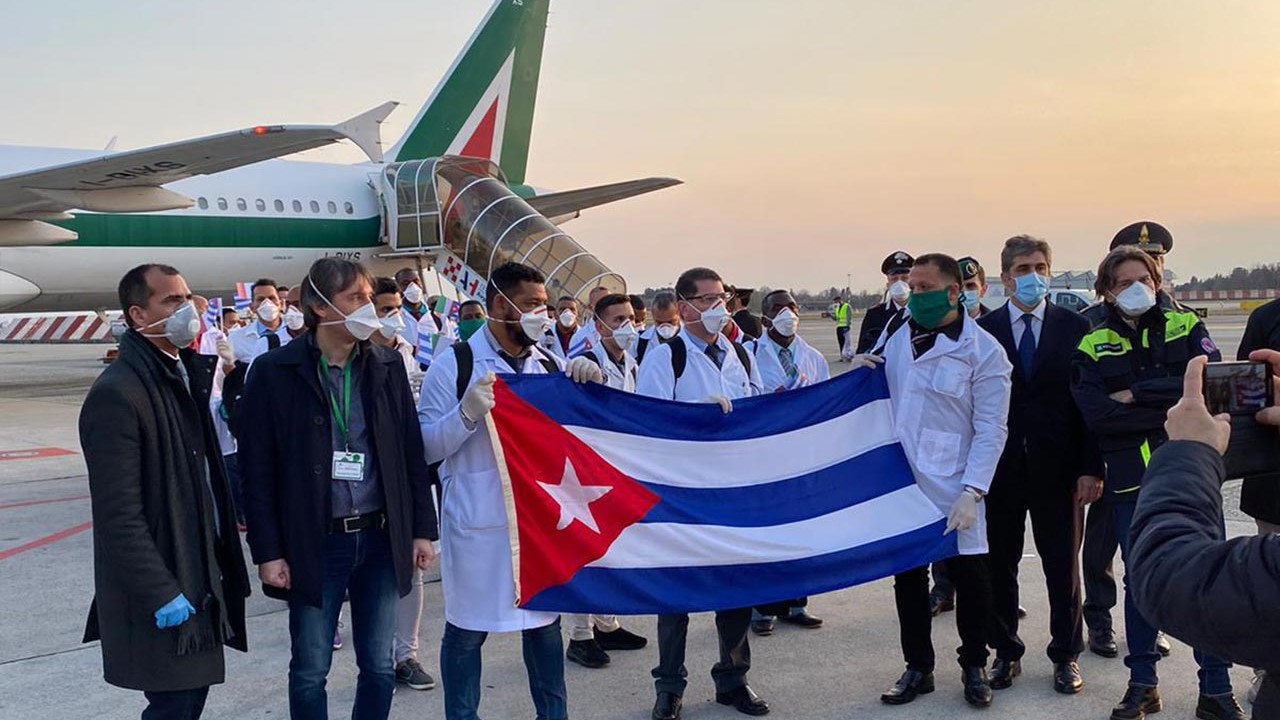
Cuban doctors prepare to leave for Italy to provide medical aid.

Image Courtesy: Malpensa airport website

Rare are those photographs which can be declared iconic right after they are taken, without awaiting the approval of the connoisseurs, critics or people. It is an ordinary-looking photo, of a large team of people, dressed in white robes, disembarking from a plane and being welcomed by someone wearing a white coat too. Take a closer look at the frame and you will note a mood of jubilation among the people who are watching them from the airport’s lounge.

The photo is of Malpensa airport at Milan, an alpha-global city recognised so far as one of the world’s four fashion capitals and the capital of North Italy’s Lombardy region. Today, it has also come to be known as a hotspot of Covid-19 infections, a site where thousands have died of the infection. The picture we are talking about is of 52 doctors and nurses from Cuba who arrived in Italy on invitation from the regional Italian minister of health and welfare, Giulio Gallera.

Italy, ironically, has been party for a long time to the economic sanctions imposed by the United States on this tiny Caribbean nation with a population of around 1 crore (10 million). The sanctions have been declared “illegal” by the United Nations time and again. But the anti-humanitarian attitude of the Italian ruling classes could not stop Cuba from sending its medical team there to combat Covid-19. Media reports tell us that Italy happens to be the sixth country—after Venezuela, Nicaragua, Jamaica, Suriname and Grenada—on the current itinerary of Cuban medical teams flying around to fight the pandemic.

( Read the full article here : https://www.newsclick.in/After-Covid-19-We-Should-All-Be-Cuba)

Corona, Capitalism and Civilisation : Ravi Sinha

Guest Post by Ravi Sinha

“Who do you blame it on? For a while it was China, until the most favourite target for the Indians appeared on the scene – you know who. When it comes to the business of blaming, Indians (a large percentage of them) would have loved it if the virus had originated somewhere in the Middle East or in Pakistan.

But new viruses have always appeared in human history, some more deadly than others. This one is the newest such calamity. Sure enough, humanity will be found standing on the other side of this crisis. But, how shall we count the losses after this mayhem is over?

Continue reading Corona, Capitalism and Civilisation : Ravi Sinha

करोना के कुछ ज़रूरी सबक़ : राजिंदर चौधरी

Guest post by RAJINDER CHAUDHARY

एक छोटे से वाइरस ने तीन बाते दोबारा याद दिला दी हैं. सब से पहली तो यह कि इन्सान कुदरत का एक छोटा हिस्सा ही है. भले ही यह बहुत प्रभावी हिस्सा है; कुदरत को तोड़ मरोड़ सकता है, मरुस्थल को हराभरा कर सकता है.  फिर भी यह कुदरत से ऊपर नहीं है, उस का मालिक नहीं है; यहे हरे भरे को मरुस्थल भी बना सकता है. कई वैज्ञानिकों के अनुसार घटते जंगलों और बढ़ती इंसानी बस्ती के चलते ही हमें करोना सरीखे वाइरस का इतना बड़ा डंक लगा है. भले ही आज सब का ध्यान करोना के कहर पर केन्द्रित है, और आशा है देर-सवेर उस का इलाज भी ढूंढ लेंगे, टीका बना लेंगे, पर जलवायु परिवर्तन और तेज़ी से ख़त्म होते पेट्रोल सरीखे नवीनीकरण-अयोग्य संसाधनों को भी न भूलें. यह भी न भूलें सारी वैज्ञानिक प्रगति के बावज़ूद प्रदूषण से बचने के लिए वाहनों पर सम-विषम का नियम लगा कर बनी हुई कार को चलाने पर रोक लगानी पड़ती है,  संयम अपनाना पड़ता है. उद्योग और निर्माण गतिविधि पर रोक लगानी पड़ती है.

Continue reading करोना के कुछ ज़रूरी सबक़ : राजिंदर चौधरी

An Open Letter to the Kerala Governor Sri Arif Mohammad Khan About Our Fight Against the Virus, But Also About Our Resistance to CAA-NRC

Dear Sir

First of all, thank you for acknowledging, even praising,the efforts of the government of Kerala and the people to protect ourselves and humanity against the threat of the corona virus. It is true that Kerala’s efforts and achievements are being lauded the world over, but those voices are never going to make any impact on the supporters of the Sangh parivar in Kerala. But your views cannot be dismissed so easily as ‘Western’ or ‘leftist’ (though they may still murmur about your Muslim name). What has really riled me in the recent past is their systematic effort at downplaying Kerala’s achievements, heaping abuse on our effort to help migrant workers, and raising baseless allegations against those who are working to mitigate the crisis. So as a historian of modern Kerala, I am writing this to offer some insights into why we have been able to do this, in the hope that you may be able to see what they will never tell you — simply because they are so sadly blinded by hate. Continue reading An Open Letter to the Kerala Governor Sri Arif Mohammad Khan About Our Fight Against the Virus, But Also About Our Resistance to CAA-NRC

Knowability and Unknowabiility of COVID-19 – Is There ‘Class’ in the Coronavirus Panic? Maya John

Guest post by MAYA JOHN

[This is the first part of a two-part series on ‘society at the time of Covid-19’]

‘An elephant was attacked by a house cat. Frustrated and trying to avoid the cat, the elephant accidentally jumps off a cliff in panic and dies.’ – Anonymous

‘The idea of the self-sufficient character of science (“science for science’s sake”) is naive: it confuses the subjective passions of the professional scientist, working in a system of profound division of labour, in conditions of a disjointed society, in which individual social functions are crystallised in a diversity of types, psychologies, passions …. The fetishising of science, as of other phenomena of social life, and the deification of the corresponding categories is a perverted ideological reflex of a society in which the division of labour has destroyed the visible connection between social function, separating them out in the consciousness of their agents as absolute and sovereign values.’ – Nikolai Bukharin, 1931

The specter of Covid-19 is haunting India and many other countries in the world. As the fear of the novel Coronavirus (SARS-CoV-2) grips India, and draconian state measures unleash havoc on the poor, it is imperative to trace back the clock so as to fully comprehend the underlying thrust of the current paranoia. Who have been carriers of the disease into India and what was done to identify and contain them? Whose paranoia is determining state policy? And are we possibly witnessing an ‘over-reaction’ shaped by the anxiety of upper classes? These questions imply the need, in class terms, for a closer scrutiny of the reasons behind the declaration of the pandemic.

Continue reading Knowability and Unknowabiility of COVID-19 – Is There ‘Class’ in the Coronavirus Panic? Maya John

As Migrants Begin their Long Trudge to Nowhere, A Note on Migration in Delhi: Jamal Kidwai

Guest Post by JAMAL KIDWAI

Most of the people in Delhi, like in rest of India (according to official estimates, 92 per cent of India’s work force comprises of informal labour) earn their living from working in the informal sector. There is extensive academic literature on this subject.  Typically, informal economy is that which does not find mention in official data, is not formally registered and regulated and falls outside the tax regulation.

The concept of informality became current in economic and social thought in the early 1970’s. It has since been re-considered and re-interpreted. The idea that the informal sector presented a liminal space for workers waiting to be absorbed by the formal sector, has been negated. Instead, current trends suggest that a majority of the Indian work force (approx.92%) labour under short-term informal contracts.  Well-known labour historian Jan Bremen has somewhere written that the fact the informal economy is not officially regulated does not imply a complete absence of regulation. There are many unofficial means of regulation. Quite often activities that do not possess registration and legal sanction get denoted as informal or ‘underground’. This practice results in the official erasure of the economic value of the goods and services produced therein. It also serves the purpose of masking the over-exploitation and socially-levered extortion to which the most unprotected and vulnerable members of the working class are subjected.

Continue reading As Migrants Begin their Long Trudge to Nowhere, A Note on Migration in Delhi: Jamal Kidwai

Srinarayanadharmam: Raghavan Thirumulpad (Part 2)

The third chapter is about precepts applicable to all human beings;  the aacharyan speaks here on the panchadharmas and the panchashuddhi. The panchadharmas are : nonviolence, truth, non-covetousness, the rejection of intoxicants,  and the avoidance of licentiousness. Dharmoyam Saarvavarnikah, say the earlier aachaaryas, mentioning nonviolence, truth, non-covetousness, celibacy, and frugality as the five crucial dharmas. The Yogasastra mentions these five as the panchayamas. Continue reading Srinarayanadharmam: Raghavan Thirumulpad (Part 2)

Balm in Troubling times – Raghavan Thirumulpad on Srinarayana Dharma

[The lockdown ought to work as a great leveler. For once, all who live in mortal bodies have been reminded of their inevitable mortality, of the absurd fragility of our existence on this planet. Even the living-gods who command a huge following have shut darshan. We have also been reminded that life on earth will not grind to a standstill if we go. Indeed, the signs are that it will thrive. 

But at the ground level, that is not happening. The better-off can see how, starkly, like never before, the privileges they enjoy, and given as they are to an amoral worship of consumption which inhibits their capacity for compassion, are more likely to shield this by resorting to any kind of ideology that justifies their privilege, probably eugenics or some kind of functionalist interpretation of caste oppressive practices. We are seeing how the poor are suffering for no fault of theirs at all. Indeed, the lockdown may help to normalize privilege even more, and render us all the more insensitive to the suffering of the working class poor. One reason why this happens is because we are already, as a society, afflicted by moral viruses — of religious bigotry, caste privilege, and ruthless capitalism. As a society, we are sick, and the pandemic is likely to exacerbate it

It must be this connection that made me turn to the work of Raghavan Thirumulpad, who was one of Kerala’s finest ayurvedic physicians, a multi-lingual scholar whose conception of individual and human wellness was inextricably related to the wellness of society and the natural world. I have long admired the ease with which he moved between theory and practice in ayurveda; but what really connected us as privileged-caste-born people who sought to become human  was that we found in Sreenarayana Guru a common refuge. For Thirumulpad, the Guru is not just a social reformer or preacher but a healer — a healer of society and individual, who drew upon Indian traditions to reinterpret a dharma adequate to the disease that afflicted society in his times.

Continue reading Balm in Troubling times – Raghavan Thirumulpad on Srinarayana Dharma

Appeal for Contributions – A Citizens’ Initiative to Provide Humanitarian Relief to the City’s Working Classes

In the wake of the health and subsistence crisis triggered by the rapid spread of Covid-19 in India, the Citizen Collective for Humanitarian Relief, in association with the Centre for Education & Communication, is organizing emergency distribution of food among the working-class families of Delhi NCR. As part of this initiative we have set up a Mazdoor Dhaba (workers’ kitchen) in Delhi University.

Our aim is to provide two cooked meals a day to those families who have lost all source of livelihood following the complete nation-wide lockdown ordered on 25th March. The cost for one family’s meal (5 persons) is about Rs. 250, and as of today we are able to reach 500 people every day. We need your help and financial support to sustain and expand this effort.

On behalf of the Citizen Collective for Humanitarian Relief

Apoorvanand, Aruna Roy, Avinash Kumar, Lokesh, Najma Rehmani, Naveen Chander,  Rahul Roy, Richa Jairaj, Satish Deshpande, Usman Jawed

If you wish to assist us, please transfer money to the following accounts. If you are an Indian citizen (even if you live abroad), then please make sure to transfer money only to the Corporation bank account. If you are a foreign national, please transfer money to the SBI account.

Bank details for INDIAN CITIZENS:

Centre for Education & Communication

Corporation Bank

SB Account No: 520101261257941

IFSC Code: CORP0000286

Branch: Greater Kailash, New Delhi


Bank details for FOREIGN NATIONALS:

Centre for Education & Communication  

State Bank of India

Current Account No: 10786724071

Swift Code: SBININBB710

Branch: Green Park Extension, New Delhi

If you are sending money to these accounts, please inform us of the same by sending an email to the following ID along with your name and address. If you want to send more than Rs 5,000/-, please send us your PAN number. We request the foreign nationals to send a copy of their passport.

Donor Information required for Foreign Citizens

Name:

Address:

Amount donated in foreign currency:

*Please attach copy of valid passport.

Please inform us when you make contribution to following email ids:

accounts@cec-india.org/ finance@cec-india.org

workersdhaba@gmail.com

For queries regarding the relief work, and how you can support it, please contact

workersdhaba@gmail.com

Avinash – +918010833325

Naveen – +919013074978

Praveen-  +919911078111

Richa-     + 919820027364

Usman –  +919953947739


For queries the money transfer, please contact the Center for Education and Communication (CEC) by email or on phone

accounts@cec-india.org/ finance@cec-india.org

Ruchika – +919899230545

Covid-19, the Climate Crisis and Lockdown – an opportunity to end the war with nature: Vishwas Satgar

This post written by VISHWAS SATGAR was first published in Daily Maverick

With the coronavirus, we are really trying to mitigate the revenge blow from nature. It’s a moment to be humble and realise our finitude in a wondrous and infinite natural order.

Covid-19 has pushed an already weak and crisis-ridden global economy over the edge. Massive value has been erased from crashing stock market prices. Many commentators are talking about the return of economic conditions similar to the great financial crash of 2007-2009. The most powerful countries in the world from China to the US have ground to a halt.

This pathogen, possibly from delicate creatures like a pangolin or a bat, has engendered the worst global pandemic since the Spanish flu (1918-1920), which killed 100-million people. Death rates are going up globally. Right-wing nationalists in Europe and the USA have been confused as this virus has jumped racist border regimes, and infected all populations. Citizens are no longer concerned about their racist messages, but rather about how to survive.

Continue reading Covid-19, the Climate Crisis and Lockdown – an opportunity to end the war with nature: Vishwas Satgar

Corona Biopolitics and Life After Capitalism – A Manifesto of Hope I

[This essay eventually became the first of a four-part series. The subsequent parts can be accessed Part II here, Part III here and Part IV here]

‘It seems we are massively entering a quarantine of consumption where we will learn how to be happy just with a simple dress, rediscovering old favourites we own, reading a forgotten book and cooking up a storm to make life beautiful. The impact of the virus will be cultural and crucial to building an alternative and profoundly different world.’ – Li Edelkoort, trend forecaster and fashion advisor

As large parts of the world reel under the impact of a lockdown that has prompted several people to recall the great lockdowns during the early twentieth century Spanisht flu and even the 14th centry plague, my thoughts in fact strayed in another direction. With international and national air traffic down to the barest minimum, with arenas of conspicuous consumption shut down, zillions of cars of the roads and construction activity to a halt, I was suddenly struck by a not-so-crazy thought: with all the suffering that a lockdown necessarily entails for the poorer sections of the population in particular, there might still be a silver lining here. Perhaps the temperature of the earth will have come down a few notches by the time we are done with this crisis and what is more, it might initiate a different mode of being in the world. It might give the world an opportunity to see what is continuously being denied by climate-deniers (as Naomi Klein recorded, backed by huge funds from right-wing US based foundations and  corporations). It might – it just might – reconnect us with what we have long left behind and have been longing for – a different pace of life where slow is beautiful, as it were.

Continue reading Corona Biopolitics and Life After Capitalism – A Manifesto of Hope I

Weaponising Idiocy: Milk-Drinking Ganesha to Taali Bajao

Then and now, a conservative Hindutva organisation had a role in spreading rumours.

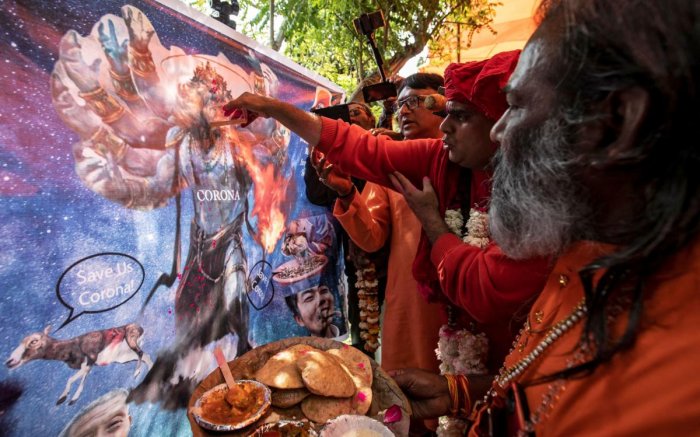
coronavirus and cow urine

Representational image. | Image Courtesy: Deccan Herald


Yad ihasti tad anyatra, yan nehasti na tat kavcit. ‘Whatever is here might be elsewhere, but what is not here could ever be found’.—The Mahabharata, 1.56.33, from Meera Nanda’s The God Market: How Globalisation is Making India More Hindu, Random House 2009.

It was the fag end of the 1st decade of the 21st century when the historian Rink Shenkman wrote his marvellous book, Just how stupid Are We? Facing the Truth about the American Voter. In an interview, he said that Americans are “ill-prepared” to guide the world’s “most powerful” democracy. The book points out the astounding inability of even “two of five voters” to name three branches of the federal government, the fact that half of Americans think that their president can suspend the Constitution, and a large section’s ignorance of the 9/11 attack and the Iraq war that followed.

His concern was the mass of people who could easily, repeatedly and systematically be misled and manipulated by politicians and further “dumb down” American politics.

This “stupidity” was on full display in images of rowdy college crowds hitting California’s beaches during spring break, prompting the governor to close them down. New York governor Andrew Cuomo warned that “young people are not Superman/woman” when it turned out that people, especially the young, are not socially distancing themselves. But only Americans are not to blame. Media tells us that “virus rebels” are displaying their stupidity virtually all over the Western world, prompting crackdowns by authorities.

There’s perhaps no similar study for South Asia, especially India, probing our “stupidity” in this crisis-time, though there’s immense fodder for it.

( Read the full text here : https://www.newsclick.in/Hindutva-Coronavirus-COVID-19-WhatsApp-Fake-News)

Statement on the imminent arrest of Gautam Navlakha and Anand Teltumbde : Alan-Thaha Human Rights Committee, Kerala

The Alan-Thaha Human Rights Committee, Kerala, expresses its deep concern and anguish over the imminent arrest of prominent intellectuals Gautam Navlakha and Anand Teltumbde in the Bhima-Koregaon case.

Continue reading Statement on the imminent arrest of Gautam Navlakha and Anand Teltumbde : Alan-Thaha Human Rights Committee, Kerala

Desirable Deaths, Malignant Neglect

Coronavirus reveals that in the capitalist world there is still no such thing as society.

Coronavirus

Bella Ciao! Bella Ciao! A song which traces its origins to the struggles of working women (rice-weeders) in 19th-century Northern Italy, and which later became an anthem of anti-fascist struggles there, recently made a comeback on the streets of Rome.

Well, there was no mass gathering, obviously, but you could hear people’s voices sing not only Bella Ciao from windows and balconies but many other patriotic numbers, some newly-composed.

With the world’s eighth-largest economy under lockdown, people restricted to their homes and fatalities due to novel coronavirus already over 1,400, this collective singing was the Italian people’s way of finding a moment of joy in this time of anxiety. It “lifted their spirits” and became a unique way for them to declare solidarity with each other.

( Read the full story here : https://www.newsclick.in/Coronavirus-Crisis-Capitalist-Society-Public-Funded-Health-System)

A Memorandum to Delhi Govt on Relief, Rehabilitation and Reconciliation in North East Delhi

Date: 20/03/2020

To,

Mr. Arvind Kejriwal

Chief Minister,

Government of National Capital Territory of Delhi

 To,

Mr. Manish Sisodia,

Deputy Chief Minister,

Government of National Capital Territory of Delhi


Subject: Relief, Rehabilitation and Reconciliation in North East Delhi

Memorandum of Demands to the Delhi Government

The communal violence in north east Delhi that took place in the last week of February is the most disgraceful event in the recent history of the city. Scores of people have lost their lives and thousands are displaced. The observations and evidence from the last three weeks suggest that the violence was not sporadic, but was organized and targeted particularly at Muslim residents in various colonies of the area. There are serious question marks on the role of the Delhi Police during the whole affair. An unbiased and thorough investigation in the matter is necessary to bring the guilty to book.

Based on observations and initial attempts at data collection from the last three weeks, the scale of devastation (material and human costs) is understood to be huge and merits a detailed assessment. While community members have been generous in opening their homes to fleeing families and civil society efforts have tried to fill in for immediate relief, the state government needs to step in to address the concerns of the affected people. There are two reasons for this. One, the crisis is the result of a state failure and has resulted in grave deprivation among the citizenry. The state thus has a moral and administrative duty to compensate and rehabilitate those affected in a compassionate and humane way. Two, the scale of the crisis is such that only the state can address it. Civil society and community effort should not be seen as a substitute for what is the state’s responsibility. While the state government had been conspicuous by its absence in the first three days of the violence, it has been trying to coordinate relief efforts since. A comprehensive plan needs to be put in place with short, medium and long term targets for which the state must take responsibility and invite non-state actors from community organisations to individual citizens that are willing to lend support to such a state led process.

Continue reading A Memorandum to Delhi Govt on Relief, Rehabilitation and Reconciliation in North East Delhi

An Inquiry in to the Anti-Muslim Violence in Northeast Delhi: Progressive Medicos and Scientists Forum

Progressive Medicos and Scientists Forum is a team of doctors that visited the area.

Members of the medical team [1] 

  1. Dr Vikas Bajpai – Assistant Professor, Centre for Social Medicine and Community Health, Jawaharlal Nehru University, New Delhi (Ph: 9717820427).
  2. Dr Harjit Bhatti – Former President, Resident Doctors Association, All India Institute of Medical Scientists (AIIMS) (Ph: 8586848479).
  3. Dr Sumitran – A consultant radiologist with a government hospital in Delhi.
  4. Five doctors from the All India Institute of Medical Sciences

It took a 25 to 30 km drive from AIIMS (All India Institute of Medical Sciences), to the violence affected areas of Northeast Delhi. We were visiting the area in the context of the massive communal violence, primarily directed against Muslims living in the area, in the wake of their resistance to the CAA Act passed recently by the parliament along with NRC-NPR which threaten to rob millions of Muslims of their Indian citizenship and render them illegal in their own country.

The effort to send this medical team was initiated in the context of massive scale of medical emergency that arose as a result of this violence. In this report, apart from reflecting on the medical suffering of the people, we shall also try to provide a snapshot of the violence that was unleashed and the role of the political-administrative machinery to address the same and its consequences, as were narrated to us by the people we met.

Continue reading An Inquiry in to the Anti-Muslim Violence in Northeast Delhi: Progressive Medicos and Scientists Forum

Over one thousand women write to Chief Ministers opposing NPR

Given that the updation of the National Population Register (NPR) is scheduled to begin from April 1, 2020 along with house listing for the Census of India 2021, women rights activists released a letter at Delhi’s Press Club on March 17, 2020, that was sent to every Chief
Minister in the country by over one thousand individual signatories and 18 organizations. The signatories include activists, writers,
academics, lawyers, doctors, farmers, professionals, anganwadi workers and women from all walks of life from more than 20 states.

LETTER TO CMs from Women’s* Groups and individuals_

Dear Chief Minister,

 *Subject: NPR PRESENTS A CLEAR DANGER TO WOMEN.*
*DE-LINK NPR FROM CENSUS HOUSE LISTING.*

  1. *We write to you as Indian women [1] who are opposed to the proposed National Population Register (NPR) [2]*. Women constitute nearly 50% of India’s population, and this opposition is based on clear evidence from our own lives.
  2. Section 14 A of the Citizenship Act, the accompanying 2003 Rules, and official reports of the Ministry of Home Affairs, all provide for using NPR data to compile the National Register of Indian Citizens (NRIC). The NRIC will be prepared by local registrars scrutinizing information of individuals in the Population Register and marking people as ‘Doubtful Citizens’.

Continue reading Over one thousand women write to Chief Ministers opposing NPR

Understanding the Rise of the BJP

Guest Post by PARVIN SULTANA

(Review of HINDUTVA: EXPLORING THE IDEA OF HINDU; NATIONALISM, Jyotirmaya Sharma ( Context 2019); M.S. GOLWALKAR, THE RSS AND INDIA, Jyotirmaya Sharma (Context, 2019) ; DECODING THE RSS: ITS TRADITIONS AND POLITICS Raosaheb Kasbe (Leftword Books, 2019) , RAJIV GANDHI TO NARENDRA MODI: BROKEN POLITY, FLICKERING REFORMS Parsa Venkateshwar Rao Jr. (Sage Select, 2019) ; MODINAMA: ISSUES THAT DID NOT MATTER Subhash Gatade (Leftword Books, 2019) 

The 2014 general elections which saw the Bharatiya Janata Party return to power with an absolute majority is believed to have brought an important paradigmatic shift to Indian politics. Scholars commenting have termed it as a majoritarian shift. Post elections, there have been discussions which tried to understand the reasons behind this massive mandate that the Right Wing political party managed to get. This Right Wing shift in India’s electoral politics was further proven by the 2019 Parliament election results which gave the BJP a larger mandate. Scholars have written trying to understand the rise of BJP—is it an isolated event or a continuation of past developments? This becomes important because even at the international level, there is a shift towards conservative politics.
Indian academia has also taken an objective look at this shift. A number of books have been written on various aspects of present-day politics, the ideologies and icons that paved the way for this rise and continue to provide intellectual fodder for this politics, the liberal economic policies which have been taken to their logical conclusion by the present government, etc. And these books have provided us with important insights to make sense of the present-day political situation of the country.

( Read the full text here : https://thebookreviewindia.org/understanding-the-rise-of-the-bjp/)

Denying Interim Bail To Anand Teltumbde and Gautam Navlakha Is Alarming : MRSD

Guest Post by MRSD ( Mumbai Rises to Save Democracy)

Statement by MRSD on Supreme Court’s rejection of pre-arrest bail plea of Anand Teltumbde and Gautam Navlakha in the Bhima Koregaon violence case

Mumbai Rises to Save Democracy (MRSD) is deeply disappointed with the Supreme Court’s rejection of the plea by Anand Teltumbde and Gautam Navlakha seeking anticipatory bail in the cases registered against them in relation to the violence at Bhima Koregaon on 1st January 2018. Their arrest is imminent in next three weeks. Nine other activists and intellectuals who have been accused in this case and charged with sections of the draconian Unlawful Activities Prevention Act (UAPA) have been imprisoned since 2018.

The top court’s order to deny interim bail is alarming given that the case against the activists is based on very thin evidence. Moreover, the cyber forensic analysis by credible investigative journalists and technical experts discredit the evidence used by Pune police to incriminate the activists. The analysis reveals that the letters which were allegedly recovered from the hard disk of Rona Wilson, one of the nine activists accused in the case, and used by the police to link the accused to a banned political party are most likely to have been planted in the disk through use of malware which allowed remote access to Wilson’s computer (https://caravanmagazine.in/politics/bhima-koregaon-case-rona-wilson-hard-disk-malware-remote-access). This clearly indicates manipulation of evidence and the fabricated nature of the case.

The government is sparing few chances for truth to emerge in this case. In January 2020, more than a year after the chargesheets were filed by the Pune police, the Union Home ministry got the case suddenly transferred to the National Investigation Agency (NIA) and thus brought the case under its control at a time when the Home department in the newly formed Maha Vikas Aghadi government in Maharashtra had announced a review of the case, setting up of a Special Investigating Team (SIT) and dropping of the false cases against the activists.

While full-blown attempts are being made by the government to incriminate the eleven intellectuals in a fabricated case, the investigation into the role of Hindutva brigade led by Milind Ekbote and Manohar Bhide in carrying out planned organised attacks on Dalits at Bhima Koregaon has come to a standstill. The state government’s failure to set up a SIT shows that the real perpetrators of violence are being shielded from prosecution.

These developments in the case and now the rejection of pre-arrest bail to two of the stalwarts of the democratic rights movement in the country on the grounds of what is not just flimsy but manipulated evidence shows the desperation of the government to repress democratic voices and spread a sense of fear amongst those who oppose the anti-people policies and actions of the Hindutva Fascist regime. MRSD extends its solidarity to the eleven activists who have been relentless defenders of human rights and people’s movements in this country and who now stand wrongly accused in this conspiracy case. We also reiterate our resolve to continue to struggle for their release and for the pursuit of truth about the violence unleashed on the peaceful Dalit-Bahujan masses at Bhima Koregaon.

  • MRSD

Participating Organisations: People’s Union of Civil Liberties (PUCL), Committee for Protection of Democratic Rights (CPDR), National Trade Union Initiative (NTUI), Trade Union Centre of India (TUCI), Student Islamic Organisation (SIO), Ambedkar Periyar Phule Study Circle (APPSC) – IIT Mumbai, Co-ordination Of Science And Technology Institute’s Student Association (COSTISA), LEAFLET, Police Reforms Watch, NCHRO, Bebaak Collective, Forum Against Oppression of Women (FAOW), LABIA- A Queer Feminist LBT Collective, Jagrut Kamgar Manch (JKM), Majlis, Indian Muslims for Secular Democracy (IMSD), Women against Sexual Violence and State repression (WSS), Bharat Bachao Andolan (BBA), Indian Social Action Forum (INSAF), People’s Commission for Shrinking Democratic Spaces (PCSDS), Human Rights Law Network (HRLN), Cause Lawyers Alliance, National Alliance of People’s Movements (NAPM), Nivara Hakk Suraksha Samiti, Kashtakari Sanghatna – Palghar, Sarvahara Jan Andolan – Raighad, Jagrut Kashtkari Sanghatana, students from various colleges in Mumbai including Homi Bhabha Research Centre, St.Xaviers and Tata Institute of Social Sciences.

The Need for a New Political Platform


[Beginning this week, ‘Parapolitics’ will be a fortnightly column appearing on the second and fourth Thursday of every month.]

We were never so helpless, never so bereft, never more in need of a platform of struggle. The need for a new political formation is acutely felt today as never before. And by a new formation I do not mean a party of the Left in any traditional sense but a different kind of left-wing formation that can act resolutely in defense of democracy.

Two developments of the past week – the crisis of Yes Bank and the defection of 22 Congress MLAs, led by Jyotiraditya Scindia, to the BJP – signal the deep crisis that we are in today. Reports suggest that each MLA was offered something like Rs 100 crore by the BJP to defect. These developments come close on the heels of a horrendous anti-Muslim carnage in Delhi where we have been witness to the the total collapse of all institutions. From the complete paralysis of the elected AAP government in the state and a Supreme Court that simply pretends not to see what’s going on, to a lapdog ‘media’ actively engaged in promoting violence – this collapse was perhaps never so evident in our history.

Continue reading The Need for a New Political Platform