Category Archives: Bad ideas

Ayodhya: Can a Dispute Reach Closure if it Still Causes Pain?

The dispute will linger until India learns coexistence from history.

Ayodhya: Can a Dispute Reach

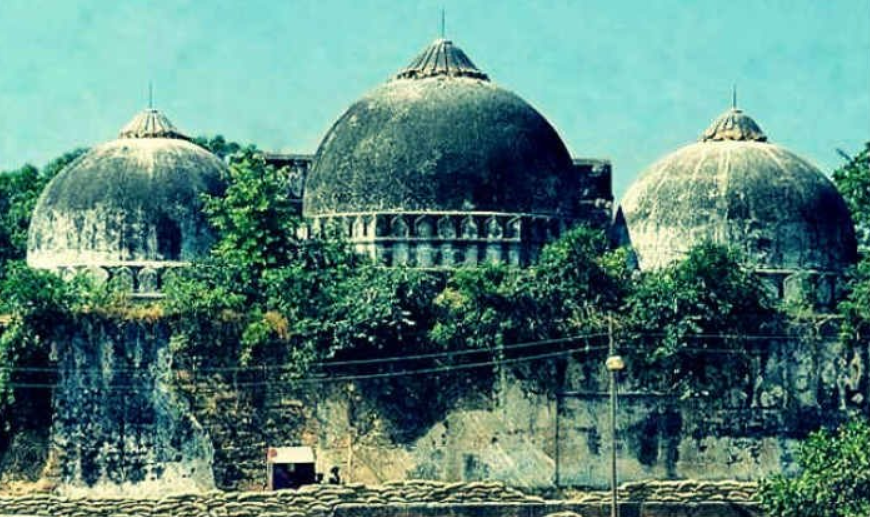
Coexistence between social groups was a social reality and a primary tenet of Indian life, long before the word secular was included in its Constitution in 1976. Now that a five-judge bench of the Supreme Court has delivered a “historic” judgement on the Babri Masjid dispute, there is a sense of disquiet. This is not just on account of the asymmetries and silences in the judgement that many writers have pointed out. It is because the court has ruled that the forces who brought down the Babri Masjid are entitled to the land on which it stood. The question remains whether there can be any real closure in a dispute if the pain it has caused continues to linger.


Hunting with the Hounds: The Supreme Court (today) on Sabarimala

It is hard to describe the mood that the unbelievably timid judgment leaves me in.  One has to stop, really, hoping that some institution will be saved from the ongoing collapse of all decency in the country. My article in The Wire.

Exit Azad! Enter Savarkar!!

Even at the breakneck pace at which its proponents are rewriting history in the Hindutva mould, its real past will habitually catch up with it.

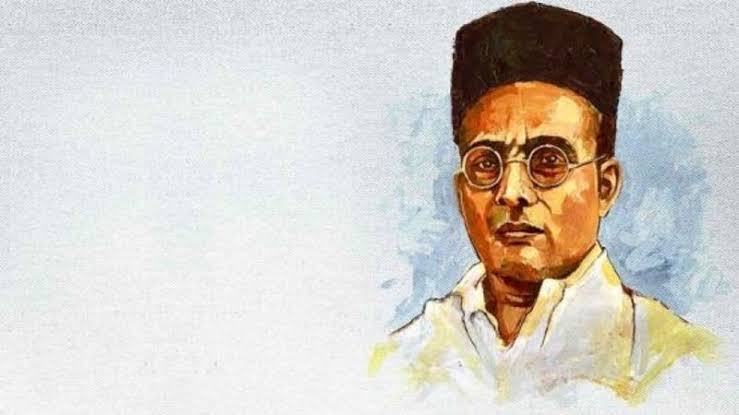
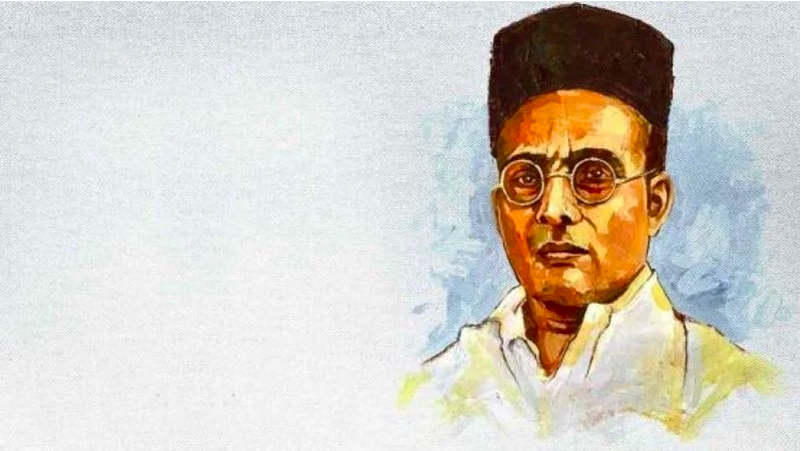
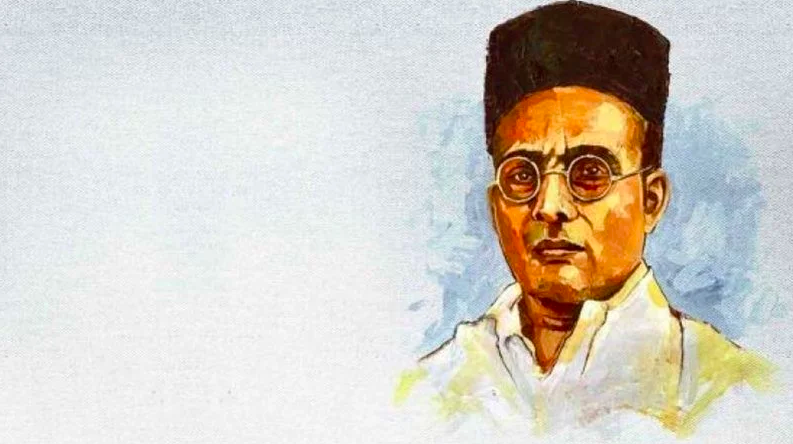
Savarkar

Last year, a statue of freedom fighter and first education minister of independent India, Maulana Abul Kalam Azad, was destroyed by Hindutva mobs at Kankinara in North 24 Parganas district, West Bengal. At the time, there were communal flare-ups in many districts of the state in the aftermath of aggressive Ram Navami marches, the first of their kind in the country.

The episode was immediately forgotten. Few would have had the premonition that the incident was was merely a precursor to the larger game-plan of the Hindutva right, to erase not just the legendary freedom fighter’s statute, but his name from history.

Now, for some reason, the Indian Council for Historical Research (ICHR) has decided to organise a seminar on ‘Veer Damodar Savarkar: Life and Mission’ on 11 November, the birth anniversary of Maulana Azad, perhaps gives an indication of their intent. This particular date also has no apparent connection with Savarkar, who was born on 28 May 1883 and died on 26 February 1966.

Besides, just over a decade ago, 11 November was declared as National Education Day, to commemorate Azad and recall his contribution to policies and institutions that streamlined the educational needs of newly-independent India. It was a day to reflect on and discuss the country’s education system and its future.

( Read the full article here : https://www.newsclick.in/exit-azad-enter-savarkar)

Politainment : Why Hindutva Brigade Spews Lies

Their fantasy is to control India’s fate by distorting historical events.

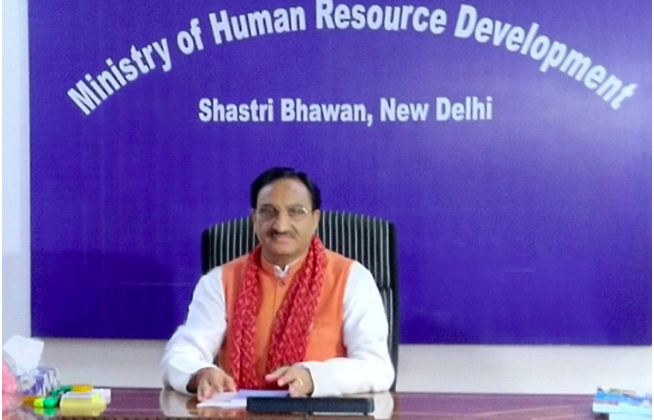
Nishank

History is witness that Buddhism, which originated in the Indian subcontinent, posed a challenge to brahmanical Hinduism. It is also recorded history that Buddhism was completely wiped out of this region centuries later, through means violent and non-violent. But the Hindutva supremacists, compelled by their desire and fantasy to re-shape national identity, want India’s past to match their views on religion. And for them, India is a nation only of and for Hindus.

That is why, through repeated false statements on the subcontinent’s “history”, they are challenging and demolishing India’s past. That is their way of attacking its multicultural present. With the goal to establish Hindu dominance in all fields, they are starting backwards, with untrue claims about “time immemorial”. The recent fabrication of Badris University by a Union minister is a step in that direction.

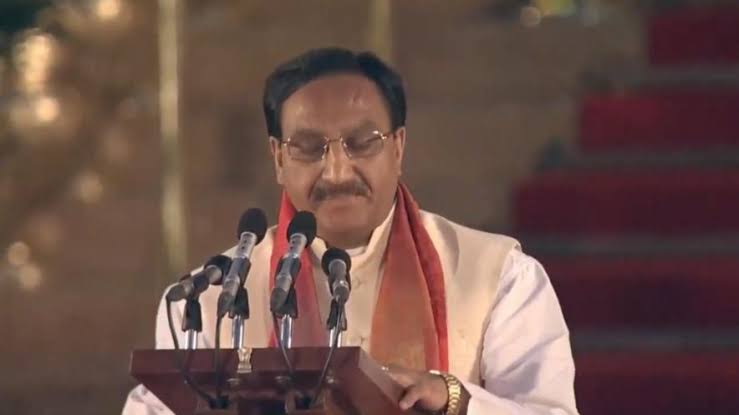
The Minister of Human Resource Development, Ramesh Pokhriyal Nishank, has said that the oldest university in the world was in Badrinath, a town in Chamoli district of Uttarakhand. The university was called “Badris”, the minister claimed in a lecture he delivered in Dehradun, a prominent city of Uttarakhand, last week. No such institution ever existed according to historical record, but Pokhriyal has insisted that will be “restored to its full glory”, presumably from funds taken from his ministry’s grants.

( Read the full article here : https://www.newsclick.in/politainment-why-hindutva-brigade-spews-lies)

Goodbye, Tipu Sultan

The Sangh Parivar has supported Tipu when it needed to.

Tipu Sultan

Ghatam Bhindyat, Patam Chhindyat, Kuryat Rasbharohanam

Yenken Prakaren, Prasidho Purusho Bhavet

(Break earthen pots, tear clothes, ride a donkey:

Men try to achieve popularity by any means.)

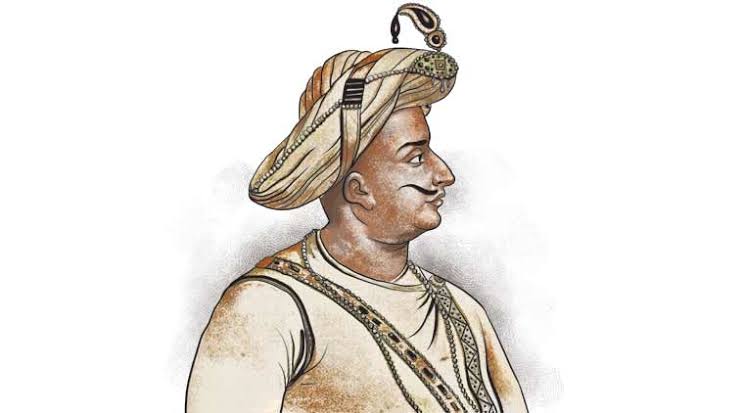
It was 2006 and DH Shankarmurthy, a nondescript swayamsevak, was handling the higher education ministry in the HD Kumarswamy-led coalition government suddenly hit the national headlines. The trigger was his unusual demand to recast history books in the mould of the Sangh Parivar. Especially his proposal to obliterate the great warrior Tipu Sultan’s name from the annals of Kannada history.

The proposal was based on the completely false pretext that Tipu did not give due importance to the Kannada language and promoted Persian language instead. Never mind that the Mysore state archaeological department holds in its possession more than thirty letters sent from Tipu to the shankaracharya of the Shringeri math, all written in Kannada.

Shankaramurthy wanted Tipu Sultan—who sacrificed his children to end the British rule—obliterated from Karnataka history on the spurious logic that the alleged neglect of Kannada language was reason enough. Even then, the demand had caused a national uproar cutting across party lines. At the time, the Bharatiya Janata Party (BJP) and the Janata Dal Secular (JD-S) were sharing power in the state. As a result, their plans fell flat. Much water has flown down the Kaveri, Godavari and every other Indian river and now a BJP-led government, holding power in the state of Karnataka and the centre has drawn up fresh plans to fulfill a task left unfinished.

( Read the full article here : https://www.newsclick.in/goodbye-tipu-sultan)

सावरकर को भारत रत्न देना आज़ादी के नायकों का अपमान है

क्या ऐसा शख़्स, जिसने अंग्रेज़ सरकार के पास माफ़ीनामे भेजे, जिन्ना से पहले धर्म के आधार पर राष्ट्र बांटने की बात कही, भारत छोड़ो आंदोलन के समय ब्रिटिश सेना में हिंदू युवाओं की भर्ती का अभियान चलाया, भारतीयों के दमन में अंग्रेज़ों का साथ दिया और देश की आज़ादी के अगुआ महात्मा गांधी की हत्या की साज़िश का सूत्रसंचालन किया, वह किसी भी मायने में भारत रत्न का हक़दार होना चाहिए?

Narendra Modi Savarkar Facebook

वक्त की निहाई अक्सर बड़ी बेरहम मालूम पड़ती है. अपने-अपने वक्त के शहंशाह, अपने-अपने जमाने के महान रणबांकुरे या आलिम सभी को आने वालों की सख्त टीका-टिप्पणियों से रूबरू होना पड़ा है.

बड़ी से बड़ी ऐतिहासिक घटनाएं- भले जिन्होंने समूचे समाज की दिशा बदलने में अहम भूमिका अदा की हो- या बड़ी से बड़ी ऐतिहासिक शख्सियतें- जिन्होंने धारा के विरुद्ध खड़ा होने का साहस कर उसे मोड़ दिया हो – कोई भी कितना भी बड़ा हो उसकी निर्मम आलोचना से बच नहीं पाया है.

यह अकारण ही नहीं कहा जाता कि आने वाली पीढ़ियां पुरानी पीढ़ियों के कंधों पर सवार होती हैं. जाहिर है वे ज्यादा दूर देख सकती हैं, पुरानी पीढ़ियों द्वारा संकलित, संशोधित ज्ञान उनकी अपनी धरोहर होता है, जिसे जज्ब कर वे आगे निकल जा सकती हैं.

समाज की विकास यात्रा को वैज्ञानिक ढंग से देखने वाले शख्स के लिए हो सकता है यह बात भले ही सामान्य मालूम पड़े, लेकिन समाज के व्यापक हिस्से में जिस तरह के अवैज्ञानिक, पश्चगामी चिंतन का बोलबाला रहता है, उसमें ऐसी कोई भी बात उसे आसानी से पच नहीं पाती.

घटनाओं और शख्सियतों का आदर्शीकरण करने की, उन्हें अपने दौर और अपने स्थान से काटकर सार्वभौमिक मानने की जो प्रवृत्ति समाज में विद्यमान रहती है, उसके चलते समाज का बड़ा हिस्सा ऐसी आलोचनाओं को बर्दाश्त नहीं कर पाता.

वैसे बात-बात पर आस्था पर हमला होने का बहाना बनाकर सड़कों पर उतरने वाली हुड़दंगी बजरंगी मानसिकता भले ही ऐसी प्रकट समीक्षा को रोकने की कोशिश करे, लेकिन इतिहास इस बात का साक्षी है कि कहीं प्रकट- तो कहीं प्रच्छन्न रूप से यह आलोचना निरंतर चलती ही रहती है और उन्हीं में नये विचारों के वाहक अंकुरित होते रहते हैं, जो फिर समाज को नये पथ पर ले जाते हैं.

फिलवक्त विनायक दामोदर सावरकर- जिन्हें उनके अनुयायी ‘स्वातंत्रयवीर’ नाम से पुकारते हैं, जो युवावस्था में ही ब्रिटिश विरोधी आंदोलन की तरफ आकर्षित हुए थे, जो बाद में कानून की पढ़ाई करने के लिए लंदन चले गए, जहां वह और रैडिकल राजनीतिक गतिविधियों में जुड़ते गए थे- इसी किस्म की पड़ताल के केंद्र में है.

( Read the full article here : http://thewirehindi.com/98705/vd-savarkar-bharat-ratna-indian-freedom-movement/)

History as Storytelling

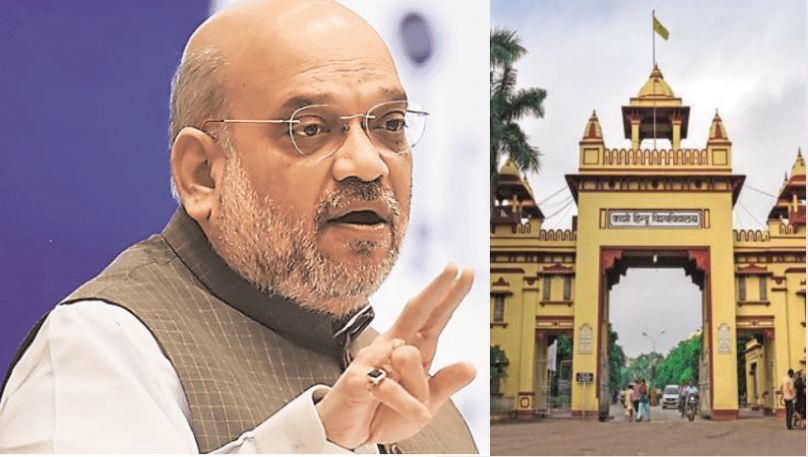
Home Minister Amit Shah, while inaugurating a two-day seminar at Banaras Hindu University, emphasised that Indian historians should “rewrite history from an Indian perspective”.

Home Minister Amit Shah

There is one thing unique about the present dispensation holding reins of power at the Centre. What one witnesses that the cabinet ministers—who go by the principle of collective responsibility—follow the dictum in letter and spirit. Thus, it is not considered unusual when a minister holding X portfolio shares their opinion about an urgent issue before Y ministry and vice versa. This process has been so normalised that when recently Home Minister Amit Shah, who according to his followers is the new ‘Iron Man’ of India—thanks to the abrogation of Article 370—shared his views on need for ‘rewriting history’, no eyebrows were raised.

No commentator even asked why the home minister—a graduate in bio-chemistry who has also worked as a stockbroker and in co-operative banks [Sheela Bhatt, “What Amit Shah’s fall really means”, July 28, 2010]—was found the most apt person to inaugurate a two-day seminar on a subject of history at Banaras Hindu University where he shared his pearls of wisdom. His emphasis was that Indian historians should “rewrite history from an Indian perspective”. The focus of the seminar was on Skandagupta Vikramaditya, the fifth-century AD emperor.

(Read the complete article here – https://www.newsclick.in/History-Storytelling)

Savarkar, India’s ’Ratna’ of a Different Kind!

BJP’s poll promise of Bharat Ratna for Savarkar, who inspired a wide spectrum of fanatic individuals and violent organisations, shows the moral vacuousness of the Hindutva project

Savarkar

“The curious fact is that as we move into the 21st century, historians have become central to politics. We historians are the monopoly suppliers of the past. The only way to modify the past that does not sooner or later go through historians is by destroying the past….Mythology is taking over from knowledge”.

It was in the wee hours of dawn of the 21st century that renowned scholar and historian, Eric Hobsbawm, had talked about the process of  “destroying the past” to “modify” it or how “mythology is replacing knowledge” in his speech at Columbia University in New York City.

Much water has flown down the Ganges, the Rheins, the Yangtzes of the world and as we stand at the cusp of the third decade of the 21st century, one realises that how this process — both literally and metaphorically — has advanced to different corners of the globe.

With the ascent of Hindutva supremacist forces in polity and society in this part of the world, perhaps this process has reached its extreme, so much so that every other saffronite seems to have gathered enough confidence to claim legitimacy to any weird thing. The news that the Bharatiya Janata Party (BJP), in its election manifesto (for the Maharashtra Assembly) has promised that it would confer Bharat Ratna, the country’ topmost honour, on VD Savarkar if voted to power, should be seen in this light.

( Read the full text here : https://www.newsclick.in/Savarkar-India-Ratna-of-a-Different-Kind)

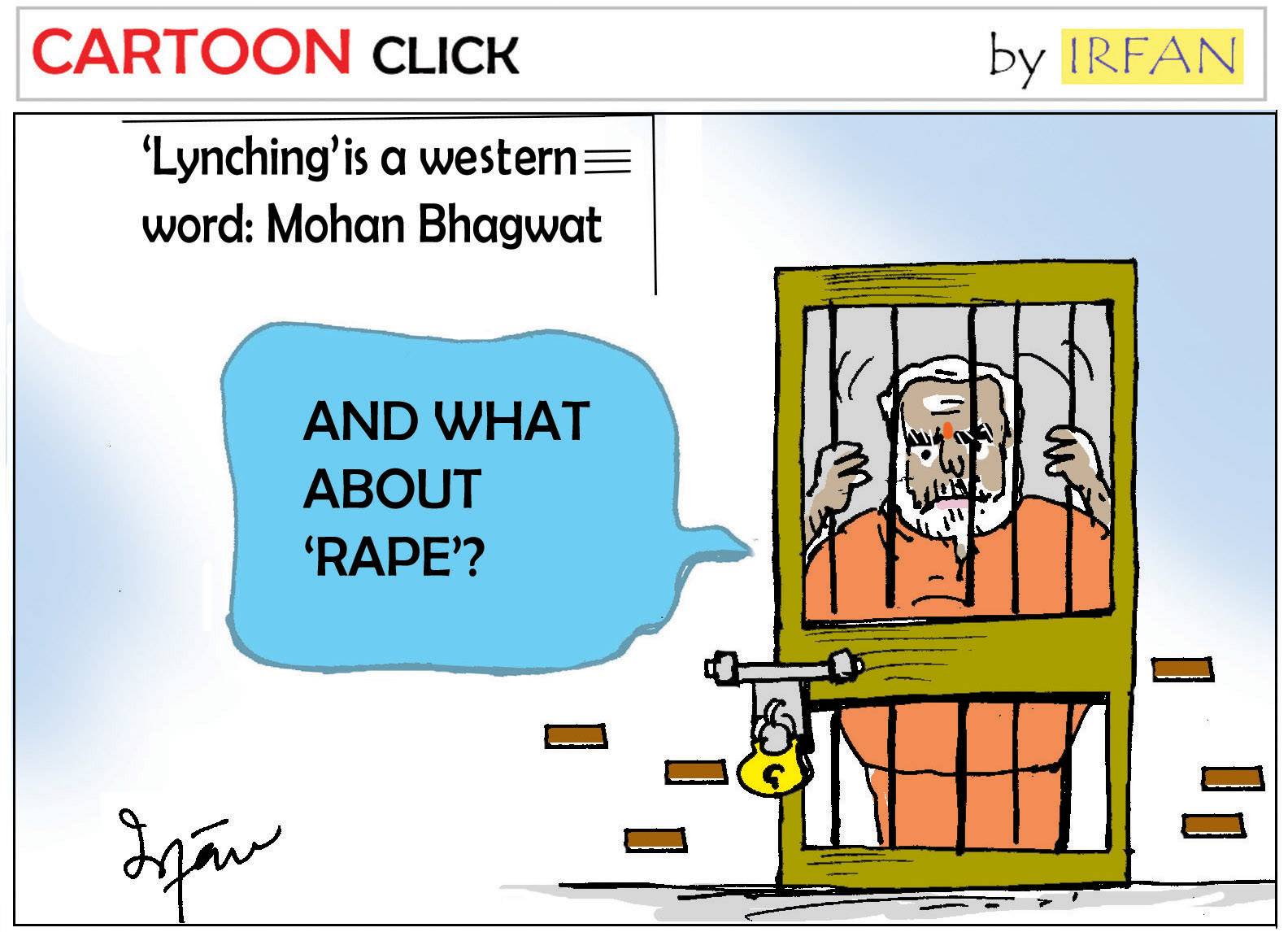
Will Lynching in Bharat Be Called Vaddh?

The Sangh’s obsession with vocabulary is not innocent.

Will Lynching in Bharat

The speech by Rashtriya Swayamsevak Sangh (RSS) supremo Mohan Bhagwat on its foundation day (Dusshera) has now become an event, watched with interest. The speech itself has a long tradition within the organisation, which all its affiliated (anushangik) bodies look upon as a guiding light.

This year was no different. Donning the Sangh’s uniform, the top echelons of its organisations attended the event. Union Minister Nitin Gadkari, Maharashtra Chief Minister Devendra Fadnavis attended too, and wore the black cap and Sangh “uniform”.

Yet, the speech by Bhagwat itself had nothing seemingly strategic. Some analysts even felt that he could not show any new direction to the RSS and its affiliates; that it seemed to have made a weak defence of the Bharatiya Janata Party (BJP) government that is ruling at the Centre and several states. “Have the tables turned on the Sangh Parivar?,’ The Wire asked, in its analysis of Bhagwat’s speech.

( Read the full text here : https://www.newsclick.in/Lynching-Bharat-Called-Vaddh)

शौचालय: एक हत्यारी कथा 

Guest Post : Fact finding team of Communist Party of India ( CPI)

[पिछले सितम्बर की 25 तारीख़ को मध्य प्रदेश के शिवपुरी ज़िले के एक गाँव भावखेड़ी में दो बच्चों की नृशंस हत्या कर दी गयी थी।  मीडिया में कारण यह आया था कि उन्हें खुले में शौच करते देख उसी गाँव  व्यक्ति को गुस्सा आ गया और उसने बच्चों को मार डाला। 

सीपीआई का एक छः सदस्यीय जाँच दल मामले की तहक़ीक़ात के लिए 1 अक्टूबर 2019 को शिवपुरी और भावखेड़ी गया था।  ग्रामीणों और पीड़ित परिवार से तथा अन्य कर्मचारियों, शिक्षकों व बच्चों से बात करने पर हमारे सामने जो तस्वीर उभरी, उसके आधार पर तैयार यह रिपोर्ट]

The Open is No Place for India's Children to Go

मृतक बच्चे (फाइल फोटो दि वायर से साभार) Continue reading शौचालय: एक हत्यारी कथा 

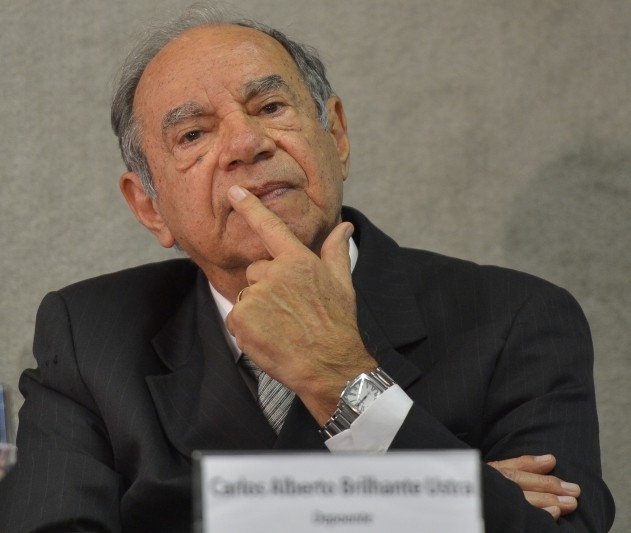
India’s Answer to Brazil’s Ustra

The Hindu Right is analogous to Right-wing regimes elsewhere.

UstraComissao

As Brazil’s Far Right rises, army man Ustra (who died in 2015), who tortured hundreds, is becoming a cult figure of a kind. Image Courtesy: Wikipedia

The popularity of Good Night Stories for Rebel Girls, which present female role models before young readers, has proved rather phenomenal. Within a span of three years, it has been published in 47 languages around the world and has sold more than a million copies.

The plan to render a Turkish version has met with a big roadblock. A board for the protection of minors from obscene publications of the Turkish government has found them offensive. It recently ruled that these books should be partially banned and treated like pornography.

The reason—they could have a ‘detrimental influence’ on young minds.

It is beyond comprehension what “negative impact” a book that promotes equality can have on impressionable minds, other than the fact that they take the idea seriously and extend it to other arenas of life. Erdogan’s Turkey is no different from Right-wing regimes elsewhere that are very particular about what children should read or not.

Jair Bolsonaro, the controversial Far Right President of Brazil, who is also known as the Trump of the Tropics, was recently in the news for similar reasons.

( Read the full text here : https://www.newsclick.in/india-answer-brazil-ustra)

New India  – New Father of Nation?

Image result for mahatma gandhi

Ms. Amruta Fadanavis – wife of Maharashtra Chief Minister Devendra Fadanavis – found herself at the centre of controversy two weeks back. Her birthday greetings to PM Modi – whom she wished ‘Father of Our Country @narendramodiji a very Happy Birthday -…’ – on her twitter evoked reaction from twitterati. Her ‘height of ignorance’,  was pointed out and her attempt was called ‘sycophancy at its top’ (https://twitter.com/fadnavis_amruta/status/1173877700290678785)

Anyway, as one hoped that this chapter around ‘discovery of a new Father of Nation’ was over and one was attempting to turn a new leaf what one witnessed was rather unusual.

The debate around ‘Father of Nation” came back with a vengeance. Continue reading New India  – New Father of Nation?

Humko Savarkarich Mangta

Jinnah propounded his two-nation theory in 1939—exactly two years after Savarkar presented it.

Savarkar

Who could have been the best prime minister of independent India? 

Nehru or (Vallabhbhai) Patel?

For more than last five years, we have been a witness to this manufactured debate—courtesy Bharatiya Janata Party (BJP), which has tried all the tricks in its kitty to create a false binary between these leading stalwarts of independence movement, who called themselves ‘Gandhi’s sipahis’.

Anyway, thanks to the differences of perception within the saffron fraternity, a new competitor to Sardar Patel seems to have emerged from within the Hindutva Brigade who is being projected as someone who would have been a “better PM”.

Uddhav Thackreay, chief of Shiv Sena and at present, a junior ally of the BJP in Maharashtra, recently made his choice clear by stating that if Veer Savarkar would have become the prime minister, “Pakistan would not have come into existence”. At a book release event, he even refused to call Nehru a Veer (courageous), making a rather provocative statement: ‘I would have called Nehru brave if he would have survived jail for 14 minutes against Savarkar who stayed in the prison for 14 long years.’

Definitely, the fact that Nehru spent more than nine years in different jails of the colonialists without ever compromising his basic principles—whereas, the 14 years spent by Savarkar were interspersed with mercy petitions sent by him to the British, wherein he had even expressed his readiness to ‘serve the government in any capacity they like’—did not bother him at all.

( Read the full article here : https://www.newsclick.in/humko-savarkarich-mangta

‘ईश्वर नहीं है’ कहने का अधिकार

Image result for periyar
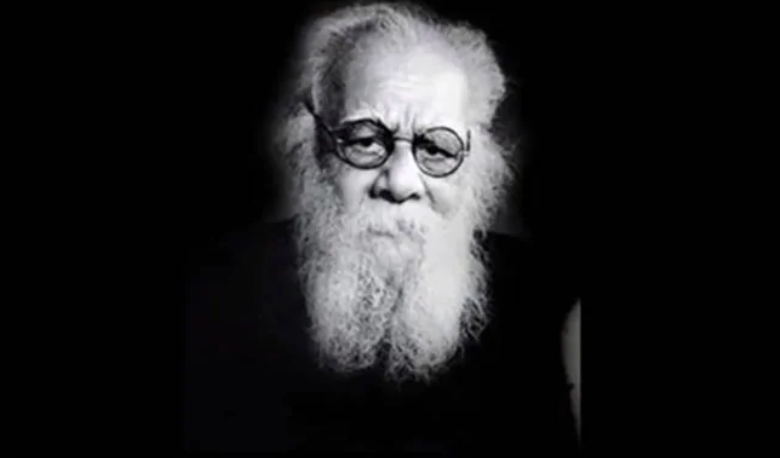
Periyar : Image – Courtesy velivada.com

क्या अभिव्यक्ति की स्वतंत्रता का अधिकार महज आस्थावानों के लिए ही लागू होता है ?

कभी कभी साधारण से प्रश्न का उत्तर पाने के लिए भी अदालती हस्तक्षेप की जरूरत पड़ती है।

मद्रास उच्च न्यायालय की – न्यायमूर्ति एस मनिकुमार और सुब्रहमण्यम प्रसाद की – द्विसदस्यीय डिवीजन बेंच को पिछले दिनो ंयह दोहराना पड़ा कि अभिव्यक्ति का अधिकार – जो भारत के संविधान के तहत मिले बुनियादी अधिकारों में शुमार है – सार्वभौमिक है और इसे समयविशेष के बहुमत के आंकड़ों के आधार पर तय नहीं किया जा सकता।

मालूम हो कि किन्ही दैवानायागम ने न्यायालय में यह जनहितयाचिका दाखिल की थी और कहा था कि तमिलनाडु के त्रिची में पेरियार की मूर्ति पर जो नास्तिकता के उद्वरण दिए गए हैं, वह ‘सार्विक ईश्वर’ को माननेवालों के लिए आपत्तिजनक हैं और उन्हें हटा दिया जाए। याद रहे रामस्वामी नायक / 17 सितम्बर 1879-24 दिसम्बर 1973/ जिन्हें ‘पेरियार’ नाम से जाना जाता है, वह आत्मसम्मान आन्दोलन के अग्रणी थे, द्रविड कझगम के संस्थापक पेरियार एक जुझारू किस्म के समाज सुधारक भी थे। याचिकाकर्ता ने मूर्ति पर लिखे उद्धरण के बारे में ‘‘कोई ईश्वर नहीं है, ईश्वर नहीं है और वाकई ईश्वर नहीं है..’ के पेरियार द्वारा कहे जाने पर भी सवाल खड़े किए थे। Continue reading ‘ईश्वर नहीं है’ कहने का अधिकार

There is no God And You Can Say so

Academics focus on secularism when secularisation can save the day.

There is no God And You Can Say so

Image Courtesy : NDTV

A simple query sometimes occasions judicial intervention: Does the right to freedom of expression apply merely to believers? On September 6, the Madras High Court dismissed a Public Interest Litigation filed by M Deivanayagam raising such a question. The petitioner wanted the atheistic inscriptions placed under the statue of Periyar, father of the Dravidian movement, installed in Tiruchirappalli, to be removed. He argued that the inscriptions are offensive to those who believe in a “universal god”.

The court upheld the right to freedom of expression—which is a part of the fundamental rights under India’s Constitution. It has reiterated that this right is universal and cannot be altered by numerical majority at any point of time.

Deivanayagam had also challenged the authenticity of the inscriptions attributed to Periyar. It reads as follows: “There is no god, no god, there really is no god/ He who created god is a fool/ He who preaches god is a scoundrel/ He who prays to god is uncivilised.”

The division bench of Justices S Manikumar and Subramonium Prasad dismissed the petition, emphasising that if a believer has the constitutional right under Article 19 to express her or his views on the existence of god and religion, then a non-believer has equal right to disagree and claim that there is no god.

Ramasamy Naicker, who is known as Periyar, pioneered the self-respect movement which sought equal status for the backward sections of in Tamil Nadu. He also founded the Dravida Kazhagham anti-caste movement and was a militant social reformer who died in 1978.

( Read the full text here :https://www.newsclick.in/There-no-God-You-Can-Say-so)

Lynchistan

Southern trees bear a strange fruit,

Blood on the leaves and blood at the root,

Black bodies swinging in the southern breeze,

Strange fruit hanging from the poplar trees.

The word lynching conjures up images of a dark period in the history of the United States of America. Between 1877 and 1950, white supremacist gangs murdered 4,000 African Americans, while the government and the police looked the other way. James Baldwin, whose essays Dark Days captures the unfolding violence, wrote, ‘A mob is not autonomous. It executes the real will of the people who rule the State’. In 1888, white supremacists lynched seven African American men for drinking from a well – which they had said was for ‘white’s only’. Baldwin recounts that story and writes, ‘The blood is on the hands of the state of Alabama which sent those mobs into the street to execute the will of the State’.

The lyrics quoted above are from the iconic song – Strange Fruit – written by the communist artist Abel Meeropol and sung by Billie Holiday. Continue reading Lynchistan

Against Aachaaram: When is Your Cloth Clean/Pure/ Both?

This is the third in the series titled Against Aachaaram: A Dossier from Malayalam on Kafila. Both excerpts have been chosen and translated by HARIKRISHNAN S. The prefatory note below is by J Devika. They are about the notions of purity of clothing harboured by the traditional caste elite in Kerala, which were revised by the neo-savarna of twentieth century Kerala.

The neo-savarna refers to a twentieth-century social formation that comprises of the upper-caste elite of traditional Kerala – the sudras (nair and ambalavasi), the samanthas and kshathriyas (the members of erstwhile ruling houses, minor and major), and the brahmins. The richer sections of the ex-untouchable Ezhava caste-community who have in effect abandoned the teachings of their chosen Guru, Sree Narayana, now actively seek membership in the neo-savarna, but are yet to be accepted fully.

Continue reading Against Aachaaram: When is Your Cloth Clean/Pure/ Both?

A War For Scientists to Join

Scientists have barely offered resistance to pseudoscience. This must change—IIT students show how.

Ramesh Pokhriyal

Surely India’s scientific community must be waking up to the realisation that their silence is detrimental to scientific development and allows many varieties of mischief to breed. In a rare show of gumption, students of the elite engineering institute, IIT Bombay, have slammed the recent decision to invite the Human Resources Development (HRD) Minister Ramesh Pokhriyal ‘Nishank’ to chair their graduation ceremony.

For too long India’s scientists have remained silent—even the credulous claims by Prime Minister Narendra Modi in a speech at the Ambani hospital in November 2014 was not challenged by them for a long time. A key role has to be played by the scientific community in the ongoing battle of ideas. Perhaps students of IIT Bombay show the way.

They have said in their in-house publicationInsight IIT Bombay, that a guest who “recognised, embodied and endorsed the scientific and moral values” of their institute should have been invited instead of the minister. Their problem is with Pokhriyal’s speech, pervaded by unscientific claims and “twisted facts”. They are under no illusion the speech tried to stoke “patriotic feelings”. To the IIT students, the speech was a “mild form of scientific blasphemy”.

( Read the full article here : https://www.newsclick.in/war-scientists-join)

Wisdom of Ganesh Gaitonde: Satya Sagar

Guest Post by SATYA SAGAR

Note: Ganesh Gaitonde is a fictional character from the Netflix series Sacred Games, but that does not make him any less real than anyone else on the planet.

Warning: Profanity ahead. Get parental advice before proceeding.

Somewhere on a yacht in choppy waters off the western Indian coast I met Ganesh Gaitonde, noted[1]political analyst, role model for the youth and public intellectual for a free-wheeling interview.

We discussed a wide range of extremely important issues confronting Indian society today from the celebration of Ganesh Chaturthi at the Ambani household to what PC (not Chidambaram) said when NJ farted in her dreams. Some trivial themes like climate change, nuclear war and crisis of Indian spirituality were also touched upon – but you can skip those portions if they bore you to death.

Ganesh Gaitonde (GG): Stop calling me ‘Gaitondeji’, you #^^$%&&&. You guys kept chanting ‘Gandhiji’ for seven decades while screwing everything he stood for. So, cut this ‘ji’ crap. I am just Ganesh – nothing more, nothing less.

Me: Gaitondeji…

Me: Ok, I apologize Ganesh. Now, even before we get into important national and social issues, can you explain why every other word you utter is always an obscenity? Continue reading Wisdom of Ganesh Gaitonde: Satya Sagar

Wishful visions, dishonest tales and bitter fruit

Review of ‘Malevolent Republic : A Short History of New India’ by K. S. Komireddi

Image result for malevolent republic

‘The idea of a peace-loving, nonviolent India exists, persists, as part of a selectively constructed and assiduously cultivated national self-image in the midst of a society pervaded by social and political violence…’ argued Prof Upinder Singh, in her well-researched voluminous book ‘ Political Violence in Ancient India’ which had appeared around two years back. She had also added that pioneers of independence struggle were instrumental in creating this ‘[m]yth of non-violence in ancient India which obscures a troubled, complex heritage.’

‘Malevolent Republic’ – A Short Hisotry of New India’ by K. S. Komireddi – a commentator, critic and journalist who has written for leading western publications, reminds one of this debate. The book tries to chronicle the trajectory of post-independence India from Nehru to Modi – and does not shy away from raising uncomfortable questions which demand broader contemplation as well as deep soul searching.

( Read the full story here : https://epaper.telegraphindia.com/calcutta/2019-09-06/71/Page-11.html)

Kashmir: The Violence in Silence

Guest Post By Maknoon Wani

“I need a toy and a new dress for Eid.”

Requests and tantrums like these are heard around Eid in every Kashmiri household but not this time. It was the 8th day of the government imposed military siege. On 5 August, 2019 the central government unilaterally scrapped the special status(autonomy, imagine that being called special status) of the only Muslim majority state in the union. Thousands were arrested to muzzle any dissent coming out of the agitated population. But seven year old Aairah was worried about her Eid shopping, which was never going to happen. 

How does it happen in the 21st century? How are millions of people house arrested and excommunicated within a few hours? Why are people celebrating a siege? How does this sell as normalcy? I spent many sleepless nights contemplating or rather trying to absorb the sheer cruelty of this situation. A group of students from my college invited me to a cake cutting ceremony which was organized to celebrate this decision. Maybe, their intentions were not so bad but did social convention dictate that a person be invited for the celebration of his misery? The shameless chest-thumping is a spectacle but an indifferent people is a tragedy. 

While I was suffering from this sense of loss and fear, people were celebrating and opining about Kashmir like they knew everything. I was told how good this decision is and how I should be happy. Kashmir, which went incommunicado days ago, was said to be normal. Reports from the foreign press regarding protests in Kashmir were refuted and labelled as western propaganda. Saner voices went more anti-national and pro-government channels got busy in peddling more lies. I, for one, went silent for a few days. Everyone was high on something. Some were planning to buy a plot in Kashmir while others were fantasying about white-skinned Kashmiri girls. History was forgotten, conveniently twisted and occasionally ignored to justify this daylight betrayal. A radicalized population is dangerous but trying to reason with an intoxicated population is foolishness. After all these days, I thought this silence must not be interpreted as normalcy and more importantly-peace.

What is happening in Kashmir and to Kashmiris is violence. Why aren’t the children going to schools and why are their playgrounds surrounded with barbed wires? Why aren’t mobile phones working? What is forcing Kashmiris to be silent? Is the mere presence of half a million armed forces not a form of violence? I have to ask these questions because no one else is. As I try to imagine the green meadows of my hometown, I am not able to block that intruding fear of not seeing my family again. The meadows might turn red forever. I see people celebrating this decision like an act of revenge; humanity might be dead forever. The claims of ushering in development and peace have fallen flat but then who wants the truth? A country which cheers the suspension of civil liberties can not be expected to be empathetic towards anyone. The silent mourners will lose fear one day, and this gloom will spread. It is only a matter of time when the monster reaches every door. 

It has been more than 20 days of this extraordinary blackout. We have seen only a few Kashmiri voices in the Indian media. A population needs to be amnesic to forget traumas like this. How can they tire us so much to make us forget our identity. We have survived three mass uprisings. Seven million Kashmiris right now are silently shouldering the coffin of the Indian democracy. The rot has started to reek, but the masks of ignorance have kept people safe. A few hundred landlines have been made operational, and this has been projected as normalcy. Senior anchors are posting videos and pictures(of normalcy) which can put North Korean propaganda to shame. When no one is being allowed to visit Kashmir, not even the Indian opposition leaders, then how can the situation be called normal. 

Recently, JK Governor, Satyapal Malik said, “If there’s no phone for ten days, so be it.” Surprisingly, he could only count ten days on the 20th day of the communication blackout. This is symbolic of the systematic dehumanization of the Kashmiris by the Indian administration. I wish to tell every Indian politician that your collective failure and greed for votes has assured Kashmiris that nothing good can be expected of this country. Our land has once again been prioritized over our lives. This is naked oppression and it is out in the open. However, this silence is not peace. It is the harbinger of burning resentment. We aren’t so small to be devoured by anyone. Our silence is deafening but not to the dead ears.  

( Maknoon Wani is a student of journalism and is in Delhi presently)