Weaponising Idiocy: Milk-Drinking Ganesha to Taali Bajao

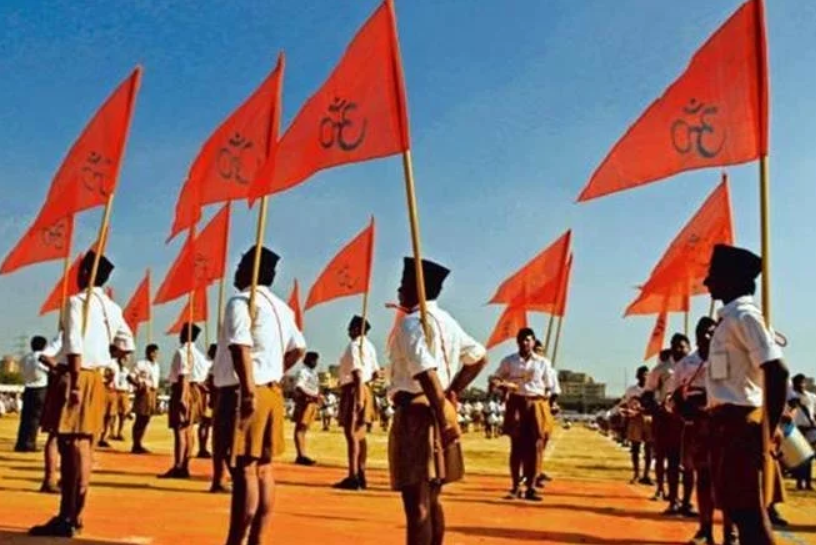
Then and now, a conservative Hindutva organisation had a role in spreading rumours.

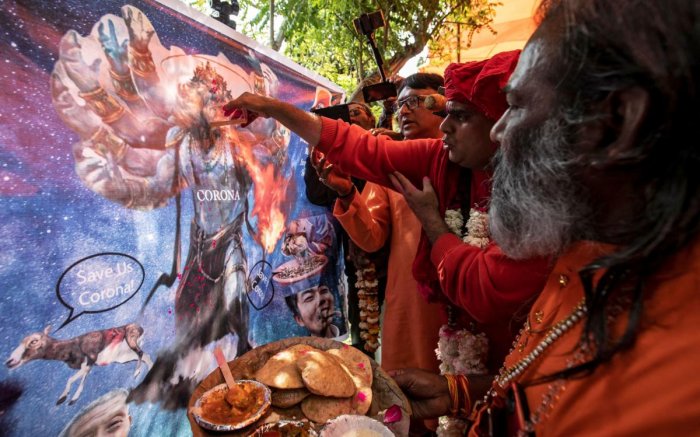
coronavirus and cow urine

Representational image. | Image Courtesy: Deccan Herald


Yad ihasti tad anyatra, yan nehasti na tat kavcit. ‘Whatever is here might be elsewhere, but what is not here could ever be found’.—The Mahabharata, 1.56.33, from Meera Nanda’s The God Market: How Globalisation is Making India More Hindu, Random House 2009.

It was the fag end of the 1st decade of the 21st century when the historian Rink Shenkman wrote his marvellous book, Just how stupid Are We? Facing the Truth about the American Voter. In an interview, he said that Americans are “ill-prepared” to guide the world’s “most powerful” democracy. The book points out the astounding inability of even “two of five voters” to name three branches of the federal government, the fact that half of Americans think that their president can suspend the Constitution, and a large section’s ignorance of the 9/11 attack and the Iraq war that followed.

His concern was the mass of people who could easily, repeatedly and systematically be misled and manipulated by politicians and further “dumb down” American politics.

This “stupidity” was on full display in images of rowdy college crowds hitting California’s beaches during spring break, prompting the governor to close them down. New York governor Andrew Cuomo warned that “young people are not Superman/woman” when it turned out that people, especially the young, are not socially distancing themselves. But only Americans are not to blame. Media tells us that “virus rebels” are displaying their stupidity virtually all over the Western world, prompting crackdowns by authorities.

There’s perhaps no similar study for South Asia, especially India, probing our “stupidity” in this crisis-time, though there’s immense fodder for it.

( Read the full text here : https://www.newsclick.in/Hindutva-Coronavirus-COVID-19-WhatsApp-Fake-News)

Statement on the imminent arrest of Gautam Navlakha and Anand Teltumbde : Alan-Thaha Human Rights Committee, Kerala

The Alan-Thaha Human Rights Committee, Kerala, expresses its deep concern and anguish over the imminent arrest of prominent intellectuals Gautam Navlakha and Anand Teltumbde in the Bhima-Koregaon case.

Continue reading Statement on the imminent arrest of Gautam Navlakha and Anand Teltumbde : Alan-Thaha Human Rights Committee, Kerala

Desirable Deaths, Malignant Neglect

Coronavirus reveals that in the capitalist world there is still no such thing as society.

Coronavirus

Bella Ciao! Bella Ciao! A song which traces its origins to the struggles of working women (rice-weeders) in 19th-century Northern Italy, and which later became an anthem of anti-fascist struggles there, recently made a comeback on the streets of Rome.

Well, there was no mass gathering, obviously, but you could hear people’s voices sing not only Bella Ciao from windows and balconies but many other patriotic numbers, some newly-composed.

With the world’s eighth-largest economy under lockdown, people restricted to their homes and fatalities due to novel coronavirus already over 1,400, this collective singing was the Italian people’s way of finding a moment of joy in this time of anxiety. It “lifted their spirits” and became a unique way for them to declare solidarity with each other.

( Read the full story here : https://www.newsclick.in/Coronavirus-Crisis-Capitalist-Society-Public-Funded-Health-System)

A Memorandum to Delhi Govt on Relief, Rehabilitation and Reconciliation in North East Delhi

Date: 20/03/2020

To,

Mr. Arvind Kejriwal

Chief Minister,

Government of National Capital Territory of Delhi

 To,

Mr. Manish Sisodia,

Deputy Chief Minister,

Government of National Capital Territory of Delhi


Subject: Relief, Rehabilitation and Reconciliation in North East Delhi

Memorandum of Demands to the Delhi Government

The communal violence in north east Delhi that took place in the last week of February is the most disgraceful event in the recent history of the city. Scores of people have lost their lives and thousands are displaced. The observations and evidence from the last three weeks suggest that the violence was not sporadic, but was organized and targeted particularly at Muslim residents in various colonies of the area. There are serious question marks on the role of the Delhi Police during the whole affair. An unbiased and thorough investigation in the matter is necessary to bring the guilty to book.

Based on observations and initial attempts at data collection from the last three weeks, the scale of devastation (material and human costs) is understood to be huge and merits a detailed assessment. While community members have been generous in opening their homes to fleeing families and civil society efforts have tried to fill in for immediate relief, the state government needs to step in to address the concerns of the affected people. There are two reasons for this. One, the crisis is the result of a state failure and has resulted in grave deprivation among the citizenry. The state thus has a moral and administrative duty to compensate and rehabilitate those affected in a compassionate and humane way. Two, the scale of the crisis is such that only the state can address it. Civil society and community effort should not be seen as a substitute for what is the state’s responsibility. While the state government had been conspicuous by its absence in the first three days of the violence, it has been trying to coordinate relief efforts since. A comprehensive plan needs to be put in place with short, medium and long term targets for which the state must take responsibility and invite non-state actors from community organisations to individual citizens that are willing to lend support to such a state led process.

Continue reading A Memorandum to Delhi Govt on Relief, Rehabilitation and Reconciliation in North East Delhi

An Inquiry in to the Anti-Muslim Violence in Northeast Delhi: Progressive Medicos and Scientists Forum

Progressive Medicos and Scientists Forum is a team of doctors that visited the area.

Members of the medical team [1] 

  1. Dr Vikas Bajpai – Assistant Professor, Centre for Social Medicine and Community Health, Jawaharlal Nehru University, New Delhi (Ph: 9717820427).
  2. Dr Harjit Bhatti – Former President, Resident Doctors Association, All India Institute of Medical Scientists (AIIMS) (Ph: 8586848479).
  3. Dr Sumitran – A consultant radiologist with a government hospital in Delhi.
  4. Five doctors from the All India Institute of Medical Sciences

It took a 25 to 30 km drive from AIIMS (All India Institute of Medical Sciences), to the violence affected areas of Northeast Delhi. We were visiting the area in the context of the massive communal violence, primarily directed against Muslims living in the area, in the wake of their resistance to the CAA Act passed recently by the parliament along with NRC-NPR which threaten to rob millions of Muslims of their Indian citizenship and render them illegal in their own country.

The effort to send this medical team was initiated in the context of massive scale of medical emergency that arose as a result of this violence. In this report, apart from reflecting on the medical suffering of the people, we shall also try to provide a snapshot of the violence that was unleashed and the role of the political-administrative machinery to address the same and its consequences, as were narrated to us by the people we met.

Continue reading An Inquiry in to the Anti-Muslim Violence in Northeast Delhi: Progressive Medicos and Scientists Forum

Over one thousand women write to Chief Ministers opposing NPR

Given that the updation of the National Population Register (NPR) is scheduled to begin from April 1, 2020 along with house listing for the Census of India 2021, women rights activists released a letter at Delhi’s Press Club on March 17, 2020, that was sent to every Chief
Minister in the country by over one thousand individual signatories and 18 organizations. The signatories include activists, writers,
academics, lawyers, doctors, farmers, professionals, anganwadi workers and women from all walks of life from more than 20 states.

LETTER TO CMs from Women’s* Groups and individuals_

Dear Chief Minister,

 *Subject: NPR PRESENTS A CLEAR DANGER TO WOMEN.*
*DE-LINK NPR FROM CENSUS HOUSE LISTING.*

  1. *We write to you as Indian women [1] who are opposed to the proposed National Population Register (NPR) [2]*. Women constitute nearly 50% of India’s population, and this opposition is based on clear evidence from our own lives.
  2. Section 14 A of the Citizenship Act, the accompanying 2003 Rules, and official reports of the Ministry of Home Affairs, all provide for using NPR data to compile the National Register of Indian Citizens (NRIC). The NRIC will be prepared by local registrars scrutinizing information of individuals in the Population Register and marking people as ‘Doubtful Citizens’.

Continue reading Over one thousand women write to Chief Ministers opposing NPR

Understanding the Rise of the BJP

Guest Post by PARVIN SULTANA

(Review of HINDUTVA: EXPLORING THE IDEA OF HINDU; NATIONALISM, Jyotirmaya Sharma ( Context 2019); M.S. GOLWALKAR, THE RSS AND INDIA, Jyotirmaya Sharma (Context, 2019) ; DECODING THE RSS: ITS TRADITIONS AND POLITICS Raosaheb Kasbe (Leftword Books, 2019) , RAJIV GANDHI TO NARENDRA MODI: BROKEN POLITY, FLICKERING REFORMS Parsa Venkateshwar Rao Jr. (Sage Select, 2019) ; MODINAMA: ISSUES THAT DID NOT MATTER Subhash Gatade (Leftword Books, 2019) 

The 2014 general elections which saw the Bharatiya Janata Party return to power with an absolute majority is believed to have brought an important paradigmatic shift to Indian politics. Scholars commenting have termed it as a majoritarian shift. Post elections, there have been discussions which tried to understand the reasons behind this massive mandate that the Right Wing political party managed to get. This Right Wing shift in India’s electoral politics was further proven by the 2019 Parliament election results which gave the BJP a larger mandate. Scholars have written trying to understand the rise of BJP—is it an isolated event or a continuation of past developments? This becomes important because even at the international level, there is a shift towards conservative politics.
Indian academia has also taken an objective look at this shift. A number of books have been written on various aspects of present-day politics, the ideologies and icons that paved the way for this rise and continue to provide intellectual fodder for this politics, the liberal economic policies which have been taken to their logical conclusion by the present government, etc. And these books have provided us with important insights to make sense of the present-day political situation of the country.

( Read the full text here : https://thebookreviewindia.org/understanding-the-rise-of-the-bjp/)

Denying Interim Bail To Anand Teltumbde and Gautam Navlakha Is Alarming : MRSD

Guest Post by MRSD ( Mumbai Rises to Save Democracy)

Statement by MRSD on Supreme Court’s rejection of pre-arrest bail plea of Anand Teltumbde and Gautam Navlakha in the Bhima Koregaon violence case

Mumbai Rises to Save Democracy (MRSD) is deeply disappointed with the Supreme Court’s rejection of the plea by Anand Teltumbde and Gautam Navlakha seeking anticipatory bail in the cases registered against them in relation to the violence at Bhima Koregaon on 1st January 2018. Their arrest is imminent in next three weeks. Nine other activists and intellectuals who have been accused in this case and charged with sections of the draconian Unlawful Activities Prevention Act (UAPA) have been imprisoned since 2018.

The top court’s order to deny interim bail is alarming given that the case against the activists is based on very thin evidence. Moreover, the cyber forensic analysis by credible investigative journalists and technical experts discredit the evidence used by Pune police to incriminate the activists. The analysis reveals that the letters which were allegedly recovered from the hard disk of Rona Wilson, one of the nine activists accused in the case, and used by the police to link the accused to a banned political party are most likely to have been planted in the disk through use of malware which allowed remote access to Wilson’s computer (https://caravanmagazine.in/politics/bhima-koregaon-case-rona-wilson-hard-disk-malware-remote-access). This clearly indicates manipulation of evidence and the fabricated nature of the case.

The government is sparing few chances for truth to emerge in this case. In January 2020, more than a year after the chargesheets were filed by the Pune police, the Union Home ministry got the case suddenly transferred to the National Investigation Agency (NIA) and thus brought the case under its control at a time when the Home department in the newly formed Maha Vikas Aghadi government in Maharashtra had announced a review of the case, setting up of a Special Investigating Team (SIT) and dropping of the false cases against the activists.

While full-blown attempts are being made by the government to incriminate the eleven intellectuals in a fabricated case, the investigation into the role of Hindutva brigade led by Milind Ekbote and Manohar Bhide in carrying out planned organised attacks on Dalits at Bhima Koregaon has come to a standstill. The state government’s failure to set up a SIT shows that the real perpetrators of violence are being shielded from prosecution.

These developments in the case and now the rejection of pre-arrest bail to two of the stalwarts of the democratic rights movement in the country on the grounds of what is not just flimsy but manipulated evidence shows the desperation of the government to repress democratic voices and spread a sense of fear amongst those who oppose the anti-people policies and actions of the Hindutva Fascist regime. MRSD extends its solidarity to the eleven activists who have been relentless defenders of human rights and people’s movements in this country and who now stand wrongly accused in this conspiracy case. We also reiterate our resolve to continue to struggle for their release and for the pursuit of truth about the violence unleashed on the peaceful Dalit-Bahujan masses at Bhima Koregaon.

  • MRSD

Participating Organisations: People’s Union of Civil Liberties (PUCL), Committee for Protection of Democratic Rights (CPDR), National Trade Union Initiative (NTUI), Trade Union Centre of India (TUCI), Student Islamic Organisation (SIO), Ambedkar Periyar Phule Study Circle (APPSC) – IIT Mumbai, Co-ordination Of Science And Technology Institute’s Student Association (COSTISA), LEAFLET, Police Reforms Watch, NCHRO, Bebaak Collective, Forum Against Oppression of Women (FAOW), LABIA- A Queer Feminist LBT Collective, Jagrut Kamgar Manch (JKM), Majlis, Indian Muslims for Secular Democracy (IMSD), Women against Sexual Violence and State repression (WSS), Bharat Bachao Andolan (BBA), Indian Social Action Forum (INSAF), People’s Commission for Shrinking Democratic Spaces (PCSDS), Human Rights Law Network (HRLN), Cause Lawyers Alliance, National Alliance of People’s Movements (NAPM), Nivara Hakk Suraksha Samiti, Kashtakari Sanghatna – Palghar, Sarvahara Jan Andolan – Raighad, Jagrut Kashtkari Sanghatana, students from various colleges in Mumbai including Homi Bhabha Research Centre, St.Xaviers and Tata Institute of Social Sciences.

The Need for a New Political Platform


[Beginning this week, ‘Parapolitics’ will be a fortnightly column appearing on the second and fourth Thursday of every month.]

We were never so helpless, never so bereft, never more in need of a platform of struggle. The need for a new political formation is acutely felt today as never before. And by a new formation I do not mean a party of the Left in any traditional sense but a different kind of left-wing formation that can act resolutely in defense of democracy.

Two developments of the past week – the crisis of Yes Bank and the defection of 22 Congress MLAs, led by Jyotiraditya Scindia, to the BJP – signal the deep crisis that we are in today. Reports suggest that each MLA was offered something like Rs 100 crore by the BJP to defect. These developments come close on the heels of a horrendous anti-Muslim carnage in Delhi where we have been witness to the the total collapse of all institutions. From the complete paralysis of the elected AAP government in the state and a Supreme Court that simply pretends not to see what’s going on, to a lapdog ‘media’ actively engaged in promoting violence – this collapse was perhaps never so evident in our history.

Continue reading The Need for a New Political Platform

Not Just Doreswamy, India’s Idea of Independence is Being Debased

Trivialisation of the freedom struggle is in the Hindutva gene, which seeks a theocracy, not an independent republic.

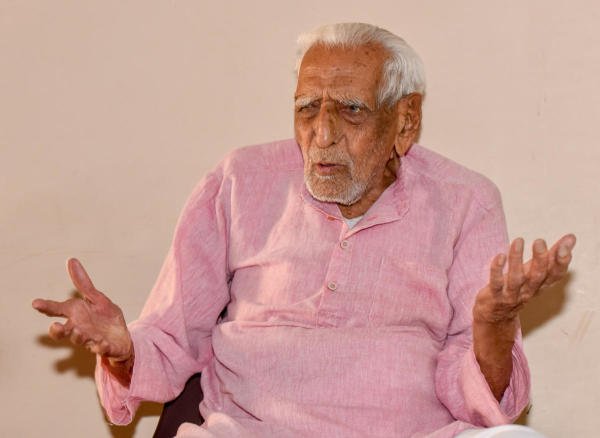
Doreswamy

“Though this be madness yet there is method in it.”

Hamlet, William Shakespeare.

The saffron brigade’s ever-readiness to stigmatise people holding differing opinions and dissenting voices reached a new low recently.

Perhaps it was the saddest day in post-independence India when a Karnataka BJP legislator hurled abuses of being a ‘Pak agent’ and ‘fake freedom-fighter at 102-year-old freedom fighter, H Doreswamy.

Sadly, not many outside the state would know that Harohalli Srinivasaiah Doreswamy, born on 10 April 1918 in the former princely state of Mysore, was first jailed in 1942 during the Quit India movement. He was associated with a group involved in making bombs and spent 14 months behind bars. After his release he continued with his mission and following Independence chose to work with slum-dwellers, the homeless and poor landless farmers, cobblers and porters. He kept himself aloof from holding political power.

In 1975, he challenged then prime minister Indira Gandhi when Emergency was declared, civil liberties were suspended and again faced jail under the draconian Defence of India Regulations Act. Despite old age, his enthusiasm for public causes remains undiminished. One issue closest to his heart remains getting the poor and the landless right to land.

Of late, he has been a prominent figure at protests against the controversial Citizenship Amendment Act (CAA) and has been openly critical of the BJP-led central government’s policies.

The BJP legislator under question is Basangouda Patil Yatnal. When the issue was raised in the Karnataka Assembly, forget issuing an unconditional apology, Yatnal remained adamant. Not just that. He got the support of many of his colleagues. It would be asking too much for the government to take action; a reprimand or case against the legislator for his comments, though they violate the Constitution which considers disrespect to freedom movement a “violation of our fundamental duties”.

( Read the full article here : https://www.newsclick.in/Not-Just-Doreswamy-India-Idea-of-Independence-is-Being-Debased)

Letters from a Malayali Hindu Sister to a Malayali Hindutva Sister : 2

via Letters from a Malayali Hindu Sister to a Malayali Hindutva Sister : 2

Letters from a Malayali Hindu Sister to a Malayali Hindutva Sister

via Letters from a Malayali Hindu Sister to a Malayali Hindutva Sister

Lokayat Conducts Unique Campaign against CAA-NRC-NPR in Pune

लोकायत नाम की संस्था की तरफ़ से CAA-NRC-NPR की असलियत समझाने के लिए एक नायाब अभियान की शुरुआत की है. देखें विडियो.

Khureji Crackdown Fact Finding Report: Lawyers Against Atrocities

[The followng is a report of the police crackdown on the peaceful protest in Khureji, against the CAA-NRC-NPR that had been going for quite some time. The team of Lawyers Against Atrocities comprising Ashutosh, Harjot, Harshita, Nasir and Rahul visited Khureji on 29 February 2020]

Brief Overview of the Situation in Khureji Khas

Since the 14thof January 2020, Khureji Khas in North East Delhi has witnessed peaceful protests against the divisive Citizenship Amendment Act (CAA), National Registry of Citizens (NRC) and the National Population Register (NPR). The people of the locality, especially women,had been congregating day and night at an open site adjacent the Hindustan Petroleum pump on the Patparganj Road. On the 23rdof February 2020, responding to the Bhim Army’s call for a Bharat Bandh, the people of Khureji Khas conducted a sit-in protest on the Patparganj Road. On request from police officials to allow for the flow of vehicular traffic, the protesters complied by first allowing road access to the nearby Vivekananda Yogashram, then vacating half the road by the night of 23rd February and finally the entire road by noon of the following day.

Despite returning to the protest site to continue the peaceful protest, heavy police deployment continued in Khureji Khas. On Monday and Tuesday (24th and 25th of February), the Delhi Police were a constant presence at the protest site. Lining the roads, the police intimidated protestors, especially women. Suddenly without provocation, on the morning of 26th February 2020, the police personnel, many of whom did not bear their name tag, stormed into the protest site brandishing and discharging firearms and proceeded to evict the protestors, beating and injuring several in the process. It is reported that during this process, the police were seen destroying CCTV cameras, notably the one in front of the Hindustan Petroleum Pump. The police arrested several protestors, from the protest site and from their homes including Ishrat Jahan, Khalid Saifi, Mohammed Salim, Vikram Pratap, Salim Ansari and Sabhu Ansari among others taking them to the Jagatpuri Police Station.

Continue reading Khureji Crackdown Fact Finding Report: Lawyers Against Atrocities

Jantar Mantar Declaration Against CAA, NRC and NPR

Guest Post : Jantar Mantar Declaration of 1 March 2020 Against CAA, NRC and NPR

Adopted  at the Convention of writers, artists, cultural activists, scientists and various associations such as Indian Cultural Forum, Janwadi Lekhak Sangh, Progressive Writers Association , Jan Sanskriti Manch, Dalit Lekhak Sangh, New Socialist Initiative, Jana Natya Manch, Delhi Science Forum, Janasamskriti (Malayalam), Vikalp, Cinema of Resistance, All India Peoples Science Network

We, at this  Convention of writers, artists, cultural activists, scientists and various associations express our deep concern over recent violence and communal genocide in Delhi.

We understand that this tragic situation is a direct outcome of the communal design and divisive politicsof CAA-NPR-NRC. The silver lining is that the common people of Delhi remained united in their fight against this outrage.  This convention reiterates that only by this unity and  mutual trust and cooperation  that the CAA-NPR-NRC design can be defeated.

We, at this  Convention of writers, artists, scientists, cultural activists and various associations declare our solidarity with the on-going non-violent movement against the draconian CAA  (Citizenship Amendment Act. 2019 ), proposed new format of NPR ( National Population Register) and the proposed NRC (National Register of Citizens) . Continue reading Jantar Mantar Declaration Against CAA, NRC and NPR

At the Edge of Postmodernity – Reflections on the Contemporary from the Global South


I

The term ‘contemporary’ is often used synonymously with ‘the present’. It is often used to connote ‘newness’. But there is another sense where it refers to the idea of inhabiting the same time (as for example in the statement: ‘Gandhi was a contemporary of Tagore’) or of the industrial revolution being contemporaneous with the emergence of the steam engine. In this sense, it is not newness but ideas of simultaneity, co-presence, coevalness etc that are sought to be invoked through the use of the term ‘contemporary’.

The problem of the contemporary is therefore also a problem of multiplicity, of many different modes of being, and in a sense, can be seen as distinct from the idea of ‘the present’. For the category of ‘the present’, on the other hand, assumes a singularity and lies at the root of all attempts to understand ‘our times’ in relation to some specific characteristic or feature in relation to which others become ‘the past’. Thus ‘our time’ could be defined in terms of the ‘information technology and communications revolution’, ‘the digital revolution’ or the ‘era of post-truth’ and ‘populism’ and so on.

Continue reading At the Edge of Postmodernity – Reflections on the Contemporary from the Global South

The Violence in Delhi, Politics and ‘Heroism of the Ordinary’


What is there to say? What can one say that has not already been said umpteen times before – during earlier rounds of communal violence elsewhere – and in Delhi this time?

The political class, true to its character, has revealed as it has so many times in the past, that when it comes to matters like communal violence, it is simply paralyzed – perhaps with the exception of the Left in states where it was strong enough to impact things.  For all its failures in other respects, this was one where the Bengal Left, for instance, too had in the past shown great promptness in nipping such possibilities in the bud. Most often this was done, not by relying only on the administrative power of the state, but with  the entire party machinery moving into action. Kerala too has had a similar record. But those instances apart, especially in states of the Northern or Western India, there hasn’t been much to write home about. What entering the political domain does to you is illustrated so starkly by the fate of the Aam Aadmi Party (AAP) and its utter capitulation to what it imagines to be the ‘Hindu sentiment’.

Continue reading The Violence in Delhi, Politics and ‘Heroism of the Ordinary’

Kejriwal and the ‘Dirty Hands Problem’

Guest Post by SURAJ JACOB

[Note: This article was written before the ongoing violence in Delhi began and is not about current affairs. It rather engages with the political problem at a broader philosophical level. – AN]

Analysts of Delhi’s recent election note thatAAP imaginatively courted voters on the BJP’s own turf (Shekhar Gupta): welfarism with a dash of nationalism and careful projection around religion. There are several critics of this strategy. Satish Deshpande criticises AAP’s quiescence in ‘mere’ development activities (its campaign “was about municipal matters such as water and electricity and nothing else”). He describes AAP as a “non-ideological management consultancy”, even arguing that its campaign conveyed the message: “Don’t worry, we have no problem with communal politics, but please don’t ask us to say it openly”. Apoorvanand also casts the AAP as “an ideology-agnostic party that does not impede the BJP’s nationalist drive”. Similar points are made by Yogendra Yadav. They castigate AAP for its ideological failure in resisting the BJP’s polarising tactics violating the spirit of the Constitution. AAP voted with the BJP on Article 370, welcomed the Supreme Court verdict on the Ayodhya temple and did not sufficiently support protests around the CAA/NRC especially in Shaheen Bagh. Besides ideological failure, Yadav also identifies AAP’s moral failures: choosing consultants and candidates based on winnability “without any moral or ideological hindrance” and undemocratically centralising power.

Deshpande, Apoorvanand and Yadav are scholars and public intellectuals with activist conscience and commitment to the public good. Taking their disquiet seriously, one may ask: How, indeed, should AAP’s campaign have been? Is the party and its dominant leader Kejriwal really “non-ideological” and “ideology-agnostic”, especially when it comes to toxic polarisation? The evidence simply doesn’t stack up for such a sweeping claim (though, according to Suhas Palshikar, “we will probably never know” Kejriwal’s real stand on these issues). Notes Monobina Gupta: “the AAP, within and outside parliament, has opposed the CAA and supported the protests in Shaheen Bagh in different ways. … What his [Kejriwal’s] ideologically-inflected critics mean to say is that he didn’t take the position they wanted him to. Yes, he didn’t run an ideological campaign.”

Continue reading Kejriwal and the ‘Dirty Hands Problem’

Why Modi and Sangh Parivar Want to ‘Disremember’ Golwalkar

PM Modi didn’t mention former RSS chief Golwalkar on his recent 114th birth anniversary. The idea is to implement his ‘essence’ in private while not mentioning him in public.

Why Modi and Sangh Parivar Want

The 114th birth anniversary of Madhav Sadashiv Golwalkar went unnoticed. Barring a stray article by a second-rung leader of the saffron party in a national daily, none from the top hierarchy deemed it even necessary to remember the second chief of the Rashtriya Swayamsevak Sangh (RSS) who followed the organisation’s founder, KB Hedgewar.

Interestingly, while Twitter-savvy Prime Minister Narendra Modi found time to tweet about his litti chokha conquest at Hunar Haat in Delhi, there was not a single line about Golwalkar on his timeline that day. It appeared a bit strange because in his book titled ‘Jyotipunj’ on the “greatest social workers” who “burnt their lives to glow the Motherland”, Modi had devoted forty pages to Golwalkar. “The life of Golwalkar Guruji is a fine example of dedication. Guruji, possessed all those qualities which are expected of an individual who lives for his goal—patience, determination, perseverance,” he wrote.

Was Modi’s or his senior colleagues’ silence inadvertent, or deliberate?

( Read the full article here : https://www.newsclick.in/Modi-Sangh-Parivar-Want-Disremember-Golwalkar)


Thoughts on the AAP’s Hindu Gestures from Kerala’s History

I have been reading with interest the exchange between Aditya Nigam and Satish Deshpande on the AAP’s strategy of avoiding ‘politics’ – or rather, distancing itself mostly from the polarised ideological debates while making small moves to shape for itself a space, arguably fuzzy, in the hegemonic discourse of Hindu. I am also witness to the unbelievably egregious attacks by the CPM leadership in Kerala against Islamist organizations protesting the CAA — the free reign granted to an explicitly communalised police force, the appallingly soft treatment of Hindutva offenders, even when they make open threats that warn Malayalis to ‘remember Gujarat’, the wanton attack on internal dissidents in the CPM using the worst instruments of the security states such as the UAPA, and the threat to dismantle the pandal of the Shaheen Bagh solidarity satyagraha in Thiruvananthapuram, something even Amit Shah has not dared to do (thankfully withdrawn after public outrage), and its blatant caste-elite majoritarian thrust while claiming to be the (sole) guardians of secularism. Continue reading Thoughts on the AAP’s Hindu Gestures from Kerala’s History

Lessons from Ambedkar and Gandhi to take forward

They represented two foundational but antagonistic visions of “what we as a society, what we as a state should embody”

( Review of ‘Radical Equality: Ambedkar, Gandhi, and The Risk of Democracy’ By Aishwary Kumar Navayana, Rs 599)

The book, Radical Equality: Ambedkar, Gandhi, and the Risk of Democracy by Aishwary Kumar, takes forward the conversation around the two “most formidable non-Western thinkers of the twentieth century, whose visions of moral and political life have left the deepest imprints”.

In the early 1990s D.R. Nagaraj published The Flaming Feet, a compilation of his essays in which he admired both Gandhi and Ambedkar. Coming close on the heels of the phenomenon of Dalit assertion, it argued that “there is a compelling necessity to achieve a synthesis of the two”. But that has not been the only attempt to examine how the ideas of these two leaders interacted, challenged each other, and how they extended or revisited the meanings of different concepts.

The book, Radical Equality: Ambedkar, Gandhi, and the Risk of Democracy by Aishwary Kumar, takes forward the conversation around the two “most formidable non-Western thinkers of the twentieth century, whose visions of moral and political life have left the deepest imprints”. For the author they “exemplified two incommensurable ways of forging a relationship between sovereignty and justice, force and disobedience”, or represented two foundational but antagonistic visions of “what we as a society, what we as a state should embody”.

Focusing mainly on Hind Swaraj — a monograph written by Gandhi on a ship to South Africa from London (1909) — and Annihilation of Caste, which happens to be the undelivered speech by Dr Ambedkar when he was invited by the Jat Pat Todak Mandal, Lahore (1936) — the organization rescinded the invite when it came across the ‘radical’ proposals he had put forward in the draft — this around 400-page book discerns “an insurrectionary element at the limit of politics” in the works of these two stalwarts. It is “an insurrection that sought to extract the political itself — and the social question — from the doctrinal prescriptions and certitude of its European past”

( Read the full text here : https://www.telegraphindia.com/culture/books/lessons-from-ambedkar-and-gandhi-to-take-forward/cid/1747042?ref=books_culture-books-page)

DISSENT, DEBATE, CREATE