Category Archives: Movements

Statement of Jadavpur University Alumni Against University Decision to Scrap Entrance Examinations

Following is a statement of Jadavpur University alumni on the current controversy around the scrapping of the entrance examination by the university authorities. 

There is also a Change.org petition that has been put up for those wanting to sign. Over 5075 people have signed the petition at last count.

Thos who who wish to sign in solidarity with Jadavpur University teachers, students and staff can do so here.

We, the alumni of Jadavpur University, unequivocally condemn the decision of the authorities to not conduct entrance examinations for admission to the university’s Bachelor of Arts programme.

Several departments of the Jadavpur Arts Faculty annually conduct their own entrance examinations. For the last forty years, teachers have carefully prepared question papers and rigorously evaluated the answers in order to admit the candidates that they deem fit. The tradition of the entrance examination, in which thousands of students participate every year, has ensured that the Faculty of Arts continues its legacy of academic excellence. No weightage is given to Board examination marks because the Boards’ prescribed methods of arts education and evaluation simply do not match those of tertiary education in the humanities. The entrance examinations test students for their interest in literature, history, philosophy and arts, their ability to think independently about texts, and their commitment to understanding the world around them using the skills of reasoning and speculation, the theoretical and methodological capital furnished by the humanities.

The entrance examination has enabled these departments to gain talented students year after year. Many of us would have never made it to the top-ranked Arts departments in the country had we been judged solely on the basis of our marks in school-leaving examinations. Admissions based on Board exam scores would have never enabled students from varied cultural, class and economic backgrounds to be trained in the humanities by the best minds in the country. The rich and diverse professional accomplishments of Jadavpur University alumni – in art, academia, film, entrepreneurship, publishing, writing, advertising and many other fields – constitute a further testament to the success of these departments in scouting and honing talent. First-person accounts of how the erstwhile admissions process created equality of opportunity and access for students from across a range of social and educational backgrounds have poured in from Jadavpur alumni since yesterday (3/7/2018). (To read personal testimonials and opinion pieces from faculty, alumni, staff and current students regarding the significance of the admission process, visit https://juforadmissiontest.wordpress.com/)

The admission test is a time-tested process which has ensured academic excellence in the Faculty of Arts and brought glory to the university. To tamper with this process is to threaten the very core of the humanities – to attack free thinking, liberty, and equality of opportunity. It directly undermines the dreams and hopes of the 17,000-odd students who have applied to Jadavpur University this year. Among these 17,000, there must be brilliant young minds that couldn’t obtain 90% or more in the Board examinations. Their merit cannot be reliably boxed into multiple-choice questions. There must be, in those 17,000, young people who do not seek conventional careers, or if they do, wish to combine them with independent thinking, exploring and lifelong learning.

To stop the admission test is to kill the dreams of anyone who does not participate in the mad rat race of public examinations. It is an attack on the community of scholars, researchers, teachers, alumni, students, and staff who have carefully built up the university and its reputation over the years. To stop the admission test is to tear into the very fabric of the university – its tradition and its history. We must recall that Jadavpur University was set up as an alternative to the education imparted by the erstwhile rulers of India, the British. It has always been home to those who dare to defy norms.

The larger implications of this administrative decision concern the scope and function of higher education in this country. Do we, as a nation, wish to create a more homogenised and technocratic culture that rewards learning by rote, or do we wish to invest in greater autonomy for centres of excellence? Difference and dissent are what all democracies should aspire to; they are the touchstones of any free and open society, and any administration that encourages these tendencies signals its confidence in itself and hope for the future. What we are seeing here is, accidentally or not, congruent with a larger attempt to fundamentally redefine the idea of higher education, to increase administrative interference in universities large and small, more and less prominent (similar conflicts are playing out in JNU, to cite just one example) and to condemn generations of young people to the backwaters of real learning, thought and creativity.

As concerned alumni, we strongly condemn the decision of the authorities to take away independent admission tests from the Faculty of Arts. We demand an immediate revocation of this order, which irrationally, pointlessly, and appallingly undertakes to disrupt a fair and successful admission process. This disruption will impact the futures of countless students, and reduce the entry-point of tertiary education in the humanities to a lottery.

We stand in solidarity with the protesting teachers, students and staff of Jadavpur University. Continue reading Statement of Jadavpur University Alumni Against University Decision to Scrap Entrance Examinations

Citizens’ Solidarity with Voices of Democracy – Against the Arrest of Five HR Activists

[This is a statement of solidarity endorsed and signed by over 200 intellectuals, artists, academicians, lawyers, journalists, and students in support of the five arrested in connection with Bhima-Koregaon case. In the 43rd year after Emergency was declared in this country, this statement was issued on June 25th 2018 condemning the arrest of such voices of democracy and demanding their immediate and unconditional release.]

We condemn the arrest of five human rights activists, professors and lawyers in connection with the Bhima-Koregaon clashes early this year. The alarming arrest of Advocate and General Secretary of Indian Association of Peoples’ Lawyers (IAPL) Surendra Gadling, Committee for the Release of Political Prisoners (CRPP) Public Relations Secretary Rona Wilson, Head of English Department Professor Shoma Sen of Nagpur University and member of Women against Sexual Violence and State Repression (WSS), cultural activist and founder of Republican Panthers Jaatiya Antachi Chalwal Sudhir Dhawale and anti-displacement activist and Prime Ministers Rural Development Fellow (PMRDF) Mahesh Raut is a clear manifestation of state terror to crush the voices of dissent in this country.

The intemperate use of sections of the IPC and Unlawful Activities (Prevention) Act (UAPA) on all five reveals legal over-reach and exposes the desperation to foist extraordinary and excessive charges on all five to ensure they remain in the clutches of the Fadnavis-Maharashtra government. All the arrested have consistently worked for the assertion of oppressed and marginalised communities against majoritarian forces, spoken out against Brahmanical patriarchy, upheld peoples’ rights to land, life and dignity, and have strived for the release of political prisoners.

Continue reading Citizens’ Solidarity with Voices of Democracy – Against the Arrest of Five HR Activists

Civil Disobedience under Democracy: The Case of Boycott of Centralised Compulsory Attendance in JNU: Tejal Khanna

Guest post by TEJAL KHANNA

It is often advised that civil disobedience in the form of breaking a law must not be practiced under a democracy. It is because democracy by giving the space for open discussion prevents a situation wherein people are compelled to think of civil disobedience. Moreover, if citizens develop faith in civil disobedience then that only undermines the rule of law. Such an act doesn’t strengthen democracy but rather helps in diminishing its ethos. People must be discouraged to break laws because in a democracy, it is they who elect their representatives through free and fair elections. These representatives then make laws to which open disobedience must not be practiced. Citizens can also vote for change of leadership in the subsequent election cycle, if they feel their representatives have been incompetent. However, while these provisions fulfil the conditions of a well functioning procedural democracy, what recourse do citizens have, when their representatives don’t act in the interest of the governed continuously but function in an autocratic manner? What if laws are made without following the spirit of democracy? Does that really result in making a substantive democracy?

Continue reading Civil Disobedience under Democracy: The Case of Boycott of Centralised Compulsory Attendance in JNU: Tejal Khanna

The Crisis in JNU – Calling out the Administration : Parnal Chirmuley

Guest Post by Parnal Chirmuley

This is the complete version of the edited text published as “Learning Without Regimentation: On Compulsory Attendance” published in The Hindu on February 19, 2018

It may, at first glance, seem odd that students of the Jawaharlal Nehru University, New Delhi, are pouring out in the thousands in angry protest against the administration’s move to enforce compuslory attendance. A leading national daily even misrepresents the boycott of this move by students and faculty as a struggle for the ‘right to not attend classes’, suggesting that they are angry over a triviality, which it is not. It is yet another assault by the present University admnistration against proven academic practices that choose not to infantilise students, and rely more on active learning and participation than on mere physical presence. It has been one among other important practices that has set this university apart. The nuances, therefore, of the anger among the students and faculty of JNU need to be fleshed out.

Continue reading The Crisis in JNU – Calling out the Administration : Parnal Chirmuley

The Festering Sore of the Caste-Wall at Vadayambady: T T Sreekumar

T T Sreekumar, an important commentator on contemporary politics in Kerala — a public intellectual who now qualifies to be an irritant in the eyes of the Kerala police, now that he has openly declared his allegiance to the dalit people fighting injustice and Vadayambady and inaugurated a protest-event there — writes about the issue and its historical origins:

When I visited Vadayambady the other day to express my solidarity with the cause of the agitation, what I witnessed there was an atmosphere of utmost fear and police terror. A big task force of police was stationed at the location. The team that included the special branch officers, had created a situation of terror at the peaceful site. Activists mentioned that a particular police officer continuously hurled abuses, including caste abuses, at the protesters that included Dalit women and children. When the protest began to draw national attention, the ruling dispensation of CPIM that had hitherto remained unconcerned has started to take up some damage control measures. However, when they finally arrived at the site of the agitation almost after a year since the agitation began, the CPIM leaders allegedly refused to address the caste question involved. Dalit activists, including women activists, surrounded them and raised several objections to this attitude pointing to their sheer hypocrisy and lack of integrity.

Read more at:

https://countercurrents.org/2018/02/02/fighting-peripheralization-dalit-movement-hindu-caste-wall-kerala/


A Revolution Called Chandrashekhar Azad ‘Ravan’ – the Republic on Trial

देख ज़िन्दां के परे, रंग-ए-चमन, जोश-ए-बहार

रक्स करना है तो पॉंव की ज़ंजीर न देख – मजरूह सुल्तानपुरी

Look –  beyond the the prison walls, the brilliance of flowers, the vitality of spring

If you must dance, ignore the chains that bind your feet – Majrooh Sultanpuri

Today, the scared Republic that has imprisoned its young idealistic fighter son, Chandrashekhar, is on trial. The Republic, scared of its own offspring, stands in the dock. This Republic Day, we must all answer how it came to pass that a gang of adventurers and marauders simply took it over, submitted it to their command, while all the elderly, wise men and women, watched. Today, when the Republic bondage we must seek answers from all those who watched helplessly – or self-righteously – as marauders took it over.

It is official now. A radiogram from the Deputy Secretary, Home, Govt of Uttar Pradesh to the Superintendent, Saharanpur District Jail, dated 23 January 2018, confirms the slapping of charges under the National Security Act, on Bhim Army founder, Chandrashekhar Azad ‘Ravan’. Pradeep Narwal, Coordinator, Committee for the Defence of Bhim Army, who met Chandrashekhar in jail yesterday, underlined how the Karni Sena activists attacking school buses and vandalizing schools were being allowed the freedom to do so while Chandrashekhar, responsible for setting up and running of schools (see the video below), is being held in jail for months and has now been slapped with charges under NSA. “Karni Sena are apparently deshbhakts and Shekher bhai and Bhim Army are ‘terrorists’ in the perverted logic of this government,” he said.


In conversations with friends and sympathizers who have been meeting him over the past months, including Pradeep Narwal, Chandrashekhar ‘Ravan’ has been expressing a fear that many of us have also had, independently, for some time now: that the government wants to actually get rid of him – just as judge Loya was, it now transpires. Continue reading A Revolution Called Chandrashekhar Azad ‘Ravan’ – the Republic on Trial

Statement about the attacks on Dalits in Bhima Koregaon & the Subsequent developments in Maharashtra : Umar Khalid

Guest Post by Umar Khalid

I went to Maharashtra as I along with other activists and intellectuals were invited to come there. I along with others was a guest there. And I would remember fondly the love and support that I received in Pune and Mumbai. I would remember the resilience and enthusiasm of the people I met and their resoluteness to fight Manuvaad and centuries old casteist tyranny. I would remember the immense inspiration that I felt, when we paid homage to Jyotiba Phule and Savitribai Phule in Phule-wada, Pune. And, No I will not let two days of media trials by a few TV anchors, who are more of professional howlers, spoil these wonderful memories. I will not let their criminal cacophony and mindless vilification of me, Jignesh & others shadow my beautiful memories of Maharashtra.

The state of Maharashtra as well as the rest of the country is at a critical juncture today. On the one hand are forces in power who want to push our country back to many centuries and on the other are people who are resisting this Neo-Peshwahi, the casteist-communal-fascist regime of BJP-RSS. In my speech at Elgar Parishaad on 31st December 2017, I had said that the year 2018 is going to be a very challenging one. The last 3 and half years of the Modi Sarkar has exposed the BJP’s jumlas of Ache Din and Vikas as hollow, bitter and brutal lies.

As the General Elections of 2019 approach, BJP/RSS will now resort to creating civil strife amongst the people, polarising them on the basis of caste and religion and unleashing attacks on muslims and Dalits. The developments over the last few days vindicate me, a little too soon. Several regions of Maharashtra are in the midst of an acute agrarian distress. Both Marathas and Dalits are victims of this agrarian crisis that has been precipitated by the policies of both Modi and Fadnavis. The BJP/RSS regime has no resolution to offer to the farmers of Maharashtra. Therefore, unleashing attacks on Dalits through their hoodlums and portraying it as a caste clash between Dalits & Marathas will remain their only strategy. Continue reading Statement about the attacks on Dalits in Bhima Koregaon & the Subsequent developments in Maharashtra : Umar Khalid

The Meaning of Jignesh Mevani

[A shorter version  of this article was published in The Wire on 18 December. I thank K. Satyanarayana, P. Sanal Mohan and Jangam Chinnaiah for their very helpful comments on it, which have helped me to clarify and elaborate on certain points.]

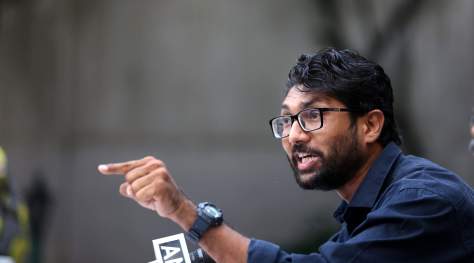
Jignesh Mevani, image courtesy New Indian Express

The rise of Jignesh Mevani constitutes a significant landmark in the political configuration in which the Congress has risen, despite itself, from a state of utter disarray to become the point of articulation for a possible political realignment in the near future. The process of political reconfiguration had already begun as a very significant section of the powerful patidar community, long understood to be the bedrock of the BJP’s social base in the state, had broken away from it. But alongside this, the rise of the young leaders Hardik Patel, Alpesh Thakore and Jignesh Mevani together produced the new young face of emergent Gujarat.

There is no doubt that the vacuum that characterized the space where the opposition should have been, no longer exists. The masthead of a new opposition formation is evident on the horizon. This turnaround in the fortunes of the Congress would not have been possible without the re-alignments in the non-electoral arena, facilitated in no small measure by the rise of this young leadership.

Continue reading The Meaning of Jignesh Mevani

The Indian Constitution too was Demolished Along With Babri Masjid 25 Years Ago

Twenty five years ago, on 6 December 1992, the structure of Babri Masjid was brought down by a mob of vandals, presided over by the top leadership of the BJP/RSS/VHP, as the Congress government led by prime minister Narasimha Rao looked on benignly. As did the Supreme Court before which a commitment was made by the Kalyan Singh (BJP) government in Uttar Pradesh – to the effect that nothing would be allowed to happen to the structure of the mosque.

Journalist Sajeda Momin, covering the demolition, recalls the scene thus,

I can still see the thousands of saffron-clad ‘kar sevaks’ clambering atop the 16th century mosque and pounding it with shovels, iron rods, pickaxes and anything they could lay their hands on. I can hear the screeching of Sadhvi Uma Bharti egging them on shouting “ek dhakka aur do, Babri Masjid tod do” through the microphones from atop the specially-built watchtower for the BJP/RSS/VHP leadership. I can visualize the three domes of the mosque collapsing inwards one by one at intervals of roughly an hour on that cold, wintery Sunday afternoon.

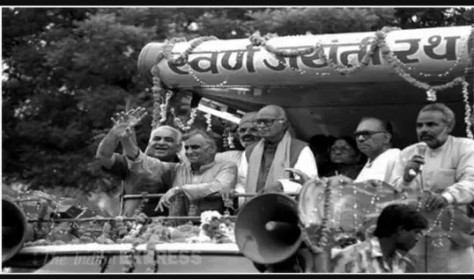
Everyone knew who were the dramatis personae at each level – and practically every bit of evidence that would ever have been required exists, captured in videos and photographs. Our present prime minister was said to be  one of the key organizers of the of the Rath Yatra that led up to the demolition and can be seen holding the microphone in his  hands in the photograph below.

Rath Yatra – precursor to the demolition, image courtesy Quora.com

Worse was to follow the demolition. The  demolition of the structure of the mosque was over that day but the process of the demolition of the Indian Constitution that had begun with what was called the ‘Ram janmabhoomi movement’ continued. By ‘Constitution’ I do not simply mean the book that embodies the law of the land but rather the very weave that came to constitute Indian society as a result of the new contract that the document called the Constitution embodied. Constitution, therefore in a triple sense. The document called the Constitution too was not merely a book of laws; it was rather, the only existing, largely agreed upon, vision of a modern India. It was a vision which was put in place through the long process of struggles, debates and contestations over the long decades of the anticolonial movement and finally given shape in, in the Constituent Assembly. There was nothing benign or innocuous about it – every bit of it had to be achieved through a fight. And yet, in the end, that was the document that embodied the vision of modern India. The only political current that stood far away from both the anticolonial struggle and had no role in the creation of this vision is the political force that rules India today.

The RSS and its numerous offshoots were neither fighting the British nor joining in the anti-caste and anti-untouchability struggles through the period since they came into existence in the mid-1920s. No wonder leaders of the Sangh combine think the anti-colonial/ national struggle was about cow-protection. That they neither subscribed to the anti-British agenda nor to the anti-caste agenda around which struggles of that period took shape, is not just a matter of historical record but is also visible in the way its leaders and ranks conduct their politics today. Every single step taken by the Sangh leaders is a step out of sync with the vision of the future spelt out by the social contract of modern India. That the Sangh attributes this vision to the Congress is an expression of its own illiteracy about the diverse forces in struggle throughout that period.

Even though it is conducted in the name of Hindus, there is nothing ‘Hindu’ about its agenda. Sangh and Sanghism is the name of a malignant political machine that seeks to destroy the very body of society in the name of an ancient past. That is the political machine we confront today. That is the political machine that we must fight today with all our vigour.

An open letter to Brinda Karat: why do female supporters of the Kerala CPIM spew such venom at Hadiya?

Dear Comrade

I can hardly describe the joy and relief I felt reading your piece on the Hadiya case in the Hindu yesterday. By now I am nearly deaf from the cacophony of misogyny, islamophobia, and sheer short-sighted rage that CPM supporters on Facebook are unleashing against this young woman.

Your voice of sanity, Comrade, is therefore a great restorative. If not for your writing, one could have well thought that the CPM was nothing more than a bunch of short sighted, power hungry, strategisers, whose total lack of ethics and values is covered up by a vapid, outdated rationalism and an equally problematic liberalism. You refuse to condemn Hadiya for choosing Islam. You acknowledge that she is brave. You unequivocally reject the father and other minions of patriarchy. You rightly criticise state patriarchy evident in the Supreme Court. Unlike many CPM supporters here, you have no illusions about the times we live in; you are clearly aware that the NIA is not something which will spare us if we stay good. Importantly, you put paid to the idea that the High Court judgement that sanctioned her illegal custody was justified — an idea assiduously nurtured by certain public figures allied with the CPM against religious Muslims. Comrade, thank you again for being so forthright and in the face of snarling islamophobes in your own ranks actually gunning for the voice you raised against her illegal custody long back.

Continue reading An open letter to Brinda Karat: why do female supporters of the Kerala CPIM spew such venom at Hadiya?

महाड़ सत्याग्रह के नब्बे साल

‘‘जब पानी में आग लगी थी’’
Inline image 1
प्रस्तावना
‘क्या पानी में आग लग सकती है ?’’
किसी भी संतुलित मस्तिष्क व्यक्ति के लिए यह सवाल विचित्र मालूम पड़ सकता है। अलबत्ता सामाजिक-राजनीतिक आंदोलनों पर निगाह रखनेवाला व्यक्ति बता सकता है कि जब लोग सदियों से जकड़ी गुलामी की बेड़ियों को तोड़ कर आगे बढ़ते हैं तो न केवल /बकौल शायर/ ‘आसमां में भी सुराख हो सकता है’ बल्कि ‘ पानी में भी आग लग सकती है।’
2017 का यह वर्ष पश्चिमी भारत की सरजमीं पर हुए एक ऐसे ही मौके की नब्बेवी सालगिरह है, जब सार्वजनिक स्थानों से छूआछूत समाप्त करने को लेकर महाड नामक जगह पर सार्वजनिक तालाब से पानी पीने के लिए डा अंबेडकर की अगुआई में हजारों की तादाद में लोग पहुंचे थे। /19-20 मार्च 2017/ कहने के लिए यह एक मामूली घटना थी, लेकिन जिस तरह नमक सत्याग्रह ने आज़ादी के आन्दोलन में एक नयी रवानी पैदा की थी, उसी तर्ज पर इस अनोखे सत्याग्रह ने देश के सामाजिक सांस्कृतिक पटल पर बग़ावत के नए सुरों को अभिव्यक्ति दी थी।

Continue reading महाड़ सत्याग्रह के नब्बे साल

Sexual Harassment in the Academia – What the Hitlist Misses: Debaditya Bhattacharya and Rina Ramdev

This is a GUEST POST by DEBADITYA BHATTACHARYA and  RINA RAMDEV


The past few years have not allowed us the respite to prepare for a fight. We were perpetually donning our war-gear – often forced without necessary ammunition into a battle that raged through parliaments and streets and colleges and colonies and our doorsteps. There was no time to strategise, no time to theorize, no time to bargain and no time to compose ourselves for the next day’s onslaughts. And yet, the onslaughts never abated. The mundane was coupled with the spectacular, the anti-national with the terrorist, the intellectual with the condom-user, the dissenter with the stone-pelter, and the everyday with the genocidal. Continue reading Sexual Harassment in the Academia – What the Hitlist Misses: Debaditya Bhattacharya and Rina Ramdev

Defend the tradition of fighting for the oppressed: Sohail Hashmi writes to the Chief Minister of Kerala

(This is the text of the open letter written by the eminent left cultural activist Sohail Hashmi to Com. Pinarayi Vijayan on the Hadiya case)

Continue reading Defend the tradition of fighting for the oppressed: Sohail Hashmi writes to the Chief Minister of Kerala

Preserve Kerala as the Shining Example of Democracy for India : Prof. Satish Deshpande writes to the Chief Minister of Kerala

(This is the text of the open letter from Prof. Satish Deshpande to the Chief Minister of Kerala on the Hadiya issue. Satish’s work Contemporary India, translated as Samakalika India, has been hugely influential in shaping the progressive understanding of Hindutva nationalism and communal hatred in Kerala.)

<!–more–>

The Honourable Chief Minister of Kerala

Shri Pinarayi Vijayan

6th October, 2017

Respected Sir,

Ever since I first came to Kerala in 1981 to study at the Centre for Development Studies (CDS) at Thiruvanathapuram, I have been a committed supporter of everything that the left tradition of your great state has achieved by way of democratic innovations in governance and social practice. Even today, I believe that Kerala continues to be a shining example in many spheres where the rest of India lags far behind.

I was therefore shocked to read about the Hadiya case and the tacit and explicit state support that underwrite her virtual house arrest today. I am told that the man that Hadiya has chosen to marry and the organisation with which he is associated may have a questionable past. Whatever be the truth of this matter, the fact is that an adult citizen’s personal choices in matters like marriage cannot be undone by the state no matter how ill-considered that choice may appear to others. Moreover, in the current climate, it is surely not irrelevant that the religion in question is Islam – it is highly unlikely that this case would have attracted any attention if Hadiya had chosen to convert to some other religion.

It is highly embarrassing – to the say the least – that a government led by a party that can claim to have played a major role in transforming Kerala society for the better is today seen to be siding with the reactionary forces.

I appeal to you to use the power vested in you by the people of Kerala to end this travesty of justice and ensure that Hadiya is left free to live her life as she chooses.

With best wishes,

Satish Deshpande

(Professor of Sociology, Delhi University)

End the isolation and imprisonment of Hadiya: Feminists write to the Chief Minister of Kerala

[A version of this letter has also been sent to Com. MC Josephine, Chairperson, Kerala State Women’s Commission] Continue reading End the isolation and imprisonment of Hadiya: Feminists write to the Chief Minister of Kerala

Let us rise to the defense of the Indian Constitution: Letter to the Kerala Chief Minister from Prof. Amit Bhaduri

[This is the text of the open letter written by eminent economist and leading development activist Prof. Amit Bhaduri, to Com. Pinarayi Vijayan] Continue reading Let us rise to the defense of the Indian Constitution: Letter to the Kerala Chief Minister from Prof. Amit Bhaduri

The Gravity of Newton : Rituparna Sengupta

This is a guest post by RITUPARNA SENGUPTA


Amit V Masurkar’s recently-released film Newton explores facets of Indian democracy at its most vulnerable. For these times of ‘nationalist’ bravado, this is a courageous topic.  The film is so named because it adopts for the most part, the point of view of its protagonist, Newton (Nutan) Kumar (Rajkummar Rao, thank you once again!) who resists corruption and hypocrisy at home and work. Continue reading The Gravity of Newton : Rituparna Sengupta

Help us resist the Hindutva thought-machine: K Satchidanandan writes to the Chief Minister of Kerala

[This is the text of the open letter written by the eminent poet and public intellectual K Satchidanandan to Com. Pinarayi Vijayan] Continue reading Help us resist the Hindutva thought-machine: K Satchidanandan writes to the Chief Minister of Kerala

Restore Hadiya’s Dignity as an Adult: Prof. Samita Sen to the Chief Minister of Kerala

(This is the text of the open letter from leading women’s studies scholar and renowned feminist intellectual, Prof. Samita Sen, to the Chief Minister of Kerala on the Hadiya case) Continue reading Restore Hadiya’s Dignity as an Adult: Prof. Samita Sen to the Chief Minister of Kerala

Statement Against Genocide and Deportation of Rohingya Muslims

Violence is sweeping Myanmar and in a short span of two weeks lakhs of ethnic Rohingya refugees have fled to Bangladesh and thousands have lost their lives. Satellite data shows, large parts of the Rakhine state, home to most of the Burmese Rohingya population have been set on fire, and murders, rape, arson, loot and forced displacement of the Rohingya population is taking place on a scale, that should be alarming for all humanity. Even the UN secretary general has called out to Mayanmar to end violence against the Rohingya and Nobel laureate Desmond Tutu has urged Mayanmar state Councillor Aung San Suu Kyi to speak out against the persecution of the Rohingya. The tragedy facing the Rohingya is of an unprecedented scale and needs to be addressed with a sense of utmost urgency.

As Indian citizens, we need to break the silence on ethnic violence against the Rohingya and the unconstitutional proposed deportation of a wide and long-residing Rohingya community from India, to certain death that awaits them in Myanmar. The Rohingyas have been living as a peaceful refugee community in various parts of India since the 1970s, with no criminal records or history of crime. Let us not be a part of this genocide. Let us stand up for justice and humanity, and raise our voice against the killings, displacement and deportation of the Rohingya!

Continue reading Statement Against Genocide and Deportation of Rohingya Muslims

पाकिस्तान का वर्तमान अब भारत का भविष्य नज़र आने लगा है

शब्द और विचार हर किस्म के कठमुल्लों को बहुत डराते हैं. विचारों से आतंकित लोगों ने अब शब्दों और विचारों के ख़िलाफ़ बंदूक उठा ली है.

New Delhi: Demonstrators hold placards with the picture of journalist Gauri Lankesh during a 'Not In My Name' protest at Jantar Mantar in New Delhi on Thursday. PTI Photo(PTI9_7_2017_000157B)

Gauri, you are more than a memory

You are a direction

For a world that should not be!

– K P Sasi

1
कुछ लोग जीते जी किवदंती बन जाते हैं. कन्नड़ भाषा के अग्रणी हस्ताक्षर पी लंकेश (जन्म 8 मार्च, 1935) ऐसे ही शख़्सियतों में शुमार किए जा सकते हैं. समाजवादी आंदोलन से ताउम्र सम्बद्ध रहे लंकेश, जो कुछ समय तक अंग्रेज़ी के प्रोफेसर भी रहे.

आज भी उनकी अपनी साप्ताहिक पत्रिका ‘लंकेश पत्रिके’ के लिए याद किए जाते हैं, जो उत्पीड़ितों, दलितों, स्त्रियों और समाज में हाशिये के तबकों का एक मंच बनी थी, जिसने कन्नड़ भाषा में आज सक्रिय कई नाम जोड़े, जो उसूल के तहत विज्ञापन नहीं लेती थी और एक समय था जब उसकी खपत हज़ारों में थी और उसके पाठकों की संख्या लाखों में.

लंकेश के बारे में मालूम है कि 25 जनवरी, 2000 को अपने साप्ताहिक का संपादकीय लिख कर सोने चले गए तो फिर जगे ही नहीं. कर्नाटक का समूचा विचारजगत स्तब्ध था. इसे विचित्र संयोग कहा जाना चाहिए कि दिल का दौरा पड़ने से हुई उनकी मौत के सत्रह साल आठ महीने और दस दिन बाद महज कर्नाटक ही नहीं, पूरे देश का विचारजगत स्तब्ध है, जब उनकी बड़ी बेटी गौरी लंकेश की मौत की ख़बर लोगों ने सुनी है, जो हत्यारों की गोलियों का शिकार हुईं.

( Read the full text of the article here : http://thewirehindi.com/18088/gauri-lankesh-murder-fundamentalist-dissent/)