Category Archives: Right watch

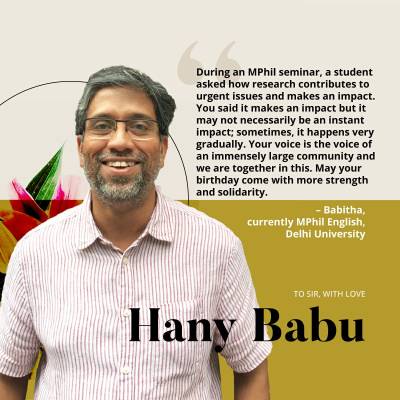
To Sir, With Love – Birthday Greetings for Professor Hany Babu From His Students

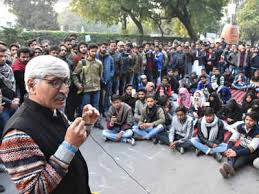
Our Professor turned 54 on August 16, while in the custody of NIA. Prof. Hany Babu M.T. from the Department of English, University of Delhi was arrested on July 28 by the NIA in a series of ongoing harassment of academics, and activists who have been vocal against the government and its policies. This act of suppressing dissenting voices in academic spaces by the State threatens the very fabric of the Indian democracy. Prof. Babu has been a strong advocate for social justice, and has worked strenuously in the anti-caste movement. As a professor of linguistics, his classes have always been about demanding an equal space for the varying languages in India and looking at English as an emancipatory language. His teachings have made, and continue to make students critically approach caste supremacy hidden within the rubric of the Indian language structure. He has always highlighted the need for equality amongst language, and language speakers.
Continue reading To Sir, With Love – Birthday Greetings for Professor Hany Babu From His Students

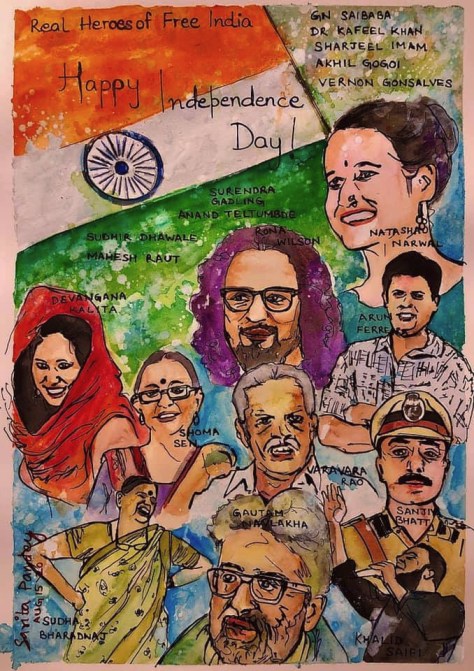
Manufacturing Evidence – How the Police is framing and arresting constitutional rights defenders in India: The Polis Project

Artist Sarita  Pandey

This report is republished from The Polis Project

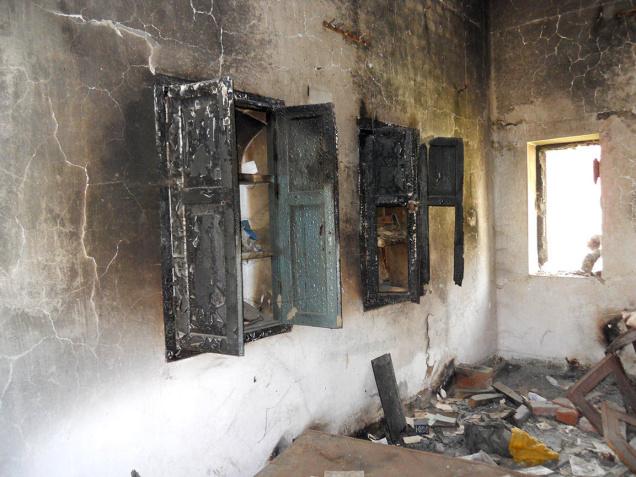
On the afternoon of 23 February 2020, communal violence broke out in Gokulpuri, a neighborhood in North-East Delhi. From there, it quickly spread to several other areas — including Seelapur, Shivpuri, and Jafrabad — raging on for four days before the situation was finally brought under control. In all, 53 people were murdered, a majority of them Muslim. Hundreds of families, mostly Muslim, were also displaced from their homes and are yet to return as it is still too dangerous. The attacks coincided with Donald Trump’s diplomatic visit to New Delhi on 24 February. This coincidence is one reason why the violence received widespread international media coverage. While large sections of the Indian domestic media have framed the violence as a “communal riot,” it is fairer to describe the events as a state-abetted pogrom against the Muslim community, that was not adequately protected — and, in some cases, was actively attacked — by the Delhi Police.

Time and again the Police have ignored mounting communal tensions, turned a blind eye to the gathering of arms by Hindu nationalist groups, and — once violence is unleashed — abandoned Muslims to their fate. Police complicity in anti-Muslim violence is an old story in India. Since Independence, countless enquiry commissions have indicted the Police for their partisan handling of sectarian conflict. Time and again the Police have ignored mounting communal tensions, turned a blind eye to the gathering of arms by Hindu nationalist groups, and — once violence is unleashed — abandoned Muslims to their fate. This cycle of violence and impunity is one major reason Hindu terror has not been stamped out in India. Yeh andar ki baat hai / police hamaare saath hai, (It’s an internal secret/ the Police are with us) as Hindu mobs chanted during the 2002 Gujarat pogrom. Continue reading Manufacturing Evidence – How the Police is framing and arresting constitutional rights defenders in India: The Polis Project

Intimations of a Bahujan Counter-Tradition and the Hindu Right

This post should be read as a sequel to my earlier post of 16 July, which had discussed the discourse of “Hindu Unity” and questions  before the struggle against the Right. That post had ended with the claim that the struggle against the Hindu Right is not so much about what we understand as “secularism” as it is about the reconstruction of a larger  Bahujan counter-tradition, the search for which was  already on.

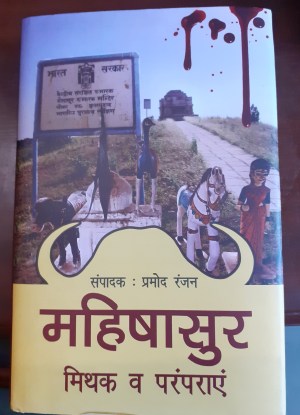
Cover of book Mahishasur – Mithak va Paramaprayen [Myths and Traditions],ed. Pramod Ranjan
I should begin with a caveat, or more correctly, an amendment to a position I adopted in the earlier post. In that piece, I had used the terms “anti-majoritarian” discourse and “anti-majoritarianism” to refer to the the larger discursive formation against the Hindu Right. I used that expression largely because I went along part of the way with Abhay Dubey who uses it in his book, to which that piece was a response. However, that expression assumes that there is only one “majority”  or only one way of imagining majority in this country. More importantly, it concedes a certain “natural pre-givenness” to the project of Hindu unity as though that were a self-evident fact. The only thing that makes the project of Hindu unity appear so “natural”, it needs to be underlined, is that it is backed by “tradition” and “religion” in a way that say a class notion of majority is not. If we assume that the dominant tradition is the sole tradition, then this term could make sense but as the  stirrings of a renewed search for a Bahujan counter-tradition, especially in North India, come into view, it gives us a sense of another possible way of imagining “majority”.  It should be underlined here that this renewed search today does not emerge out of the blue from nowhere but draws on the work of earlier medieval thinkers and social/ religious reformers not just in the North (for instance Kabir, Ravi Das and Nanak) but also from Phule, Ayyankali, Sri Narayana Guru, Periyar, Iyothee Thass and many others in the South in more recent times. There is one difference however: rather than use the negative descriptor “Non-Brahmin”, the present search is more explicitly about the production of a Bahujan identity. Ambedkar of course, remains a continuous reference point in this discourse.

Continue reading Intimations of a Bahujan Counter-Tradition and the Hindu Right

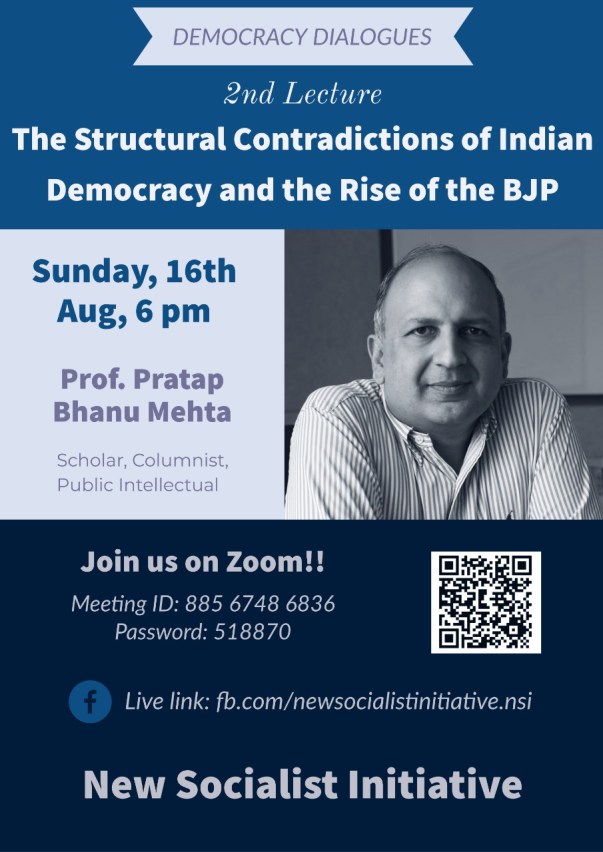
The Structural Contradictions of Indian Democracy and the Rise of the BJP : Prof Pratap Bhanu Mehta

[Democracy Dialogues Lecture Series ( Webinar)
Organised by New Socialist Initiative]

Date and Time: Sunday, August 16, 2020, at 6 PM IST (8.30 AM EST in the US)


Topic: The Structural Contradictions of Indian Democracy and the rise of the BJP

Abstract:

This talk explores the deep social transformations that have made the dominance of the BJP possible. It will take a longer view of the trajectory of Indian democracy and explore the profound changes in social and economic identities underway that have prepared a propitious ground for the rise of the BJP.

The Speaker: Prof Pratap Bhanu Mehta

Internationally renowned scholar and political scientist Prof Pratap Bhanu Mehta taught at Harvard, at New York University and at JNU. He was the Vice Chancellor of the Ashoka University till recently and served as the President of the premier think tank, Centre for Policy Research. Educated at Oxford and a Ph.D. from Princeton University, Prof Mehta is a columnist at Indian Express, a leading public intellectual and a bold and thoughtful voice for reason and justice. Among many honours and prizes to his credit, he is recipient of the Infosys Prize, the Adisheshiah Prize and the Amartya Sen Prize.

[New Socialist Initiative Presents
Democracy Dialogues – Lecture Series

The idea behind this series – which we call ‘Democracy Dialogues’ – is basically to initiate as well as join in the on-going conversation around this theme in academic as well as activist circles.

We feel that the very idea of democracy which has taken deep roots across the world, has come under scanner for various reasons. At the same time we have been witness to the ascendance of right-wing forces and fascistic demagogues via the same democratic route. There is this apparently anomalous situation in which the spread and deepening of democracy have often led to generating mass support for these reactionary and fascistic forces.

Coming to India, there have been valid concerns about the rise of authoritarian streak among Indians and how it has helped strengthen BJP’s hard right turn. The strong support for democracy here is accompanied by increasing fascination towards majoritarian-authoritarian politics. In fact, we would like to state that a vigorous electoral democracy here has become a vehicle for hindutva-ite counterrevolution.

The inaugural lecture in the series was delivered by Prof Suhas Palshikar on 12 th July 2020. The theme of Prof Palshikar’s presentation was  TRAJECTORY OF INDIA’S DEMOCRACY AND CONTEMPORARY CHALLENGES]


Nationwide condemnation of Delhi Police regarding their interrogation of Prof. Apoorvanand

We stand firmly with Apoorvanand, our friend and fellow member of the Kafila collective, as we do with all those being interrogated and framed by Delhi Police for the violence in Delhi. We also stand with all political prisoners of this  fascist regime. 

Before you read the statement below, endorsed by over a thousand people from different parts of India, take a look at this detailed expose of how the Delhi Police is trying desperately to cook up a conspiracy theory  that will leave the actual planners and executors of the anti Muslim pogrom in Delhi in January, to roam free, while arresting and intimidating hundreds of people who peacefully and non-violently protested the unconstitutional CAA.  Ajoy Ashirwad Mahaprashasta carefully dissects the anti CAA Whatsapp groups out of which the Delhi Police is trying to concoct a bizarre narrative, in The Wire.

Apoorvanand, Image courtesy Times of India

STATEMENT

On August 3, 2020 the Special Branch of the Delhi Police called in Prof. Apoorvanand, well-known writer, public speaker and Professor of Hindi at Delhi University, where he spent 5 hours, for an interrogation in connection with the Northeast Delhi riots. The police have seized his phone. This comes close on the heels of the interrogation of many other intellectuals and activists.

A day when authorities feel free to haul in the nation’s leading public voices to police stations, merely because they speak against the policies and ideology of the ruling government, is a day we must all be deeply concerned. Also, a day when we must overcome all fear, to stand up for each individual’s right to disagree, dissent, and thereby deepen our democracy. For this democracy today faces its most serious crisis since independence, far more critical than Indira Gandhi’s Emergency 45 years ago. As concerned citizens who love and value our democracy, and our country, we must speak out before it is too late and all voices of freedom are silenced forever.

Continue reading Nationwide condemnation of Delhi Police regarding their interrogation of Prof. Apoorvanand

“There is no god in that temple”: Rabindranath Tagore/Translated by Banojyotsna Lahiri

Banojyotsna Lahiri shared her translation of some excerpts from  a poem by Rabindranath Tagore, written 120 years ago, titled “Deeno Daan”.

It is about a temple.

Original Bangla below the translation.

“There is no god in that temple”, said the Saint.

The King was enraged;
“No God? Oh Saint, aren’t you speaking like an atheist?
On that throne studded with priceless gems, beams the golden idol,
And yet, you proclaim that it is empty?”

“It is not empty; rather, it is full of royal pride.
You have bestowed yourself, oh King, not the God of this world”,
Remarked the saint.

The King frowned, “2 million golden coins
were showered on that grand structure that kisses the sky,
I offered it to the Gods after performing all the necessary rituals,
And you dare claim that in such a grand temple,
There is no presence of God”? Continue reading “There is no god in that temple”: Rabindranath Tagore/Translated by Banojyotsna Lahiri

गैर-दक्षिणपंथी विचारकों के आत्ममंथन का घोषणा पत्र है अभय दुबे की पुस्तक : अरविंद कुमार

Guest post by ARVIND KUMAR

अभय दुबे की पुस्तक हिन्दू एकता बनाम ज्ञान की राजनीति पर जारी बहस में एक योगदान।

दि प्रिंट में 8 जुलाई 2020 को  योगेंद्र यादव का लेख ‘भारतीय सेक्युलरिज्म पर हिन्दी की यह किताब उदारवादियों की पोल खोल सकती थी मगर नज़रअंदाज़ कर दी गई है’, अभय दुबे की पुस्तक को केंद्र मे रखकर लिखा गया है.  उन्होनें लिखा: “अगर अभय की किताब के तर्क उन सेकुलर बुद्धिजीवियों के कान तक टहलकर नहीं पहुंचे जिनके लिखत-पढ़त की उन्होंने आलोचना की है तो इसकी वजह को पहचान पाना मुश्किल नहीं. वजह वही है जिसे अभय ने अपनी किताब में रेखांकित किया है कि भारत के अँग्रेज़ीदाँ मध्यवर्ग की सेकुलर-लिबरल विचारधारा और देश के शेष समाज के बीच सोच समझ के धरातल पर एक खाई मौजूद है.” योगेंद्र के लेख के जवाब में, दि प्रिंट में ही 15 जुलाई को राजमोहन गांधी का लेख ‘भारत में धर्मनिरपेक्षता की विचारधारा पराजित नहीं हुई है, इसके पैरोकारों को आरएसएस  पर दोष मढ़ना बंद करना होगा’ पढ़कर संतोष और असंतोष दोनों हुआ. संतोष इसलिए कि योगेंद्र के आग्रह पर बुद्धिजीवियों ने बहस को आगे बढ़ाने की पहल तो की. इसी कड़ी में 16 जुलाई 2020 को काफ़िला में छपा आदित्य निगम का लेख ‘डिसकोर्स ऑफ हिन्दू युनीटी इन द स्ट्र्गल अगेन्स्ट द राइट’ को भी देखा जा सकता है.

Continue reading गैर-दक्षिणपंथी विचारकों के आत्ममंथन का घोषणा पत्र है अभय दुबे की पुस्तक : अरविंद कुमार

Release Prof Hany Babu – A Statement of Solidarity from his Students

We are publishing below a statement by about 350 current and former students of Hany Babu, condemning his arrest on cooked up charges, and expressing solidarity with him.  

Students’ Statement of Solidarity: Release Prof. Hany Babu

We, the undersigned former and current students of Prof Hany Babu M.T., condemn his arrest by the National Investigation Agency (NIA) on Tuesday and stand in firm solidarity with him. Prof. Babu is a noted academic, a well known anti-caste activist, and a member of the committee formed for the defence of G.N. Saibaba, a former Delhi University professor who is over 90% disabled, and wheelchair bound. Prof. Babu has maintained his innocence since the illegal raid at his Noida apartment last year in September by Pune police. The raid, which was conducted without a warrant, resulted in the Pune Police confiscating Prof. Babu’s laptop, mobile phones, two booklets printed for the G.N. Saibaba defence committee and two books which are publicly available in bookstores and libraries. The nature of his alleged ‘crime’ remains unclear because the NIA’s warrant is, in our opinion, deliberately vague with clearly fabricated accusations. According to news reports, the ‘evidence’ that has apparently led to Prof Babu’s arrest was based off of an e folder on his hard disk. He was, however, not given a hash value for his laptop. 

We believe this is a direct attack on education, activists and the academic space at large.     It is outrageous that on 23rd June Prof. Babu was summoned to Mumbai from Noida during a pandemic. His summon and arrest cannot be seen in isolation. Activists like Anand Teltumbde, Gautam Navlakha, Devangana Kalita, Natasha Narwal, Gulfisha Fatima and Sharjeel Usmani were also arrested during the ongoing pandemic which mandates social distancing. Overcrowded jails have now become the new Covid19 hotspots. Activists arrested earlier, like Sharjeel Imam, Akhil Gogoi, and Varavara Rao, and, according to recent news reports, many other prisoners, have also tested Covid positive.  

We demand Prof. Babu’s immediate release, and reaffirm our complete solidarity with our Professor, Dr. Hany Babu. We also demand the release of all political prisoners who were arrested in cases related to the Elgar-Parishad, as well as the anti-CAA protestors booked under the draconian Unlawful Activities and Prevention Act, which makes bail almost impossible under medical and humanitarian grounds despite the ongoing pandemic. Continue reading Release Prof Hany Babu – A Statement of Solidarity from his Students

Once Upon a Time There Was a Campus (and Why it is Still There) – A Fable: Hammersickle Rubberchappal

Guest post by HAMMERSICKLE RUBBERCHAPPAL

From the very title you can tell that it is a story with a happy end. It is also a true story.

Image courtesy Kevin Clancy Studio

Once upon a time there was a campus. In a slightly shabby postcolonial country. When they became post-colonial, they decided they needed somewhere to send their bright minds, so they could think, read, and learn to write. And since they were dusting themselves off after they had booted the colonisers out, they also knew that most people in that shabby country had nowhere they could send their kids to learn and grow because everyone lived in all kinds of faraway parts of the country, had no money, and had very difficult lives. Some enthusiastic, farsighted, and sensible people in their parliament decided to make this possible. They made the laws, they found the space, barren and brown, in a hot part of a sprawling northern town. Then they got the best minds from everywhere, to teach and to learn, so that together they could do their best to make everyone a citizen of a slightly less shabby postcolonial country.

For half a century, this campus flourished. It became green from brown, it had slightly rickety places for everyone to live in. There were many small and big places you could go for a hot meal. Yes, it cost the government some money, but not that much. There are people who say very tall buildings are phallic symbols. Interestingly though, the tallest building on the campus was the library. Slowly, the busy people on this campus took on the responsibility for how the shabby postcolonial country would think. Not everyone was happy, but all these people were so sincere and so committed and so good, that no one could really say they were wrong. They learned languages from all over so they could speak with the world, they learned about the past in history, about the present in sciences that were very talkative and social, and thought hopeful and sciencey thoughts about the future. Even the walls danced with poetry, purpose, and an abandon of colour.

Then came those years of frightening and radically evil people who began to take over entire countries. Not that this was entirely new, it had happened before. How that could happen again is being investigated to this day, but is dark matter for another story. And then this shabby postcolonial country fell to the same fate. Continue reading Once Upon a Time There Was a Campus (and Why it is Still There) – A Fable: Hammersickle Rubberchappal

Gramsci, the “Puranic” and Shekhar Gupta


Re-reading Antonio Gramsci lately, in preparation for a webinar organized by the Dean, School of Social Sciences, University of Hyderabad on “Gandhi, Ambedkar, Gramsci”, I was struck by an aspect of his thought that I had not really understood in all its dimensions earlier. This aspect is directly related to the relationship between subalternity and the political party, a  lifelong preoccupation for him, linked in turn to the problem of “philosophy” and “thought”.  Some of the reflections here on this question were also sparked off also by some questions that were raised during the discussion.

Skhekhar Gupta on Taali-Thaali and Diya

It was while searching for something related to the Indian government’s handling of the Covid-19 situation, that I hit upon this astonishing article by Mr Shekhar Gupta, which is my peg for the discussion that  follows. It is an older article (4 April 2020), for I must confess I had stopped reading him long ago given the  sheer predictability of what he had to say. But here he seems to have surpassed himself. The title itself first caught my attention: “Poke fun at taali, thaali, diya and mombatti all you want. Modi couldn’t care less“. Shekhar Gupta was one of those who had, in the run up to the 2014 elections, come out with brass band to clear the way for Narendra Modi’s accession to power. But hadn’t he lately – so I had heard – started expressing some criticisms of the regime? Tavleen Sigh certainly had. So what is Gupta saying? Well for one thing, I realized that his deep fascination with the Modi persona continues unabated but that is something I can’t blame him for. We can’t determine what our taste-buds like, can we? I am also not surprised that Gupta’s tone regarding his imagined secular-liberal adversaries is one of derision. What struck me was that all that he is basically saying in the article is that Modi knows who he should speak to and he is able to read the popular mind, but this banality is presented as one great insight of all times!

Continue reading Gramsci, the “Puranic” and Shekhar Gupta

Discourse of Hindu Unity and Challenges in the Struggle Against the Right


In a recent book Hindu Ekta Banaam Gyan ki Rajneeti [Hindu Unity versus the Politics of Knowledge] (Vani 2019), my colleague and friend Abhay Kumar Dubey raises some extremely important issues that have now become central to the struggle for a more just and inclusive India. The book is in Hindi and written in the highly provocative and combative style that characterizes most of Abhay’s writings but there is something profundly disturbing – and enlightening – about the key point that  he has to make. In this brief piece I discuss it here for the benefit of the non-Hindi reader (which is not the same as ‘English-speaking’ or ‘English-educated’). However, those who understand Hindi and are interested can watch the 42-minute discussion between Abhay Dubey and myself (recorded in Janaury this year) for the Youtube book discussion channel Parakh run by Kamal Nayan Choubey. The video is embedded this post below.

The central concern of the book is with certain blindspots in what Abhay calls the ‘Centrist discourse’ [madhyamargi vimarsh] or interchangeably, ‘anti-majoritarian discourse’ [bahusankhyakvaad virodhi vimarsh] – which, for some reason, has been rendered as ‘secular ideology’ by Yogendra Yadav in a recent piece in The Print. (Yadav’s piece and Rajmohan Gandhi’s response in defense of ‘secular ideology’ can he read here and here). In keeping with Abhay’s usage, I will use the term ‘anti-majoritarian’ rather than ‘secular’ discourse for this specific configuration that emerges in the the 1990s, for as we will see, this is not a simple continuation of the secular discourse of the 1980s. For the earlier discursive formation, however, I will continue to use the term secular and we will see below how the two differ.

The blindspots that Abhay insistently and relentlessly draws the readers’ attention to, have to do with the very superficial and often hugely misleading understanding of the Rashtriya Swayamsevak Sangh (RSS) and its deeper connections with the much longer and larger history of the project of forging ‘Hindu unity’.

Continue reading Discourse of Hindu Unity and Challenges in the Struggle Against the Right

सलाह: मुरीद बरघूती/अनुवाद: आयेशा किदवाई

You can read the English translation by Radwa Ashour, of Palestinian poet Mourid Barghouti’s poem Counsel, below this translation into Hindustani by AYESHA KIDWAI

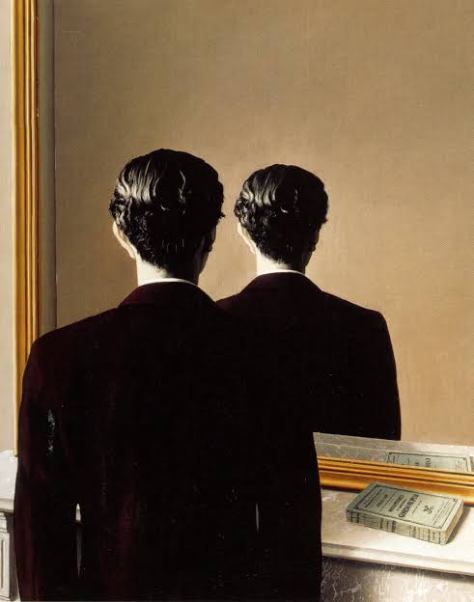
“La reproduction interdite” by Rene Magritte 1937.

सलाह 

हैरत ज़दा, असमंजस में,

उस ने हमें बुलवाया

और हम हाज़िर हुए.

उसकी संगेमरमर की बालकनी के तले खड़े हुए:

दुखी लग रहा था वो.

हाथ लरज़ रहे थे

जब से एक ज्योतिष ने उस से ये कह दिया था

किसी की सलाह नहीं लोगे, तो मौत पक्की है“. Continue reading सलाह: मुरीद बरघूती/अनुवाद: आयेशा किदवाई

बिहार चुनाव आते ही प्रतिबंधित रणवीर सेना को एक बार फिर कौन हवा दे रहा है?

रणवीर सेना, जिस पर बहुत पहले पाबंदी लगायी जा चुकी है, नए सिरे से सुर्खियों में है।

पिछले दिनों उसने अपने सोशल मीडिया पेज पर भीम आर्मी के बिहार प्रमुख गौरव सिराज और एक अन्य कार्यकर्ता वेद प्रकाश को खुलेआम धमकाया है। उसने अपने ‘सैनिकों’ को आदेश दिया है कि उन्हें ‘जिन्दा या मुर्दा’ गिरफ्तार करें। बताया जाता है कि इस युवा अम्बेडकरवादी ने ब्रह्मेश्वर मुखिया- जो रणवीर सेना के प्रमुख थे और 2012 में किसी हत्यारे गिरोह के हाथों मारे गए थे- के बारे में जो टिप्पणी की, वह रणवीर सेना के लोगों को नागवार गुजरी है।

प्रश्न उठता है कि इस तरह खुलेआम धमकाने के लिए, मारने पीटने की बात करने के लिए क्या ‘सेना’ पर कार्रवाई होगी? अगर इतिहास को गवाह मान लिया जाए तो इसकी संभावना बहुत कम दिखती है। Continue reading बिहार चुनाव आते ही प्रतिबंधित रणवीर सेना को एक बार फिर कौन हवा दे रहा है?

Shadow of Laxmanpur Bathe on Bihar Election

An unpredictable element has found a new lease of life thanks to the coming Assembly election.

Laxmanpur Bathe on Bihar Election

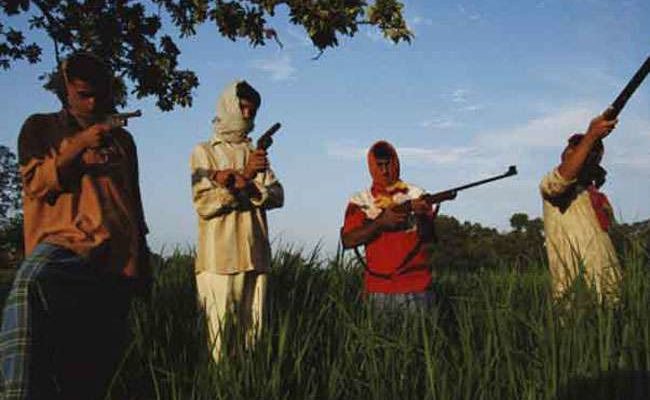
The outlawed Ranvir Sena—the private army of upper caste landlords of Bihar—is in the news again. It recently threatened the Bihar chief of the Bhim Army, Gaurav Siraj, and one of its activists, Ved Prakash, through a Facebook post. The so-called army has “ordered” its “sainiks” to “arrest” him dead or alive. The sena is apparently peeved over how the young dynamic leader of the Ambedkarite organisation has described Brahmeshwar Singh, their slain “Mukhiya” who was killed in 2012.

Will there be any action against those who have threatened the young leader? If history is any guide then there is little possibility of this.

Merely two years ago, Nawal Kishor Kumar, Editor Hindi, Forward Press was targeted by this “sena”. The aggrieved journalist had lodged a police complaint but there has been no progress in the investigation.

It is not that there is no law to punish such miscreants. Social media posts of the threatening kind relate to various offences under the Indian Penal Code, from criminal intimidation punishable under section 503 to section 505 related to creating mischief in public, to section 506 which awards punishment for criminal intimidation and section 153A which relates to penalties for promoting enmity between different groups and so on. In fact, based on its activities, the Ranvir Sena is also liable to be prosecuted under section 3 of the Bihar Control of Crimes Act, section 3 of the Arms Act and section 3 of the Scheduled Castes and Scheduled Tribes (Prevention of Atrocities) Act, 1989.”

( Read the full text here)

पानी की फ़र्माबरदारी: मुरीद बरघूती /अनुवाद: आयेशा किदवाई

You can see the English translation of the original poem by the Palestinian poet Mourid Barghouti , after this translation into Hindustani by AYESHA KIDWAI

कितनी कला, बारीक़ सोच, हिचकिचाहट, और क़ुरबानी की रातें,
कम या ज़्यादा कीमत अदा कर,
तुम्हें लगती हैं एक सरल सा
आला अविष्कार करने में?

एक तानाशाह बनाने में तुम्हें सिर्फ
एक बार ही घुटना टेकना है. Continue reading पानी की फ़र्माबरदारी: मुरीद बरघूती /अनुवाद: आयेशा किदवाई

महिला आन्दोलनकारियों की गिरफ्तारियां और भारत सरकार की पितृसत्ता : अमन अभिषेक

Guest Post by Aman Abhishek

Big Brother's Patriarchal Authoritarianism

गुलफीशा फ़ातिमा, सफुरा जरगर, देवांगना कलिता और नताशा नरवाल

दुनिया के जाने-माने प्रोफ़ेसर और पत्रकार डॉक्टर लेता होन्ग फ़िंचर अपनी किताब “बिट्रेइंग बिग ब्रदर: दी फेमनिस्ट अवेकनिंग इन चाइना” में लिखती हैं कि किस तरह चीनी सरकार के द्वारा मार्च 2015 में पांच कार्यकर्तायों की गिरफ्तारी ने चीनी नारीवादी आन्दोलन को एक नया मोड़ दे दिया | जिन पांच महिलाओं को गिरफ्तार किया गया था वे विश्वमहिला दिवस के मौके पर यौन उत्पीडन के खिलाफ बसों और ट्रेनों में पर्चे बाँट रही थी | परन्तु चीनी सरकार ने झगड़े उसकाने के आरोप लगाकर गिरफ्तारी कर ली | इसका परिणाम यह हुआ कि ये पांच महिलाएं “फेमस फाइव” यानी “पांच प्रसिद्ध” के नाम से जानी गई | इन गिरफ्तारियों ने चीनी नारीवादी आदोंलन को कमजोर करने के बजाए एक नयी उर्जा प्रदान की और गिरफ्तारियों के विरोध में बड़े पैमाने पर आन्दोलन शुरू हो गए|

अब भारत में हाल की परिस्थितियों पर गौर करें | दिसम्बर 2019 से मार्च 2020 तक देश के सैकड़ों सार्वजनिक स्थानों पर हजारों आन्दोलनकारियों ने, महिलाओं के नेतृत्व में, सीएए के विरोध में सशक्त और शांतिपूर्ण आन्दोलन किया और लगातार धरना चला | शाहीनबाग जैसे जगहों पर रात दिन धरने चले | देश भर के आन्दोलनकारी उसी सीएए का विरोध कर रहे थे जिसे संयुक्त्त राष्ट्र संघ और और अनेकों मानवाधिकार संगठनों ने मुस्लिम विरोधी और घोर पक्षपातपूर्ण करार दिया है| महिलाओं के नेतृत्व और भागीदारी की वजह से सीएए विरोधी आन्दोलन केवल नागरिकता के सवालों तक सीमित न रहकर भारतीय नारीवादी आन्दोलन के इतिहास में एक अहम कड़ी बन गया |

अप्रैल से भारत सरकार ने सीएए विरोधी आन्दोलन के महिला नेतृत्व की गिरफ्तारियां शुरू कर दी | इन महिलाओं की गिरफ्तारियों की वजह हिंसा भड़काने से लेकर आतंकवाद तक बताई गई | गिरफ्तार लोगों में शामिल गुलफीशा फ़ातिमा मुस्लिम समुदाय की नेता हैं, सफुरा जरगर जामिया मिलिया की छात्रा हैं तथा गिरफ्तारी के वक्त तीन माह से गर्भवती थी | देवांगना कलिता और नताशा नरवाल , पिंजड़ा तोड़ आन्दोलन की संस्थापक हैं (पिंजड़ा तोड़ समूह के कार्यकर्ताओं ने शैक्षणिक संस्थाओं में लैंगिक भेद-भाव और पितृसत्ता के खिलाफ आन्दोलन किया है) | यह गिरफ्तारियां एक वैश्विक महामारी के दौरान की गई है, जो इस महिलाओं की जिन्दगी के लिए घातक साबित हो सकता है | Continue reading महिला आन्दोलनकारियों की गिरफ्तारियां और भारत सरकार की पितृसत्ता : अमन अभिषेक

Treacherous Road to Make Manu History

Even today the attempt is to whitewash Manusmriti, not shun it. But all is not lost as the ripples of Black Lives Matter have reached Indian shores.

manusmiriti ambedkar hindutva

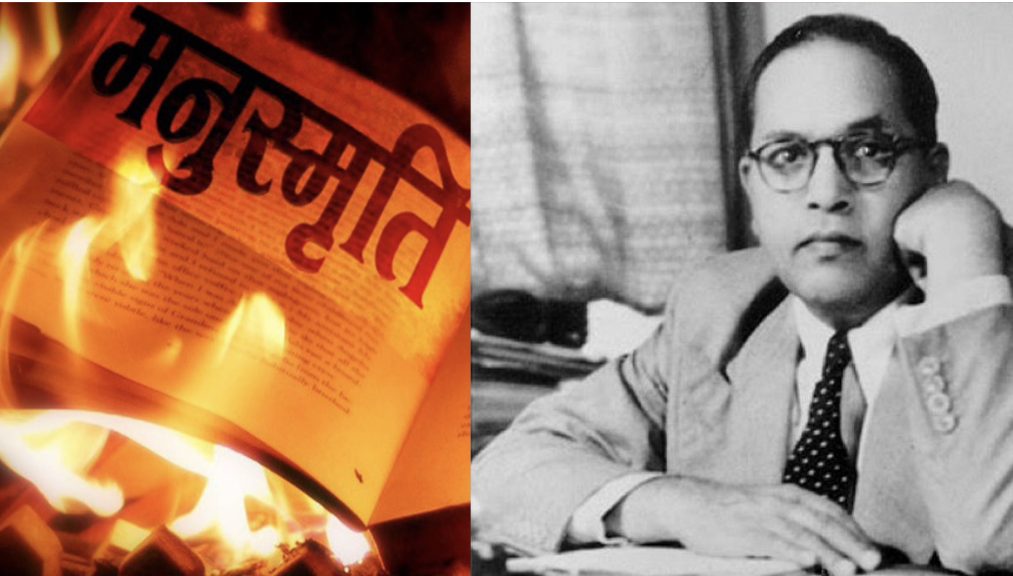
It was 1927, the second phase of the historic Mahad Satyagrah was on, and Dr. Bhimrao Ambedkar led thousands of people in burning the Manusmriti, an act he compared with the French Revolution of 1789. Time and again, in speeches and writings, he categorically opposed the world-view of Manu, the legendary figure to whom are attributed the tenets of the Manusmriti, said to be dated to around 100 CE.

In the book written by scholar and activist Anand Teltumbde, Mahad: The Making of the First Dalit Revolt, published by Navayana in 2017, is recorded the resolution which was proposed by the social activist Gangadhar Sahasrabuddhe, and then read out at the Mahad Satyagrah. It states that the firm opinion of this conference is that the Manusmriti, “taking into consideration its verses which undermined the Shudra caste, thwarted their progress, and made their social, political and economic slavery permanent…is not worthy of becoming a religious or a sacred book. And in order to give expression to this opinion, this conference is performing the cremation rites of such a religious book which has been divisive of people and destroyer of humanity.”

Twenty three years later, Dr Ambedkar marked the promulgation of the Constitution of India as the “end of the rule by Manu”. And yet, 70 years thereafter, a significant section of Indians are still fascinated by Manu and have no qualms in venerating him. Even the Black Lives Matter protests in the United States and large parts of Europe, in which statues of slave-owners and colonialists are being knocked down or disfigured, the Indian followers of Manu have no regrets about deifying him.

( Read the full article here)

Paradigms Lost, Past Continuous – Saraswati and some other rivers: Janaki Nair

Guest post by JANAKI NAIR

Maj General GD Bakshi (hereafter MGB) feels enough is enough. Having dealt with the Information Warfare and Psychological Operations in the Indian Army, he has now trained his guns on the internal enemy, abandoning the trenches of Jai Jawan for the far messier archaeologists’ hangout. In his battle dress – impeccable suits and ties– he wages war in the cause of snatching back History from historians, particularly Marxist Historians, Oxford and Harvard Historians, Colonial Historians, Tony Joseph, and above all JNU Historians who pose the Greatest Threat to the Continuity of our National Past. (Fortunately, he has not heard of Subaltern Historians, who have dared to polish up arguments instead of his shoes; or of feminist or Dalit historians, who impertinently ask whatever happened to the Vedic dasi).  While waging this war, he also hopes to win some minor battles on behalf of the Indian Taxpayer by shutting down JNU.

Then MGB had a second think: why waste a chance of planting a flag on a beautiful 1000-acre campus just because it was a Marxist redoubt? And what safer flag in these times of COVID than a Webinar in the JNU ether?  So MGB is ready to announce the Paradigm Shift in the study of the Saraswati Civilisation.  (For those who were reared on that disloyal diet of NCERT books, it refers to the Indus Valley Civilisation, or Harappan Culture).  This Paradigm Shift will fortunately not be as fickle as the Sutlej,  which changed its course mid-holocene. In fact, this Paradigm Shift does not rely much on historians or archaeologists,  but more on scientists – geologists, geneticists, accurate carbon dating physicists – who along with MGB, alone are capable of Total Objectivity, and know that only Good Things happened in the Indian past. Continue reading Paradigms Lost, Past Continuous – Saraswati and some other rivers: Janaki Nair

Can Rest of India ‘Do’ a Mallapuram ?

Ruins of an ancient Jain temple in Arimbra

Ruins of old Jain Style Temple at Arimbra 

Mallapuram, Kerala’s lone Muslim-majority district, made history recently.

The 5,000 mosques in the district would remain closed indefinitely.

Logic behind this decision is simple.

As the state is witnessing spike in Coronavirus infection recently, it was found more prudent to keep the doors closed for devotees. Panakkad Sayyed Sadiq Ali Shihab Thangal, a leading Islamic Scholar and Malappuram district president of the Indian Union Muslim League, shared this news with a section of the media.

Thus while the rest of the country is witnessing opening of places of worship under Unlock 1, Mallapuram has decided otherwise. Continue reading Can Rest of India ‘Do’ a Mallapuram ?

Truth Behind India’s Hierarchies of Pain

Perhaps celebrities know that talking about the plight of an animal—who died in a state not ruled by the ruling dispensation at the Centre—is a safe bet

Migrants

Migrants wait for a means of transport to travel to their native places during the fourth phase of the ongoing COVID-19 nationwide lockdown, at Kundali Industrial Area in Sonipat. (Photo: PTI)

The killing of a pregnant elephant has caused national outrage. The elephant had strayed into a village in Palakkad, Kerala, and is said to have been fed a fruit stuffed with firecrackers, which exploded in its mouth. It is impossible to comprehend the tremendous suffering of the elephant, who died a painful death. It is also learnt that people in the region have in the past used incendiary materials to protect their crop from animals, particularly wild boar.

One person was arrested after the matter came to light and few others have been identified. Kerala Chief Minister Pinarayi Vijayan has promised “justice will prevail”, but one does not know if that includes legal action against the hatemongers—including a former cabinet minister who gave the incident a communal colour by claiming, incorrectly, that the incident occurred in Muslim-majority Malappuram. A sitting cabinet minister also retweeted this fake news, which further vitiated the atmosphere.

In a complaint to the Malappuram Police, a lawyer has urged the police chief to file an FIR against the former minister and others for a “derogatory” campaign against the district.

Now, many Indian celebrities, for example Indian cricket team captain Virat Kohli, have said that they are “appalled” by the incident. The chairman of India’s biggest corporate giant, Ratan Tata, has compared the “criminal act” with “meditated murder”. The celebrities, the anchors of 24/7 news channels and many other prominent figures are undeniably upset by the plight of the elephant. But do they also feel the same kind of outrage and disquiet over the communal overtones being imparted to it?

( Read the full article here)

Public Display of Faith Can Wait, Humanity Cannot

It is inevitable that the virus will spread anywhere people gather in numbers.

Faith in India

Representational Image

India went for the world’s toughest lockdown in March, when just about 500 Covid-19 cases had been reported. And it has started withdrawing the lockdown when India has become the seventh-worst pandemic-affected nation, with over 1.91 lakh infections and close to 5,500 deaths. India is registering giant spikes in active cases of Covid-19, but the home ministry has come out with a phased plan to unlock India. The current phase of re-opening will focus on the economy. It has been decided that malls, hotels, restaurants and places of worship will reopen from 8 June onwards.

Concerns over the economic downturn are understandable. The latest GDP data shows the slowest pace of growth in 11 years in the last quarter of 2019-20, and the economy has been hit hard by the Covid-inspired sudden and complete lockdown. But one fails to understand the decision to open religious places at such an early date.

It remains unanswered whether religious places are being thrown open to pre-empt Mamata Banerjee, the Chief Minister of West Bengal, who has announced that her state would open all places of worship from 1 June. It is also not known whether this is being done, as BS Yediyurappa, the Chief Minister of Karnataka, wrote in his letter to the Prime Minister, because devotees are insisting that religious sites be opened.

( Read the full article here )