Category Archives: Violence/Conflict

The Aam Aadmi Party and Animal Farm

The plot of George Orwell’s ‘Animal Farm’ can be summarized in a single sentence – “This novel demonstrates the consequences of the addition of four important words -‘but’,  ‘some’, ‘more’, and ‘others’ to the phrase – <all animals are equal>”.

In other words, it describes the transition from the axiomatic statement <all animals are equal> to the qualified formula <all animals are equal, but some animals are more equal than others>.

Aam Aadmi Party founder and Delhi’s new chief minister Arvind Kejriwal’s ruling out the possibility of referendums in Kashmir about the presence of the armed forces in Jammu & Kashmir (in response to his party colleague Prashant Bhushan’s endorsement of the idea of such a referendum during a recent television appearance) could signify a shift within the Aam Aadmi Party’s evolving political doctrine that parallels the transition that the pigs in Animal Farm made while turning their revolution into a counter-revolution. Continue reading The Aam Aadmi Party and Animal Farm

We are all Anwar Congo

1-the-act-of-killing-TAOK_AnwarBehindCamera_rgb

In 1965-66, Indonesia killed one million people it suspected were ‘communists’. Others who became victims of this cleansing were ethnic Chinese. An American filmmaker, Joshua Oppenheimer, goes to Indonesia and bumps into a man, Anwar Congo, who himself killed a thousand people. He and his friends, who were part of the extermination of real or imagined communists, happily boast about what they did and describe it in detail. Oppenheimer tells them that they should make a feature film reenacting what happened. Oppenheimer then makes a documentary about these people making a film about what they did.

The Act of Killing released last year but the world is still talking about it. When you watch it, you can scarcely believe what you see. Anwar Congo shows us how he perfected a method of killing that would produce the least blood. He wraps a steel wire around the victim’s neck, ties the wire to a pole and pulls it from the other end. He then watches how the video looks on television and says he shouldn’t be smiling, his face should look cruel, he shouldn’t be wearing white pants. He’d never wear clothes like that while doing the killings. Continue reading We are all Anwar Congo

Independent inquiry into Muzaffarnagar ‘Riots’: Mohan Rao, Ish Mishra, Pragya Singh, Vikas Bajpai

Press Statement on the Report  prepared by Mohan Rao, Ish Mishra, Pragya Singh and Vikas Bajpai                                                                                

December 30, 2013

A team of independent academics and a journalist carried out an inquiry into the communal violence that shook Muzaffarnagar district in UP this past September. The report is based on the findings of the team during its visit to Muzaffarnagar district on the 9th and the 10th of November and again on the 27th November. The members of the team were:

  • Dr. Mohan Rao, Faculty, Centre for Social Medicine and Community Health, JNU.
  • Mr Ish Misra, Faculty, Department of Political Science, Hindu College, Delhi University.
  • Ms.Pragya Singh, Journalist, Outlook, and
  • Dr. Vikas Bajpai, Ph.D. Scholar, Centre for Social Medicine and Community Health, JNU.

The team also drew upon the assistance of Dr. Subhash Tyagi, Professor of Geography, Machra College, Meerut, and Praveen Raj Tyagi, Principal Greenland Public School, Duhai, Ghaziabad, in the collection of some data and the conduct of the visit.

OBJECTIVES OF OUR ENQUIRY:

  1. To investigate the role of state agencies in either preventing or containing violence, in taking appropriate punitive actions against the guilty and also to investigate some incidents of communal violence.
  2. To investigate the role of the government in providing relief and rehabilitating the displaced and the progress made in displaced people going back to their villages and homes.
  3. To understand economic, social and political reasons that led to the recent spate of communal violence in this area of Western Uttar Pradesh. Continue reading Independent inquiry into Muzaffarnagar ‘Riots’: Mohan Rao, Ish Mishra, Pragya Singh, Vikas Bajpai

ऐसा तो गुजरात में भी नहीं हुआ था: अपूर्वानंद

ऐसा तो गुजरात में भी नहीं हुआ था! हाँ! हमें 2002 की गर्मियां ज़रूर याद हैं, मस्जिदों में चल रही पनाहगाह की याद है, याद हैं गम से खामोश और समझदार आँखें जो हमें देख रही थीं जो उनका दुःख बँटाने आए थे वहाँ, कुछ घंटे, कुछ दिन, कुछ वक्त गुजारने, फिर जो अपने घरों को लौट जाने को थे क्योंकि हमारे घर थे जहां हम लौट सकते थे, घर जो आपका इंतज़ार जितना करता है उससे कहीं ज़्यादा दिन-हफ्ते उससे बाहर गुजारते हुए आप उसका करते हैं. वे आँखें जानती थीं कि हमारे घर हैं लौटने को और उनके नहीं हैं. वे अशफाक, सायरा, शकीला होने की वजह से बार-बार घर खोजने को नए, सिरे से उन्हें बसाने को मजबूर हैं, कि उनको  और उनकी आगे की पीढ़ियों को इसका इत्मीनान दिलाने में यह धर्मनिरपेक्ष भारत,यह हिन्दुस्तान लाचार है. जिसकी हस्ती कभी नहीं मिटती, उस हिन्दुस्तान को बनाने वालों में कई को ज़रूर एक ज़िंदगी में कई जिंदगियां गढ़नी पड़ती हैं. एक घर के बाद कई घर बसाने पड़ते हैं. Continue reading ऐसा तो गुजरात में भी नहीं हुआ था: अपूर्वानंद

Magistrate Ganatra’s Dictionary and the Crime Scene of Language

Written in the wake of the dismissal of Zakia Jafri’s Petition by an Ahmedabad Metropolitan Magistrate’s Court

On 13th June, 1971, a courageous Pakistani journalist called Anthony Mascaranhas published an article in the Sunday Times, London, which was headlined ‘Genocide‘. The story of how this article got to be written and published is noteworthy in itself – and is an object lesson in how an ethical journalist takes and follows through a difficult decision. Forty two years later, Is it too late to wonder if a Gujarati magistrate could have taken an ethical leaf out of a Pakistani-Goan journalist’s lexicon?

Continue reading Magistrate Ganatra’s Dictionary and the Crime Scene of Language

In Tragic and Tough Times – Thoughts in the Wake of A Rape Charge and a Suicide: Sucheta De and Shivani Nag

Guest Post by SUCHETA DE and SHIVANI NAG

In Tragic and Tough Times, Let Us be True to Our Democratic and Gender-Just Principles.

We are confronted by a painful episode involving a rape charge and a suicide, that poses many tough and tangled questions to us – as the JNU community and also as individuals and activists committed to secularism, democracy and gender justice. Let us, for a moment, reiterate what one of the late Khurshid Anwar’s friends has said in his recent post on Kafila: the suicide does not prove him guilty of the charge of rape, and it does not prove his innocence either.

The suicide is a horrible, tragic occurrence – and it is a tragedy we should not compound with irresponsible utterances. A charge of rape does not necessarily turn the accused into a convicted rapist. True. And equally truly, it does not turn the woman making the charge, overnight, into a slut, a murderer, or a communal/political conspirator. Continue reading In Tragic and Tough Times – Thoughts in the Wake of A Rape Charge and a Suicide: Sucheta De and Shivani Nag

Hayaat-e-Azadi, The Life of Freedom: Suvaid Yaseen

Guest Post by SUVAID YASEEN

Ho Agar Khudnigar-o-Khudgar-o-Khudgeer Khudi
Ye Bhi Mumkin Hai Ke Tu Mout Se Bhi Mer Na Sake

[If the ‘ego’ is selfpreserving, selfcreating and selfsustaining, 
Then it is possible that even death may not kill you.]
— Allama Iqbal,  Hayaat-e-Abadi, Zarb-e-Kaleem

Hayaat / Life
Hayaat / Life

The News

On the evening of 14th July 2013, I received a text message from a friend saying Hayaat had been hit by pellets in the eyes. Both his eyes were damaged. As I read the text, I became numb. I was at loss how to respond, trying to sink in what had just happened.

Continue reading Hayaat-e-Azadi, The Life of Freedom: Suvaid Yaseen

An Incomplete Reunion – Ruining the Post-Partition Party: Archit Guha

Guest post by ARCHIT GUHA

Reproduced without Permission from Life

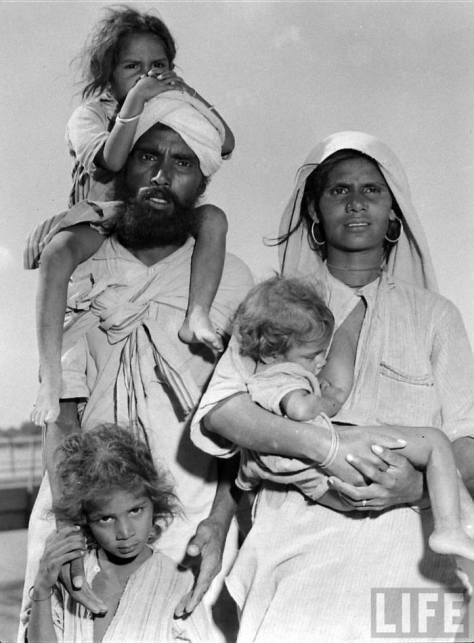
By this point, every Indian, Pakistani, and their grandfathers has watched the Google Partition ad, tears welled up in their eyes. For the uninitiated, Google’s recent advertisement tugs at heartstrings, telling the tale of two chaddi buddies, separated by Partition, and reunited by their grandchildren nearly seventy years later. When the ad went viral via Facebook, sitting thousands of miles away in America, I bawled as I watched the granddaughter listening to her grandfather’s nostalgic retelling of the idyllic life he led in Lahore, eating jhajhariya, with his buddy Yusuf, and his granddaughter’s instant Google fixes to reunite him with Yusuf in Delhi. Continue reading An Incomplete Reunion – Ruining the Post-Partition Party: Archit Guha

Ganguly Must Go – Chairs of Rights Bodies Must be Above Reproach

Statement from Women’s Groups Across India on 16 December 2013

Exactly one year ago, the gang-rape of a young woman triggered immense outrage across the board, putting freedom from rape and sexual assault at the forefront of public debate. From law reform to overhaul of institutions of justice delivery, from media sensitization to public awareness, women’s safety is now squarely on the public agenda, thanks to mass protests. Ironically, during those very protests, on 24 December 2012, a young lawyer revealed that a retired judge of the highest court in land had sexually harassed her while she was working with him as an intern, and that she was unable to speak about it only ten months later.

According to her statement, Justice (Retd) A.K. Ganguly currently the Chairman of the West Bengal Human Rights Commission said, “’You know that I’m attracted to you, don’t you? You must be thinking, what, this old man is getting drunk and saying such things. But I really like you, I love you’. When I tried to move away, he kissed my arm and repeated that he loved me.” This is not merely inappropriate behavior by a senior over junior staff or interns; it is not merely over-stepping of boundaries; it is not merely friendly overtures: such acts constitute a clear case of abuse of power and sexual harassment at the workplace.  Continue reading Ganguly Must Go – Chairs of Rights Bodies Must be Above Reproach

The Anti-Rape Movement -The Political Vision of ‘Naari Mukti/Sabki Mukti’: Kavita Krishnan

Guest Post by KAVITA KRISHNAN

Anti Rape Protest at CM Shiela Dixit's House, Photo by Vijay Kumar
Anti Rape Protest at CM Shiela Dixit’s House, Photo by Vijay Kumar

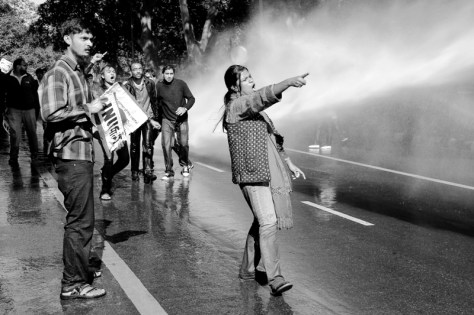
A year ago, a massive movement erupted on the streets of Delhi and the country – against the brutal gangrape of a young woman on a bus, leading to her death. Looking back at that movement a year later, it is clear that the questions, concerns and above all the tensions and debates embedded in that movement are with us still – and are quite crucial to the political discourse around us.

Continue reading The Anti-Rape Movement -The Political Vision of ‘Naari Mukti/Sabki Mukti’: Kavita Krishnan

Former Tehelka journalist speaks out

This is the full text of the statement issued today to the media by the gutsy woman journalist who refused to take sexual harassment as routine. More power to her and others like her!

I am heartened by the broad support I have received over the past fortnight. However, I am deeply concerned and very disturbed by insinuations that my complaint is part of a pre-election political conspiracy.

I categorically refute such insinuations and put forward the following arguments:

The struggle for women to assert control over their lives and their bodies is most certainly a political one, but feminist politics and its concerns are wider than the narrow universe of our political parties. Thus, I call upon our political parties to resist the temptation to turn a very important discussion about gender, power and violence into a conversation about themselves.

Continue reading Former Tehelka journalist speaks out

Protect the Privacy of the Tehelka Journalist: Report Responsibly

GUEST POST BY ‘REPORT RESPONSIBLY’
To all editors, journalists, bloggers, users of social media, and the public:

Some websites and blogs are posting the Tehelka journalist’s complaint to the magazine’s management or reproducing parts of it, perhaps with intent to expose a grave act of sexual assault by a man occupying a powerful position. However, in doing so, they are violating basic ethical and legal injunctions on the way cases of sexual assault must be reported.

The journalist’s complaint to her company is a private document and not a public one. While private documents can be leaked in the ‘public interest’, this principle is applicable to the emails of Tarun Tejpal and Shoma Chaudhury sent to Tehelka staffers, not to the journalist’s emailed complaint. In cases of sexual assault, it is a well established principle that the media can name the perpetrator, but not the victim. The identity and privacy of a victim must be protected at all costs.We are distressed that many people are circulating the journalist’s emails, and other journalists, bloggers and users of social media are publishing it in parts or whole.

Continue reading Protect the Privacy of the Tehelka Journalist: Report Responsibly

Adivasis of Kerala: Citizens or Cannon fodder?

This is a guest post by JAISON COOPER

Notwithstanding the opposition of many Adivasi organizations and progressive forces, the government of Kerala appears bent on moving forward with its project of recruiting Adivasis as home guards, paying them Rs.500 per day, to take on the Maoist guerrillas allegedly active in the Western Ghats. It is obvious that the state government is not learning lessons from the Salwa Judum experience in Central India and is bent on making Adivasis scapegoats in its impending showdown with the Maoists. Continue reading Adivasis of Kerala: Citizens or Cannon fodder?

श्रीलंका और हम

श्रीलंका अभी खबरों में है. लेकिन ज़्यादातर हिंदी अखबारों को पढ़ने से आपको अंदाज़ नहीं मिलेगा कि सुदूर दक्षिण में स्थित इस नन्हें-से मुल्क में क्या कुछ हो रहा है जिससे हमारा भी रिश्ता है.वहाँ अभी‘कॉमनवेल्थ’ देशों का सम्मलेन हो रहा है और हमारे प्रधानमंत्री उसमें शामिल नहीं हो पा रहे हैं.श्रीलंका ने कहा है कि वह उनकी मजबूरी समझता है. तमिल राजनेताओं के हंगामे की वजह से प्रधानमंत्री ने अपनी जगह विदेश मंत्री को इस सम्मलेन में भारत का प्रतिनिधित्व करने को कहा है. इस सम्मलेन में श्रीलंका को अगले दो साल के लिए ‘कॉमनवेल्थ’ का नेतृत्व करने को कहा जाएगा. इस पर भारत को ऐतराज नहीं है और अब तक किसी और मुल्क ने भी अपनी आपत्ति दर्ज नहीं कराई है. Continue reading श्रीलंका और हम

Manmohan Singh says ‘No’ to CHOGM 2013, with a whimper: Anonymous

An Anonymous Guest Post

So, Prime Minister Manmohan Singh will not be attending CHOGM 2013 in Colombo after all. Many sections of Indian political and civil society, in Tamil Nadu in particular, will no doubt welcome this. But in reality, far from packing a punch this decision comes more as a whimper. If media reports are to be believed the PM’s letter to Rajapakse “does not talk about the reasons for Dr. Singh skipping the meet”. Muddled and last minute as it has been, far from demonstrating intent the decision actually betrays a singular lack of it, leaving India with little by way of leverage while doing its credibility no good. The PM’s absence will not be comfortable for Rajapakse but in the manner it has come it will in fact cost him little or at least much less than it would have if Delhi had made this decision count politically. But then the United Progressive Alliance is too busy dealing with its own rising electoral insecurities to care for India’s strategic interests let alone the human rights of Tamils in Sri Lanka. Continue reading Manmohan Singh says ‘No’ to CHOGM 2013, with a whimper: Anonymous

Waiting for the Director:Indian Premiere of ‘No Fire Zone: The Killing Fields of Sri Lanka’

On 7th November the full length version of the documentary “No Fire Zone: The Killing Fields of Sri Lanka’ will be premiered at the India International Center for the first time in India and discussed by eminent thinkers, journalists and activists. Callum Macrae, the Director of ‘No Fire Zone’, a film on the last days of the civil war in Sri Lanka has not received his visa to come to India and participate in the discussions despite applying over eight months ago! 

Two years ago when Channel 4 in the UK first aired the documentary, it sent shockwaves through the international community. The Sri Lankan civil war, which ended in mid-2009 with the decimation of the LTTE by the Sri Lankan army was supposed to have been a ‘glorious’ chapter in the vanquishing of a ‘terrorist’ force. Continue reading Waiting for the Director:Indian Premiere of ‘No Fire Zone: The Killing Fields of Sri Lanka’

सामूहिक अपराध और जवाबदेही

मुज्ज़फरनगर की सांप्रदायिक हिंसा की जिम्मेदारी तय करने का मसला पेचीदा होता जा रहा है.क़त्ल हुए हैं,बलात्कार की रिपोर्ट है, घर लूटे और बर्बाद किए गए हैं.हजारों मुसलमान अपने घरों और गावों से बेदखल कर दिए गए हैं.यह सब कुछ अपने आप तो नहीं हुआ होगा.किसी भी अपराध के मामले में इंसाफ की प्रक्रिया की शुरुआत अभियुक्तों की पहचान और उनकी नामजदगी से होती है.मुज्ज़फरनगर के हिंदू ग्रामीणों को इस पर ऐतराज है.उनका दावा है कि शिकायतें, जो मुस्लिम उत्पीड़ितों ने दर्ज कराई हैं और जिनके आधार पर अभियुक्तों को चिह्नित किया गया है,गलत हैं.वे और उनके लोग निर्दोष हैं और इसलिए पुलिस को धर पकड़ की अपनी कार्रवाई से बाज आना चाहिए.

अभियुक्तों को गिरफ्तार करने गई पुलिस पर हमले किए जा रहे हैं और पकड़े गए लोगों को छुड़ा लिया जा रहा है.हथियारों के साथ औरतें सड़क पर हैं,कहते हुए कि वे अपने बच्चों और मर्दों के साथ नाइंसाफी नहीं होने देंगी.किसी तुलना के लिए नहीं,लेकिन ऐसे सामूहिक प्रतिरोध के बारे में राय कायम करने एक लिए क्या हम किसी दहशतगर्द हमले में शक की बिना पर किसी मुस्लिम बस्ती में की जा गिरफ्तारी के इसी तरह के सामूहिक विरोध की कल्पना कर सकते हैं?उस समय हम उसे उस समूह की  अविचारित सामूहिक प्रतिक्रिया ही मानेंगे. Continue reading सामूहिक अपराध और जवाबदेही

1984 and the Spectre of Narendra Modi: Ravinder Kaur

Guest Post by Ravinder Kaur 

As India begins the countdown to the 2014 general elections, a new discourse has started taking shape around its minority populations. It is called the ‘what about 1984’ argument. The supporters of Narendra Modi in a bid to deflect attention from his role in 2002 pogrom usually throw 1984 at his critics. The critics have lately begun responding by placing 1984 pogrom in  a less grave category in comparison to 2002. The difference we are told is the political ideology – Congress is inherently secular and 1984 an aberration whereas BJP is communal and 2002 symptomatic. This unfortunate comparison means that the ‘what about 1984’ argument has unintentionally turned 1984 pogrom into an exclusive Congress problem even when it sets out to call out Modi’s anti-minority stance. The role of Hindutava ideology has been airbrushed out of the history that led to 1984 pogrom as a consequence.

Continue reading 1984 and the Spectre of Narendra Modi: Ravinder Kaur

Will Logarani Be The Last Victim Of Violence Against Women? Cayathri. D

GUEST POST BY CAYATHRI D via Ground Views

All photographs by the author, or sent by the author (in the original post)

Around 5pm on 17 October 2013, within the Jaffna municipality, one of our friends (a male youth resident of Jaffna) came to our home (a few friends were gathered there) looking very disturbed.…

READ MORE HERE

पड़ोसी और अजनबी

पड़ोसी कब पड़ोसी न रह कर अजनबी बन जाता है ? या वह हमेशा ही एक अजनबी रहता है जिस पर मौक़ा मिलते ही हमला करने में ज़रा हिचक नहीं होती ? हम अपना पड़ोस चुनते कैसे हैं? क्या पड़ोस मात्र एक भौगोलिक अवधारणा है? क्या जो भौगोलिक दृष्टि से हमारे करीब है, वही हमारा पड़ोसी होगा? पड़ोस चुनना क्या हमारे बस में नहीं? क्या पड़ोस कुछकुछ धर्म या भारतीय जाति की तरह है जिसके साथ जीवन भर जीने को हम बाध्य हैं? क्या पड़ोस का अर्थ हमेशा आत्मीयता ही है? क्या पड़ोस का मतलब एक दूसरे का ख़याल रखना,आड़े वक्त एक दूसरे के काम आना ही है? या यह रिश्ता अक्सर उदासीनता का होता है , जिसमें हमें दरअसल अपने पड़ोसी में दिलचस्पी नहीं होती? क्या इस उदासीनता के हिंसा में बदल जाने के लिए कोई भी कारण काफी हो सकता है? यह प्रश्न जितना शहर के सन्दर्भ में प्रासंगिक है उतना ही भारतीय गाँव के सन्दर्भ में भी पूछे जाने योग्य है. एक बार फिर, मुज़फ्फरनगर के गाँव में हुई हिंसा के बाद, पड़ोस के मायने पर बात करना ज़रूरी हो उठा है. Continue reading पड़ोसी और अजनबी

Nobody Killed the 58 People Who Died in Laxmanpur Bathe on 1 December 1997: Dipankar Bhattacharya

Guest Post by Dipankar Bhattacharya

Predictably enough, the Patna High Court has acquitted all the 26 persons convicted by the trial court in the Laxmanpur-Bathe massacre case. This is the fourth successive instance of wholesale acquittal of convicts by the Patna High Court in cases of massacre of the oppressed rural poor in Bihar. Once again eye witness accounts have been dismissed as being not fully credible and convicts granted acquittal on ‘benefit of doubt’. The judges could not however disprove the fact that 58 people had been killed and post-mortems done, and hence they asked the trial court to calculate the compensation payable to the nearest kin of the victims as per relevant provisions the Motor Vehicles Act on the basis of the minimum wage prevalent in the area at the time of the massacre. They of course did not forget to add that any ex gratia paid after the massacre should be deducted from the amount of compensation!

Continue reading Nobody Killed the 58 People Who Died in Laxmanpur Bathe on 1 December 1997: Dipankar Bhattacharya