Category Archives: Government

In the Name of Fidel – The Left Reads the Mandate: Vipin Kumar Chirakkara

This is a guest post by VIPIN KUMAR CHIRAKKARA

Party has two faces: V.S. Achuthanandan (centre) with Pinarayi Vijayan (left)
Party has two faces: V.S. Achuthanandan (centre) with Pinarayi Vijayan (left) Photo and Caption Courtesy – Indian Express.

In his address to the media in Thiruvananthapuram after the Left won the mandate in Kerala, Sitaram Yechury announced two positions to be given to two leaders of his own party who had successfully contested the elections from there.  One is that of the leader of the legislative party of the CPI-M, or effectively the chief ministership of Kerala.  That went to Pinarayi Vijayan.  The other one went to V.S. Achuthanandan.  He is made the Fidel Castro of Kerala.  Yechury, the embattled general secretary of the party who is also known to be closer to VS than to Vijayan, elaborated on the function of the second position since, seemingly, he felt that people could develop doubts about the implication of this honour, if not an anxiety whether the left victory in a single assembly election is turning Kerala into Cuba.  He clarified that VS will be an inspirational symbol providing advice and direction to the new government, and added that the veteran leader could not head the government due to his advanced age and poor health.  Yechury was, of course, flanked by the state secretary of the party Kodiyeri Balakrishnan and VS himself.  The suspense thriller of this election thus had the curtain fall, with an anti-climactic scene of unity.

It would deprive us of a unique opportunity to know another meaning of the mandate if we ignore how Yechury has read it.  He interpreted the mandate in the same address to the media that was held in Kerala’s capital.  He had a special reading to offer us, indeed different from what we all would ordinarily imagine.  His reading is distinguished from ours by its methodology itself.  He does not look at the assembly elections with reference to states where elections have taken place now. According to him, elections took place in 820 seats.  He took out his cell phone and provided the statistics of the results.  The BJP could win only in 64 assembly seats, the Congress in 115 whereas the Left has been victorious in 124.  He said that this was “the absolute ground reality”.  He assured us, the anxious beings, further that this reality implied no such threat as the return of the saffron.  When a journalist mentioned to him the victory of the Trinamool Congress that had won above 210 seats in West Bengal, he said he had in mind only the national parties.  So, we are expected to understand if we haven’t yet, that the Left’s is indeed an impressive performance as a national party!

Continue reading In the Name of Fidel – The Left Reads the Mandate: Vipin Kumar Chirakkara

Modiversary – Mera Desh Badal Raha Hai! Really

It was late mid-eighties when we use to do streetplays in Varanasi as part of our activities as a left student group – which called itself ‘Gatividhi Vichar Manch’ in Banaras Hindu University. One such plays was titled Desh ko Aage Badhao. The 5-7 minute play was part of a compilation of many other plays brought out possibly by Jana Natya Manch. We must have done hundreds of shows of the other play Raja Ka Baja – which was about the dire state of education and employment.

The theme of this short play Desh ko Aage Badhao was rather crisp. It showed a Netaji/leader in white clothes telling people gathered around him how the ‘nation is progressing’. When the innocent people ask for details, then he starts listing out his personal achivements and the wealth he has acquired through all these years of ‘serving the masses’. The tagline was Arrey Murkhon, dekho desh kaise aage badh raha hai‘ ( You fools, look how the nation is progressing)

The end scence showed people coming together, getting organised and slowly pushing the Netaji. When the terrified Netaji use to ask Arrey Murkhon, yeh kya kar rahe ho. (What are you doing idiots). The awakened people use to answer in unison Netaji, desh ko aage badha rahe hain ( We are pushing the nation forward).

I was reminded of this short play when TV started showing the ad how the nation is changing and how it is progressing with a tagline Mera Desh Badal Raha Hai, Aage Badh Raha Hai. ( How my nation is changing, and advancing) focussing itself on two years of Modi government at the centre. Continue reading Modiversary – Mera Desh Badal Raha Hai! Really

Congratulations on the Completion of Two Years of Government: Reaction of JNU student, Bihu Chamadia

Guest Post by BIHU CHAMADIA

Congratulations on the completion of two years of government. But I just want to ask a simple one line question. Completion of two years but at what cost? At the cost of increase in the number of farmer suicides, at the cost of creating war-like situations in educational institutions, at the cost of acting as a catalyst of widening the gap between hindu-muslim, at the cost of increasing imports and decreasing exports. Celebration on such a large scale because of course it is the first ever government in the history of the world to complete 2 years of governance ! With on-going crisis in the country BJP spends 1000 crores on a programme for this celebration. We would have no problem if this money was yours but sadly it’s not its ours. So now to all the tax payers who had problem with JNU raising its voice I ask you have you people become blind and deaf or are suffering from amnesia and forgot how to read and write.

Well, you speak well Mr Modi but the problem is that you only speak. You and your whole cabinet knows that each and every student of these educational institutes can give you people a befitting reply to all your one liners but we choose not to. People laugh at what your ministers says and say what a fool but I have a completely opposite view. You people are not fool you people are smart, very smart indeed.  Your every policy and every one liner can have a nice reply. Continue reading Congratulations on the Completion of Two Years of Government: Reaction of JNU student, Bihu Chamadia

What the UGC Gazette Notification 2016 Portends for the State of Higher Education in India: Rina Ramdev and Debaditya Bhattacharya

This is a guest post by RINA RAMDEV AND DEBADITYA BHATTACHARYA

The much-debated API (Academic Performance Indicator) system, linking promotions of faculty members in Indian universities/colleges to a quantifiable assessment of their performance, was introduced by the University Grants Commission (UGC) in its 2010 Regulations. Since then, there has been mounting resistance and discontent among massive sections of the teaching community – forcing the UGC to withdraw the said assessment framework for a while in 2013, before reintroducing it across institutions of higher education. However, over the years, the ire of protesting teachers has translated into a sustained critique of the API system and its failure to account for the infrastructural inadequacies of public institutions as adversely impacting the promotion prospects of thousands of teachers across the country.

It was rightly argued that a point-based appraisal pattern reduces teaching as an adventure of ideas into a standardised set of visible-verifiable outcomes and deliverables, expending in this, the necessary surplus of every academic encounter. The clock-timed hours of classroom-teaching – convertible into digits and decimals – were not only incommensurate to the disaggregation of thought beyond workdays and work-hours, but also insisted on a corporate-model professionalism limiting the exact interface between the teacher[-as-service-provider] and the student[-as-client].

The perils of quantification notwithstanding, the API system practically sought to make teaching a redundant exercise in terms of ‘necessary qualifications’ for faculty promotions. With a lucrative price-tagging of the ‘value’ of research activities conducted by individual teachers outside of teaching-schedules and the consequent structures of waging intellectual productivity through the numbers of projects and publications, the API contributed to a voiding of the classroom in undergraduate colleges in many parts of the country. Forced to prove her/his levels of productivity as the most essential claim to survival and growth within the field, the teacher needed but little to do by way of engaging students. And yet, on the contrary, the government persisted with its policy of withdrawing research grants and forcing research organisations to look for alternative sources of funding to sustain their work. Consequently, teachers have been infrastructurally forced into producing dubious research in the cause of ‘career advancement’, self-funding their way into business-rackets parading as scholarly platforms.

Continue reading What the UGC Gazette Notification 2016 Portends for the State of Higher Education in India: Rina Ramdev and Debaditya Bhattacharya

Public Burdens of Religion and the Lightness of Atheism : Sanjay Kumar

Guest Post by Sanjay Kumar

Death evokes strongest of human emotions. However, exploring and finding reasons behind a death is also part of our humanity. Legal codes in all countries demand criminal investigations of deaths due to the so called ‘unnatural’ causes. Medical sciences have advanced largely due to explorations of the other, ‘natural’ causes of death. Deaths due to completely avoidable reasons fall in a category of their own. How a society deals with such deaths is a good indicator of how it treats its living.

One hundred and eight people died in an explosion during a fire cracker festival in a temple in Kollam, Kerala on 10th April. According to reports, the district administration had not given permission for the event, citing hazards of firing crackers close to a densely populated area, and the fact that the fire cracking festivities were actually in the form of a competition. Yet, pressure from the powerful temple trust meant that the programme was held amid full police presence. The accident happened in one of the better governed states of India, which also boasts of a vigilant citizenry. Continue reading Public Burdens of Religion and the Lightness of Atheism : Sanjay Kumar

Sahmat statement on intimidation and threats to scholars and activists

Guest Post : Sahmat statement on intimidation and threats to scholars and activists who investigated human rights abuses in Chhattisgarh

Date 24.5.2016

We strongly condemn the Chhattisgarh government and its police force for using intimidation and threats of a criminal case against academics and political activists investigating human rights abuses in the southern parts of the state, especially Bastar and Dantewada. A fact finding team consisting of Prof. Archana Prasad, Jawaharlal Nehru University (JNU), Prof. Nandini Sundar, Delhi University (DU) and Vineet Tiwari, researcher at CPI’s Joshi-Adhikari Institute recently visited the area for 5 days between 12-16 May 2016. They were accompanied by Sanjay Parate, Chhattisgarh State Secretary CPI-M.

After the visit the team was accused of spreading dissent against security agencies and supporting the ’Maoists’. The statement by the state home minister Ram Sewak Paikra in the Times of India reportedly calling the three reputed Delhi based academicians ‘anti-nationals’ and ‘Maoist’ is part of a recent and explicit trend to stifle the freedom of expression and movement through a state crackdown on political dissent. The threat of an FIR and further harassment looms large. The local contacts, escorts and villagers who hosted the team are being harassed and intimidated by the Police in order to fabricate evidence and ensure that they help no other study team in the future.

The Press Release by the team clearly indicts both the Chhattisgarh state and Maoist violence and reveals how ordinary Adivasis, struggling for a dignified existence and protesting against the violation of basic rights have little space to voice genuine grievances.

This is the latest in a long line of actions to criminalize dissent, free expression and movement, and stifle fair reportage of events which have become hallmarks of the Chhattisgarh government.

We appeal to all democrats to condemn this brazen attempt at intimidation by the State and its Security Agencies.

Bishnupriya Dutt, (JNU)
Ranjani Mazumdar, (JNU)
Surinder Jodhka, JNU)
Neeladri Bhattacharyya, (JNU)
Jaivir Singh, (JNU)
Vivek Kumar, (JNU)
Sachidanand Sinha, (JNU)

Continue reading Sahmat statement on intimidation and threats to scholars and activists

कुल्हाडी की छाया में उम्मीद

‘शब्द हिरासत में हैं और हत्यारे खुलेआम घुम रहे हैं’

( Photo Courtesy : freethinker.co.uk, Martyr Rajib Haider who was killed by the Islamists on 15 th February 2013)

आम दिनों में ऐसे बयानों पर कोई गौर नहीं करता, मगर एक ऐसे समय में जबकि आप के कई साथी इस्लामिस्टों के हाथों मारे गए हों और उनके द्वारा जारी हिट लिस्ट में आप का नाम भी शुमार हो और उधर अपने आप को सेक्युलर कहलानेवाली सरकार भी  इन आततायियों के खिलाफ सख्त कदम उठाएगी ऐसी कोई उम्मीद नहीं दिखती तो, उस पृष्ठ भूमि में तीन ब्लागर्स द्वारा अपना नाम लेकर जारी किया गया एक बयान विद्रोह की आवाज़ को नए सिरेसे बुलन्द करना है। (http://sacw.net/article12741.html)

कुल्हाडी की छाया में उम्मीद’ यही शीर्षक है उस पत्र का जो बांगलादेश के युवा ब्लॉगर और लेखक आरिफ जेबतिक ने लिखा है। सरकार की समझौतापरस्ती की आलोचना करते हुए वह लिखते हैं कि ‘जब किसी नागरिक की हत्या होती है और राज्य की प्राथमिकता होती है कि पहले यह पता किया जाए कि उसने लिखा क्या न कि हत्यारों को पकड़ा जाए, तब स्पष्ट होता है कि इन ब्लागर्स के हत्यारों को पकड़ने में सरकार की कितनी दिलचस्पी है।’ ‘मेरे विचार चुपचाप रोते हैं’ शीर्षक से एक अन्य पत्र मारूफ रोसूल ने भी लिखा है जो लेखक हैं और ‘मुक्तो मोना’ (Mukto Mona ) नामक ब्लॉग के लिए नियमित लिखते हैं। वह लिखते हैं कि बुनियादपरस्त लोग पूरी दुनिया में उत्पात मचाए हुए हैं, अभिव्यक्ति की स्वतंत्रता, मुक्त चिंतन सभी खतरे में है और इसलिए यह संघर्ष अनथक जारी रहना चाहिए, इसके पहले कि यह शैतानी ताकतें हमारी स्वतंत्रता में एक और कील न ठोंक दे।’ तीसरा पत्र जानेमाने ब्लागर एवं कार्यकर्ता इमरान सरकार ने लिखा है जो ‘बांगलादेश ब्लागर्स एण्ड आनलाइन एक्टिविस्ट नेटवर्क‘ के अग्रणी हैं तथा, ‘गणजागरण मंच‘ जैसे सेक्युलर आन्दोलन के प्रवक्ता हैं। इमरान सरकार लिखते हैं कि ‘शब्द हिरासत में हैं और हत्यारे खुलेआम घुम रहे हैं।’ ..हत्यारे मुक्त चिन्तन के रास्ते में एक के बाद एक बैरिकेड खड़े कर रहे हैं। एक एक सहयोद्धा की मौत के साथ उनके शोक में निकले जुलसों में लोगों की तादाद बढ़ रही है और सरकार हत्यारों को पकड़ने के बजाय ब्लागर्स के लेखन पर ही सवाल खड़ा कर रही है और सूचना एवं सम्प्रेषण टेक्नोलोजी की धारा 57 का इस्तेमाल करते हुए ब्लागर्स को ही गिरफतार कर रही है।’ Continue reading कुल्हाडी की छाया में उम्मीद

Staking the Terrain – Political Economy, Environmental History and Nature Conservation: Shashank Kela

Guest post by SHASHANK KELA

The aim of this essay is to make connections between things that are usually studied separately – environmental history, political economy, conservation practice and adivasi politics – and I apologize in advance for the demands it makes upon the reader’s attention. The belief that this potential convergence could do with wider discussion is my sole justification for putting it up here.

Environmental history in India is not a very old discipline – the first mongraphs began appearing in the 1980s, and more and more books and papers have been added to the historiography since 2000. Let us examine certain themes as outlined in a cross-section of recent scholarship.

One key debate centers upon whether the colonial period can be regarded as an ecological watershed. An influential book by Ramchandra Guha and Madhav Gadgil argued that, before the advent of colonialism, there existed a harmonizing tendency between human beings and the environment, a balance between resource use and preservation mediated largely through the caste system: colonialism shattered this equilibrium and the values associated with it.[1] This idealizing view, eliding different time periods and state structures, was bound to come under attack and much subsequent scholarship has been devoted to unpicking its conclusions.

Sumit Guha shows how at least one natural resource, namely wild grass for fodder, had become scarce in the Deccan by the Maratha period thanks to the demands of armies, nobles and zamindars, who engrossed it by enclosing tracts of common land. This fierce arbitrariness fostered a system of free grazing and discouraged sustainable management through collective protection of the commons.[2] Meanwhile the argument that sacred groves are strands of untouched forest – repositories of biodiversity – is refuted by Claude Garcia and J-P Pascal in their study of Kodagu.[3] Far from being untouched, groves there are heavily used and managed, and show clear signs of degradation associated with use. Continue reading Staking the Terrain – Political Economy, Environmental History and Nature Conservation: Shashank Kela

Why exoneration of Sadhvi Pragya should worry everyone who stands for justice

Why exoneration of Sadhvi Pragya should worry everyone who stands for justice

There are a few photographs which the bigwigs of the Hindutva Brigade/Sangh Parivar would like to be erased from public memory. One such photograph shows Sadhvi Pragya, an ex-member of the ABVP, sitting with Shivraj Singh Chouhan, Chief Minister of Madhya Pradesh, Rajnath Singh and few others. As it was later revealed they had gathered to console the widow of a BJP leader from MP, who had just died.

Public memory is very short but one can stretch it a bit to recollect the tremendous consternation in BJP/RSS circles when Sadhvi Pragya was arrested by the Anti Terrorist Squad led by the legendary police office Hemant Karkare on 23 October, 2008 for her alleged role in the 2008 Malegaon bomb blast. This photograph had suddenly gone viral when there were denials by many leaders of the saffron brigade that they had never met her.

Now that the NIA, the federal agency established by the government to combat terror in India, has given a ‘clean chit’ to Sadhvi Pragya and few of her accomplices, should one expect that all those photographs showing her proximity to various leaders of the saffron establishment would be prominently exhibited? It must be remembered that leaders of BJP have even claimed that it was an act of “treason” to arrest her.

(Read the remaining article here : http://www.catchnews.com/politics-news/why-exoneration-of-sadhvi-pragya-should-worry-everyone-who-stands-for-justice-1463399413.html)

The HLEC and the Aporias of ‘Committeed’ Enquiries: Rina Ramdev and Debaditya Bhattacharya

This is a guest post by Rina Ramdev and Debaditya Bhattacharya

Students of JNU have been on an indefinite hunger-strike for over 15 days now, and the administration’s only official response so far had been the Vice Chancellor’s May 4 statement invoking the vocabulary of the ‘lawful’ and the ‘constitutional’ — in ambivalences closer to threat than appeal. The subsequent May 10 Academic Council meeting has been historic, both for its 53 members’ overwhelming denunciation of the HLEC report, as also for the indelible image of a fleeing VC now forever etched in campus folklore. Further, the Delhi High Court’s stay on the fine imposed upon one of the students lends hope for similar stays with the remaining beleaguered students’ cases. The VC has consequently been referring to the enquiry mandate as being sub-judice, only to grant it an interim legitimacy that may symbolically defeat the stridency of student resistance. Letters have been sent out to the parents of striking students, in an attempt to re-route intimidation and pressure through other non-official means of paternalism. Given the conditions of duress being thus created, until the HLEC’s report is revoked in entirety, there is every reason to believe that the administration’s vindictive punitive designs will leech into the future of university freedoms and campus democracy irreversibly.

Continue reading The HLEC and the Aporias of ‘Committeed’ Enquiries: Rina Ramdev and Debaditya Bhattacharya

Degrees of Self-Deception: Rama Srinivasan

Guest post by RAMA SRINIVASAN

Modi and his double, image courtesy, IndiaTV news

As the crisis of fake degrees blows over I want to be the one to ask the naïve question: Why would Narendra Modi lie? I know it is a naïve question because lies are the most banal political strategy ever. There is a man in US today who repeatedly states that he will make the Mexican government pay for a beautiful, great wall on the border of US and Mexico and people believe him with a degree of sincerity that is frightening. In 2014, at least 31 percent of eligible Indian voters believed in Modi’s promises of development and some of them still do. There may be some who, at the end of the five years, actually believe that Modi has delivered on those promises. But such lies are different. My question is simply: why would he lie on an affidavit which functions as a legally-binding oath?

In his previous election affidavit filed for 2012 Gujarat elections he had left the spouse’s name column empty but following ‘strict legal advice’ he agreed to mention his wife’s name on the affidavit filed for Lok Sabha elections. Technically he had withheld information in previous affidavits which amounts to a legal offence since he had not filed his papers to ‘the best of his knowledge’ but this is not the same as actively lying as it now turns out could be the case with his educational qualifications. Legal experts will determine what is tantamount to punishable crime but if Modi did have legal counsel, who advised him to “come clean on the marriage” as this Times of India article states, why would he continue to provide inaccurate information on other aspects of life?

One speculative answer could be that he knew he was being closely watched as he made his bid for the PM’s post and that his papers would be scrutinised and compared with previous drafts. So it made sense to remain consistent with some of the information even though he had obviously been cornered on the question of his marital status. And yet, as the story of how Modi came to acknowledge the existence of his wife Jashodaben proves, if he had to reveal inconsistencies in previous records, 2014 would have been the best time to do this. No amount of exposés could have hurt the man at that time – his bhakt army, on and offline, on Twitter, were efficiently managing the show and could provide a useful media spin/misdirection to take the focus away from the affidavit that declared to the world that Jashodaben’s repeated claims regarding her marriage and abandonment were not unfounded. Even as the Gujarat Congress urged the state Election Commission, unsuccessfully, to reject his application on the grounds that he had not provided information regarding his spouse’s assets or PAN card number, Modi cruised to victory since his deliberate inconsistencies seem to matter very little to voters.

At that point Modi, indeed, seemed invincible. He was giving explosive speeches and deftly avoiding uncomfortable questions from journalists. In an interview with Rajdeep Sardesai, Modi replied to an indirect question on 2002 with this classic deflection tactic: “My best wishes are with you, Rajdeep Sardesai. You have been living off this issue for the last 10 years … I have heard that those who curse Modi get Rajya Sabha seats or Padma awards. So you have my best wishes to continue this campaign (against Modi) and reach Rajya Sabha or win Padma awards with help of your friends.” What was apparent in the interview is now widely acknowledged as the process of constructing a larger-than-life image, where the man referred to himself in third person. Continue reading Degrees of Self-Deception: Rama Srinivasan

But She was a Law Student …


In a way that is perhaps unprecedented, today, a very large number of Malayalis feel connected to each other by a veritable tsunami of pain. No wonder perhaps, because the veils of our complacency have been ripped off too thoroughly. The immediate context is the gruesome murder of a young Dalit student in central Kerala, in the tiny, rickety squatter-shack that was her home, in full daylight.

At a single stroke, the incident fully exposed the dimensions of social exclusion in contemporary Kerala. Hers was an all-woman family among families deemed ‘properly gendered’, they were lower caste people trapped and isolated among upper and middle caste families, they were the working-class poor without property in an area full of propertied domestic-oriented bourgeois and petty-bourgeois families. Oppressed in all these ways, they were invisible to the state and the political parties. They possessed no form of capital that would have allowed them upward mobility. Yet, the young woman struggled on and reached the law college.

‘But she went to college’, some ask, ‘how could she have been so helpless?’

Read the rest of the article here 


रोहित वेमुला हम तुम्हारे दिखाए हुए रास्ते पर चल रहे हैं: अनन्त प्रकाश नारायण

अतिथि पोस्ट : अनन्त प्रकाश नारायण

12232699_240984726266767_438392505759428328_o

भूख हड़ताल का बारहवां दिन (12th Days) चल रहा है. प्रशासन कितना दवाब में है कुछ भी कहा नही जा सकता है. हाँ, अगल बगल के हालात देख कर, बात-चीत सुन कर इतना तो जरुर समझ में आ रहा है कि कुछ तो “अन्दर” जरुर चल रहा है. अध्यापक संघ हमारे साथ खड़ा है. उन्होंने हमारे समर्थन में एक दिन का भूख हड़ताल भी किया और अब क्रमिक भूख हड़ताल पर है. हमसे हमारे शुभचिंतको द्वारा बार बार आग्रह किया जा रहा है कि हम भूख हड़ताल को छोड़े. हम जब इस भूख हड़ताल पर बैठ रहे थे तो हमारे सामने की स्थिति ने हमे चेता दिया था कि ये करो या मरो की स्थिति है. इसलिए हमने नारा/स्लोगन भी दिया कि ये भूख हड़ताल हमारी मांगो तक या फिर हमारी मौत तक. हमारी मांग बिलकुल स्पष्ट है कि हम अलोकतांत्रिक, जातिवादी उच्चस्तरीय जांच कमिटी को नहीं मानते है. इसलिए इसके आधार पर हम कुछ छात्र-छात्राओ पर जो आरोप व दंड लगाये गए है उनको ख़ारिज किया जाये और प्रशासन बदले की भावना से इन छात्र-छात्राओ पर कार्यवाही करना बंद करे और जे.एन.यू. के एडमिशन पालिसी को लेकर कुछ मांगे है. सजा क्या है? कुछ का विश्वविद्यालय से निष्कासन, कुछ का हॉस्टल-निष्कासन और कुछ लोगों पर भारी जुर्माने की राशि और कुछ लोगों के उपर यह सब कुछ. अब जब हम आन्दोलन में है तो यह साफ़ साफ़ देख पा रहे है कि यही तो हुआ था हैदराबाद के साथियों के साथ. एक एक चीज हू-ब-हू बिलकुल इसी तरह. इसी तरह से हॉस्टल से निकल कर सड़क पर रहने के लिए विवश किया गया था. इसी तरह तो कोशिश की गई थी रोहित और उसके साथियों को देश और दुनिया के सामने एंटी-नेशनल के तमगे से नवाज देने की. नतीजा क्या हुआ सबके सामने है.

इस भूख हड़ताल के दौरान लोग हमसे मिलने आ रहे है. कुछ लोगों ने जुर्माने की राशि को जुटाने का प्रस्ताव दिया, तो कुछ लोगों ने खुद ही जुर्माने की राशि देने का प्रस्ताव दिया. हम उनके प्रति अपना आभार प्रकट करते हैं. लेकिन क्या यह लड़ाई कुछ दंण्ड/जुर्माने के खिलाफ लड़ाई है? नहीं, यह लड़ाई देश बचने की लड़ाई है. बहुत ही सरल शब्दों में कहा जाये तो इस लड़ाई से यह तय होगा कि इस सत्ता/सरकार के रहते इस देश में विरोध की आवाजो/dissents के लिए कोई जगह होगी की नहीं. जे.एन.यू का प्रोग्रेसिव स्टूडेंट मूवमेंट अपने क्रांतिकारी कलेवर के साथ अपनी पहचान लिए खड़ा रहता है. यह क्रांतिकारी स्टूडेंट मूवमेंट यह तय तो करता ही है कि इस कैंपस  को इतना समावेसित/इंक्लूसिव बना कर रखा जाये कि समाज के सबसे निचले तबके के लिए भी यह विश्वविद्यालय का गेट खुला रहे लेकिन साथ ही साथ इस छात्र-आन्दोलन ने अन्दर और बाहर के मुद्दे का भी भेद मिटा दिया और देश के सामने एक वैकल्पिक राजनीति का मॉडल ले करके सामने आया.

बीते दिनों इस स्टूडेंट-मूवमेंट के साथ साथ पूरे जे.एन.यू को निशाने पर लिया गया और इसे एक संस्थान के रूप में देश-विरोधी ठहरा देने का प्रयास हुआ. आखिर देश है क्या? आखिर हम देशभक्ति माने किसे? अभी कुछ दिनों पहले हम देश की विभिन्न जगहों पर कैम्पेन में थे. उन सभाओ व परिचर्चाओ के दौरान भी देशभक्ति चर्चा का एक गर्म विषय रहा. उन सवालों को करने वाले लोग ही कई बार इन सवालो का जवाब दे देते. वो भारत का नक्शा दिखा कर के और भारत की सीमाओं को दिखाते हुए बोलते इन सीमाओं के भीतर जो कुछ भी है देश है. इसका मतलब पेड़-पौधे, रेलगाड़ी, प्लेटफार्म, पहाड़, जंगल, कारखाने, यहाँ के लोग, खनिज-संपदा, नदियाँ, तालाब, इत्यादि सब कुछ देश है. इस दौरान मुझे अपवादिक रूप से भी कोई ऐसा व्यक्ति नहीं मिला जिसने देश की इस परिभाषा से असहमति जताई. देश के लिए प्रतीक बने, संविधान बना, कानून बने और जैसे-जैसे यह देश बदलता जाता है, आगे बढ़ता जाता है, उसी के आधार पर प्रतीक से ले करके कानून तक सब चीज़ों में परिवर्तन होता जाता  है. देश के लिए प्रतीक होते हैं, प्रतीकों का कोई देश नहीं होता है. देश लगातार चलने वाली एक प्रक्रिया का हिस्सा है. देश रोज़ बनता है और हमेशा नये ढंग में हमारे सामने आता रहता है, जिसे इस देश का गरीब, किसान, मजदूर और बाकी मेहनतकश लोग बनाते है. अब लड़ाई इस बात की है कि यह देश किसका है? और इसका मालिक कौन होगा? इस देश की संपत्ति, संसाधनों पर हक किसका होगा? यही गरीब, मजदूर, किसान और मेहनतकश लोग जो रोज़ इस देश को बनाते है, जब अपने हक के लिए खडे होते है तो इस देश की सत्ता/सरकार चंद पूंजीपतियों के साथ क्यूँ खड़ी हो जाती है? और इस देश को बनाने वालों के हक में जब जे.एन.यू. जैसे संस्थान आवाज़ उठाते हैं तो उसे देशद्रोही करार देने की कोशिश क्यों होती है?

जिस समय जे.एन.यू. का मसला ही पूरे देश में चर्चा का विषय बना रहा उस समय जे.एन.यू. प्रशासन व इस देश की सत्ता ने बड़ी चालाकी से अपने मंसूबों को पूरा करने में इस समय का इस्तेमाल किया. यह सर्वविदित है कि  जे.एन.यू. अपनी एडमिशन पालिसी  के कारण ही अपना एक इनक्लूसिव/समावेशिक कैरेक्टर बना पाया है. लगभग 24 साल से चली आ रही इस पालिसी को प्रशासन ने बदल दिया और स्टूडेंट कम्युनिटी को कुछ खबर तक नहीं हुई. दूसरा, ओबीसी के मिनिमम एलिजिबिलिटी कट ऑफ, जिसको चार साल (4 years) के लम्बे संघर्ष के बाद सुप्रीम कोर्ट तक जा करके इस जे.एन.यू. प्रशासन के खिलाफ जीत कर लाया गया था और इसे सिर्फ जे.एन.यू. नही पूरे देश के संस्थानों के लिए अनिवार्य किया गया था, उसको ख़त्म कर दिया गया और किसी को कानो-कान खबर नहीं हुई. इसी तर्ज पर दूसरी तरफ सत्ता में बैठे लोगों ने इस समय का फायदा विजय माल्या को इस देश के बाहर भेजने के लिए इस्तेमाल किया. ये सत्ता/सरकार की बहुत ही पुरानी तरकीब रही है कि अगर देश की कुछ रियल समस्याएँ हैं तो उसकी तरफ से ध्यान भटकाने के लिए कुछ ऐसा करो कि इस देश के लोगों का ध्यान उधर जाए ही ना. इस सरकार के 2 साल बीत जाने के बाद इनके पास ऐसा कुछ भी नहीं है जो इस देश के लोगों के सामने गिना सके कि हमने क्या किया. ये चुनाव पर चुनाव हारते जा रहे हैं. तब इन्होने इस देश के लोगों का ध्यान उनकी विफलता से हटाने के लिए जे.एन.यू. “काण्ड” को गढ़ा. इस साजिश को साफ़ साफ़ समझा जा सकता है कि जब जे.एन.यू. का आन्दोलन चल रहा था उस समय भाजपा अध्यक्ष ने घोषणा की कि वह इस मामले को लेकर के यू.पी. के घर-घर में जाएंगे. यूपी के घर घर ही क्यूँ? क्यूंकि वहाँ चुनाव आने वाले हैं. धूमिल ने सत्ता/सरकार के इसी साजिश की ओर इशारा करते हुए हमे सावधान किया और लिखा कि

चंद चालाक लोगों ने

जिनकी नरभक्षी जीभ ने

पसीने का स्वाद चख लिया है,

बहस के लिए भूख की जगह भाषा को रख दिया है….

अगर धूमिल की इसी बात को और आगे बढाते हुए कहा जाए तो आज भूख की जगह प्रतीकों/सिम्बल्स/नारों को रखने की कोशिश चल रही है. यानि हमारे जीवन की रियल समस्याओ से ध्यान हटा देने की हर बार की तरह एक कोशिश, एक साजिश .

जे.एन.यू. में जब ये आन्दोलन चल रहा है तब इस आन्दोलन को लेकर तरह तरह की शंकाए/भय, जो कि बहुत  हद तक जायज़ भी है, ज़ाहिर किये जा रहे हैं. हमको यह कहा जा रहा है की इस प्रशासन से हमें कोई उम्मीद नहीं रखनी चाहिए. हम इस बात से पूरी तरह सहमत हैं कि हमें इस प्रशासन से कोई उम्मीद नहीं रखनी चाहिए. तब इस स्थिति में हमें क्या करना चाहिए? हमारे सामने क्या रास्ता है? हमारे ऊपर जो दंडात्मक कार्यवाहियां हुई है, उनको मान लेना चाहिये? हमारा यह साफ़ साफ़ मानना है कि ये दंडात्मक कार्यवाहियां हमारे उपर एक विचारधारात्मक कार्यवाही (ideological punishment) है. भले ही यह कार्यवाही कुछ छात्र-छात्राओं पर की गयी है लेकिन इसका निशाना पूरा जे.एन.यू. ही है. इसका कारण स्पष्ट है कि जे.एन.यू. साम्प्रदायिकता व साम्राज्यवाद विरोधी होने के कारण हमेशा से सत्ता के निशाने पर रहा है. यहाँ पर समाज के हर तबके की आवाज़ के लिए एक जगह है और इतना ही काफी है आरएसएस के लिए कि वह जे.एन.यू. विरोधी हो. जेएनयू के छात्र आन्दोलन की विशेषता है कि यह कैम्पस के मुद्दों को उठाने के साथ साथ देश दुनिया में चल रही प्रत्येक चीज़ पर सजग रहता है, और ज़रूरत पड़ने पर हस्तक्षेप भी करता है और इसी का परिणाम है कि इस सरकार के सत्ता में आने से पहले और बाद में हमेशा से जब भी इन्होने इस देश के लोगों के खिलाफ कदम उठाएं हैं तब-तब इन्हें यहाँ के छात्रों के आन्दोलन/विरोध का सामना करना पडा है.

अब इन सारी चीज़ों को ध्यान में रखकर देखें तो हमें क्या करना चाहिए? नए कुलपति/वाईस-चांसलर साहब की नियुक्ति हुई है, वो अपने संघ के एजेंडे पर बेशर्मी और पूरी इमानदारी के साथ काम कर रहे है. उनको जे.एन.यू. के कैरेक्टर को ख़त्म करना है. ऐसे समय में छात्र-आन्दोलन की ज़िम्मेदारी क्या होगी? क्या हम लोग इस देश के छात्र-आन्दोलन के प्रति जवाबदेह नहीं है जबकि आज एक ऐतिहासिक जवाबदेही हमारे कंधो पर है. जे.एन.यू. के छात्र-आन्दोलन को इस देश में एक सम्मानजनक स्थान हासिल है. कई लोग तो इसे भारतीय छात्र-आन्दोलन का लाइट हाउस तक भी कह देते हैं. यह सही बात है कि हम जब किसी आन्दोलन में होते हैं तो हम यह तय करते है  कि इस आन्दोलन से हमें कम से कम क्या निकाल कर लाना है. लेकिन इस आन्दोलन में क्या कुछ कम-ज्यादा/ मिनिमम-मैक्सिमम जैसा कुछ भी है? यह तो पूरे जे.एन.यू. को बचाने की लड़ाई है. यह देश के लोकतंत्र को बचाने की लड़ाई है. यह आन्दोलन सिर्फ आये हुए संकट को टाल देने के लिए नहीं है, बल्कि आने वाली पीढ़ियों के प्रति जवाबदेही के लिए भी है. अगर इस आन्दोलन को लेकर सोचने का नज़रिया होगा तो यह बिलकुल नहीं होगा कि इस आन्दोलन से कैसे निकला जाए, बल्कि यह होगा कि इस आन्दोलन में कैसे और धंसा जाए और इसे और कैसे धारदार बनाया जाये. अगर “उन्होंने” कुछ तय कर लिया है तो हमें भी कुछ तय करना होगा. हम किसी मुगालते या भावुकता में भूख हड़ताल में नहीं बैठे हैं बल्कि पूरी तरह से सोची समझी गयी राजनीतिक प्रतिबद्धता के साथ हम इस आन्दोलन में गए हैं. हम भी नहीं जानते है कि हमारी लड़ाई का अंजाम क्या होगा. आज हम अपनी लड़ाई को रोहित वेमुला की लड़ाई से अलग करके नहीं देखते हैं. रोहित ने हमें संदेश दिया कि अगर बर्बाद ही होना है तो लड़ते हुए बर्बाद हो. रोहित हम तुम्हारे दिखाए हुए रास्ते पर चल रहे हैं.

अनन्त प्रकाश नारायण

(लेखक जे.एन.यू. के सेंटर फॉर द स्टडी ऑफ़ लॉ एंड गवर्नेंस के शोध-छात्र हैं और जे.एन.यू. छात्र संघ के पूर्व उपाध्यक्ष हैं.)

जिशा, मेरी दोस्त, दलितों की जान इतनी सस्ती क्यों है? चिंटू

अतिथि पोस्ट : चिंटू

Josh
जिशा

जिशा, मेरी दोस्त मेरी यार, क्या कहूँ यार तुम्हारे साथ जो दंविये बर्बरता हुई उसके लिए मुझे  शब्द नहीं मिल रहे हैं कुछ कहने को. ये देश ये समाज हर रोज़ ऐसे झटके  देता रहता है और इतना देता है, इतना देता है, की हमारे लिए वीभत्स से वीभत्स घटना क्रूरतम से क्रूरतम घटना साधरण बन गई है और इन घटनाओं को पचाने की क्षमता में भी हम माहीर हो गए है. देखो न दोस्त, असाधारण कहाँ कुछ रह गया है. बचपन से आज तक तो यही सब देख- देख कर पले बढे हैं हम सब की, जो कुछ हो अपना हक़ मत मांगना, पढने लिखने की बात मत करना , बाप या भाई लात घूंसे  मार- मार कर तुम्हे अधमरा कर दे लेकिन एक शब्द भी उनके खिलाफ बोलने की गुस्ताखी मत करना, गाँव के उच्च जाति वर्ग के सामंती तुम्हे अगर छेड़े तुम्हारा बलात्कार करे तो उसका बहिष्कार मत करना कियोंकि ये तो उनका जन्म सिद्ध अधिकार है.

तुम्हारे लिए जो लक्ष्मण रेखा खिंची गई है उससे बाहर जाने की कोशिश की तो तुम्हारी शामत आना पक्की है. और शादी? ये तो दूसरी जात में तो दूर की बात अपनी जाति  में भी करने का अधिकार या आजादी की बात मत करना ये तय करना घर के बड़े पुरुषों के कंधे पर छोड़ो. सती सावित्री बनो, एक सद्गुणी बेटी, बहु और पत्नी बनो इसी में तुम्हारी भलाई है.


Continue reading जिशा, मेरी दोस्त, दलितों की जान इतनी सस्ती क्यों है? चिंटू

Summer of Rage: JNU Students Begin Fast Unto Death against HLEC Report

13083178_1763261193905640_250606241251585686_n

Spring has given way to the beginning of a turbulent summer. April, is a cruel month. Temperatures have risen, and so has the level of rage in university campuses. The JNU University Authorities (and their masters – in the Ministry of Human Resources Development, the Prime Minister’s Office and the RSS Citadels in Mahal, Nagpur and Jhandewalan, Delhi) thought that they could break the resolve of the students by enacting a series of harsh measures against them just before exams begin and the university term ends in summer vacations.

Chintu Kumari, Anirban Bhattacharya and other students give the call to protest against the HLEC and call for a Hunger Strike. Photo, Courtesy, Azhar Amim

13055719_10154616732485016_4978357478249045500_o

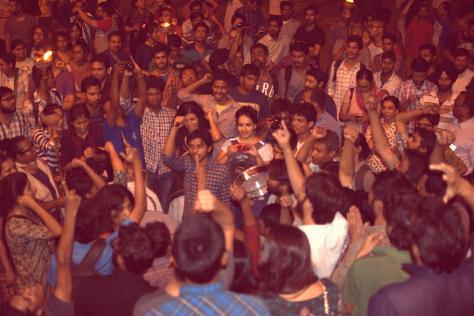
This is a time, they must have thought, when students will be busy with preparations, and the rising heat will discourage the kind of mass mobilizations that the campus has seen since February. Students in JNU resolved a few hours ago to prove them wrong, and decided to fight back . A massive gathering stood its ground at the Administrative Block, aptly re-christened, ‘Freedom Square’.

Rama Naga, Gen.Sec. JNUSU, (Centre) and JNU Students Calling for Indefinite Hunger Strike on April 27, 2016. Photo, Courtesy, Azhar Amim

They have decided that a batch of students will sit on indefinite hunger strike – a ‘fast unto death’ – until the JNU authorities roll back the draconian measures listed in the HLEC Report.

The 20 students who will be sitting in indefinite hunger strike at JNU.

There’s no looking back now. Whatever happens from now on wards, will be seen as a consequence of the cruel, evil mindset of the current regime, which truly treats the lives of the young as dispensable ballast. Its time to prove them wrong. This is a call that goes out to all students and teachers, and sensible individuals, not just in JNU, not just in Universities and Colleges all across India and all the territories administered by the Indian republic, but to everyone reading this post anywhere in the world, to stand by the courageous students of JNU. It is our responsibility to see that the JNU Authorities see reason and back down. If anything untoward happens to any student, the university authorities, and the regime backing them, will be clearly culpable.

Here is Umar Khalid, speaking just before commencing his Hunger Strike

Here is Chintu, former Gen. Sec. JNUSU, speaking at the Mashaal Juloos, (Torchlight Procession) just before beginning the Hunger Strike.

Listen to Kanhaiya Kumar, President of the JNUSU – restating the reasons for the continuation of the movement.

Thanks to the ‘We are JNU Media Group’ and the AISA Youtube Channel, for the videos.

Rise Up against the Proxy War on Students by the Modi Regime: Shehla Rashid

Guest Post by Shehla Rashid, (Vice President, Jawaharlal Nehru University Students’ Union)

Rise up against the proxy war on students by the Modi regime.

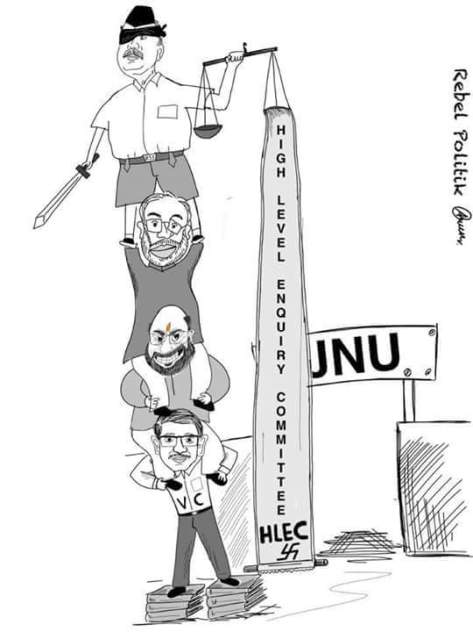
Cartoon by V. Arun Kumar

JNUSU rejects the report of the enquiry committee constituted by the Vice-Chancellor to look into the 9th of February incident. JNUSU also rejects its reports and any punishment handed out by it. The JNUSU and JNUTA had repeatedly asked the administration to democratise the enquiry committee, but this was not done.  Now, when the holidays are here, the VC has made public the punishments, after one and a half months of submission of the HLEC (High Level Enquiry Committee) report. Continue reading Rise Up against the Proxy War on Students by the Modi Regime: Shehla Rashid

JNU High Level Committee Delivers a Low Blow – Students Unjustly Rusticated, Fined, Declared ‘Out of Bounds’

So, the High Level Enquiry Committee at JNU, set up under the watch of Jagadish Kumar, the recently appointed Vice Chancellor, has just delivered a low blow. A summary of its decisions (taken from the Facebook Wall of JNUSU Vice President, Shehla Rashid) meted out as the consequences of the events of February 9 and after is as follows :

Umar Khalid, rusticated for one semester + 20K fine.

Anirban, rusticated till 15 July & from 25 July, out of bounds for 5 years.

Another Kashmiri student rusticated for two semesters.

Ashutosh, former JNUSU President, removed from hostel for one year + fine.

Chintu, former JNUSU Gen Sec: 20K fine

Rama, current JNUSU Gen Sec: 20K fine

Anant, former JNUSU Vice-President: 20K fine

Aishwarya, current GSCASH representative: 20K fine.

Gargi, current JNUSU councillor: 20 K fine

Shveta Raj, current SL & CS Convener: 20 K fine

Kanhaiyya, current JNUSU President: 10K fine

Other organisers fined from 10K to 20K

Two ex students declared out of bounds from campus.

This is an administration, which, in obedience to its backers in the Ministry of Human Resource Development and the Government of India, that knows only one way of dealing with the students in its charge – and that is a replica of the vindictive path that eventually drove Rohith Vemula to his institutionally mandated death in Hyderabad University.

This is an administration that invited police to intervene in what was essentially a dispute between groups of students, at the instigation of right wing thugs. Continue reading JNU High Level Committee Delivers a Low Blow – Students Unjustly Rusticated, Fined, Declared ‘Out of Bounds’

Media figures call for Release of Himal Editor Kanak Mani Dixit

New Delhi, April 23 — Editors and media figures as well as intellectuals and scholars from India, Nepal, Bangladesh, UK, US, Australia and Sri Lanka have called for the release of Himal editor and prominent Nepali journalist Kanak Mani Dixit who was arrested yesterday in Katmandu by anti-graft officials.

The following is the text of the statement:

It is with deep concern that we have learned of the arrest today of Kanak Mani Dixit, the widely respected founder-editor of Himal Media and a courageous voice for transparency, freedom of expression and democratic rights in Nepal and across South Asia. The charges are related to alleged corruption but Kanak Dixit says it is part of a vendetta pursued against him by people in Government.

We have known Kanak Dixit as a true professional, human rights defender and energetic journalist whose credentials are built on robust research and tremendous courage. Himal Media, a pioneer in South Asia journalism, has published Himal South Asia, Nepali Times and Himal Khabar Patrika (in the Nepali language). He has written extensively for international media including leading newspapers in India and is chairman of Sajha Yatayat, a state run transportation company, which he has been turning around from a loss-making entity. Continue reading Media figures call for Release of Himal Editor Kanak Mani Dixit

Folk Singer Kovan Lampoons Jayalalitha’s Promise

Kovan, the Dalit-activist poet and singer and member of a revolutionary organisation PALA (People’s Arts And Literary Association), from Trichy district in Tamil Nadu, has been in the news lately. One of his anti-Jayalalitha songs earned him the ire of the state government, which slapped a Sedition case against him in December 2015.

In this video sent to us by Vinavu Thalam, Kovan lampoons Jayalalitha’s promise of “step by step prohibition” as “peg by peg de-addiction”!

Seduce the gullible voters with false promise/ File sedition cases against those who fight/ This is her game/ The game of a cheat/

In Chennai slang, “Bongu” means, a Cheat! She is the AMMA of all cheats!

Responding to the Challenges of Blue and Red – Reminiscences of a JNU-HCU Alumna: Shipra Nigam

This is a guest post by SHIPRA NIGAM

That the past few months have been cataclysmic is an understatement. Personal tragedies and political catastrophes have exploded within our most cherished spaces, and brought a churning in them.  What was truly transformative was the experience of both the emergence of broad solidarities against right-wing fascism, and of the reminders of multiple registers and contexts within them. These underline the need for multiple conversations to understand both our common struggles, as well as the contradictions within, and to renew a resolve for introspection through them as we move towards real ‘azaadi’.

There is of course an ongoing debate on this, and here I felt that some binaries being invoked in it are not very convincing, while others brought home stark truths that pose challenges to a patriarchal, majoritarian caste hindu ordering of society, within which we are all located at different levels of hierarchy, complicity, and engagement.

I have been part of both public universities under fire right now, and the present brings home the urgency of the dual task of defending the public university as a space for pushing the boundaries of critical thought, and confronting the very hierarchies and complicities with power that shape it. This is necessary even as processes of democratisation and affirmative action take root in public institutions . So these are some reminiscences from an alumna of both these public universities who has been wrestling with articulations and complexities which lie beyond institutional labels or binaries. Continue reading Responding to the Challenges of Blue and Red – Reminiscences of a JNU-HCU Alumna: Shipra Nigam

Kashmir IG Police Refuses to Speak with Handwara Minor Girl: JKCCS

Guest Post by Jammu & Kashmir Coalition  of Civil Society

Since last 3 days, JKCCS has been approaching the Inspector General (IG) of JK Police, Javed Geelani for a meeting in connection with the illegal detention of the minor girl and her family. Yesterday evening the Handwara minor girl spoke to JKCCS team on phone. She and her family informed that against their will the police has shifted them to a stranger’s house 15 kms from Handwara town. After detailed discussion JKCCS proposed her to call the IGP Kashmir and Chairperson of the State Commission for Women, Nayeema Mehjoor directly to inform them about her ordeal in the illegal police detention, her demand for free movement and an immediate access to her lawyers. 
The minor girl called the IG several times but only once he picked up the phone. After she identified herself, the IG cancelled the call. JKCCS team called DIG Ghulam Hassan Bhat and requested him to inform the IG that the minor girl wants to talk to him urgently. We were assured that the IG will speak to the girl. 

Immediately after that the police personnel went inside the house where the girl is detained and threatened her to not call the IG Kashmir, Javed Geelani.

The minor girl was able to speak to Nayeema Mehjoor and gave her detailed statement and requested her to facilitate her conversation with IGP Javed Geelani. Ms. Mehjoor promised to help.

The minor girl and her family wanted to communicate to the highest police officials that the police should stop her illegal detention and allow her to meet her lawyers so that she can herself alongwith her family proactively contribute in the legal struggle.