Shyama Prasad Mukherjee’s Role: Official Myths on J&K Busted

Dear Prime Minister, nothing about Jammu & Kashmir is as your party sees it
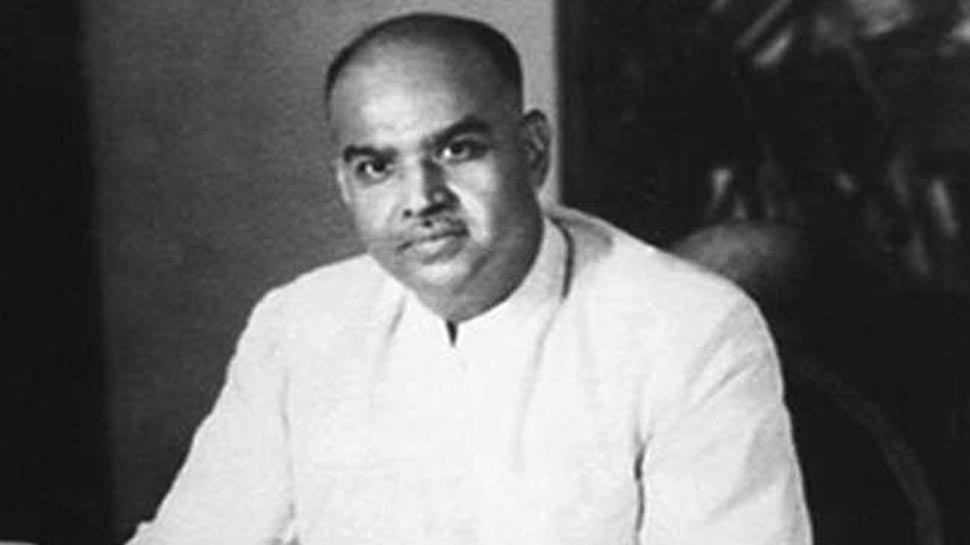
Syama Prasad

Economist and activist Jean Dreze, who has co-authored books with Nobel laureates, such as Amartya Sen and Angus Deaton, was in the headlines for a placard he carried to a protest rally in Delhi earlier this week. His placard challenged the government’s most critical justification for its controversial move to scrap Article 35A and read down Article 370 in Jammu and Kashmir (J&K). The placard displayed statistics that compare J&K with Gujarat, which is Prime Minister Narendra Modi and Home Minister Amit Shah’s home state. Dreze clearly showed how Gujarat lags behind J&K on a raft of development indices.

Although Dreze’s data beautifully punctures the government’s claim that J&K’s special status was a hindrance to its progress, Modi in his address to the nation on Wednesday night repeated the same argument, based on dubious claims. For instance, his claim that J&K lags behind other Indian states in matters of health services, education and so on, is patently incorrect.

Figures recorded in the National Family Health Survey (NFHS) has extended the debate further and shown that J&K already excels many other Indian states on several human development counts. Once again, this underlines that all talk about how “development” will reach J&K after Article 370 is made redundant is sheer humbug.

The propagation of false information brings home the fact that the government has gone very far to generate legitimacy for its decisions in J&K. In his address to the nation, Modi also said that his government had “fulfilled the dreams of [BR] Ambedkar as well as [the then Home Minister Vallabhbahi] Patel”.

( Read the full article here : https://www.newsclick.in/index.php/shyama-prasad-mukherjees-role-official-myths-jk-busted)
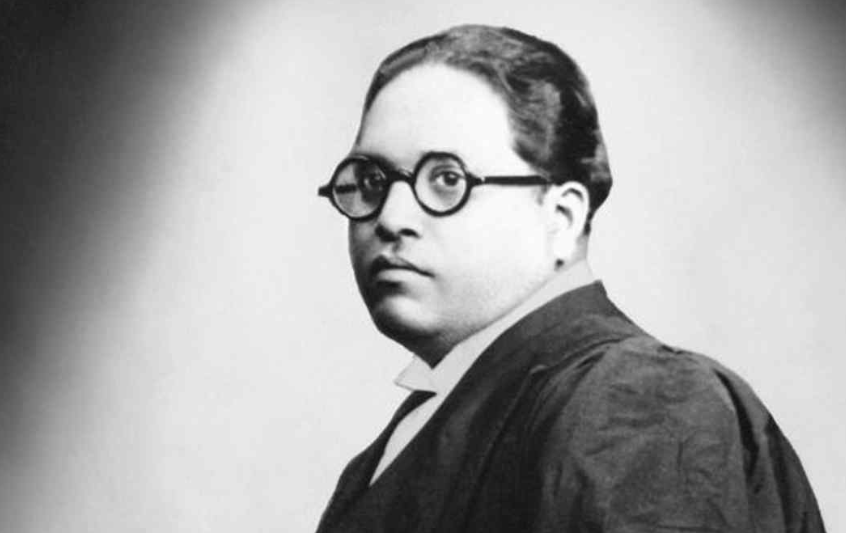
Towards a ‘Suitable’ Ambedkar

Is tweaking of Babasaheb’s iconic slogan — Educate, Organise, Agitate — by the Gujarat government part of a pan-India phenomenon in the saffron camp?

Towards a ‘Suitable’ Ambedkar

Does anyone still remember the ‘re-editing’ of Collected Works of Mahatma Gandhi during National Democratic Alliance (NDA)-I period when demands were raised that it should to be scrapped and the original collected works should to be reinstated so that readers/scholars are made available the ‘most authentic version of writings and utterances of Gandhi’. Noted Gandhians had underlined then how the revised Collected Works and adjoining CDs (compact discs) issued during 2001 had ‘five hundred entries missing’ from the original one.

Thanks to the exit of the Bharatiya Janata Party-led NDA government in 2004, the original Collected Works could be restored and even published online so that henceforth no government — deliberately or inadvertently — is able to make any changes in the works.

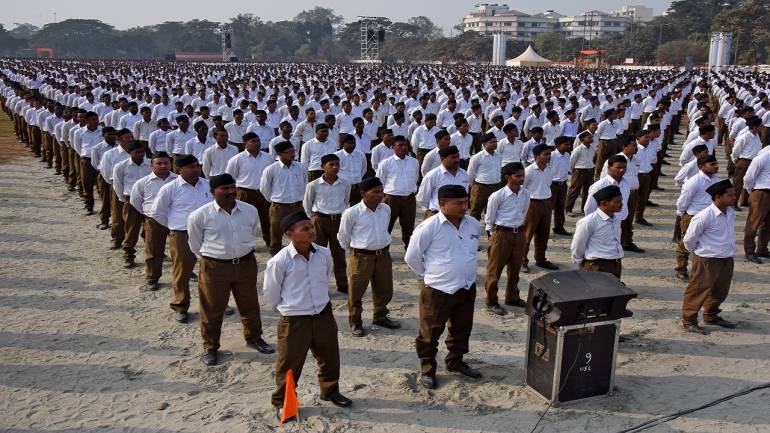
Well, while the project to ‘re-edit’ Gandhi was undertaken in a big way, which could be exposed in time, what one observes that surreptitiously or not so surreptitiously, the project to edit other icons of the anti-colonial or social emancipation movement is on in very many ways. It has been quite a long time since both Gandhi as well as Ambedkar — who were once anathema to the Hindutva project — have been included as ‘Pratahsmaraniya‘ (worth remembering in the morning) in the RSS shakhas. The emphasis seems to be on to present a more sanitised image of them which is more acceptable to the ruling dispensation.

A recent example of this has come from Gujarat.

(Read the full article here : https://www.newsclick.in/index.php/Towards-Suitable-Ambedkar)

रवीश कुमार: हिंदुस्तान का दुखता हुआ दिल

यह बिरले होता है कि ख़बरनवीस ख़ुद ख़बर बन जाए।पिछले तीन रोज़ से एक ख़बरची ही ख़बर है: रवीश कुमार।

याद आती है कोई 18 साल पहले रवीश से एक मुलाक़ात। “ दिक्कत यह हुई है टेलिविज़न की दुनिया में कि जिसे ख़बर दिखाने का काम है, वह सोच बैठा है कि लोग समाचार नहीं, उसे देखने टी वी खोलते हैं।” रवीश ने कहा। उस वक़्त वे रिपोर्टिंग का काम कर रहे थे। हमने महात्मा गांधी अंतरराष्ट्रीय विश्वविद्यालय में अपने संघर्ष को लेकर उनसे रिपोर्टिंग का अनुरोध किया था। रिपोर्ट बनी।लेकिन रवीश ने कहा, “ माफ़ कीजिए, कमज़ोर रिपोर्ट है!” कोई रिपोर्टर यह कहे,तब भी यह सोचना भी मुश्किल था,आज तो है ही।

Continue reading रवीश कुमार: हिंदुस्तान का दुखता हुआ दिल

83 Delhi University English Teachers’ Statement against Politically Motivated Attacks on Syllabus

The following is the full text of the statement issued by 83 English teachers of Delhi University against the attack on the syllabus:

We, the teachers of English across Delhi University are shocked and appalled at the unacademic, politically motivated attack on our syllabus. This is a democratically drafted syllabus, which involved faculty participation from around 40 colleges; over 2 years, and more than 3000 working hours have been spent on it. It is a matter of sorrow and deep academic concern that the syllabus is now being maligned, and is sought to be scuttled, by certain political groups at the University.

Continue reading 83 Delhi University English Teachers’ Statement against Politically Motivated Attacks on Syllabus

More lies from the Election Commission – good job, The Quint!

Previous posts on the stealing of the 2019 Lok Sabha Elections on Kafila, which have links to many other substantiated stories in other journals and news portals:

The “massive mandate” of 2019 and the role of the Election Commission  – Nivedita Menon

Update On “Tally Mismatch” In 2019 Lok Sabha Elections: Ravi Nair

Lok Sabha Elections 2019 – Calling The Election Commission To Account: Statement By Retired Civil Servants, Veterans, Academics And Concerned Citizens

EC Misleads Public With Bogus RTI Reply On VVPAT Count: Poonam Agarwal

RTI Reveals Pvt Consultants Have EVM Access, Why is EC Denying It? POONAM AGARWAL in The Quint.

The Election Commission of India has always maintained that no private company or outsourcing in any form is involved in the election process. But The Quint’s investigation has found this to not be true.

An RTI in The Quint’s possession shows that the Electronics Corporation of India Limited (ECIL), a PSU that manufactures EVMs and VVPAT machines, engaged private engineers as “consultants” and that these private engineers have worked with the Election Commission in Assembly Elections since 2017 and even in the 2019 Lok Sabha election.

Their job was extremely sensitive – to check and maintain EVMs and VVPATs, starting from First level Checking (FLC) right up till and including the Counting Day, which means they had easy access to EVMs through the course of the elections.

Read the full article here.

Militarising Minds, Hindutvaising the Nation

A military school under RSS is worrisome because of earlier experiences, such as the Malegaon and Nanded blasts, that were concretised with the intervention and involvement of Hindutva activists.

RSS military school

Representational image. | Image Courtesy: Money Control

Rare are the occasions when the Rashtriya Swayamsewak Sangh (RSS) — which could be said to be the biggest organisation of Hindu men — moves beyond its founder member Dr Hedgewar to build memorials.

Whatever might be the consideration behind it, but it came as a little surprise that the RSS has decided to start a school in the memory of its first non-brahmin and non-Maharashtrian supremo Rajendra Singh alias Rajju Bhaiya (1922-2003), who was its chief from 1994-2000. This proposed ‘Rajju Bhaiya Sainik Vidya Mandir’, will be set up in Shikarpur tehsil of Bulandshahr district, where the former supremo was born and it will start functioning from next year.

Vidya Bharati, the education wing of the RSS, which already runs 20,000 schools across India, would be running this military school as well. It is being said that this Army School will follow the Central Board of Secondary Education (CBSE) curriculum and will have classes running from Class 6 to Class 12.

Normally, an idea to start a school is met with jubilation, but this news has caused an opposite effect. From educationists, to social activists to political leaders, one can hear voices of concern.

( Read the full article here : https://www.newsclick.in/RSS-Military-School-Uttar-Pradesh-Hindutva)

DIsmantling of JNu

20 September is close. Birthday of Chandrashekhar. The young left leader who was murdered in Siwan in 1997. Before he went there he was in the Jawaharlal Nehru University. Known to generations of the university as the President of its students’union. We organise an annual  memorial lecture in his name at Patna . This year we had decided to invite a Professor from his university to deliver the lecture. She said a cautious yes as she was not sure if she would be given leave for it. For the last three years the teachers of the JNU have seen their leave application rejected, not only for popular lectures like the one above but also for seminars organised by their professional bodies or peers. But we insisted that she should try. So, we wrote a formal invitation letter to her, without mentioning the significance of the lecture. I apologised to Chandrashekhar for my cowardice. He would have smiled and called it an act of Brechtian cunning, defeating the vicious enemy non-violently.

Continue reading DIsmantling of JNu

About Menstrual Rights: Astha Savyasachi

Guest post by Astha Savyasachi

Humankind, right in the beginning, came face to face with menstruation. So, by now we as a society should have learnt to deal with it. But as we all know that it remains a problem for most of us. When we say this we don’t deny that we have successfully made it less of discomfort for a section of the people. 

It should not lead us to forget we are still far behind as a society to realize that the female body deserves and requires medical assistance to sustain the bodily changes [mostly hormonal] and mineral losses during the entire menstrual cycle. The politicians thumping their chests and taking oaths to protect Bharat Mata are yet to realize that the existing and breathing women also are entitled to human rights and need to be paid a lot more attention than the mere national personification of India [that too notinclusive of everyone in the geographical boundaries of India] in the image of a woman that is Bharat Mata . The irony is that the goddesses enjoy privileges and the existent women are devoid of even basic rights.

Continue reading About Menstrual Rights: Astha Savyasachi

From revered icon to unruly subject – Irom Sharmila and the politics of gender: Panchali Ray

Guest Post by PANCHALI RAY

In the month of August, 2016, Irom Sharmila Chanu, also known as the ‘Iron Lady’ and ‘Mengoubi’ (the fair one) announced that she would break her 16 year long hunger fast, which she commenced  as a protest against the imposition of AFSPA (Armed Forces (Special Powers) Act) by the Indian state on the tiny hilly state of Manipur. While some cheered, others were curious, and many shocked and angry at what they perceived as her betrayal of the Manipuri cause. The backlash from her community was quick and ferocious, and newspaper headlines carried titillating stories of how she was rejected by her ‘own’.[1]

While much has been written on Sharmila’s hunger strike, her breaking of the fast, and entry into electoral politics, there has not been an equal amount of discussion on the politics of gender. For instance, the fact that Sharmila’s location in the North-Eastern part of the country has been central to her marginalization and non-acknowledgement[2], or that the mainstream media’s highlighting of her predicament, post-hunger strike, reinforced stereotypes of Manipur as the ‘wild’ and ‘savage’ North East[3] has received considerable attention.

Continue reading From revered icon to unruly subject – Irom Sharmila and the politics of gender: Panchali Ray

Return of Hindutva: A Challenge for Secularism

Guest Post by Gargi Chakravartty

BOOK REVIEW

Hindutva’s Second Coming by Subhash Gatade; published by Media House, Delhi; 2019; pages: 272; Rs 395 (US $ 18).

The return of Modi to power with a huge margin in this 2019 election is a clear verdict for the Hindutva plank. Why and how it happened leave us, the secular billions, to ponder about the reality and its aftermath. And at that juncture Subhas Gatade’s 272-page analysis titled ‘Hindutva’s Second Coming’ gives us something concrete to think over once again. This in-depth study with rich academic perception is a commendable work, bereft of jargons and convoluted expressions, often found in books written from a high pedestal which goes beyond the mental reach of lay readers. Precisely for this reason the author needs to be specially acclaimed for bringing out facts at one place based on notes and references which are so far scattered in divergent historical materials. It serves as a Reader for millions who are combating communalism and distortion of history at the grassroot level.

( Read the full text here : http://www.mainstreamweekly.net/article8847.html)

Immigrant Detention Centres in India – need for transparency: Paresh Hate

Guest post by PARESH HATE

From what knowledge we have so far, it seems clear that the issue of citizenship and migration in South Asia is not any less complicated or politically charged than in Global North. Assam Accord and National Registry of Citizenship were already polarizing individuals across the political spectrum.  The demonisation of Bangladeshi immigrants continues throughout the country. But the entering of BJP in Assam politics has complicated the matter even further. Beyond the stories of deportation and violence at the border between India and Bangladesh, now we are also witnessing a rise of detention centres all over India which has put the lives of many migrants effectively into a state of limbo where they are designated for deportation but do not know when they will meet this fate.

Continue reading Immigrant Detention Centres in India – need for transparency: Paresh Hate

EC Misleads Public With Bogus RTI Reply on VVPAT Count: Poonam Agarwal

Evidence mounts of something extremely rotten in the state of India and the recent Lok Sabha elections.

We have raised this question on Kafila for a while now, see The Massive Mandate and Open Letter to Election Commission of India by civil servants, the serious charges in which have been met with total silence.

Now POONAM AGARWAL writes in The Quint, which has been investigating the issue for some time.

The current state of India’s Election Commission (EC) raises doubts about its transparency and fairness, especially when we find that it is misleading the public in its RTI replies.

The EC was constituted in 1950 to conduct free and fair elections, and was established as an autonomous body solely so that it can work independently. Is that what it’s doing?

The Quint filed an RTI seeking information and documents on the VVPAT count data during the Lok Sabha elections 2019. In reply, the EC refused to share the documents on the grounds that the VVPAT data is not available with the Commission (which means, at the EC headquarters in Delhi).

Here’s How the EC Is Misleading Citizens.

Read the full article at The Quint.


मोदीनामा : हिंदुत्व का उन्माद


मई 2019 में नरेंद्र मोदी के नेतृत्व में हिंदुत्ववादी दक्षिणपंथी भारतीय जनता पार्टी ने शानदार चुनावी जीत हासिल की।
यह जीत सामान्य समझ को धता बताती है – जीवन और आजीविका जैसी आधारभूत बातें इस चुनाव का मुद्दा क्यों नहीं बन पाईं? ऐसा क्यों है कि सामान्य और सभ्य लोगों के लिए भी

हिंदुत्व के ठेकेदारों की गुंडागर्दी बेमानी हो गई? क्यों एक आक्रामक और मर्दवादी कट्टरवाद हमारे समाज के लिए सामान्य सी बात हो गई है? ऐसा क्यों है कि बेहद जरूरी मुद्दे आज गैरजरूरी हो गए हैं?

ये सवाल चुनावी समीकरणों और जोड़-तोड़ से कहीं आगे और गहरे हैं। असल में मोदी और भाजपा ने सिर्फ चुनावी नक्शों को ही नहीं बदला है बल्कि सामाजिकं मानदंडों के तोड़-फोड़ की भी शुरूआत कर दी है।

यह किताब प्रधानमंत्री के तौर पर मोदी के पिछले पांच वर्षों की यात्रा को देखते हुए आने वाले पांच वर्षों के लिए एक चेतावनी है।

978-81-940778-5-5

LeftWord Books, New Delhi, 2019

Language: Hindi, 131 pages, 5.5″ x 8.5″

Price INR 195.00 Book Club Price INR 137

(https://mayday.leftword.com/catalog/product/view/id/21471)

SUBHASH GATADE
Subhash Gatade is a left activist and author. He is the author of Charvak ke Vaaris (Hindi, 2018), Ambedkar ani Rashtriya Swayamsevak Sangh (Marathi, 2016), Godse’s Children: Hindutva Terror in India (2011) and The Saffron Condition (2011). His writings for children include Pahad Se Uncha Aadmi (2010).

The Politics of Piety in Naya Pakistan: Afiya Zia

Guest Post by AFIYA ZIA

A year ago, Pakistan’s national elections brought in a new government led by the Pakistan Tehreeq e Insaf (PTI) and headed by the former-cricketer-turned politician, Imran Khan. Khan had been drifting in the political wilderness for 22 years, waiting for providence to appoint him Prime Minister. As the 2018 elections loomed, this was not looking possible. However, a series of legal cases of corruption started being levelled against the serving PM, Nawaz Sharif, and efforts were made to atrophy others from the major parties of the PML-N and PPP (who had signed the ‘charter of democracy’ to prevent military intervention in civilian governance). The methods of these moves made it clear that the ‘establishment’ was betting on a new horse. Khan was not taking any risks though.

Six months before the national election, he entered marriage for the third time (with no less controversy than his previous marriages) to Bushra Maneka who was also his spiritual guide or pirni. A mother and a grandmother, there was speculation that Bushra divorced her husband for the higher cause of marrying the PM-in-waiting. In the days prior to the summer election, Khan performed Umrah in Mecca with Bushra, and was seen prostrating at a shrine in Pakistan and accessorised with rosaries and amulets in preparation for the polls.

Continue reading The Politics of Piety in Naya Pakistan: Afiya Zia

Against Aachaaram: Srinarayana Guru

The excerpt below is translated by DARSHAN SUBRAMANIAM. The note that follows is by J Devika.

Continue reading Against Aachaaram: Srinarayana Guru

Against Aachaaram: A Dossier from Malayalam – Announcement

This is to announce a new series of postings I will be doing, relating to aachaaram in Kerala.

Aachaaram is loosely translated as ‘customary practices’ or ‘customary rituals’, but in 19th century Malayali society, it referred to a massive, inter-connected, all-pervading web of practices, rituals, and ideas which bolstered the domination of the upper-castes — in Kerala’s context, this meant the Brahmin-sudra nexus — over the lower castes. It touched the most intimate and personal aspects of a person’s life; through it,  the allegiances and the labour of lower caste communities were extracted to benefit the upper castes. The lower-caste assertions of the late 19th and early 20th centuries here, through which modern democracy became a possibility at all, were directed against this web. Aachaaram, however, survived this phase through shrinking its spatial presence to savarna homes and temples; later, after the re-consolidation of brahmin-sudra power, towards the end of the 20th century, the rise of spiritual capitalism had led to aacharam’s resurrection as the vehicle of gendered savarna power — and as the provider of opening gambits for the Hindu fundamentalists — in Kerala .

In this series, I will post translations of selections/excerpts from the writings of the critics of aachaaram from early 20th century Kerala, with short reflections on each for the present. The many different readings of Hinduism that arose in that period when the Brahmin-sudra nexus was thrown into confusion, as well as the many different dreams of social liberation from different parts of the world that entered Malayali society then — from C Krishnan’s Buddhism to Marxism — produced powerful critical exposures that revealed aachaaram to be nothing but a vehicle and instrument of the power of certain groups over others. The effort made by these voices to point to the danger that it posed to a dream of a just society was largely ignored by the mainstream, especially the mainstream left.

The first of these is an excerpt from a conversation between the well-known social revolutionary, the avarna-born seer, spiritual leader, and philosopher, Srinarayana Guru and his disciples in which the annual pilgrimage to Sivagiri was planned, which I will post separately.


Will India Remember Dadri’s Akhlaq, as Germany Recalls Victims of Nazi Barbarism?

The German acceptance for stolpersteine plaques helps them honour victims of Nazism. One wonders if it will ever be possible to take up similar projects in this part of South Asia.

Germany Recalls Victims of Nazi Barbarism

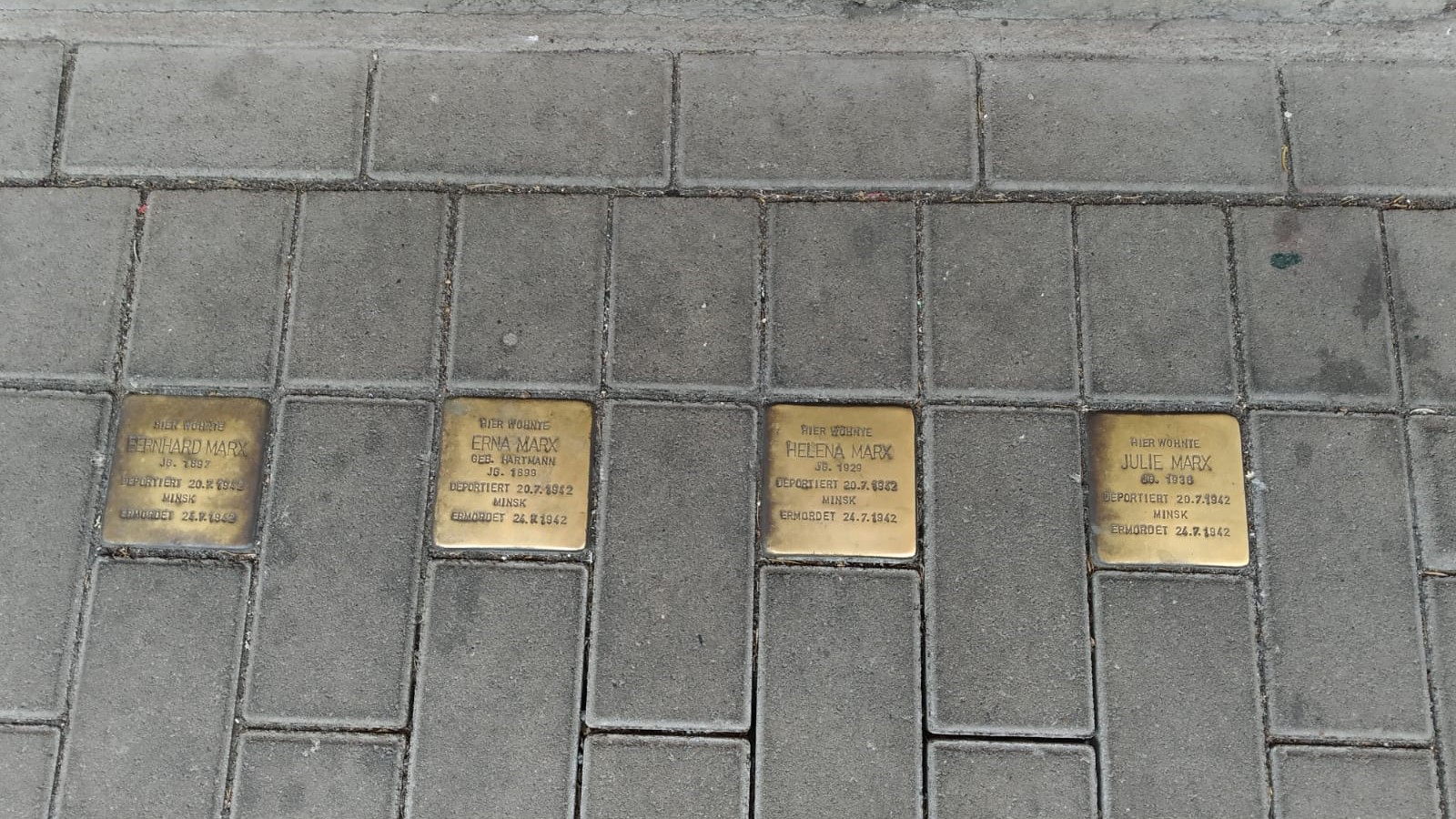
Hier Wohnte Bernhard Marx

JB 1897

Deportiert 20.07.1942

Minsk

Ermordet 24.07.1942

‘Here lived Bernhard Marx

Year of Birth 1897

Deported 20.07.1942

Minsk

Assassinated 24.07.1942’

It was while walking past a desolate street in Bonn that we stumbled upon some brass plates on which the names of the members of a family were engraved. The name Bernhard, supposedly the head of this family, was engraved on the first plate, followed by three to his right: Erna Marx Geb Hartman, (born 1899), Helena (1929) and Julie (1938).

This was an ill-fated Jewish family from Bonn, deported to the dreaded Minsk concentration—rather extermination—camp that was brutally murdered just four days after they got there. The youngest, Julie was barely four when she died.

Estimates of how many died in this camp over a period of two years vary but at least 65000, mainly Jews, perished there until it was liberated by the Soviet forces.

The young researcher who was our host and guide to the city said that the brass plaques, raised on stone, are called stolpersteine. Stolper means to stumble in German and steine means stone. The idea behind erecting stolpersteine is to raise awareness about events that took place in the late thirties and early forties in this region, when millions of innocent people—Jews, Romas, Jehovah’s Witnesses, homosexuals and political dissidents—were sent to the gas chambers or brutally killed by the Nazi regime.

( Read the full article here : https://www.newsclick.in/India-Remember-Dadri-Akhlaq-Germany-Victims-Nazi-Barbarism)

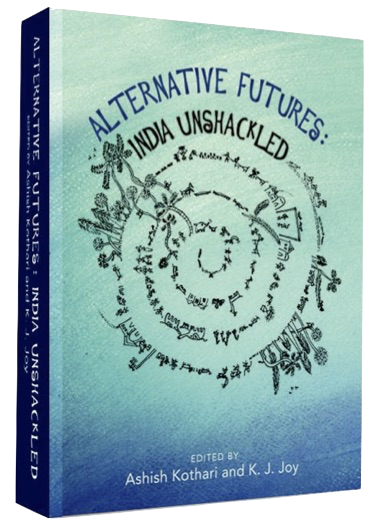
Alternative Futures – India Unshackled

Alternative Futures
Alternative Futures – India Unshackled

After the Berlin wall fell in 1989 and the Soviet Union collapsed in 1991, many consigned ideologies and alternatives to the rubble of history. The end of the cold war was explained as the victory, not just of liberal ethos and individual freedom, but of dynamic, market-driven capitalism championed by likes of Ronald Reagan, Margaret Thatcher and Manmohan Singh. India’s left also embraced this belief in practice, promoting foreign and national capitals and capitalist-led industrialization. They hoped market miracles would generate employment and wealth. Women such as MedhaPatkar, a social activist and a fierce opponent of the globalized developmental model and Sudha Bhardwaj, a trade union activist in Chhattisgarh seemed as thoroughly on the wrong side of the history as it was possible to be. Continue reading Alternative Futures – India Unshackled

Marx in Brussels

The most remarkable development during his time in Brussels was the penning down of the Communist Manifesto, which firmly established Marx as well as Engels as the intellectual leaders of the working class movement.

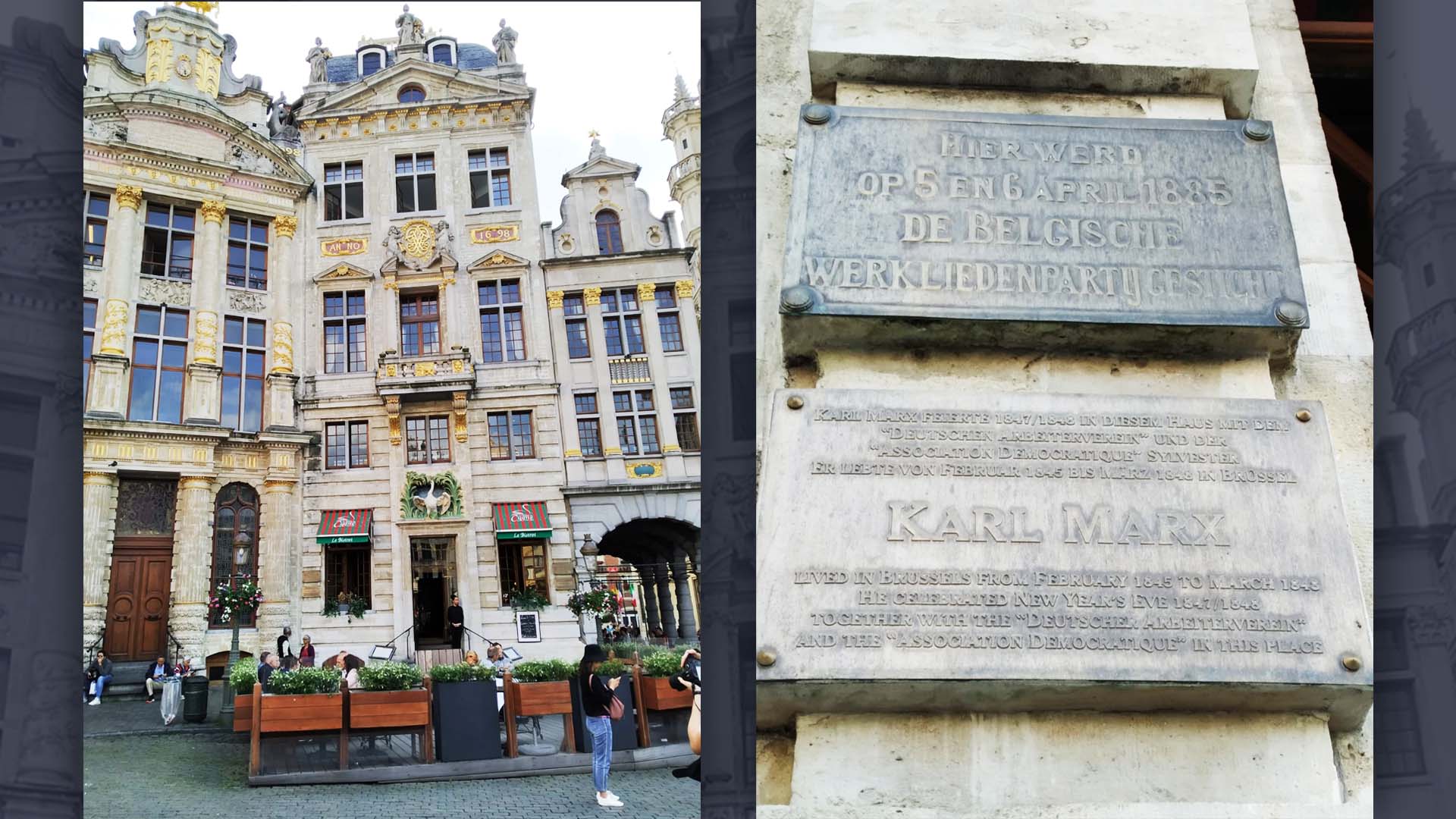
Marx in Brussels

Karl Marx

Lived in Brussels from February 1845 to March 1848

He celebrated New Year’s Eve 1947/48 together with the “Deutscher Arbeiterverein” and the “Association Democratique” in this place

The plaque put on a building which housed a restaurant ‘Le Cygne, The Swan’ now is the only memory left of the days when history was ‘made’ here. According to legend, it is the same place ‘[w]here the First International had convened’  and Marx and his lifelong friend and comrade Engels ‘[h]ad written the Communist Manifesto’.

No doubt it was the same place when Marx, Engels, Mozes Hess – who was another early luminary of socialism and who supposedly had influenced Engels about communism – and other associates of the surging workers movement pondered over many of those ideas which have been memorialised in the opening sentences of the Manifesto, “A spectre is haunting Europe — the spectre of communism….”

May be the historic slogan ‘Workers of the World Unite, You have nothing to lose but your chains’ which later reverberated throughout the world – whose echoes are still heard – had its ‘humble’ beginning in one of those very rooms, where Marx and his close associates used to educate workers about their exploitation.

Scores of people sitting in this particular restaurant which was serving them sumptuous food and choicest drinks were completely oblivious of all those details. Few of them rather looked at us with a sense of disbelief and dismay, when they witnessed us taking photos of the nondescript wall which had the plaque put on it. Perhaps they looked more satisfied that they are enjoying food at a place which is situated on the Grand Place or Grote Markt, which is the central square of Brussels and is considered one of the most beautiful squares in Europe and is also part of UN Heritage.

( Read the full article here : https://www.newsclick.in/karl-marx-in-brussels)

Modinama : Issues That Did Not Matter

In May 2019, the party of the Hindu Right, Bharatiya Janata Party, under Narendra Modi, won a spectacular electoral victory.

The victory seemed to defy common sense – why did conversations of life and livelihood not dominate the election? Why did the thuggery of the Hindutva vigilantes seem inconsequential to vast numbers of ordinary, decent people? Why is an aggressive, masculine fundamentalism so normalized in our society today?

In other words, why didn’t the issues that matter, seem to matter? The question goes deeper than electoral arithmetic. It asks if Modi and the BJP have not only changed the electoral map, but also begun to corrode social norms.

This book, based on Modi’s first five years as prime minister, is a warning for the next five.

SUBHASH GATADE

Subhash Gatade is a left activist and author. He is the author of Charvak ke Vaaris (Hindi, 2018), Ambedkar ani Rashtriya Swayamsevak Sangh (Marathi, 2016), Godse’s Children: Hindutva Terror in India (2011) and The Saffron Condition (2011). His writings for children include Pahad Se Uncha Aadmi (2010).

978-81-934666-9-8

LeftWord Books, New Delhi, 2019

Language: English

128 pages, 5.5″ x 8.5″

Price INR 195.00 Book Club Price INR 137.00

(https://mayday.leftword.com/catalog/product/view/id/21450)


DISSENT, DEBATE, CREATE