Tag Archives: BJP

How to Draw a Line on the Ground : Ravi Sinha

Comments for the Washington DC Diaspora Program on “Karnataka Election Outcome and the Two Contesting Ideologies”

Guest Post by Dr Ravi Sinha

I must begin with a disclaimer. I am no expert on how elections are won or lost. Nor can I claim any competence in deciphering an electionresultfor what has worked and what has not. I will not be offering, therefore, any fresh insights into the results of recently concluded Assembly elections in Karnataka beyond what is already well-known from the media reports and analyses. I plan to focus primarily on the latter half of the title of the discussion today – the Two Contesting Ideologies.

The question of ideologies too is not easy to pose, let alone answer, especially when it comes to the muddy fields of politics on the ground. It is one thing to draw a clear ideological line on paper; it is quite another to do so on the actual ground of politics. In the normal course of politics – at least in a polity that has managed to settle into a normal course – ideological lines are seldom clearly drawn. Those whoinsist ondrawing a clear ideological line in all circumstances are invariably pushed to the margins of thenormal mode of politics.

There are times, however, when politics must undergo a paradigm shift. Ideological battle lines are,more or less,clearly drawn under such conditions, and sometimes, even if rarely, revolutionary transformations ensue from such shifts. The ideological lines may or may not be clearly visible during the actual political turbulence, but one can decipher them in hindsight after the polity and the society settle into a new normal.

One cannot say that India today sits on the brink of a political paradigm shift that promises a revolution. In fact, a shift of decidedly regressive kind has taken place with the rise of Hindutva. Nearly a decade after 2014, it is clear now, at least to those who would care to see, what a disaster India has brought upon itself. The damage done to the economy, to the social fabric, to theinstitutions of governance, and to the democratic process itself,is being felt in the bones of the country. India has been pushed back by decades in what has been at best a slow advance to a reasonably enlightened democratic republic with a moderately prosperous and not too uncaring economy. It will take many decades to recover what has been lost in just one decade. And yet, there is no guarantee that we will stop hurtling towards an even greater disaster in 2024.

Under these circumstances,one should not be considered naïve or conservative if one were to wish fora restorative kind of paradigm shift. One realises now that merelyturning the political clock back by a decade would bring a huge sigh of relief to the country. In times of disasters like this one, it is not a crime to hope for a kind of restoration, especially when revolutions are nowhere on the horizon. It is for this reason that the success of Rahul Gandhi’s Bharat Jodo Yatra followed by the resounding victory of Congress Party in the Karnataka Assembly elections have come as a big sigh of relief and a desperately needed ray of hope in the aware citizenry and, to a significant extent, even among the suffering masses and oppressed communities across the country.

One must, however, ask the question: has the Karnataka outcome resulted from clearly drawing an ideological line at the ground level? Disappointing as it may sound, the answer is largely in the negative. Actually, it should not be as disappointing as it sounds. As I said,drawing such a line in the muddy fields of electoral politics is not a simple or at times even a desirable thing to do. Insisting on this in all circumstances may in fact be counter-productive. One can however ask the converse question: do these results shed some useful light on how to draw an ideological dividing line on the ground? The answer to this question is clearly affirmative. I will be dwelling mostly on this apparently paradoxical situation.

First thing to be noted in the Karnataka outcome is that Congress, which confronted the BJP and the saffron brigade directly, did score a decisive victory, but it is far from the case that Hindutva has suffered a fatal blow. The BJP maintained its vote percentage of roughly 36 percent it had garnered in 2018. At this aggregate level of electoral analysis, the gains of Congress appear to have come at the cost of Janata Dal Secular (JDS),a regional party whose vote percentage has declined by the same 5 percentage points.Despite its name, this party has clearly moved closer to the BJP in the aftermath of the elections.

But one should not rush to conclusions just on the basis of aggregate numbers. Congress has not won only because of its gains in the Mysore region where JDS has been strong. It has won most of the seats in northern Karnataka adjacent both to the Telugu states and to Maharashtra. It has made gains in the rural areas all over the state. The point to note, however, is that not only has the BJP maintained its aggregate vote percentage, it has also made gains in many areas. It has gained ground wherever communal divide has been pronounced and Hindutva is entrenched. In the coastal region of Udupi-Mangalore it has stood its ground and even improved its vote percentage. Same is the case with the urban conglomerate of Bengaluru where it has won 15 out of 28 seats. Spectacular is the case of Srirangapatna where its vote share skyrocketed from 6.4 percent in 2018 to 22.8 percent in 2023. This is the place where an intense communal campaign has been around claims of yet another mosque being a temple. It will be foolhardy to think that Hindutva has lost its ground in Karnataka.

A tell-tale sign of the hold of Hindutva was in the episode of Bajrang Dal and Bajrang Bali. When none other than the Prime Minister himself equated the hooligans with the monkey god, and sought help from the muscle power of one and the blessings of the other, many across the country laughed at this mockery. And yet, it was not a laughing matter. Many leaders of Congress bent over backwards to put on display their religious credentials – even D K Shivakumar, a key architect of Karnataka victory, made well-publicized visits to temples and Congress campaigners began to count how many Hanuman temples Mallikarjun Kharge, the Congress President, had built in his native Hyderabad region of Karnataka. Those who knew the situation on ground, and those who knew a thing or two about how elections are won and lost in India, did not take this matter lightly.

In the electoral analyses splattered across the media, the victory of Congress has been attributed to multiple factors, but three among them stand out – the so-called anti-incumbency of an exceptionally corrupt government, the economic hardships of the poor who area vast majority of the population, and a relatively strong organizational presence of the Congress Party in Karnataka. Such analyses also factor-in the role ofvote bankssupposedly based on castes and communities – Lingayats, Vokkaligas, Kurubas, Dalits, Muslims and so on. But, managing such vote banks is a necessary detail of any electoral strategy – often expressed in the euphemistic phrase of social engineering. It does not define an ideological dividing line. If one tries hard to extract some such line from the enormous complexity of Indian politics, two large conglomerates of factors stand out – Hindutva, cultural nationalism, religious and other traditional identities form one such conglomerate and the issues of poverty, class, basic security of life and material well-being form the other.

Given the history of the 20th century, class has been the centre-piece of the canonical definition of ideological dividing line. Many who swear by this definition and reject the possibility of any other definition would underline the fact that the Karnataka election was won because the poor, especially in the rural hinterlands, supported Congress. While this underlines the fact that the class factor hasn’t gone away anywhere, it does not explaina far more effective presence of the other factors. As I have already mentioned, the victory of Congress does not mean that Hindutva has been defeated in Karnataka and it is not the case that the poor have voted for Congress because they detest Hindutva.

Fact of the matter is that there seem to exist two different axes along which ideological dividing lines can be drawn in today’s politics. The class axis has been the canonical one, but there seems to be another axis.For want of a well-thought-out nomenclature let us call it the cultural axis.It includes identities based on religion, caste, race, ethnicity, community, languages and even civilisations.This axis has become far more operational in the arena of democratic and electoral politics. Actually, part of the question can be posed even more sharply. Why is it that the ever-present class axis almost never gives rise to a politically operational class identity? (The same question can be posed in relation to the gender axis too, even if in a different way.) As many a leftist trade unionist would testify, the class that comes together on the factory floor seldom remembers the class identity and solidarity in the voting booth. Here I would not even try to get into the high theory of relationship between class and culture. For the purpose at hand, I will take a pragmatic tack and treat these two realms as relatively autonomous even if connected at some deep subterranean layer.

The rise of culture in politics is not confined to the so-called Third World. Samuel Huntington, the Harvard don famous for his Clash of Civilizations, can be easily chastised by other dons of the progressive kinds, especially after he showed his true colours by prodding the Americans to ask the question – Who Are We? – and encouraged them to be wary of the Latino immigrants who pose a threat, in his reckoning, to the American national identity. Chastising him is the easy part. But how does one explain the rise of Donald Trump in American politics which has happened more or less along the same lines Huntington theorised? Trumps do not arise just because the likes of Huntington construct their theories. The sources of Trumpism lie in the deeper layers of American society. Similarly, the political traction of Hindutva arises, at least in parts, from the deeper layers of the Indian social mind.

To add to the puzzle and to the tragedy, democracy itself, especially of the fiercely competitive kind, plays a role in bringing the worst out of the hidden layers of the social mind. Who in the world can claim to have a better alternative to democracy? And yet, there are examples galore of democracy landing itself in very strange places. The example of Hitler coming to power through democracy may sound hackneyed except that the phenomenon is far more ubiquitous in the world today. You in the United States had your Trump and I am told that Trumpism hasn’t gone away anywhere. We in India haveNarendra Modi; Turkey just re-elected Erdogan who has been in power since 2003, first as Prime Minister and subsequently as President; Bolsanaro of Brazil was barely defeated; Putin is too well-known an example to forget. One can go on and on and cite examples where democracy finds curious ways to commit suicide. But one thing would be common in all such examples.The cultural axis playsa crucially important political role.

In saying all this I am aware of the fact that the cultural axis does not become operationalon its ownin the political arena. Popular democracy with competitive elections is not exclusively a cultural phenomenon. After all, this whole exercise is for constituting a State and electing a government for running an economic and a political system. This system constitutes itself in the political arena and ostensibly operates in that arena, but competitive electoral processes force it to dig into the cultural unconscious of the social mind. In analogy with depth psychology, I often describe it as depth politics. The cultural unconscious of the Indian social mind, whose layers have been deposited over centuries and millennia, becomes operational in modern politics through competitive electoral democracy.

In the case of the United States,one often hears about the deep state that pulls the wires of democracy while itself remaining beyond the reach of constitutional and democratic powers and procedures. In India the deep state may not be as deep, but it is definitely there and the existence of a cultural unconscious comes very handy to it. In fact, the Indian deep state does not feel the necessity to remain invisible and confined to the depths. There are examples galore of unconstitutional, undemocratic and unscrupulous acts on the part of the political as well as economic forces and agents. All that is being done to the Indian economy, to the public resources, to the constitutional and democratic institutions, is not very hidden. But the point to note is that the state, whether deep or otherwise, finds it handy to manipulate the cultural unconscious and democracy itself becomes an accomplice in this exercise.

Michael Walzer, the Princeton political philosopher, has drawn attention to another curious phenomenon in which, I suspect, the cultural axis is deeply implicated. In his book, The Paradox of Liberation, he points out examples of national liberation movements that led to independence from foreign rule and to establishment of secular, liberal and enlightened democracies, but within a few decades the secular revolutionsmade way forreligious counter-revolutions. The irony is that the counter-revolutions were brought about through the same democratic process which had been instituted by the founding fathers for the purpose of erecting a secular, democratic and enlightened republic. India figures prominently in Walzer’s Paradox, although being a large and complex country the replacement of “revolution” by “counter-revolution” has taken its time. It took half a century after the departure of Jawaharlal Nehru for someone like Narendra Modi to come to power and replace the Nehruvian hegemony with the hegemony of Hindutva.

In saying all this my purpose is to underline the obvious that is often ignored by those who are accustomed to drawing the ideological dividing line only across the class axis. The dividing line on the actual ground of politics cuts across both the axes of class and of culture. In the rough and tumble of competitive electoral politics one is no wiser if one can prove that the latter is a derivative of the former. If class were to be the only operational axis, the Left would have conquered the world rather easily. On the other hand, if culture were to be the only operational axis,it would become impossible to ward off the ascendance of the right-wing. Fortunately, this is not the case on the ground. Even the Sangh Parivar cannot live by Hindutva alone. Even Narendra Modi has to see beyond the Hindu-Muslim divide and talk – at least talk – of Sabka Saath, SabkaVikaas.

It is in this light that the lessons of Karnataka should be read off. By and large the cultural axis was tilted against Congress while the class axis was tilted in its favour. The art of drawing an ideological line on the actual ground requires navigating the political topography along both these axes. Congress managed to do this in Karnataka this time. The BJP lost primarily because the class axis became steeply tilted against it. Hardships faced by the poor had been greatly exacerbated by corruption and misrule.

One should not, however, read too much into the relative importance of class in the Karnataka example. As I have mentioned already, Hindutva has not disappeared from Karnataka. Congress managed to hit the sweet spot because it could take advantage of the class dimension without hurting itself along the culture axis. This situation can be contrasted with a hypothetical situation if the Left were to be the principal opponent of BJP. An equally strong Left would not have fared as well as Congress mainly because it does not know how to navigate itself along the cultural axis which is tilted too steeply against it in most places on the subcontinent.

At the same time, one should not take the eyes off the absolute necessity of drawing a clear ideological line. In the situation that has arisen in India after nearly a decade of Modi Rule, this has become a must even for electoral battles. Given the importance of two axes and the uneven-ness of the political topography, such a line may not be straight, but it must be clear. One can see its importance in the example of the Janata Dal (Secular) debacle. It failed to take up a clear ideological position and planned for winning enough seats through its traditional influence and regular vote-bank politics to be in the position of a king-maker. This tactic has worked in the past but it backfired in the present situation. People were wary of its lack of ideological commitment.

Beyond uplifting the morale of forces opposed to Hindutva and in addition to appearing as a ray of hope in the distressing political atmosphere in India, Karnataka results also have reasonably clear lessons for the all-important battle of 2024. But there are no strong indications that these lessons are being learnt by the entire opposition. In theloud clamours for opposition unity, parties and leaders areadopting negotiating positions as if they are already on the table for seat-sharing. Everyone seems to be angling for the largest piece of the opposition cake. There are talks of putting up one candidate of united opposition against each BJP candidate. There is much advice to Congress to be large-hearted and make sacrifices for the sake of opposition unity.

The obvious necessity of drawing a clear ideological line is getting lost in this noise of opposition unity. There are only two political forces with a relatively unblemished record of fighting against Hindutva – the Congress and the Left. The record of every other force is tainted in varying degrees. Some have been confused or short-sighted while there are many who have been downright opportunists.

There are problems with the two resolute fighters too. Left, as mentioned already, has been especially inept at fighting along the axis of culture. This adds to its handicaps arising out of other ailments such as dogmatism, sectarianism or unthinking populism. Congress, on the other hand, is a much larger political force, but it also has had much bigger problems. Given its long and complicated history, and its more recent omissions and commissions in the political arena, it cannot entirely be absolved from accusations of paving the way for Hindutva. It has often functioned as a half-way-house between secularism and Hindutva and has had leaders and cadres who can cross over to the other side without batting an eye-lid. Congress has never been a shining example of a clear ideology or a cadre-based party. And yet, things have been changing for the better in recent months and years. There has been much internal churning and Congress has emerged as the central force around which all other anti-Hindutva forces could be mobilised for the battle at hand.

Emergence of Rahul Gandhi as an ideological leader and a resolute fighter has been a turning point in the recent history of Congress. Bharat Jodo Yatra has changed the political atmosphere in the country. And yet, Rahul’s Congress is not in a strong enough position to bring about an ideological unity among the disparate political forces of the opposition. The problem is further complicated by the fact that many of the regional parties stand to lose if Congress gains ground in their part of the country. Nearly everyone wants Congress to be strong elsewhere but weak or non-existent in their own areas.

People like us cannot really chart out the course for the opposition in India. We are neither at the drawing board nor at the negotiating table. All we can do is to have a reasonable wish-list.But we have to be receptive to complexity when it comes to larger strategies. One corner of India is so different from another. In Kerala, for example, where Congress and Left are faced with each other, it will be alright if they continue to be at each other’s neck provided they keep the doors shut for BJP. In West Bengal on the other hand, it is not unthinkable that Congress and Left together fight against Mamta Banerjee’s TMC but in such a way that they snatch the ground from BJP and become the main opposition to TMC. In that part of India, this may be the most effective way to fight BJP at the national level. There are other parts of the country where, for example, opposing BJP by putting up one united opposition candidate in each constituency will be tantamount to ensuring that BJP gets more than 50 percent of the votes. One could go on and on about the complexities of India’s political geography.

Ideological line must be drawn but we cannot expect it to be very straight. We should expect Congress to play the lead role in the battle at hand and yet we should not expect it to bind its hand and feet with ideological ropes in such a way that it becomes as ineffective in fighting the real battle against Hindutvaas, for example, Left has become.

In the end, we should also remember that fascists may come to power through elections but they are not very amenable to being dislodged from power through elections. January 6th in the United States had a happy outcome thanks to the relative robustness of American institutions. The Indian analogue of the January 6thwould more likely be a death knell for Indian democracy which is already under a great deal of stress.

On that depressing note, let me stop here.

June 10, 2023

( Ravi Sinha is an activist-scholar who has been associated with progressive movements for nearly four decades. He is one of the founders and a leading member of New Socialist Initiative.)
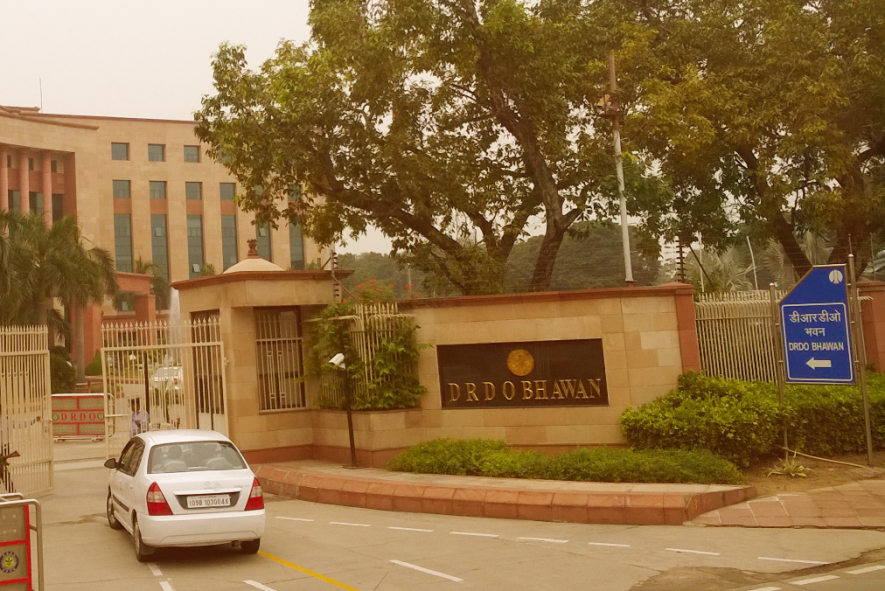
Hindutva Brigade Must Break Silence Over Espionage Allegation

The list of people associated with Hindutva outfits caught in damning revelations keeps growing.

Recent revelations involving alleged espionage involving Prof Pradeep Kurulkar at the Defence Research and Development Organisation should have shaken up the establishment. After all, Kurulkar is said to have handled crucial projects related to India’s defence and reportedly was the lead designer or team leader for projects on missile launchers and subsonic cruise missiles.

Reports say Kurulkar was in contact, over WhatsApp, with a Pakistani Inter-Services Intelligence (ISI) agent late last year. His suspicious activities were reported to the police by DRDO, and in January, his laptop and two mobile phones were seized. The Maharashtra Anti-Terrorism Squad (ATS) is now handling the case. Kurulkar’s foreign trips are also under the scanner.

Such discoveries have long-term implications for India’s national security. Initial reports from ANI, a news agency known for its proximity to the ruling regime, did not mention Kurulkar’s name. The news agency did not initially mention his name in its tweets, though pictures of his face were circulating on social media and news outlets. The sequence of events left many wondering if the tweets deliberately concealed his name to create a doubt over his identity.

No doubt, Indian investigators will examine if the neighbouring country’s sleuths have penetrated India’s defence research sector and the extent to which Kurulkar has compromised India’s secrets. But it’s worth noting this case has not been handed over to the National Investigation Agency. Formed in the immediate aftermath of the 2008 Mumbai terrorist attack and supposedly more equipped and experienced to handle cases with cross-border ramifications, this agency has been busy filing plenty of cases—so, why not this one? ( Read the full article here)

No Reason  to Bow Down to So-called Modi Storm, Time for Unity to Strike: Sankar Ray

Guest post by SANKAR RAY

We have been living through an unnatural and scary time in India. Those in power today are ideologically responsible for destroying the greatest achievement of India’s freedom struggle. The achievement is stable parliamentary democracy, one of the main conditions for whose existence and development is accommodation of dissent and transparency therein. The symptoms of this destruction are often horrendous.

The Bharatiya Janata Party (BJP) won 156 out of 182 seats in the recently held Gujarat Assembly elections. The pattern of state politics was completely reversed as BJP’s number of seats increased from 99 to 182 from 2017 to 2022 and Congress’s seats decreased from 77 to 17. But BJP’s strength in municipal and panchayat elections in Gujarat was decreasing.

Continue reading No Reason  to Bow Down to So-called Modi Storm, Time for Unity to Strike: Sankar Ray

How Did UP Decide : Identities, Interests and Politics – Prof Zoya Hasan

Prof Zoya Hasan, Professor Emerita, Jawaharlal Nehru University and Distinguished Faculty, Council for Social Development, New Delhi, will be delivering a Special lecture  in the Democracy Dialogues Series, organised by New Socialist Initiative, at 6 PM, (IST) Sunday, 24 th April, 2022.

She will be speaking on ‘‘How did UP Decide: Identities, Interests and Politics”

Join Zoom Meeting
https://us02web.zoom.us/j/81240964790?pwd=OEd1OU00ejA5d1ZxYWlMRzFaOGNkdz09

Meeting ID: 812 4096 4790
Passcode: 975399

Facebook Live on – http://fb.com/newsocialistinitiative.nsi

Abstract

How did UP Decide: Identities, Interests and Politics

Uttar Pradesh has just seen an intensely contested assembly election which resulted in a second straight victory for the Bharatiya Janata Party in this politically crucial state. This momentous outcome is the subject of intense debate among analysts and indeed the public at large. There was a premise this time, particularly in UP, that communal polarisation wasn’t working because of acute economic discontent which could trigger electoral change. However, the large-scale discontent over many economic issues, including jobs, did not translate into a decision to vote out the government. Many analysts have attributed BJP’s reelection to welfare measures and free rations to the poor during the lockdown. This cannot explain BJP’s persistent success which extends beyond this election. The welfarist argument ignores the compelling logic of long term communalism and the systematic construction of the Hindu vote in UP politics since the time of the Ramjanmabhoomi movement centered in UP and the communal campaigns in the last five years, its impact is reflected in the election results.This construction of the Hindu vote also trumped the caste-based politics of the regional Samajwadi Party and Bahujan Samaj Party through a mobilization of upper caste and  non-dominant backward and lower caste communities. Communal polarization and identity politics is the keystone of their strategy and the decisive factor driving electoral choices. 

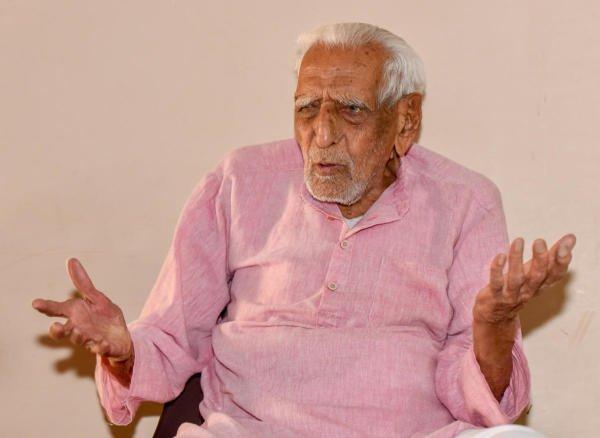
Legendary freedom fighter HS Doreswamy is no more

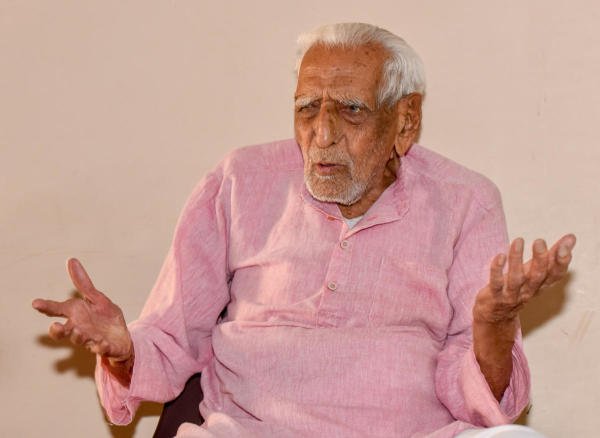
Doreswamy

Legendary freedom fighter and Civil Rights activist Harohalli Srinivasaiah Doreswamy popularly known as HS Doreswamy breathed his last yesterday.

The 103 year-old Gandhian, who kept the ‘conscience of Karnataka till his very last breath, and was the tallest public intellectual, who appeased none and spared none‘ would be remembered for his enthusiasm for public causes till he remained alive

Born on 10 April 1918 in Harohalli village in the then princely state of Mysore, he was jailed for the first time during Quit India movement – for his association with a group involved in making bombs and who spent 14 months of his life then – never stopped working for people even after independence.

In 1975, he had even challenged the then prime minister Indira Gandhi when emergency was declared, civil liberties stood suspended and who faced jail under the draconian Defence of India rule.

One of the issues closest to his heart remained getting land rights for the poor and the landless.

Before the first wave of Covid 19 struck he has been a prominent figure at protests against the controversial Citizenship Amendment Act (CAA) and has been openly critical of BJP-led central government’s policies.

He was cremated with state honours but it was clear as mirror that the BJP government in Karnataka always felt uncomfortable with his presence.

A year before last a leading BJP legislator had hurled choicest abuses at this legendary freedom fighter, and when the issue was raised in the Karnataka assembly, forget issuing any unconditional apology for his remarks the legislator not only remained adamant but received support from many of his colleagues.

Missing footsoldiers seek positivity amid raging pandemic

While Rome never burned, Nero never played the fiddle…

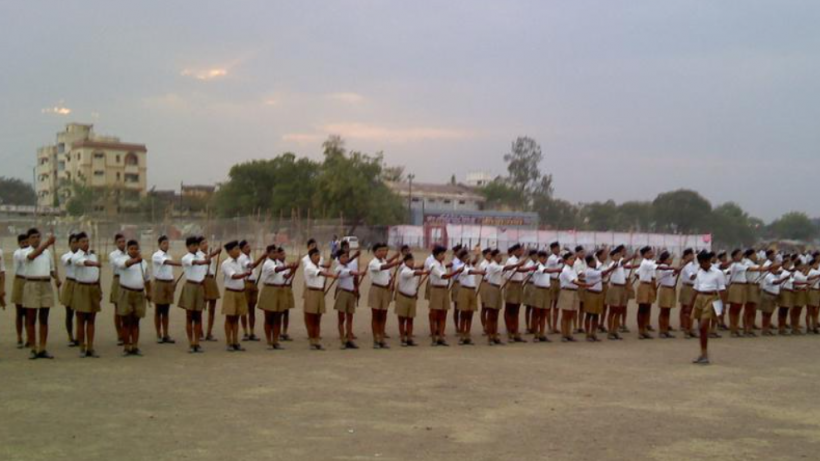
RSS

Pragya Singh Thakur, the Lok Sabha Member of Parliament from Bhopal, would never have imagined that the leading Hindi daily Dainik Bhaskar would mark her return to her constituency after a 70-day gap with a sarcastic article published on its front page. The headline read, “He Digvijayi Sadhvi Pragya! Shukriya, Aap Ko Bhopal ki Yaad to Aayi—O World Conqueror, Many Thanks, You Remembered Bhopal at Last.”

The daily was giving vent to the feelings of the lakhs of citizens of the capital of Madhya Pradesh. Some had even organised a social media campaign revolving around their “missing” MP.

The last time Thakur was in the city was 2 March, to participate in a condolence meeting for a BJP leader. Thereafter, she was away from the city. The intervening period had proved extremely harsh for residents due to the deadly second wave of the Covid-19 pandemic, which has already claimed hundreds of lives

The anger of citizens was palpable. That is why the daily asked her, “When Bhopal was sick and desperate for help, you were not to be seen. When the city needed oxygen and Remdesivir, you were still not here.”

The absence of an elected leader belonging to the ruling dispensation when people need her the most raises a pertinent question. Was this an exception? Forget the fact that the BJP-Sangh Parivar repeatedly claim they are “disciplined soldiers”, a number of those associated with right-wing organisations have gone missing in action. 

( Read the full article here)

Ominous Dark Clouds Over Bengal’s Skies…

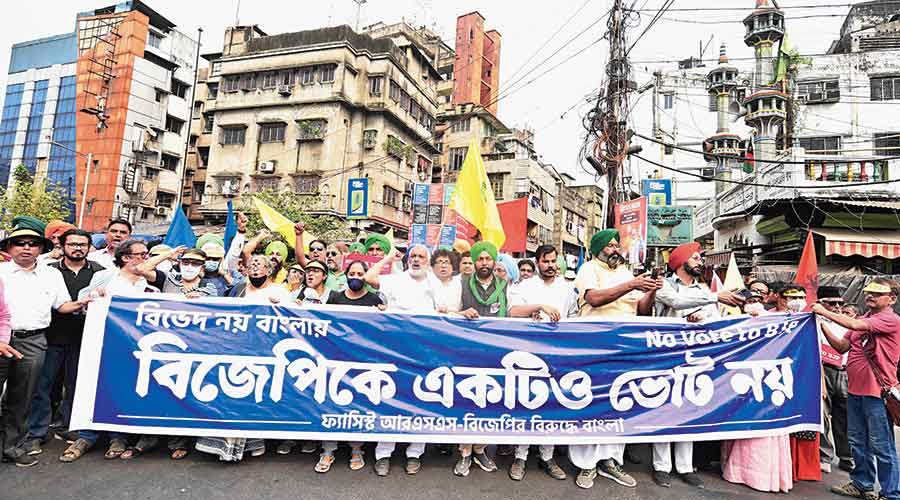
A demonstration by the ‘No Vote to BJP’ campaign in Kolkata, (older image) courtesy The Telegraph

As close to 8.5 lakh voters spread over 35 Assembly constituencies go to vote today in the last phase of Bengal’s elections, the line from the famous jatra Nabab Siraj-Ud-Doula from which the title of this post is extracted, haunts. The original ‘jatra pala’, written by Sachin Sengupta was staged in 1938 had a dialogue that announced the dark clouds collecting at Bengal’s horizons. The lines ‘Banglar akashe aaj durjoger ghanaghata/ Taar shyamal prantore rakter alpona’ have since resounded in the many iterations of the play, over the decades. The figures of Siraj-Ud-Daula and the traitor Mir Jafar have generally become part of Bengal’s political vocabulary but this time round the sense of Bengal being under attack from ‘outsiders’ has been pervasive. Along with that other episode of political folklore – repeated attacks by the borgis or the plunderous cavalrymen of the Maratha Empire, on Bengal has been recalled often. The attacks by the borgis were followed, only a few years later, by the Battle of Plassey (Palashi), in which Siraj-Ud-Daula was defeated after Robert Clive bribed Mir Jafar, his army commander, to betray the Nawab. 

This time round too, it is widely believed, the aggression by ‘outsiders’ cannot and will not succeed but for the Mir Jafar’s who collaborate with the aggressors.

Continue reading Ominous Dark Clouds Over Bengal’s Skies…

What happens when faith overrides sense ?

The severity of the second wave and the government’s unpreparedness demonstrate the limits of ‘strong’ leadership and religion-based politics.

What Happens When Faith Overrides Sense?
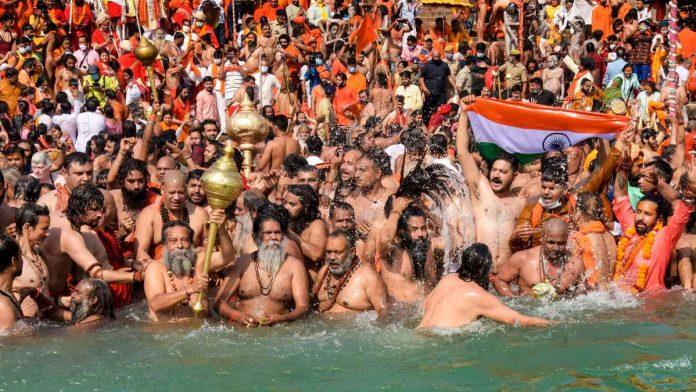
Image : Courtesy PTI

It was 1527, and Martin Luther, leader of the Protestant Reformation, wrote a letter advising a Lutheran leader what a believer should do during an epidemic. Europe was in the deadly grip of the bubonic plague at the time. It had killed thousands of people.

Extracts of his letter are relevant even today, especially the parts where Luther talks about what to do during an epidemic: “…Then I shall fumigate, help purify the air, administer medicine, and take it. I shall avoid places and persons where my presence is not needed in order not to become contaminated and thus perchance infect and pollute others, and so cause their death as a result of my negligence.”

Tirath Singh Rawat, the Chief Minister of Uttarakhand, perhaps does not know of this letter or its contents. Surprisingly, he does not even seem to recall the experiences from last year. In fact, much of what happened during the Covid epidemic seems lost on him. In 2020, public places of worship and religious gatherings became super-spreaders of the virus. That is why, for the first time, religious congregations were banned everywhere from Mecca to the Vatican to arrest the spread of the pandemic.

So, it is strange that Rawat cannot recall how believers took the back seat and ceded space to science during the first wave. Indeed, he has made a specious claim that faith in God will overcome the fear of the virus, in the context of the Kumbh Mela, a gathering where tens of lakhs of people gathered earlier this month.

( Read the full text here )

Fascism, Democracy and the Left : Com Dipankar Bhattacharya


The 6th lecture in the Democracy Dialogues series organized by the New Socialist Initiative was delivered by Com Dipankar Bhattacharya, General Secretary of CPI (ML) Liberation on 20 th December 6 pm (IST) where he spoke on ‘Fascism, Democracy and the Left’

Abstract  : ‘Fascism, Democracy, and the Left’

With the rise of the Modi government, BJP has managed to establish a vicious grip on Indian polity. Parliamentary democracy and the constitutional vision of a secular democratic Indian republic have come under fierce attack. Instead of remaining busy with studying historical parallels we should treat the present phase as the rise of the Indian model of fascism and resist it with all our might. While we can locate the present Indian developments in the context of global economic and political trends in the post-Soviet world, there are strong roots in Indian history and society. One should revisit Ambedkar and the warnings he had issued right at the time of adoption of India’s Constitution.
The Left vision and role in politics has been historically identified with ideas and experiments of building socialism, but the challenge for socialism to offer a superior model of democracy has remained fatally neglected. In the face of a fascist offensive, the Left in India must emerge and assert as the most consistent and reliable champion of democracy.

Continue reading Fascism, Democracy and the Left : Com Dipankar Bhattacharya

इस्लामिस्ट एवं हिन्दुत्ववादी: कब तक चलेगी यह जुगलबंदी!

आखिर इस्लामिस्ट क्यों खुश हैं नागरिकता संशोधन अधिनियम से

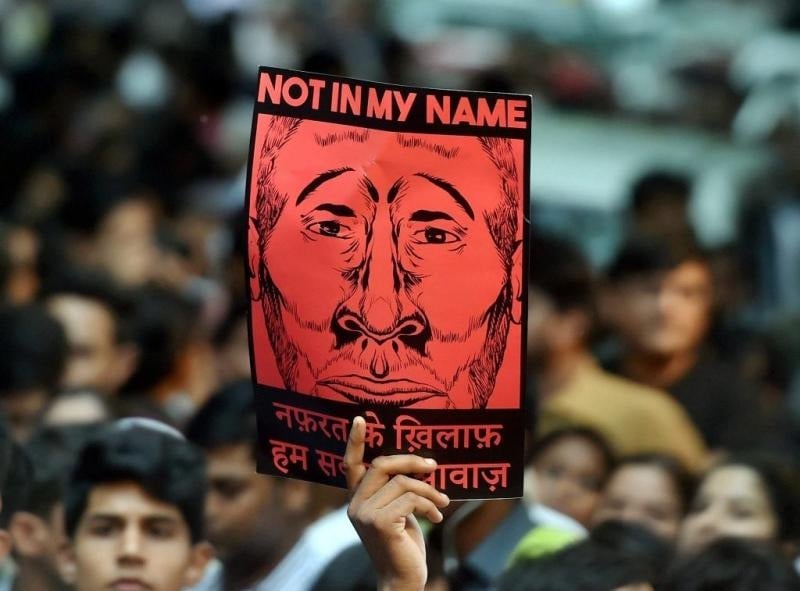
not in my name

प्रतीकात्मक तस्वीर। 

विजयादशमी के दिन सरसंघचालक की तकरीर आम तौर पर आने वाले समय का संकेत प्रदान करती है।

विश्लेषक उस व्याख्यान की पड़ताल करके इस बात का अंदाज़ा लगाते हैं कि दिल्ली में सत्तासीन संघ के आनुषंगिक संगठन भाजपा की आगामी योजना क्या होगी।

विगत माह विजयादशमी के दिन संघ सुप्रीमो के व्याख्यान का फोकस नागरिता संशोधन अधिनियम पर था, जिसमें उन्होंने यह दावा किया कि यह अधिनियम किसी भी ‘धार्मिक समुदाय’ के साथ भेदभाव नहीं करता है और मुसलमानों को एक छद्म प्रचार से गुमराह किया गया है। उनके मुताबिक संसद में यह कानून संवैधानिक प्रक्रिया का पालन करके पारित हुआ है, एक तरह से सरहद पार के उन भाइयों एवं बहनों को सुरक्षा प्रदान करता है, जिन्हें वहां धार्मिक प्रताडना झेलनी पड़ती है।

मालूम हो कि उन दिनों चूंकि बिहार चुनावों की सरगर्मियां बनी हुई थीं, लिहाजा उनके वक्तव्यों से निकले संकेतों पर अधिक बात नहीं हो सकी।

गौरतलब है कि बंगाल के चुनावों के मद्देनज़र भाजपा के कुछ अग्रणी नेताओं ने भी इसी किस्म की बातें शुरू कर दी हैं। मालूम हो कई बार अपनी आम सभाओं में उनके कई अग्रणी, ‘दीमक’ की तरह ऐसे ‘अवांछितों’ को हटाने की बात पहले ही कर चुके हैं।

प्रश्न यह है कि क्या कोविड काल में इस सम्बन्ध में नियम बनाने का जो सिलसिला छोड़ दिया गया था क्या उसी मार्ग पर सरकार चलने वाली है और इसे लागू किया जाने वाला है या यह सिर्फ चुनावी सरगर्मी बनाए रखने का मामला है।

( Read the full article here )

Bengal 2021, Fascism and the Left(s)


‘The specific threat of National Socialism was obscured amid general talk of the perils of “fascists”, a term egregiously applied to Bruning, Social Democrats and all and sundry. Dogmatic catastrophist theorising led the Communists to actively underplay the Nazis: Ernst Thalman warned the KPD [Communist Party of Germany] Central Committee in February 1932 “that nothing would be more disastrous than an opportunistic overestimation of Hitler-fascism.’  – Michael Burleigh, The Third Reich – A New History, p. 136

Ernst Thalman warned his party’s Central Committee against ‘opportunistically overestimating Hitler’, literally months before Hitler was appointed Chancellor in January the following year. What is more, this statement was made at a time when the intentions of the Nazis were hidden to nobody. As Burleigh puts it, they had frequently announced their contempt for the law and ‘by 1932 were vowing to intern Communists and Social Democrat opponents in concentration camps.’ (p. 149) Thalman, we know, was killed in the Buchenwald concentration camp in August 1944, eleven years after being held in captivity. Indeed, Thalman was arrested barely a year after he warned his party not to overestimate ‘Hitler-fascism’.

Continue reading Bengal 2021, Fascism and the Left(s)

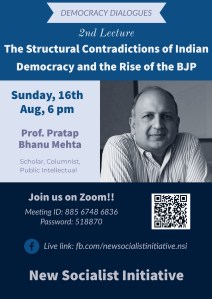
The Structural Contradictions of Indian Democracy and the Rise of the BJP : Prof Pratap Bhanu Mehta

[Democracy Dialogues Lecture Series ( Webinar)
Organised by New Socialist Initiative]

Date and Time: Sunday, August 16, 2020, at 6 PM IST (8.30 AM EST in the US)


Topic: The Structural Contradictions of Indian Democracy and the rise of the BJP

Abstract:

This talk explores the deep social transformations that have made the dominance of the BJP possible. It will take a longer view of the trajectory of Indian democracy and explore the profound changes in social and economic identities underway that have prepared a propitious ground for the rise of the BJP.

The Speaker: Prof Pratap Bhanu Mehta

Internationally renowned scholar and political scientist Prof Pratap Bhanu Mehta taught at Harvard, at New York University and at JNU. He was the Vice Chancellor of the Ashoka University till recently and served as the President of the premier think tank, Centre for Policy Research. Educated at Oxford and a Ph.D. from Princeton University, Prof Mehta is a columnist at Indian Express, a leading public intellectual and a bold and thoughtful voice for reason and justice. Among many honours and prizes to his credit, he is recipient of the Infosys Prize, the Adisheshiah Prize and the Amartya Sen Prize.

[New Socialist Initiative Presents
Democracy Dialogues – Lecture Series

The idea behind this series – which we call ‘Democracy Dialogues’ – is basically to initiate as well as join in the on-going conversation around this theme in academic as well as activist circles.

We feel that the very idea of democracy which has taken deep roots across the world, has come under scanner for various reasons. At the same time we have been witness to the ascendance of right-wing forces and fascistic demagogues via the same democratic route. There is this apparently anomalous situation in which the spread and deepening of democracy have often led to generating mass support for these reactionary and fascistic forces.

Coming to India, there have been valid concerns about the rise of authoritarian streak among Indians and how it has helped strengthen BJP’s hard right turn. The strong support for democracy here is accompanied by increasing fascination towards majoritarian-authoritarian politics. In fact, we would like to state that a vigorous electoral democracy here has become a vehicle for hindutva-ite counterrevolution.

The inaugural lecture in the series was delivered by Prof Suhas Palshikar on 12 th July 2020. The theme of Prof Palshikar’s presentation was  TRAJECTORY OF INDIA’S DEMOCRACY AND CONTEMPORARY CHALLENGES]


Trajectory of India’s Democracy and Contemporary Challenges : Prof Suhas Palshikar

[Inaugural Lecture of ‘Democracy Dialogues’ Series ( Webinar)
Organised by New Socialist Initiative, 12 th July 2020]

Join us on facebook.com/newsocialistinitiative.nsi for further updates


( Prof Suhas Palshikar, Chief Editor, Studies in Indian Politics and Co-director, Lokniti at the Centre for the Study of Developing Societies, delivered the inaugural lecture in the ‘Democracy Dialogues’ Series initiated by New Socialist Initiative.

In this lecture he attempted to trace the roots of the current moment of India’s democracy in the overall global journey of democracy, the extra-ordinarily ambitious and yet problematic foundational moment of Indian democracy and the many diversions India’s democracy has taken over time. He argued that unimaginative handling of the extra-ordinary ambition and Statist understanding of the ‘power-democracy’ dialectic formed the basis for easy distortions of democratic practice and that while populism and majoritarianism are the current challenges, they are by no means only special to the present and therefore, even as critique and course-correction of present political crisis is urgently required, a more long-term view of the trajectory of Indian democracy is necessary.

Here follows a detailed summary of his presentation prepared by Dr Sanjay Kumar)

Continue reading Trajectory of India’s Democracy and Contemporary Challenges : Prof Suhas Palshikar

Shadow of Laxmanpur Bathe on Bihar Election

An unpredictable element has found a new lease of life thanks to the coming Assembly election.

Laxmanpur Bathe on Bihar Election

The outlawed Ranvir Sena—the private army of upper caste landlords of Bihar—is in the news again. It recently threatened the Bihar chief of the Bhim Army, Gaurav Siraj, and one of its activists, Ved Prakash, through a Facebook post. The so-called army has “ordered” its “sainiks” to “arrest” him dead or alive. The sena is apparently peeved over how the young dynamic leader of the Ambedkarite organisation has described Brahmeshwar Singh, their slain “Mukhiya” who was killed in 2012.

Will there be any action against those who have threatened the young leader? If history is any guide then there is little possibility of this.

Merely two years ago, Nawal Kishor Kumar, Editor Hindi, Forward Press was targeted by this “sena”. The aggrieved journalist had lodged a police complaint but there has been no progress in the investigation.

It is not that there is no law to punish such miscreants. Social media posts of the threatening kind relate to various offences under the Indian Penal Code, from criminal intimidation punishable under section 503 to section 505 related to creating mischief in public, to section 506 which awards punishment for criminal intimidation and section 153A which relates to penalties for promoting enmity between different groups and so on. In fact, based on its activities, the Ranvir Sena is also liable to be prosecuted under section 3 of the Bihar Control of Crimes Act, section 3 of the Arms Act and section 3 of the Scheduled Castes and Scheduled Tribes (Prevention of Atrocities) Act, 1989.”

( Read the full text here)

Truth Behind India’s Hierarchies of Pain

Perhaps celebrities know that talking about the plight of an animal—who died in a state not ruled by the ruling dispensation at the Centre—is a safe bet

Migrants

Migrants wait for a means of transport to travel to their native places during the fourth phase of the ongoing COVID-19 nationwide lockdown, at Kundali Industrial Area in Sonipat. (Photo: PTI)

The killing of a pregnant elephant has caused national outrage. The elephant had strayed into a village in Palakkad, Kerala, and is said to have been fed a fruit stuffed with firecrackers, which exploded in its mouth. It is impossible to comprehend the tremendous suffering of the elephant, who died a painful death. It is also learnt that people in the region have in the past used incendiary materials to protect their crop from animals, particularly wild boar.

One person was arrested after the matter came to light and few others have been identified. Kerala Chief Minister Pinarayi Vijayan has promised “justice will prevail”, but one does not know if that includes legal action against the hatemongers—including a former cabinet minister who gave the incident a communal colour by claiming, incorrectly, that the incident occurred in Muslim-majority Malappuram. A sitting cabinet minister also retweeted this fake news, which further vitiated the atmosphere.

In a complaint to the Malappuram Police, a lawyer has urged the police chief to file an FIR against the former minister and others for a “derogatory” campaign against the district.

Now, many Indian celebrities, for example Indian cricket team captain Virat Kohli, have said that they are “appalled” by the incident. The chairman of India’s biggest corporate giant, Ratan Tata, has compared the “criminal act” with “meditated murder”. The celebrities, the anchors of 24/7 news channels and many other prominent figures are undeniably upset by the plight of the elephant. But do they also feel the same kind of outrage and disquiet over the communal overtones being imparted to it?

( Read the full article here)

Operation Eklavya in Action at Premier Institutes

India is neglecting caste-based discrimination in higher educational institutions at its own peril.

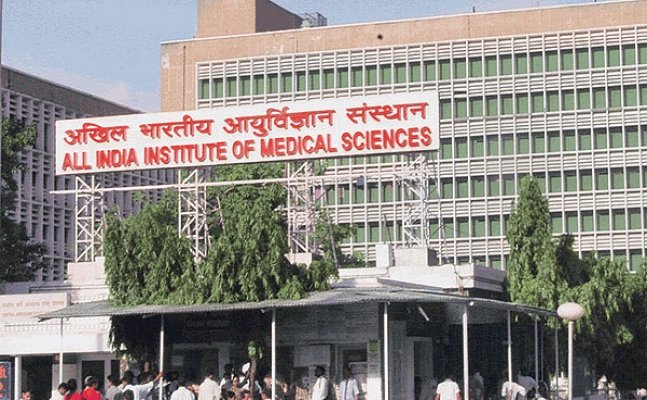
AIIMS Caste Discrimination

It was exactly 13 years back that the Thorat Committee, constituted in September 2006 to enquire into allegations of differential treatment of Scheduled Caste and Scheduled Tribe students at the premier medical institute, AIIMS—was released.

The first of its kind in independent India, this three-member committee led by then chairman of the University Grants Commission, Sukhdeo Thorat, had looked deeply into the many shades of discrimination faced by students of non-elite castes in the institute.

What it discovered after talking to students and faculty was, to say the least, shocking. Some 72% of SC/ST students mentioned facing some discrimination during the teaching sessions. Second, caste-based discrimination was prevalent in the hostels, for instance around 88% students reported experiencing of social isolation in various forms. The committee’s report also outlined the discrimination faced by SC/ST professors.

This context frames the alleged suicide attempt of a female doctor a fortnight ago in the same institute. The doctor, who worked at the Dental Research Centre of AIIMS, was allegedly facing sexual harassment and caste discrimination. This is another reminder that there has not been a qualitative change in the institute in the long years since the Thorat Committee report.

( )Read the full article here)

Why Activists Want Prisons Decongested

The Supreme Court also wants to reduce the Covid-19 risks posed by overcrowded jails, but there is little progress so far.

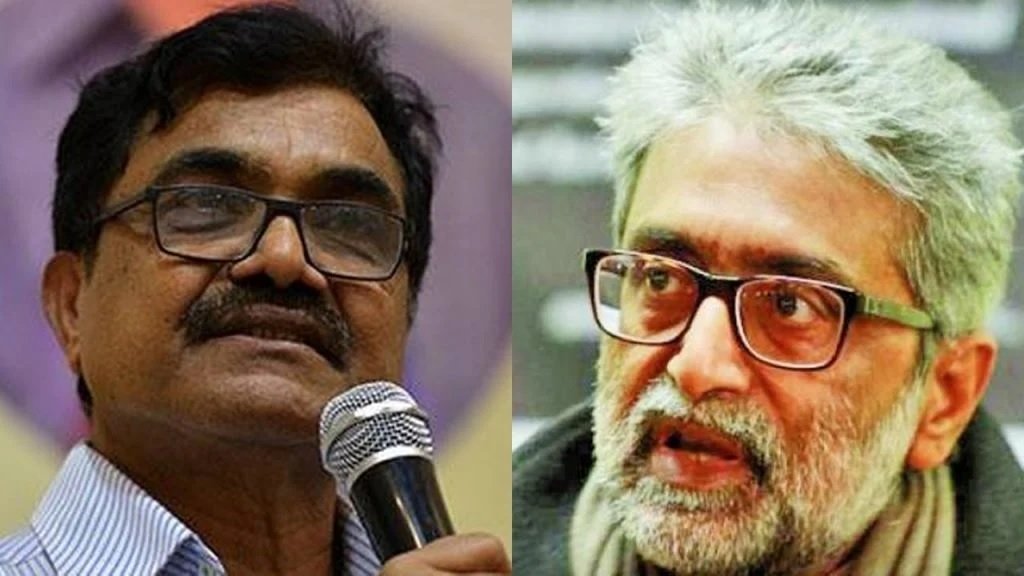
Navlakha and Teltumbde

Late in March, Sirous Asgari, a materials science and engineering professor from Iran, who is at present detained by the United States Immigration and Customs Enforcement (ICE), had warned about the “inhumane” conditions at the ICE facility that could turn it into a hot spot of Covid-19 fatalities.

April has made his worst nightmares come true. Asgari, who has a history of respiratory problems, has been infected by the Novel Coronavirus, which causes the Covid-19 disease. The news created international outrage last month. Not only the Iranian foreign ministry, many United States lawmakers and human rights groups also demanded his release, but it was not to be.

At the facility in which Asgari is still lodged (though he has been exonerated of all the charges he faced in the United States), people are usually detained for no more than 72 hours, but the Coronavirus outbreak has delayed deportations. People like him are simply caught up in the system. Asgari can leave the United States and resume work in Iran—where the viral epidemic has already claimed more than 60,000 lives—because he simply isn’t being taken before a judge.

Asgari’s plight reminds of another incarceration, this one in an Indian jail; that of Anand Teltumbde, who has been arrested in the Bhima-Koregaon case. On 26 April, noted activist-filmmaker Anand Patwardhan had, in a Facebook post, expressed deep concern about the health of 70-year-old Teltumbde, who also suffers from respiratory problems.

( Read the full text here : https://www.newsclick.in/Prisons-during-lockdown-needs-to-be-decongested)

Understanding the Rise of the BJP

Guest Post by PARVIN SULTANA

(Review of HINDUTVA: EXPLORING THE IDEA OF HINDU; NATIONALISM, Jyotirmaya Sharma ( Context 2019); M.S. GOLWALKAR, THE RSS AND INDIA, Jyotirmaya Sharma (Context, 2019) ; DECODING THE RSS: ITS TRADITIONS AND POLITICS Raosaheb Kasbe (Leftword Books, 2019) , RAJIV GANDHI TO NARENDRA MODI: BROKEN POLITY, FLICKERING REFORMS Parsa Venkateshwar Rao Jr. (Sage Select, 2019) ; MODINAMA: ISSUES THAT DID NOT MATTER Subhash Gatade (Leftword Books, 2019) 

The 2014 general elections which saw the Bharatiya Janata Party return to power with an absolute majority is believed to have brought an important paradigmatic shift to Indian politics. Scholars commenting have termed it as a majoritarian shift. Post elections, there have been discussions which tried to understand the reasons behind this massive mandate that the Right Wing political party managed to get. This Right Wing shift in India’s electoral politics was further proven by the 2019 Parliament election results which gave the BJP a larger mandate. Scholars have written trying to understand the rise of BJP—is it an isolated event or a continuation of past developments? This becomes important because even at the international level, there is a shift towards conservative politics.
Indian academia has also taken an objective look at this shift. A number of books have been written on various aspects of present-day politics, the ideologies and icons that paved the way for this rise and continue to provide intellectual fodder for this politics, the liberal economic policies which have been taken to their logical conclusion by the present government, etc. And these books have provided us with important insights to make sense of the present-day political situation of the country.

( Read the full text here : https://thebookreviewindia.org/understanding-the-rise-of-the-bjp/)

Not Just Doreswamy, India’s Idea of Independence is Being Debased

Trivialisation of the freedom struggle is in the Hindutva gene, which seeks a theocracy, not an independent republic.

Doreswamy

“Though this be madness yet there is method in it.”

Hamlet, William Shakespeare.

The saffron brigade’s ever-readiness to stigmatise people holding differing opinions and dissenting voices reached a new low recently.

Perhaps it was the saddest day in post-independence India when a Karnataka BJP legislator hurled abuses of being a ‘Pak agent’ and ‘fake freedom-fighter at 102-year-old freedom fighter, H Doreswamy.

Sadly, not many outside the state would know that Harohalli Srinivasaiah Doreswamy, born on 10 April 1918 in the former princely state of Mysore, was first jailed in 1942 during the Quit India movement. He was associated with a group involved in making bombs and spent 14 months behind bars. After his release he continued with his mission and following Independence chose to work with slum-dwellers, the homeless and poor landless farmers, cobblers and porters. He kept himself aloof from holding political power.

In 1975, he challenged then prime minister Indira Gandhi when Emergency was declared, civil liberties were suspended and again faced jail under the draconian Defence of India Regulations Act. Despite old age, his enthusiasm for public causes remains undiminished. One issue closest to his heart remains getting the poor and the landless right to land.

Of late, he has been a prominent figure at protests against the controversial Citizenship Amendment Act (CAA) and has been openly critical of the BJP-led central government’s policies.

The BJP legislator under question is Basangouda Patil Yatnal. When the issue was raised in the Karnataka Assembly, forget issuing an unconditional apology, Yatnal remained adamant. Not just that. He got the support of many of his colleagues. It would be asking too much for the government to take action; a reprimand or case against the legislator for his comments, though they violate the Constitution which considers disrespect to freedom movement a “violation of our fundamental duties”.

( Read the full article here : https://www.newsclick.in/Not-Just-Doreswamy-India-Idea-of-Independence-is-Being-Debased)

Jantar Mantar Declaration Against CAA, NRC and NPR

Guest Post : Jantar Mantar Declaration of 1 March 2020 Against CAA, NRC and NPR

Adopted  at the Convention of writers, artists, cultural activists, scientists and various associations such as Indian Cultural Forum, Janwadi Lekhak Sangh, Progressive Writers Association , Jan Sanskriti Manch, Dalit Lekhak Sangh, New Socialist Initiative, Jana Natya Manch, Delhi Science Forum, Janasamskriti (Malayalam), Vikalp, Cinema of Resistance, All India Peoples Science Network

We, at this  Convention of writers, artists, cultural activists, scientists and various associations express our deep concern over recent violence and communal genocide in Delhi.

We understand that this tragic situation is a direct outcome of the communal design and divisive politicsof CAA-NPR-NRC. The silver lining is that the common people of Delhi remained united in their fight against this outrage.  This convention reiterates that only by this unity and  mutual trust and cooperation  that the CAA-NPR-NRC design can be defeated.

We, at this  Convention of writers, artists, scientists, cultural activists and various associations declare our solidarity with the on-going non-violent movement against the draconian CAA  (Citizenship Amendment Act. 2019 ), proposed new format of NPR ( National Population Register) and the proposed NRC (National Register of Citizens) . Continue reading Jantar Mantar Declaration Against CAA, NRC and NPR

The Violence in Delhi, Politics and ‘Heroism of the Ordinary’


What is there to say? What can one say that has not already been said umpteen times before – during earlier rounds of communal violence elsewhere – and in Delhi this time?

The political class, true to its character, has revealed as it has so many times in the past, that when it comes to matters like communal violence, it is simply paralyzed – perhaps with the exception of the Left in states where it was strong enough to impact things.  For all its failures in other respects, this was one where the Bengal Left, for instance, too had in the past shown great promptness in nipping such possibilities in the bud. Most often this was done, not by relying only on the administrative power of the state, but with  the entire party machinery moving into action. Kerala too has had a similar record. But those instances apart, especially in states of the Northern or Western India, there hasn’t been much to write home about. What entering the political domain does to you is illustrated so starkly by the fate of the Aam Aadmi Party (AAP) and its utter capitulation to what it imagines to be the ‘Hindu sentiment’.

Continue reading The Violence in Delhi, Politics and ‘Heroism of the Ordinary’