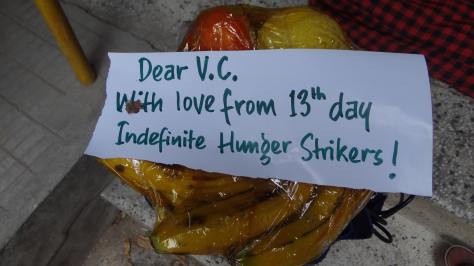
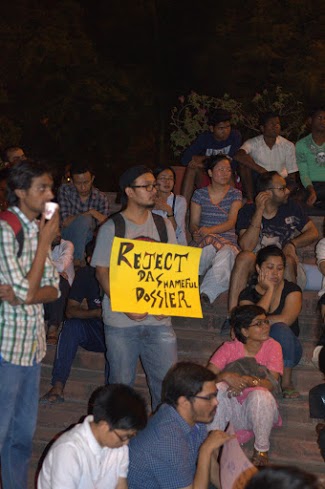
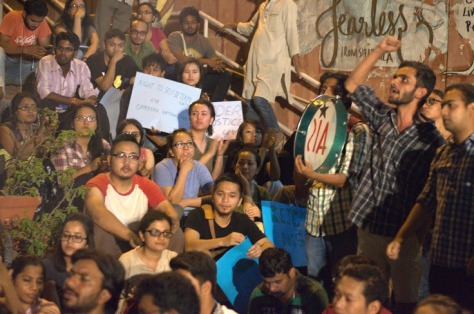
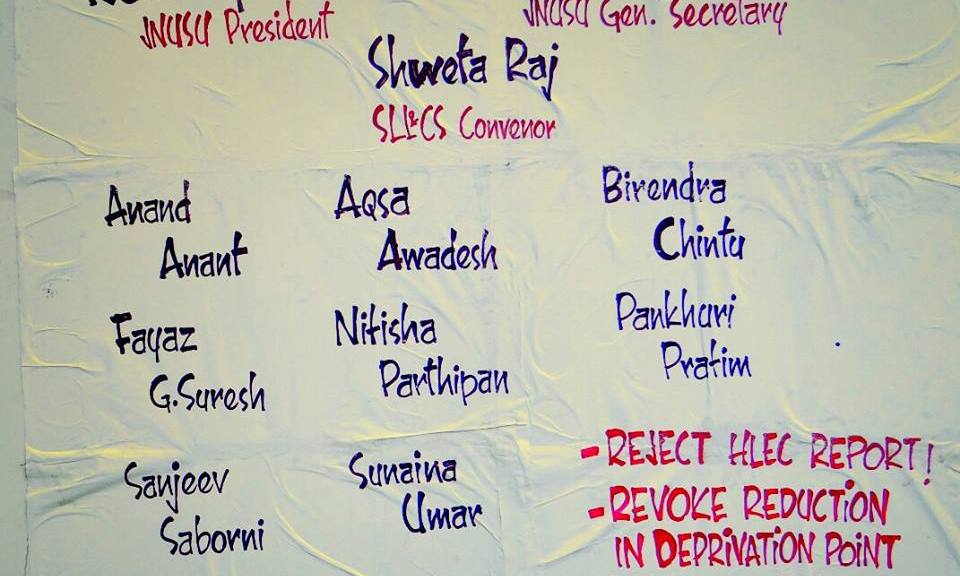
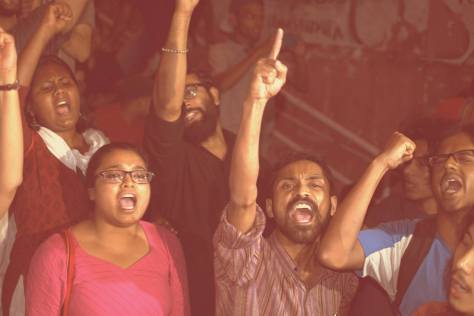
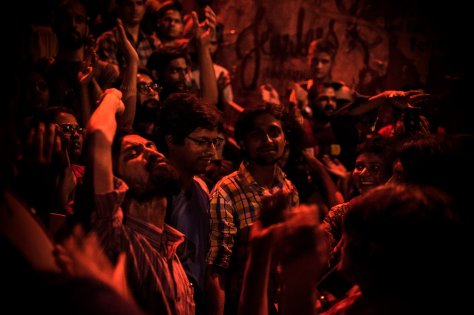
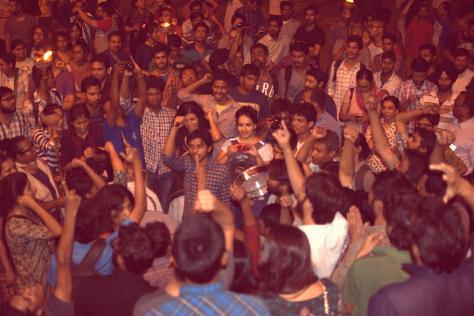
The 10th of May, the 13th Day of the Hunger Strike by JNU Students in protest against the HLEC Report was also the day scheduled for a meeting of the Academic Council of JNU. Students and faculty had resolved to stage a massive protest. Student and Faculty members of the Academic Council had also resolved to forcefully present issues related to the current crisis in the university at the AC Meeting. The events of the day are presented here through a series of videos and photographs uploaded by different people from JNU.
[ Video by Samim Asgor Ali, taken from his Youtube Channel ]
They tell the story of how students were generous with their tormentor, the VC, Jagadeesh Kumar, and how he ran away.
One day, his backers, Smriti Irani, Rajnath Singh and even Narendra Modi, and all the goons in the RSS headquarters at Mahal, Nagpur and Jhandewalan, Delhi will have to run for cover in a similar fashion when faced with the ‘gift’ of the fruits of their actions.
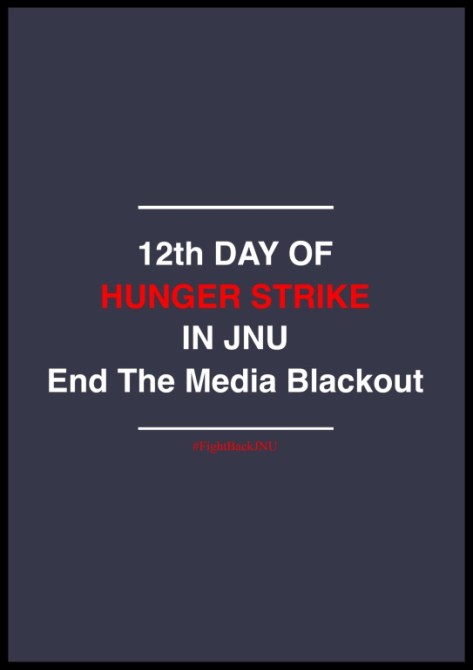
The JNU Students’ Hunger Strike Enters Day 12. Ketone counts go up, Weight goes down, Morale stays miles high. Media fatigue shows that crusading news anchors are no match to hunger striking students when it comes to stamina, and, may we say, courage. The university authorities, the JNU VC and his gang, the government, the RSS-ABVP, remain what they are – losers.
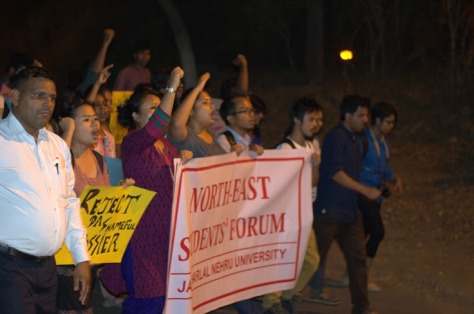
North East Students’ Forum JNU organized a protest march on May 4, demanding strong action against teachers who are involved in preparing the “internal dossier”. The dossier was also burnt by NESF at Administration Block – Freedom Square – JNU.
जिशा, मेरी दोस्त मेरी यार, क्या कहूँ यार तुम्हारे साथ जो दंविये बर्बरता हुई उसके लिए मुझे शब्द नहीं मिल रहे हैं कुछ कहने को. ये देश ये समाज हर रोज़ ऐसे झटके देता रहता है और इतना देता है, इतना देता है, की हमारे लिए वीभत्स से वीभत्स घटना क्रूरतम से क्रूरतम घटना साधरण बन गई है और इन घटनाओं को पचाने की क्षमता में भी हम माहीर हो गए है. देखो न दोस्त, असाधारण कहाँ कुछ रह गया है. बचपन से आज तक तो यही सब देख- देख कर पले बढे हैं हम सब की, जो कुछ हो अपना हक़ मत मांगना, पढने लिखने की बात मत करना , बाप या भाई लात घूंसे मार- मार कर तुम्हे अधमरा कर दे लेकिन एक शब्द भी उनके खिलाफ बोलने की गुस्ताखी मत करना, गाँव के उच्च जाति वर्ग के सामंती तुम्हे अगर छेड़े तुम्हारा बलात्कार करे तो उसका बहिष्कार मत करना कियोंकि ये तो उनका जन्म सिद्ध अधिकार है.
तुम्हारे लिए जो लक्ष्मण रेखा खिंची गई है उससे बाहर जाने की कोशिश की तो तुम्हारी शामत आना पक्की है. और शादी? ये तो दूसरी जात में तो दूर की बात अपनी जाति में भी करने का अधिकार या आजादी की बात मत करना ये तय करना घर के बड़े पुरुषों के कंधे पर छोड़ो. सती सावित्री बनो, एक सद्गुणी बेटी, बहु और पत्नी बनो इसी में तुम्हारी भलाई है.
At the end of the 6th day of the Indefinite Hunger Strike by JNU Students, the ‘We Are JNU‘ Facebook Page uploaded a gallery of portraits of the 17 students on Hunger Strike, together with details of their medical conditions. We are sharing this post on Kafila in solidarity
Guest Post by Aswathi Nair and Umar Khalid (With Photographs and Videos by K. Fayaz Ahmed, Azhar Amim, Samim Asgor Ali, Reyazul Haque and Agnitra Ghosh)
Exactly nine years back, in 2007, ten students were rusticated (again) in the month of May for their “crime” of agitating along with workers to ensure the legally mandatory minimum wages for the workers here in JNU. It was the peak of summer, the time of holidays, and the administration (like this time, like every time) thought that they could break the unity of the workers and students with crackdown timed to coincide with what was thought to be the ‘weakest’ time for mobilization on campus. The administration’s plans did not bear fruit then, they will not work now either.
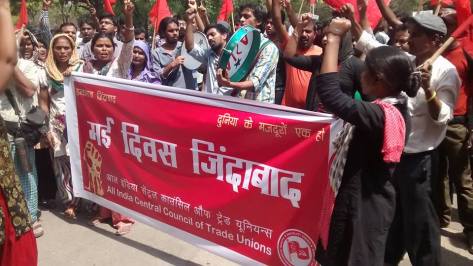
Workers and Students Unite in JNU on May 1, 2016, International Labour Day
We are in that strange time again. The summer of 2016 has witnessed a May Day wherein the workers in JNU not only took out their own rally, but also rallied with us students sitting on the 4th Day of their Indefinite Hunger Strike against administrative crackdown on our democratic spaces. Continue reading Workers and Students Unite on May Day in JNU: Aswathi Nair & Umar Khalid→
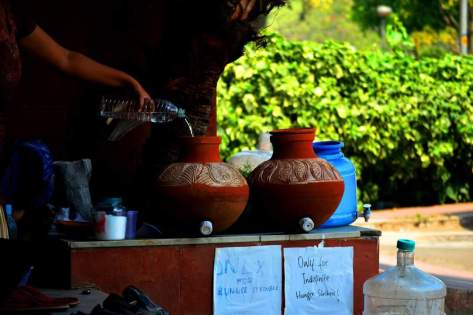
Water – A Gift for Hunger Strikers. Photo Courtesy, K. Fayaz Ahmed
“I wanted to bring you something but I didn’t know what to get you so I got you a bottle of water,” says a friend who would perhaps never identify herself as a student activist but since 9th February, like many like her, has been an integral part of the stand with JNU movement.
19 of us have decided to sit on an indefinite hunger strike till the time the farcical report of the High Level Enquiry is not rolled backed in its entirety. Today, April 30th, is the third day of our hunger strike.
What does it mean to dissent in a world in which everyone claims to be a dissenter? What does it take to build a critical vantage-point, one that is not merely the easy pastime of fault-finding, when we all seem to already know what will be truly critical? Ever since the oppositional energy generated against Hindutva fascism in and through the Kiss of Love campaigns dissipated into the rival folds of the Human and the Anti-Human in Kerala, these questions have troubled me. The prospect of being sucked into one side of such a binary formation is terrifying enough to scare one away from engaging with either side; but worse is the pain that follows the realization that the unique moment of hope – the hope that the diverse groups that populate the anti-Hindutva civil society may well be able to form a bond of trust, however tentative and fragile, more than merely strategic connections – is well and truly in the past. Both sides have indulged in belligerent and damaging caricaturing of each other’s positions, as if the annihilation of the other was the very condition of the survival of the one. Continue reading ‘Radical’ Critics and KaBodyscapes→
Spring has given way to the beginning of a turbulent summer. April, is a cruel month. Temperatures have risen, and so has the level of rage in university campuses. The JNU University Authorities (and their masters – in the Ministry of Human Resources Development, the Prime Minister’s Office and the RSS Citadels in Mahal, Nagpur and Jhandewalan, Delhi) thought that they could break the resolve of the students by enacting a series of harsh measures against them just before exams begin and the university term ends in summer vacations.
Chintu Kumari, Anirban Bhattacharya and other students give the call to protest against the HLEC and call for a Hunger Strike. Photo, Courtesy, Azhar Amim
This is a time, they must have thought, when students will be busy with preparations, and the rising heat will discourage the kind of mass mobilizations that the campus has seen since February. Students in JNU resolved a few hours ago to prove them wrong, and decided to fight back . A massive gathering stood its ground at the Administrative Block, aptly re-christened, ‘Freedom Square’.
Rama Naga, Gen.Sec. JNUSU, (Centre) and JNU Students Calling for Indefinite Hunger Strike on April 27, 2016. Photo, Courtesy, Azhar Amim
They have decided that a batch of students will sit on indefinite hunger strike – a ‘fast unto death’ – until the JNU authorities roll back the draconian measures listed in the HLEC Report.
There’s no looking back now. Whatever happens from now on wards, will be seen as a consequence of the cruel, evil mindset of the current regime, which truly treats the lives of the young as dispensable ballast. Its time to prove them wrong. This is a call that goes out to all students and teachers, and sensible individuals, not just in JNU, not just in Universities and Colleges all across India and all the territories administered by the Indian republic, but to everyone reading this post anywhere in the world, to stand by the courageous students of JNU. It is our responsibility to see that the JNU Authorities see reason and back down. If anything untoward happens to any student, the university authorities, and the regime backing them, will be clearly culpable.
Here is Umar Khalid, speaking just before commencing his Hunger Strike
Here is Chintu, former Gen. Sec. JNUSU, speaking at the Mashaal Juloos, (Torchlight Procession) just before beginning the Hunger Strike.
Listen to Kanhaiya Kumar, President of the JNUSU – restating the reasons for the continuation of the movement.
Thanks to the ‘We are JNU Media Group’ and the AISA Youtube Channel, for the videos.
[ The prurient fantasies contained in the ‘JNU Dossier’, produced by some right wing faculty members of JNU in or around October 2015, have been ‘outed’ by an excellent report by Ajoy Ashirwad Mahaprashasta in Wire.org. This comes exactly at the time when the JNU administration has shown its fangs by delivering a low blow by way of the measures outlined in the report of the ‘High Level Enquiry Committee’ appointed by the Vice Chancellor. An impartial examination of the HLEC document and the ‘Dossier’ in will reveal some startlingly resonant patterns. Clearly, the ‘Dossier’, which had been dismissed by the former Vice-Chanceller, Prof. Sopory, has been reincarnated at the express orders of the Nagpuri masters of the present dispensation. We are sharing below an excellent response to the ‘Dossier’ by Ayesha Kidwai, one of the professors – ‘named’ in the dossier. This is taken from Ayesha Kidwai’s status update on her Facebook Page.
Sanghi smut is in season again! For the authors of the Dirty Dossier, JNU nights are forever scented with musk, with couples draped on every bush, suitably fortified by free alcohol, thoughts of secession, and cash payments supplied by the Awesome Foursome. At its peak, the party can practically involve the whole university, because as per Shri Gyan Dev Ahuja’s estimates, the number of students frolicking this will be 7000 (3000 condom users X 2, plus 500 injectable walas X 2). (Assuming of course that the few hundred left over have gone to fieldwork, have exams, or are abstemious and/or abstinent in nature.)
Laugh as we may (and must) at these feverish imaginings, it’s also important to understand that the very notion of a free university challenges not only misogyny, but also the social apartheid produced by caste and exclusionary religion.
Guest Post by Shehla Rashid, (Vice President, Jawaharlal Nehru University Students’ Union)
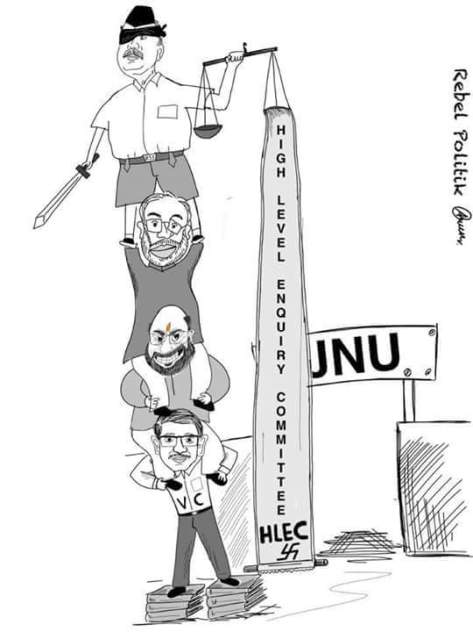
Rise up against the proxy war on students by the Modi regime.
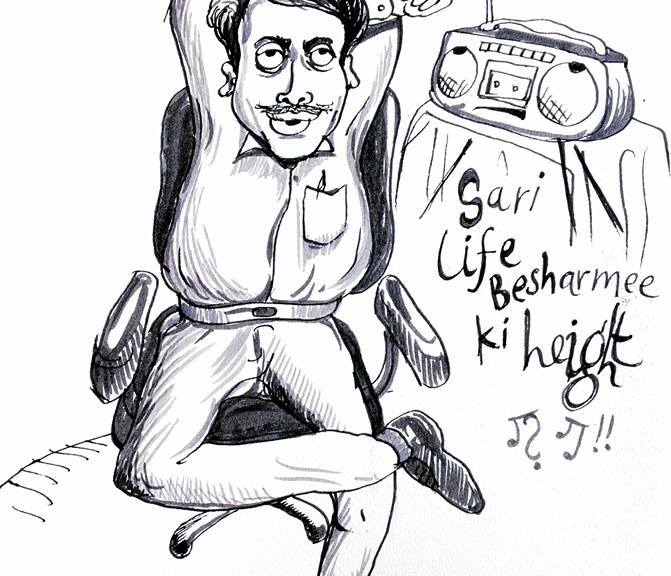
Cartoon by V. Arun Kumar
JNUSU rejects the report of the enquiry committee constituted by the Vice-Chancellor to look into the 9th of February incident. JNUSU also rejects its reports and any punishment handed out by it. The JNUSU and JNUTA had repeatedly asked the administration to democratise the enquiry committee, but this was not done. Now, when the holidays are here, the VC has made public the punishments, after one and a half months of submission of the HLEC (High Level Enquiry Committee) report. Continue reading Rise Up against the Proxy War on Students by the Modi Regime: Shehla Rashid→
Text of the talk delivered on April 22, 2016 at the Indian Cultural Centre, Colombo on the occasion of B. R. Ambedkar Commemoration.
Ambedkar’s Legacy: Critique of Religion, Quest for Social Justice and the Paradox of Constitutionalism
Jayadeva Uyangoda, Senior professor of Political Science, University of Colombo
May I begin my talk this evening by thanking His Excellency Y. K. Sinha the Indian High Commissioner in Colombo for inviting me to deliver this lecture on B. R. Ambedkar? This event is part of a series of celebrations in connection with the 125th birth anniversary of Babasaheb Ambedkar, which fell on the 14th of April. I am afraid my talk may not celebrate great Ambedkar’s memory and legacy as such. It will only present some disjointed and hurriedly constructed thoughts about the life and legacy of this great son of South Asia.
Ambedkar’s name is well known in Sri Lanka. In Sinhalese society, the popular culture of which I am somewhat familiar with, Ambedkar is known as the leader of India’s Harijan communities. The word dalit is not in much use in Sinhalese society. The Gandhian neologism of harijan is better known. Ambedkar is respected as the Harijan leader who embraced Buddhism along with several thousands of his followers. Sinhalese Buddhists are particularly sympathetic to Ambedkar and his social reform movement. For them, Ambedkar’s project constituted a critique and a rejection of Hinduism. This is despite the fact that Buddhism has historically and in terms of elite as well as popular practices been closely interwoven with Hinduism. Quite independent of Ambedkar, Sri Lankan Buddhists have a somewhat ambivalent attitude towards Hinduism and Hindu traditions as well. It is almost like their ambivalence towards India in general, as some of their intellectuals and professionals seem to be inclined to demonstrate these days. Continue reading Jayadeva Uyangoda on Ambedkar’s Legacy→
Free speech cannot come with a price tag -10,000/- or 20,000/- or even a rupee!
Dissent cannot be evicted!
Ideas cannot be made out of bounds!
Reason cannot be rusticated!
So, the High Level Enquiry Committee at JNU, set up under the watch of Jagadish Kumar, the recently appointed Vice Chancellor, has just delivered a low blow. A summary of its decisions (taken from the Facebook Wall of JNUSU Vice President, Shehla Rashid) meted out as the consequences of the events of February 9 and after is as follows :
Umar Khalid, rusticated for one semester + 20K fine.
Anirban, rusticated till 15 July & from 25 July, out of bounds for 5 years.
Another Kashmiri student rusticated for two semesters.
Ashutosh, former JNUSU President, removed from hostel for one year + fine.
Chintu, former JNUSU Gen Sec: 20K fine
Rama, current JNUSU Gen Sec: 20K fine
Anant, former JNUSU Vice-President: 20K fine
Aishwarya, current GSCASH representative: 20K fine.
Gargi, current JNUSU councillor: 20 K fine
Shveta Raj, current SL & CS Convener: 20 K fine
Kanhaiyya, current JNUSU President: 10K fine
Other organisers fined from 10K to 20K
Two ex students declared out of bounds from campus.
This is an administration, which, in obedience to its backers in the Ministry of Human Resource Development and the Government of India, that knows only one way of dealing with the students in its charge – and that is a replica of the vindictive path that eventually drove Rohith Vemula to his institutionally mandated death in Hyderabad University.
In the remote corners of Sangrur district of Punjab, 20-something year old women got together during a village celebration of Ravidas Jayanti. These girls from Matoi village had one purpose that day, to declare the formation of their Ekta Club, a club formed with the objective of fighting for equal status, equal opportunities and most importantly, claiming a share in the village land by participating in the annual auction of Shamilat land.
Upon making this valiant declaration, they were bombarded with insults and mocked for demanding their rights. “Who are you to claim rights over land, you are just a bunch of Dalit girls! What will you even get out of owning a piece of land?”, people questioned. To this, the women replied, “It is a matter of legal right and our demands are legitimate claims for what belongs to us. In claiming our legal rights, we seek equal status, satisfaction and self respect”.
Out of this group of ten women were two sisters leading the struggle, Gurmeet Kaur and Sandeep Kaur. They had been at the forefront of formation of the Ekta Club and the fight for claiming Shamilat land.
The Punjab Village Common Lands Regulation Act, 1961 (the Punjab Act)
This was the scene in 2014, a day on which a few Dalit families led by this group of young women, stood up against the upper caste families and farmers of Matoi, to claim their share in the Shamilat land.
Under the Punjab Act, Shamilat land has been defined as inter alia the land used or reserved for the benefit of the village and community. Such land may be utilised for various purposes including constructing schools, drinking wells, roads etc. 30% of the Shamilat land is reserved for families from the Scheduled Castes, 10% for families from the Backward Classes and further 10% for dependants of army personnel killed in war after the independence of India (Reserved Land). Continue reading An Ode To Women’s Struggle In Matoi: Shailza Sharma→
जे.एन.यू. में 9 फरवरी को एक घटना घटी. घटना क्या थी अब उसके बारे में बहुत सी चीजे स्पष्ट हो चुकी है. सरकार का दमन चला जिसके परिणामस्वरुप एक आन्दोलन चला. कहा ये जा रहा है कि आन्दोलन के कारण सरकार बैकफुट पर है. ये आन्दोलन अभी भी चल रहा है. जब ये मुद्दा पुरे देश में गरमाया जा रहा था उस समय बहुत सारी चीजे डिबेट का हिस्सा बनी जैसे राष्ट्रवाद क्या है? अभिव्यक्ति की स्वतंत्रता (Right to Freedom of Speech and Expression) को कैसे देखा जाये? आज़ादी की सीमा क्या होगी? क्या टैक्स से पढने वाले स्टूडेंट्स को “इतना बोलना” शोभा देता है? क्या जब सीमा पर जवान मर रहे है तो “ये काम” किया जा सकता है? ये सारे मुद्दे बहुत ही जोर–शोर से सरकार के पक्ष से या फिर इसके उलट लोकतंत्र के पक्ष में बात रखने वालों की तरफ से भी की जा रही थी. लेकिन इसी बीच में एक खतरनाक अवधारणा सरकार के तरफ से बात रखने वाले और जाने अनजाने लोकतंत्र की तरफ से भी बात रखने वाले टी.वी. चैनलो, अखबारों, इंटेलेक्चुअल, राजनीतिज्ञों की तरफ से रखी जा रही थी. वो अवधारणा थी कि राजनीति बहुत बुरी चीज है और छात्र राजनीति तो बदतर. यहाँ तक कि हमारी पैरोकारी करने वाला पक्ष भी यह बार-बार साबित करने का प्रयास कर रहा था कि ये सामान्य से पढने लिखने वाले छात्र है इनका राजनीति से कोई मतलब नही है. ये लोग तो बस कभी कभी कुछ यू हीं करते रहते हैं. क्या अगर हमारे बारे में यह टैग लग जाता कि हम राजनीति करने वाले लोग है तो हमारे पक्ष से बात रखना इतना मुश्किल हो जाता. जबकि यह सर्वविदित है कि जिन कुछ छात्रो के नाम राजद्रोह के तहत लिए जा रहे है वे वामपंथ की सक्रिय राजनीति का हिस्सा है. आने वाले समय में हम आन्दोलन को किस हद तक जीतते है और आगे ले जा करके इसको इस फासिस्ट सरकार के लिए कितना खतरनाक बना पाते है ये अभी तय होना बाकी है लेकिन “मुख्याधारा” की राजनीति करने वाली पार्टियाँ, जिसको प्रोग्रेसिव छात्र-आन्दोलन ने हमेशा उनके जन –विरोधी रवैये के कारण चैलेंज दिया है, एक बार इस मौके को राजनीति, खासतौर से अगर छात्र करे तो, बहुत ही गलत चीज है इसको स्थापित करने में लगी हैं. छात्रों का काम काज सिर्फ पढना-लिखना है और इसके इतर वो अगर कोई और काम करते है तो वो अपनी “सीमा” लांघते है. बड़ी-बड़ी मल्टीनेशनल कंपनियों में छोटे-छोटे उम्र के कमाने वाले लोगों के साथ तुलना करके ये समझाने की कोशिश की गई कि आप जितनी कम उम्र में जितना ज्यादा कमा लेते है आप उतने ही सफल स्टूडेंट है. हम अभी लगभग बीस दिन के एक कैंपेन में थे. इस कैंपेन के तहत देश के विभिन्न हिस्सों खास तौर से उत्तर भारत के गाँवो और छोटे-छोटे कस्बो और कुछ शहरो में मेरा जाना हुआ. जिसमे जे. एन. यू. पर बात होती, भगत सिंह और डॉ. अम्बेडकर के विज़न पर बात होती. जब इन विषयों पर बात होती तो नैचुरली मोदी सरकार के ऊपर बात होती. उन कार्यक्रमों में कुछ ऐसे लोग भी मिलते जिनका कहना होता कि आप लोगों के साथ जो हुआ गलत हुआ लेकिन इस मैटर को लेकर अब आप लोग राजनीति कर रहे है. मोदी के खिलाफ आप लोग जो इतना बोल रहे है उससे अब आप लोग एक्सपोज हो गये है कि आप लोग राजनीति कर रहे है. क्या सच में राजनीति इतनी बुरी चीज है कि उससे स्टूडेंट्स को दूर रहना चाहिए? Continue reading जी हाँ, हम राजनीति करते हैं : अनन्त प्रकाश नारायण→
That the past few months have been cataclysmic is an understatement. Personal tragedies and political catastrophes have exploded within our most cherished spaces, and brought a churning in them. What was truly transformative was the experience of both the emergence of broad solidarities against right-wing fascism, and of the reminders of multiple registers and contexts within them. These underline the need for multiple conversations to understand both our common struggles, as well as the contradictions within, and to renew a resolve for introspection through them as we move towards real ‘azaadi’.
There is of course an ongoing debate on this, and here I felt that some binaries being invoked in it are not very convincing, while others brought home stark truths that pose challenges to a patriarchal, majoritarian caste hindu ordering of society, within which we are all located at different levels of hierarchy, complicity, and engagement.
I have been part of both public universities under fire right now, and the present brings home the urgency of the dual task of defending the public university as a space for pushing the boundaries of critical thought, and confronting the very hierarchies and complicities with power that shape it. This is necessary even as processes of democratisation and affirmative action take root in public institutions . So these are some reminiscences from an alumna of both these public universities who has been wrestling with articulations and complexities which lie beyond institutional labels or binaries. Continue reading Responding to the Challenges of Blue and Red – Reminiscences of a JNU-HCU Alumna: Shipra Nigam→
In Conversation with Bezwada Wilson, National Convener of Safai Karmachari Andolan
The 125 day Bhim Yatra which started from Dibrugarh and traveresed 30 states and 500 districts to reach Delhi is now over. As everybody knows it culminated in a big rally coupled with people’s hearing where families of those victims who died while cleaning sewers and septic tanks shared their plight at the hands of state as well as civil society. The call of this Bhim Yatra raised by Safai Karmacharis – ‘Stop Killing Us’ – would could keep reverberating for quite some time. (https://kafila.org/2016/04/14/bhim-yatra-so-that-there-are-no-more-killings/)
Here follows an interview with Bezwada Wilson, National Convener of Safai Karmachari Andolan
How do you see the impact of ‘Bhim Yatra’ ?
As far as those people who are still condemned to do scavenging is concerned, the 125 day Bhim Yatra has made two significant impacts :
– It has made people aware that a new act (2013 act) has come into existence for elimination of manual scavenging and they should make use of it for their liberation.
Guest Post by Shehla Rashid. Based on a Status Update on her Facebook Page.
They tell us that the military is meant for fighting the “terrorists”; But most of the time, it is the civilians who are killed.
They tell us that “special powers” for the army are necessary for national unity; But the army only teaches us how to hate India.
They say the University is anti-national because it wants to break India; But it’s the University that teaches us to love Indians.
Then, who is anti-national? Those who teach us how to hate India, or those who teach us how to love Indians?
Yes, we see the difference between India and Indians; India is at war with Indians throughout India.
I wish the Indian state could also see the difference between Kashmir, which it claims as its own, and Kashmiris who belong to no one; They claim to love Kashmir but hate and kill Kashmiris.
This is a statement of March 29, 2016 from students, faculty and affiliates of Columbia University. We publish it below with apologies for the delay.
We, students, faculty and affiliates of Columbia University, strongly condemn the violation and atrocities brought upon the students and faculty of the Hyderabad Central University (HCU) on March 22, 2016. Since Professor Appa Rao Podile was on leave and under investigation for the institutional murder of Rohith Vemula, his return to the campus to resume duties as the Vice Chancellor was unacceptable. The students justifiably organized a peaceful protest in the campus that day. The institutional responses to that, by the University authorities, the Andhra and Telangana police force, Rapid Action Force personnel, the media, and the members of the Akhil Bharatiya Vidyarthi Parishad (ABVP) on campus, were outrageous, inhuman, and fascist. The University authorities, instructed by Prof Podile, shut down the Internet connection, dining hall and drinking water facilities in retaliation to the peaceful student protest. The Andhra and Telangana police force lathi-charged students and faculty, violently beat up and severely injured them, molested and threatened to rape female students, targeted Muslims and Dalits, abused them verbally, and eventually arrested 24 students and 3 faculty. The ABVP members resorted to violence and aggressive sloganeering from the very beginning of the students’ peaceful protest and also attacked and injured them. The mainstream media has been ignoring these atrocious events at a Central university campus and has decidedly turned away from its responsibility and its accountability to the public. This is ironic, at the very least, when some of the news anchors just last month were so focused on fabricating stories of “terrorist” and “anti-national” activities at the Jawaharlal Nehru University, Delhi. The media ultimately failed to demonize the students then. Now, yet again, the media is unabashedly siding with the authoritarian regime of corporate and state power; this time by ignoring the brutality of the police and the HCU authorities.
We strongly condemn
– the fascist abuse of power by the University authorities, who decided to deprive the students of basic facilities as ‘revenge’ for the peaceful demonstration
– the violence, the targeting and the brutality of the police force
– the irresponsibility of the media for not reporting this on prime time and for effectively siding with the tyrannical regime in power
– the atrocities unleashed by the casteist, capitalist, Hindu fundamentalist government and its affiliates, especially ABVP.