Category Archives: Culture

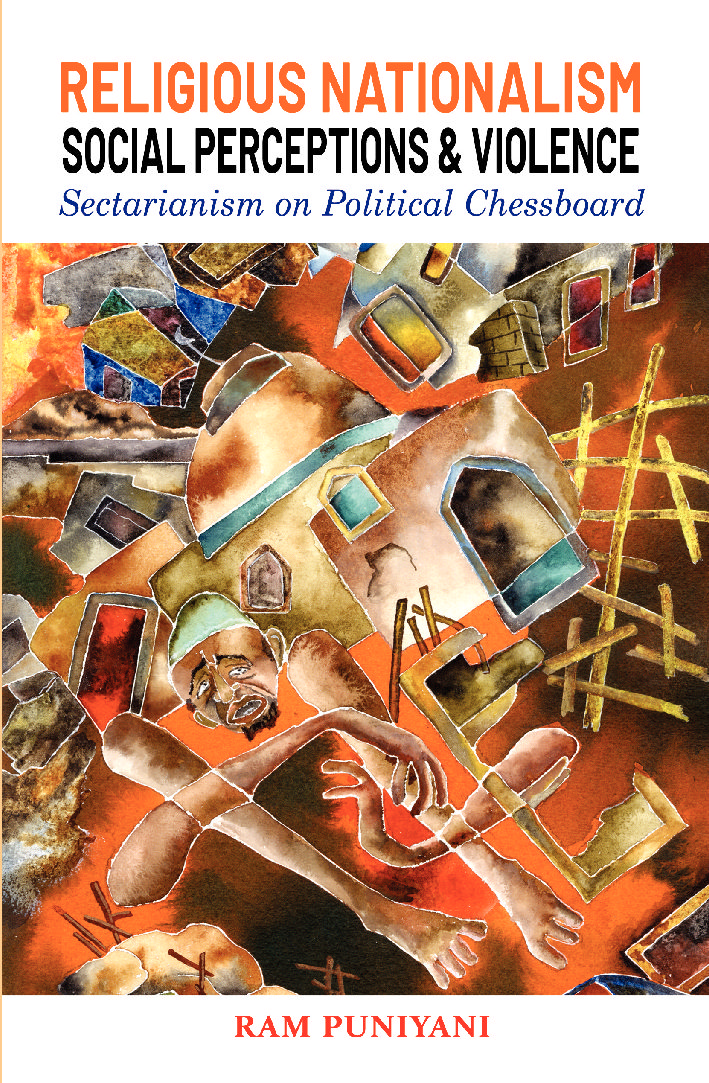
Corporate Social Media in India: Sell Hate, Enjoy Profit

The bias that social media platforms such as Facebook display reflects their own world-view as much as it does the regimes they support.

Corporate Social Media in India

A few gave the appearance of being truly psychopathic individuals. The mass of others were ragged and illiterate peasants easily roused to hatred of the Tutsi. Perhaps the most sinister people I met were the educated political elite, men and women of charm and sophistication who spoke flawless French and who could engage in long philosophical debates about the nature of war and democracy. But they shared one thing in common with the soldiers and the peasants: they were drowning in the blood of their fellow countrymen.

Fergal Kane, a journalist with the BBC, wrote these chilling lines in his book, Season of Blood: A Rwandan Journey, winner of the Orwell prize in 1995. The organised and planned killing in Rwanda, one of the darkest episodes of the 20th century, resulted in the death of eight lakh Tutsi.

It is a strange coincidence that a year and a half before these unfortunate developments, the biggest democracy in the world went through its own cataclysmic moment, when Hindutva supremacist forces demolished a 500-year-old mosque after a long and bloody campaign. Even after the demolition large-scale communal riots broke out all over India, in which thousands died and whose scars are still difficult to heal.

There is at least one thing in common between what Rwanda went through and what India witnessed in 1992: both tragedies demonstrated how the media can prepare and provoke ordinary people into unleashing untold miseries on their neighbours. Continue reading Corporate Social Media in India: Sell Hate, Enjoy Profit

To Sir, With Love – Birthday Greetings for Professor Hany Babu From His Students

Our Professor turned 54 on August 16, while in the custody of NIA. Prof. Hany Babu M.T. from the Department of English, University of Delhi was arrested on July 28 by the NIA in a series of ongoing harassment of academics, and activists who have been vocal against the government and its policies. This act of suppressing dissenting voices in academic spaces by the State threatens the very fabric of the Indian democracy. Prof. Babu has been a strong advocate for social justice, and has worked strenuously in the anti-caste movement. As a professor of linguistics, his classes have always been about demanding an equal space for the varying languages in India and looking at English as an emancipatory language. His teachings have made, and continue to make students critically approach caste supremacy hidden within the rubric of the Indian language structure. He has always highlighted the need for equality amongst language, and language speakers.
Continue reading To Sir, With Love – Birthday Greetings for Professor Hany Babu From His Students

Intimations of a Bahujan Counter-Tradition and the Hindu Right

This post should be read as a sequel to my earlier post of 16 July, which had discussed the discourse of “Hindu Unity” and questions  before the struggle against the Right. That post had ended with the claim that the struggle against the Hindu Right is not so much about what we understand as “secularism” as it is about the reconstruction of a larger  Bahujan counter-tradition, the search for which was  already on.

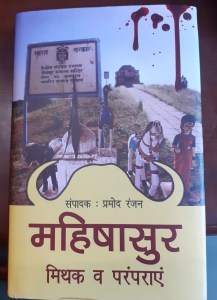
Cover of book Mahishasur – Mithak va Paramaprayen [Myths and Traditions],ed. Pramod Ranjan
I should begin with a caveat, or more correctly, an amendment to a position I adopted in the earlier post. In that piece, I had used the terms “anti-majoritarian” discourse and “anti-majoritarianism” to refer to the the larger discursive formation against the Hindu Right. I used that expression largely because I went along part of the way with Abhay Dubey who uses it in his book, to which that piece was a response. However, that expression assumes that there is only one “majority”  or only one way of imagining majority in this country. More importantly, it concedes a certain “natural pre-givenness” to the project of Hindu unity as though that were a self-evident fact. The only thing that makes the project of Hindu unity appear so “natural”, it needs to be underlined, is that it is backed by “tradition” and “religion” in a way that say a class notion of majority is not. If we assume that the dominant tradition is the sole tradition, then this term could make sense but as the  stirrings of a renewed search for a Bahujan counter-tradition, especially in North India, come into view, it gives us a sense of another possible way of imagining “majority”.  It should be underlined here that this renewed search today does not emerge out of the blue from nowhere but draws on the work of earlier medieval thinkers and social/ religious reformers not just in the North (for instance Kabir, Ravi Das and Nanak) but also from Phule, Ayyankali, Sri Narayana Guru, Periyar, Iyothee Thass and many others in the South in more recent times. There is one difference however: rather than use the negative descriptor “Non-Brahmin”, the present search is more explicitly about the production of a Bahujan identity. Ambedkar of course, remains a continuous reference point in this discourse.

Continue reading Intimations of a Bahujan Counter-Tradition and the Hindu Right

“लहू से मेरी पेशानी पे हिंदुस्तान लिख देना” – सलाम राहत इंदौरी साहब, अलविदा

Agha Ashraf Ali – The Flamboyant Kashmiri Story-teller: Jamal Kidwai

Guest post by JAMAL KIDWAI

Agha Sahab ( Agha Ashraf Ali), passed away at the age of 94 on the 7th of  August, 2020.

Agha Ashraf Ali

I was lucky to know Agha Sahab closely because of his intimate connection with Jamia Millia Islamia and our long standing family friendship. He would come down to Delhi in the winter and spend a lot of time at my parents home, drinking tea in the winter sun. But I got to know him as a friend when I started visiting Srinagar from 1999 onwards, for programmes being conducted being by the  NGO I worked with . My trips would remain incomplete if I did not visit him.

Continue reading Agha Ashraf Ali – The Flamboyant Kashmiri Story-teller: Jamal Kidwai

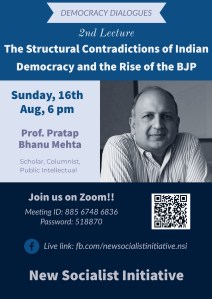
The Structural Contradictions of Indian Democracy and the Rise of the BJP : Prof Pratap Bhanu Mehta

[Democracy Dialogues Lecture Series ( Webinar)
Organised by New Socialist Initiative]

Date and Time: Sunday, August 16, 2020, at 6 PM IST (8.30 AM EST in the US)


Topic: The Structural Contradictions of Indian Democracy and the rise of the BJP

Abstract:

This talk explores the deep social transformations that have made the dominance of the BJP possible. It will take a longer view of the trajectory of Indian democracy and explore the profound changes in social and economic identities underway that have prepared a propitious ground for the rise of the BJP.

The Speaker: Prof Pratap Bhanu Mehta

Internationally renowned scholar and political scientist Prof Pratap Bhanu Mehta taught at Harvard, at New York University and at JNU. He was the Vice Chancellor of the Ashoka University till recently and served as the President of the premier think tank, Centre for Policy Research. Educated at Oxford and a Ph.D. from Princeton University, Prof Mehta is a columnist at Indian Express, a leading public intellectual and a bold and thoughtful voice for reason and justice. Among many honours and prizes to his credit, he is recipient of the Infosys Prize, the Adisheshiah Prize and the Amartya Sen Prize.

[New Socialist Initiative Presents
Democracy Dialogues – Lecture Series

The idea behind this series – which we call ‘Democracy Dialogues’ – is basically to initiate as well as join in the on-going conversation around this theme in academic as well as activist circles.

We feel that the very idea of democracy which has taken deep roots across the world, has come under scanner for various reasons. At the same time we have been witness to the ascendance of right-wing forces and fascistic demagogues via the same democratic route. There is this apparently anomalous situation in which the spread and deepening of democracy have often led to generating mass support for these reactionary and fascistic forces.

Coming to India, there have been valid concerns about the rise of authoritarian streak among Indians and how it has helped strengthen BJP’s hard right turn. The strong support for democracy here is accompanied by increasing fascination towards majoritarian-authoritarian politics. In fact, we would like to state that a vigorous electoral democracy here has become a vehicle for hindutva-ite counterrevolution.

The inaugural lecture in the series was delivered by Prof Suhas Palshikar on 12 th July 2020. The theme of Prof Palshikar’s presentation was  TRAJECTORY OF INDIA’S DEMOCRACY AND CONTEMPORARY CHALLENGES]


एक अनोखी रात: मुरीद बरघूती/अनुवाद: आयेशा किदवई

You can see the English translation by Radwa Ashour of the original poem in Arabic by the Palestinian poet Mourid Barghouti , after this translation into Hindustani by AYESHA KIDWAI

एक अनोखी रात

उसकी उंगली दरवाज़े की घंटी को बस छूनेवाली है

दरवाज़ा, बहुत ही आहिस्ता आहिस्ता,

खुलता है.

वो अंदर आता है.

अपने कमरे में जाता है.

है तो, यहां:

उसकी तस्वीर, उसके नन्हे से पलंग के बराबर

उसका स्कूल का बस्ता, अँधेरे में,

जागता हुआ.

अपने आप को सोते हुए देखता है

दो ख़्वाबों के दरमियाँ, दो झंडों के.

वो सभी दरवाज़ों को खटखटाता है

— खटखटाने वाला था. पर नहीं.

सब उठ जाते हैं:

“लौट आया!”

“ख़ुदा कसम, लौट आया!,” चिल्लाते हैं

पर उनके शोर से कोई आवाज़ नहीं मचती.

बाहें फैलाते हैं मोहम्मद को समेटने के लिए

पर उनके हाथ उसके कन्धों तक पहुंचते नहीं. Continue reading एक अनोखी रात: मुरीद बरघूती/अनुवाद: आयेशा किदवई

केन्द्रीय विश्वविद्यालय: वर्चस्वशाली जातियों के नए ठिकाने ?

अगर हम प्रोफेसरों के पदों की बात करें तो यूजीसी के मुताबिक अनुसूचित जाति से आने वाले प्रत्याशियों के लिए आरक्षित 82.82 फीसदी पद, अनुसूचित जनजाति तबके से आने वाले तबकों के लिए आरक्षित 93.98 फीसदी पद और अन्य पिछड़ी जातियों के लिए आरक्षित 99.95 फीसदी पद आज भी खाली पड़े हैं। असोसिएट प्रोफेसर के पदों की बात करें तो स्थिति उतनी ही खराब दिखती है: अनुसूचित जातियों के लिए आरक्षित 76.57 फीसदी पद, अनुसूचित जनजातियों के लिए आरक्षित 89.01 फीसदी पद और अन्य पिछड़ी जातियों के लिए आरक्षित 94.30 फीसदी पद खाली पड़े हैं।

क्या हम कभी जान सकेंगे कि मुल्क के चालीस केन्द्रीय विश्वविद्यालयों में नियुक्त उपकुलपतियों के श्रेणीबद्ध वितरण- अर्थात वह किन सामाजिक श्रेणियों से ताल्लुक रखते हैं- के बारे में ?

शायद कभी नहीं !

विश्वविद्यालय अनुदान आयोग के केन्द्रीय विश्वविद्यालय ब्युरो में ऐसे कोई रेकॉर्ड रखे नहीं जाते।

किसी बाहरी व्यक्ति के लिए इन सूचनाओं का अभाव बेहद मामूली लग सकता है अलबत्ता अगर हम अधिक गहरे में जाकर पड़ताल करें तो हम पूछ सकते हैं कि सर्वोच्च पदों की यह कथित ‘जातिविहीनता’ का सम्बन्ध क्या इसी तथ्य से जोड़ा जा सकता है कि इन चालीस विश्वविद्यालयों में- सामाजिक और शारीरिक तौर पर हाशिये पर रहने वाले तबकों से आने वाले अध्यापकों की मौजूदगी नगण्य है। फिर वह चाहे अनुसूचित जाति, जनजाति हो या अन्य पिछड़ी जातियां हो या विकलांग तबके से आने वाले लोग हों। इन तबकों की इन पदों से साद्रश्यता के अभाव का अन्दाज़ा इस बात से लगाया जा सकता है कि इन श्रेणियों से आने वाले तबकों के लिए आरक्षित प्रोफेसरों के 99 फीसदी पद आज भी खाली पड़े हैं।

दिल्ली विश्वविद्यालय के एक कालेज में, एडहॉक/तदर्थ अध्यापक के तौर पर कार्यरत लक्ष्मण यादव द्वारा विश्वविद्यालय अनुदान आयोग को सूचना अधिकार के तहत जो याचिका दायर की गयी थी, उसी के औपचारिक जवाब के तौर पर ऐसे कई सारे अचम्भित करने वाले तथ्य सामने आए हैं। अगर हम प्रोफेसरों के पदों की बात करें तो यूजीसी के मुताबिक अनुसूचित जाति से आने वाले प्रत्याशियों के लिए आरक्षित 82.82 फीसदी पद, अनुसूचित जनजाति तबके से आने वाले तबकों के लिए आरक्षित 93.98 फीसदी पद और अन्य पिछड़ी जातियों के लिए आरक्षित 99.95 फीसदी पद आज भी खाली पड़े हैं। अगर हम असोसिएट प्रोफेसर के पदों की बात करें तो स्थिति उतनी ही खराब दिखती है: अनुसूचित जातियों के लिए आरक्षित 76.57 फीसदी पद, अनुसूचित जनजातियों के लिए आरक्षित 89.01 फीसदी पद और अन्य पिछड़ी जातियों के लिए आरक्षित 94.30 फीसदी पद खाली पड़े हैं। असिस्टेंण्ट प्रोफेसर पद के लिए आरक्षित पदों के आंकड़े उतने खराब नहीं हैं जिसमें अनुसूचित जातियों के लिए आरक्षित 29.92 फीसदी पद, अनुसूचित जनजातियों के लिए आरक्षित 33.47 फीसदी पद और अन्य पिछड़ी जातियों के लिए आरक्षित 41.82 फीसदी पद खाली पड़े हैं। (देखें- मीडिया विजिल की रिपोर्ट)

Continue reading केन्द्रीय विश्वविद्यालय: वर्चस्वशाली जातियों के नए ठिकाने ?

Are Central Universities Modern-Day Agraharams?

A caste-based society will overcome legal codes that make equality the norm unless people actively bring change.

Are Central Universities

Will we ever know the category-wise distribution of vice chancellors of the forty central universities located across the country? Thanks to the rules governing these universities, and those of the University Grants Commission, there is no such record.

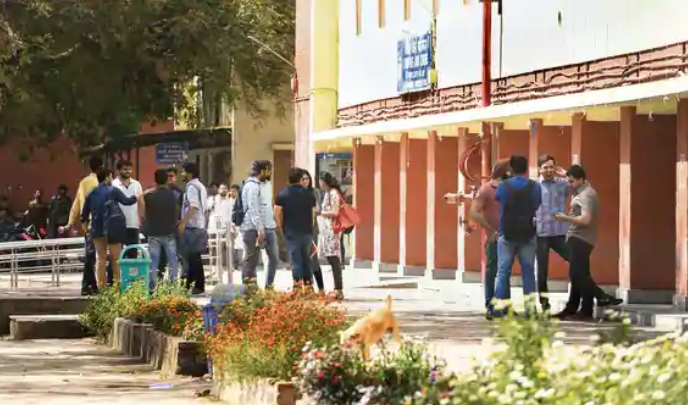
This form of “castelessness” at the top is coupled with marginal representation of teachers from socially and physically marginalised sections. Be it the Scheduled Castes, Scheduled Tribes the Other Backward Classes or persons with disabilities, they are hardly ever appointed to teaching posts in central universities. A marker of the invisibilisation of these social groups is the fact that up to 96.65% of the posts of professor meant for candidates from these categories were unfilled on 1 January 2020.

This was discovered by a Delhi University teacher, who sought the information from the UGC under the Right to Information Act. More than 82% posts of professors meant for Scheduled Caste candidates, 93.98% posts meant for Scheduled Tribes and 96.65% posts meant for OBCs still remain vacant. The situation for associate professors is equally dismal, though there are fewer vacant posts of assistant professors for OBCs.

Any news can go viral these days but this explosive disclosure, which raises questions about recruitment procedures and their inherent biases was barely noticed. An explanation is that such news has lost its novelty. Perhaps everybody is aware of the metamorphosis of central universities into a new kind of Agraharam or abode of elite castes.

( Read the full article here)

“There is no god in that temple”: Rabindranath Tagore/Translated by Banojyotsna Lahiri

Banojyotsna Lahiri shared her translation of some excerpts from  a poem by Rabindranath Tagore, written 120 years ago, titled “Deeno Daan”.

It is about a temple.

Original Bangla below the translation.

“There is no god in that temple”, said the Saint.

The King was enraged;
“No God? Oh Saint, aren’t you speaking like an atheist?
On that throne studded with priceless gems, beams the golden idol,
And yet, you proclaim that it is empty?”

“It is not empty; rather, it is full of royal pride.
You have bestowed yourself, oh King, not the God of this world”,
Remarked the saint.

The King frowned, “2 million golden coins
were showered on that grand structure that kisses the sky,
I offered it to the Gods after performing all the necessary rituals,
And you dare claim that in such a grand temple,
There is no presence of God”? Continue reading “There is no god in that temple”: Rabindranath Tagore/Translated by Banojyotsna Lahiri

क्या राम मंदिर की आड़ में अपनी विफलताएं छिपा रही है मोदी सरकार

यह मानने के पर्याप्त आधार हैं कि राम मंदिर के भूमि पूजन के लिए चुना गया यह समय एक छोटी रेखा के बगल में बड़ी रेखा खींचने की क़वायद है, ताकि नरेंद्र मोदी और उनकी सरकार की बढ़ती असफलताएं जैसे- कोविड कुप्रबंधन, बदहाल होती अर्थव्यवस्था और गलवान घाटी प्रसंग- इस परदे के पीछे चले जाएं.

Ayodhya: A hoarding of PM Narendra Modi and other leaders put up beside a statue of Lord Hanuman, ahead of the foundation laying ceremony of Ram Temple, in Ayodhya, Thursday, July 30, 2020. (PTI Photo)(PTI30-07-2020 000044B)

अयोध्या में राम मंदिर के भूमि पूजन से पहले लगा प्रधानमंत्री नरेंद्र मोदी और अन्य नेताओं का एक होर्डिंग. (फोटो: पीटीआई)

बीते दिनों जनाब उद्धव ठाकरे द्वारा अयोध्या में राम मंदिर के प्रस्तावित भूमि पूजन को लेकर जो सुझाव दिया गया है, वह गौरतलब है.

मालूम हो कि आयोजकों की तरफ से जिन लोगों को इसके लिए न्योता दिया गया है, उसमें महाराष्ट्र के मुख्यमंत्री का नाम भी शामिल है, उसी संदर्भ में उन्होंने इस बात पर जोर दिया है कि ‘ई-भूमि पूजन किया जा सकता है और भूमि पूजन समारोह को वीडियो कॉन्फ्रेंसिंग के जरिये भी अंजाम दिया जा सकता है.’

उनका कहना है कि इस कार्यक्रम में लाखों लोग शामिल होना चाहेंगे और क्या उन्हें वहां पहुंचने से रोका जा सकता है? कोरोना महामारी को लेकर देश-दुनिया भर में जो संघर्ष अभी जारी है और जहां धार्मिक सम्मेलनों पर पाबंदी बनी हुई है, ऐसे में उनकी बात गौरतलब है.

गौर करें कि ऐसा आयोजन जिसका लाइव टेलीकास्ट भी किया जाएगा, कोई चाहे न चाहे देश में जगह जगह जनता के अच्छे-खासे हिस्से को सड़कों पर उतरने के लिए प्रेरित करेगा.

और अगर दक्षिणपंथी जमातें इस बारे में अतिसक्रियता दिखा दें तो फिर जगह जगह भीड़ बेकाबू भी हो सकती है और केंद्र सरकार और गृह मंत्रालय द्वारा जारी गाइडलाइंस की भी धज्जियां उड़ सकती हैं.

( Read the complete article here)


गैर-दक्षिणपंथी विचारकों के आत्ममंथन का घोषणा पत्र है अभय दुबे की पुस्तक : अरविंद कुमार

Guest post by ARVIND KUMAR

अभय दुबे की पुस्तक हिन्दू एकता बनाम ज्ञान की राजनीति पर जारी बहस में एक योगदान।

दि प्रिंट में 8 जुलाई 2020 को  योगेंद्र यादव का लेख ‘भारतीय सेक्युलरिज्म पर हिन्दी की यह किताब उदारवादियों की पोल खोल सकती थी मगर नज़रअंदाज़ कर दी गई है’, अभय दुबे की पुस्तक को केंद्र मे रखकर लिखा गया है.  उन्होनें लिखा: “अगर अभय की किताब के तर्क उन सेकुलर बुद्धिजीवियों के कान तक टहलकर नहीं पहुंचे जिनके लिखत-पढ़त की उन्होंने आलोचना की है तो इसकी वजह को पहचान पाना मुश्किल नहीं. वजह वही है जिसे अभय ने अपनी किताब में रेखांकित किया है कि भारत के अँग्रेज़ीदाँ मध्यवर्ग की सेकुलर-लिबरल विचारधारा और देश के शेष समाज के बीच सोच समझ के धरातल पर एक खाई मौजूद है.” योगेंद्र के लेख के जवाब में, दि प्रिंट में ही 15 जुलाई को राजमोहन गांधी का लेख ‘भारत में धर्मनिरपेक्षता की विचारधारा पराजित नहीं हुई है, इसके पैरोकारों को आरएसएस  पर दोष मढ़ना बंद करना होगा’ पढ़कर संतोष और असंतोष दोनों हुआ. संतोष इसलिए कि योगेंद्र के आग्रह पर बुद्धिजीवियों ने बहस को आगे बढ़ाने की पहल तो की. इसी कड़ी में 16 जुलाई 2020 को काफ़िला में छपा आदित्य निगम का लेख ‘डिसकोर्स ऑफ हिन्दू युनीटी इन द स्ट्र्गल अगेन्स्ट द राइट’ को भी देखा जा सकता है.

Continue reading गैर-दक्षिणपंथी विचारकों के आत्ममंथन का घोषणा पत्र है अभय दुबे की पुस्तक : अरविंद कुमार

आज़ाद जनतंत्र में सत्तर साल बाद भी वेल्लोर से विरमगाम तक श्मशान भूमि से वंचित हैं दलित

क्या कोई जानता है 21वीं सदी की शुरुआत में चकवारा के दलितों के एक अहम संघर्ष को? जयपुर से बमुश्किल पचास किलोमीटर दूर चकवारा के दलितों ने गांव के सार्वजनिक तालाब पर समान हक पाने के लिए इस संघर्ष को आगे बढ़ाया था। अठारह साल का वक्फा गुजर गया जब दलितों ने इस संघर्ष में जीत हासिल की थी, जिसमें तमाम मानवाधिकार संगठनों एवं प्रगतिशील लोगों ने भी उनका साथ दिया था। (सितम्बर 2002)

विश्लेषकों को याद होगा कि इस संघर्ष में तमाम लोगों को डॉ. अम्बेडकर द्वारा शुरू किए गए ऐतिहासिक महाड़ सत्याग्रह की झलक दिखायी दी थी जब मार्च 1927 में हजारों दलित एवं अन्य मानवाधिकारप्रेमी महाड़ के चवदार तालाब पर जुलूस की शक्ल में गए थे और वहां उन्होंने पानी पीया था। जानवरों को वहां पानी पीने से कोई मना नहीं करता था, मगर दलितों को रोका जाता था। (ज्‍यादा जानकारी के लिए देखें: Mahad – The Making of the First Dalit Revolt – Dr Anand Teltumbde, Navayana)

चकवारा में बाद में क्या हुआ इसके बारे में तो अधिकतर लोग नहीं जानते होंगे।

Continue reading आज़ाद जनतंत्र में सत्तर साल बाद भी वेल्लोर से विरमगाम तक श्मशान भूमि से वंचित हैं दलित

No End to Humiliation of Dalits Even After Death

The attitude of respect and reverence towards fellow men is yet to develop in India.

No End to Humiliation of Dalits

Does anybody still remember the Dalits of Chakwara, a village around 50km from Jaipur in Rajasthan, who had launched a struggle to gain access to the pond in their village? It is more than 18 years since the Dalits, supported by human rights organisations, won that fight for water. Their undertaking had echoes with the historic struggle launched by Dr BR Ambedkar in March 1927 at Chavdar tank at Mahad to assert the equal rights of Dalits to water. It is well known to most people that while animals were allowed to use the water of this tank in present-day Raigad district of the state, the Dalits were not. Anand Teltumbde has described the events of this satyagraha in his book, Mahad: The Making of the First Dalit Revolt, published by Navayana in 2016.

But what happened at Chakwara after the Dalits started using the village pond is hardly known: the upper castes slowly stopped using the water from the pond once the Dalits gained access to it, saying it had become “impure”. Enraged by the assertion of the Dalits and keen to humiliate them for it, they dug up the village sewer and directed the waste water to their own village pond. There is no change in the status quo there.

Around 700km away, in Viramgam near Ahmedabad in Gujarat, a village cemetery used by Dalits was recently flooded with sewer water, a stark reminder that the gap of two decades has not changed the caste scenario in the country. The executioners of this sinister plan in Viramgam were the residents of two housing societies in which the well-off and educated middle classes live. For more than the last six months, the graves of the socially-disadvantaged Vankar, Chamar, Rohit, Dangasia, Shetwa and other communities have been surrounded by dirty water. The district administration did not intervene on behalf of the Dalits despite their repeated complaints. The fact that dignity after death is being denied to marginalised communities did not seem to rouse the administration.

( Read the full text here)

Rest In Power John Lewis

John Lewis ( 21 February 1940 – 17 July 2020)

Legendary Civil Rights leader John Lewis died on 17 th July 2020.

An analyst wrote ”Lewis, a titan of the civil rights movement, died on Friday at the age of 80, severing a vital link with the generation that rose in the 60s to resist the US’s version of racial apartheid. The news was met with a depth of grief normally reserved for former presidents. Lewis transcended party politics and was truly admired and beloved.”

A state trooper beats John Lewis with a club

A state trooper beats John Lewis (kneeling, right) with a club in Selma, Alabama, in 1965. Lewis sustained a fractured skull in the assault. Photograph: unknown/AP

A CNN documentary entitled John Lewis: Good Trouble, quotes him: “I tried to do what was right, fair and just. When I was growing up in rural Alabama, my mother always said, ‘Boy, don’t get in trouble … but I saw those signs that said ‘white’, ‘colored’, and I would say, ‘Why?’

“And she would say again, ‘Don’t get in trouble. You will be beaten. You will go to jail. You may not live. But … the words of Dr King and the actions of Rosa Parks inspired me to get in trouble. And I’ve been getting in trouble ever since. Good trouble. Necessary trouble.”


Imagining India for Contemporary Politics- What Should the Left Do? : Ravi Sinha


(Webinar – Sunday, July 19, 5 pm)

Shakespeare said, what is past is prologue. A simple-minded rationalist may be contented to assume that past is fixed as it has already gone into the making of the present. Nothing can be done to change it. The truth however is that past is being ‘remade’ every day. Imaginations of ancient glories or of humiliating defeats in the distant past are being deployed in contemporary politics all across the world. This phenomenon has been a key element behind the resurgence of rightwing in many countries. Contemporary India is a calamitous example where a perverse variant of mass-democratic politics has been fashioned through the political ideology of Hindutva resulting in serious damage to democracy and to people’s welfare.

Contemporary politics is driven more pressingly to such ideological re-imaginings in the conditions of vigorously competitive electoral democracies. The phenomenon is far more pronounced in countries with a significant minority (religious, racial, linguistic-cultural etc.) that can be portrayed as a historical villain. The majority can, then, be mobilized through the political process of polarisation in which some historical-civilizational-social tectonic plate is deployed in the service of electoral-political objectives. India is a pre-eminent example of this tragic phenomenon.

Invariably, left and progressive forces find themselves handicapped in these circumstances. Attempts to prove that such polarising strategies based on re-imagining the past are malignant turn out to be politically ineffective. A typical response from such forces has been to counter the emotive with the economic and to challenge cultural nationalism with anti-colonial, anti-imperialist nationalism. These strategies have failed miserably. Other social and resistance movements too have attempted partial re-imagining of India’s past from the standpoint of traditionally oppressed communities (Dalit, feminist, native-ist, etc.). While offering some resources to the respective movements, these efforts have failed equally miserably in challenging the Hindutva’s cultural nationalism. The efforts of some of the liberal bourgeois forces, on the other hand, to gain ground by partly imitating the Hindutva forces (variants of soft hindutva) have been no more than a laughing stock. Continue reading Imagining India for Contemporary Politics- What Should the Left Do? : Ravi Sinha

Discourse of Hindu Unity and Challenges in the Struggle Against the Right


In a recent book Hindu Ekta Banaam Gyan ki Rajneeti [Hindu Unity versus the Politics of Knowledge] (Vani 2019), my colleague and friend Abhay Kumar Dubey raises some extremely important issues that have now become central to the struggle for a more just and inclusive India. The book is in Hindi and written in the highly provocative and combative style that characterizes most of Abhay’s writings but there is something profundly disturbing – and enlightening – about the key point that  he has to make. In this brief piece I discuss it here for the benefit of the non-Hindi reader (which is not the same as ‘English-speaking’ or ‘English-educated’). However, those who understand Hindi and are interested can watch the 42-minute discussion between Abhay Dubey and myself (recorded in Janaury this year) for the Youtube book discussion channel Parakh run by Kamal Nayan Choubey. The video is embedded this post below.

The central concern of the book is with certain blindspots in what Abhay calls the ‘Centrist discourse’ [madhyamargi vimarsh] or interchangeably, ‘anti-majoritarian discourse’ [bahusankhyakvaad virodhi vimarsh] – which, for some reason, has been rendered as ‘secular ideology’ by Yogendra Yadav in a recent piece in The Print. (Yadav’s piece and Rajmohan Gandhi’s response in defense of ‘secular ideology’ can he read here and here). In keeping with Abhay’s usage, I will use the term ‘anti-majoritarian’ rather than ‘secular’ discourse for this specific configuration that emerges in the the 1990s, for as we will see, this is not a simple continuation of the secular discourse of the 1980s. For the earlier discursive formation, however, I will continue to use the term secular and we will see below how the two differ.

The blindspots that Abhay insistently and relentlessly draws the readers’ attention to, have to do with the very superficial and often hugely misleading understanding of the Rashtriya Swayamsevak Sangh (RSS) and its deeper connections with the much longer and larger history of the project of forging ‘Hindu unity’.

Continue reading Discourse of Hindu Unity and Challenges in the Struggle Against the Right

Cisco Case Shows Indians Still Take Caste Where they Go

How discrimination is integrated into the daily lives of the Indian diaspora still needs to be understood.

Cisco Case Shows Indians

What happens to caste when Indians migrate to Western countries? Do their feelings of being born superior or inferior, their belief in the purity-pollution ethic, just melt away? The “model minority” has tried to avoid a conversation on this issue but it returns to haunt them time and again. Now the American state of California is at the centre of yet another caste controversy.

The last serious discussion around Indian-Americans and caste took place in 2015, when the California State Board of Education initiated a regular ten-year public review of the school curriculum framework. The conservative Hindu American Foundation (HAF) and the South Asian Histories for All Coalition (an interfaith, multi-racial, inter-caste coalition) clashed over HAF’s proposed interventions, which essentially sought to erase caste from the syllabus. The Coalition took the position that evidence and record of the injustices of caste and religious intolerance in South Asian must not be erased.

( Read the full article here)

सलाह: मुरीद बरघूती/अनुवाद: आयेशा किदवाई

You can read the English translation by Radwa Ashour, of Palestinian poet Mourid Barghouti’s poem Counsel, below this translation into Hindustani by AYESHA KIDWAI

“La reproduction interdite” by Rene Magritte 1937.

सलाह 

हैरत ज़दा, असमंजस में,

उस ने हमें बुलवाया

और हम हाज़िर हुए.

उसकी संगेमरमर की बालकनी के तले खड़े हुए:

दुखी लग रहा था वो.

हाथ लरज़ रहे थे

जब से एक ज्योतिष ने उस से ये कह दिया था

किसी की सलाह नहीं लोगे, तो मौत पक्की है“. Continue reading सलाह: मुरीद बरघूती/अनुवाद: आयेशा किदवाई

जातिगत भेदभाव को लेकर कब ख़त्म होगा भारतीयों का दोहरापन

भारतीयों के मन में व्याप्त दोहरापन यही है कि वह ऑस्ट्रेलिया में भारतीय छात्रों पर होने वाली ज़्यादतियों से उद्वेलित दिखते हैं, पर अपने यहां के संस्थानों में आए दिन दलित-आदिवासी या अल्पसंख्यक छात्रों के साथ होने वाली ज़्यादतियों को सहजबोध का हिस्सा मानकर चलते हैं.

(फोटो: रॉयटर्स)

(फोटो: रॉयटर्स)

‘जाति समस्या- सैद्धांतिक और व्यावहारिक तौर पर एक विकराल मामला है. व्यावहारिक तौर पर देखें तो वह एक ऐसी संस्था है जो प्रचंड परिणामों का संकेत देती है. वह एक स्थानीय समस्या है, लेकिन एक ऐसी समस्या जो बड़ी क्षति को जन्म दे सकती है. जब तक भारत में जाति अस्तित्व में है, हिंदुओं के लिए यह संभव नहीं होगा कि वह अंतरजातीय विवाह करें या बाहरी लोगों के साथ सामाजिक अंतर्क्रिया बढ़ाएं. और अगर हिंदू पृथ्वी के दूसरे हिस्सों में पहुंचते हैं, तो फिर भारतीय जाति विश्व समस्या बनेगी.’

– डॉ. बीआर आंबेडकर (1916)

वर्ष 1916 के मई महीने में कोलंबिया विश्वविद्यालय में मानव वंशशास्त्र विभाग में सेमिनार में डॉ. आंबेडकर ने ‘भारत में जाति- उनकी प्रणाली, उनका उद्गम और विकास’ (Castes In India- Their Mechanism, Genesis and Development) पर अपना पेपर पढ़ा था.

पेपर पढ़ते हुए उन्होंने इस बात की भविष्यवाणी की थी कि किस तरह एक दिन जाति विश्व समस्या भी बनेगी, उनके बोल थे, ‘अगर हिंदू दुनिया के दूसरे हिस्सों में पहुंचते हैं, तो फिर भारतीय जाति विश्व समस्या बनेगी.’

उनके इस वक्तव्य के 104 साल बाद उसी अमेरिका के कैलिफोर्निया से आई यह खबर इसी बात की ताईद करती है.

ध्यान रहे कैलीफोर्निया राज्य सरकार की तरफ से वहां की एक अग्रणी बहुदेशीय कंपनी सिस्को सिस्टम्स के खिलाफ दायर एक मुकदमे के बहाने यही बात नए सिरे से उजागर हुई है, जिसका फोकस वहां कार्यरत एक दलित इंजीनियर के साथ वहां तैनात दो कथित ऊंची जाति के इंजीनियर द्वारा जातिगत भेदभाव की घटना से है. Continue reading जातिगत भेदभाव को लेकर कब ख़त्म होगा भारतीयों का दोहरापन

लो मैं उठी: माया एंजलो/अनुवाद: निवेदिता मेनन

MAYA ANGELOU recites her iconic poem Still I Rise, followed by the translation into Hindustani by NIVEDITA MENON below.


चाहे लिख दो मेरी कहानी,

झूठी, विकृत, कडवी सी,

चाहे कुचलो   मिट्टी में,

उड़ जाऊंगी,  धूल जैसी।


मेरी गुस्ताखी से हो नाराज़?

क्या इतना दुःख है दिल में?

मेरी चाल का यह गुरूर,

मानो तेल के कुँए बैठक में।

Continue reading लो मैं उठी: माया एंजलो/अनुवाद: निवेदिता मेनन