Category Archives: Culture

Against Aachaaram : Kuttippuzha Krishna Pillai on the veneration of Parasurama

This is the fourth in a series titled Against Aachaaram: A Dossier from Malayalam on Kafila. The note below is by J Devika. The excerpt from the essay by Kuttippuzha Krishna Pillai is translated by UTHARA GEETHA.

The formation of the linguistic state of Kerala was the culmination of a long process of negotiation around Malayalam as a common cultural ethos for the new Malayali. It ultimately became a battle-ground on which the defenders and opponents of aachaaram clashed.  Aachaaram – and the brahmin-sudra nexus – had taken a sound beating when the avarna rose up against these in the late 19th and early 20th centuries. However, both these did not go under. Instead, they were transformed – aachaaram was put through the seive of Victorian values, and the part of it that survived this process was hailed as the ‘quintessence’ of Malayali Hindu culture. The brahmin-sudra social contract, long existent as the major axis of both exploitation and oppression in the Malayalam-speaking regions, was soon resurrected as ‘savarna Hindu’. This new elite defined itself in terms of the newly-recovered ‘ Malayali Hindu cultural essence’.

One important way this elite and this insidious cultural identity manoeuvred itself into public discourse was by depicting itself as the cultural core of the new United Kerala. However, the best of Malayali intellectuals of the time, especially the poets — Balamani Amma, Vailoppilly Sreedhara Menon, Edassery Govindan Nair, and even P Kunhiraman Nair – crafted a vision of Kerala that was still rooted in many ways in local culture, nature and ethos, but was removed from aachaaram and its despicable connotations. The degree to which they succeeded in this, and their level of commitment to the destruction of aachaaram varied, but there was a general effort to seek other cultural moorings for the New Kerala. The most prominent of the moves made in this direction was perhaps the resurrection of the myth of the Asura King Maveli and the reimagining of Onam around him, rather than Vamana.

In the excerpt below, Kuttippuzha Krishna Pillai (1900-1971), one of Malayalam’s finest modern intellectuals and champions of free thought and unfettered conscience, makes a scathing critique of the attempts to sneak aachaaram back into imagination of new Kerala during the discussion about it as a unified cultural entity. He takes unerring aim at an image of the father-figure of aachaaram in Kerala, Parasurama, which was mounted at the entrance to a major conference on United Kerala, held at Thrissur in 1947.

[Kuttippuzha Krishna Pillai, ‘Parasurama chithram’, Kuttippuzhayute Prabandhangal Vol.3, Thrissur: Kerala Sahitya Akademi, 1990, pp.85-88]

The Image of Parasuraman

The newspapers have reported that an image of axe-bearing Parasurama has been installed on the tower at the entrance to the Aikya Kerala Nagar. It would be useful if the organizers explained what they mean by this image. The myth of Parasuraman, in sum, is a tale about his act of gifting the land of Kerala which he created by throwing his axe into the sea to Brahmins, to atone for his sin of having murdered Kshetriyakings twenty-one times. Do the organizers assign any value to this grandmother’s tale? Does this picture or this story contain anything that could inspire the creation of United Kerala in the future? Whatever that may be, there may not be many in these times of the twentieth century who will passively suffer the sight of the coffin of such made-up stories carried out and put on display. This image will only be perceived as a black flag symbolizing superstition and slavery by those who desire freedom. If we confer significance to Parasuraman’s history today, that means accepting ideas that besmear the face of humanity, free conscience and modern science. Let us see what all makes up the story:

  1. A Brahmin with supernatural powers strong enough to create land by drying up the sea with just a throw of his axe lived in India.
  2. The whole of Kerala belongs to the Brahmins according to the heirship granted by the donor.
  3. Redemption from sin is possible through making offerings to Brahmins.
  4. You can be absolved of multiple murders through such offering to Brahmins.
  5. Brahmins are the highest and finest caste and their lives are most valuable.
  6. As the whole of the earth belongs to the Brahmins, other castes are their mere tenants.
  7. Due to the same reason, the ruling powers are also Brahmin.


How many of those celebrating the United Kerala celebrations today at Thrissur believe the notions listed above? We ought to introspect on how these kinds of superstitions have pushed Malayalis, especially Hindus, into utter degradation, and about the many ways in which they were reduced to mere menials of the Brahmins. So many are the aachaaram-procedures and blind beliefs well-established over centuries, that this disgusting servitude has permeated the blood of the Savarna and is now dried up into an ugly stain. The blind aacharam of making offerings to the brahmins has cost the savarna Hindus so many lakhs of rupees! [And yet] isn’t this idiotic practice still embraced by many? Brahmin landlordism has its roots in this story of Parasuraman. How many lakhs of Keralites were exploited by the economic system built upon this! Have they attained freedom from this economic exploitation even today?

Even today, it is upon the slogan Go brahminaibhya shubhamasthu nithyam that the Hindu kings wield their sceptre. Good things should befall the Brahmins and the cows which provide them with milk and butter; to hell with others! Look how deep the Brahminical roots have sunk! Can’t you see its dark shadows on all aspects of a Keralite’s life? This image of Parasurama is in actuality the very slavishness of the savarnas to brahmins sunk deep in their subconscious raising its head. It is a disgraceful self-espoused flag of slavery even to them. When that is the case of the savarna, not to speak of the avarna!  They cannot bear it even for a moment. It is the veritable caste-devil which has given rise of six or seven lakhs of abjected and oppressed people. And this is just about the Hindus. Think about another side. Does ‘Keralite’ only refer to Hindus? What worth does this image of Parasuraman hold for the people belonging to other religions? Do not Christians, Muslims, Jews and other communities have an equal status in United Kerala? The utter inappropriateness of an image of a Brahmin clutching his weapon belligerently, reiterating Brahmanical control over the whole world placed in front of a hall in which the United Kerala conference is held for all Keralites irrespective of religion and caste, is surely worth thinking about. Such images do not encourage friendship among different religious groups. Rather, they sow the seeds of disharmony and competition. Some might strain hard to reinterpret this picture and confer new meaning(s), attempting to connect it to modern ideas. They should understand that the common people would still comprehend it with reference to existing meaning conventions. It is impossible to uproot centuries-old deep-rooted meanings and channels of faith with a new interpretation. Is it not evident that Mahatma Gandhi is failing miserably in his attempts to reinterpret the Varna system and the chanting of Ram’s name as he strives to advocate the unity of all religions and to develop goodwill among Hindus and Muslims? Aren’t the bloodbaths of North India today a result of his journey through this dangerous path for well over twenty-five years? Religion, in its everyday meaning and tradition, would culminate in collective insanity. Gandhiji’s toils only helped to inflame it all the more.

We should particularly remember that people trying to dig up the Aryan culture under new names and forms are manuring religious fanaticisms dormant in humanity. The display of monsters from the past, like this image of Parasurama will result in such ugly outcomes. I think there are already disputes and clashes regarding the same in the newspapers. Only images that inspire brotherhood among over the one and a half crore of Keralites should be exhibited. This image of Parasuraman which proclaims Kerala’senslavementto brahmins and blind belief in religion should hereby be removed immediately. It would be amusing to know how the non-violent followers of Gandhi view this representation of a man who committed murder twenty-one times. As it is, they who are the chief trumpeters of United Kerala. It is also very amusing that the very first sight that will fall upon the Hallowed Eyes of the Rajah of Cochin, who will arrive in honour to inaugurate the conference, will be of a Kshatriya-slayer!!


Uthara Geetha is currently an Erasmus Mundus scholar at the Centre for Women Studies, University of York.

‘ईश्वर नहीं है’ कहने का अधिकार

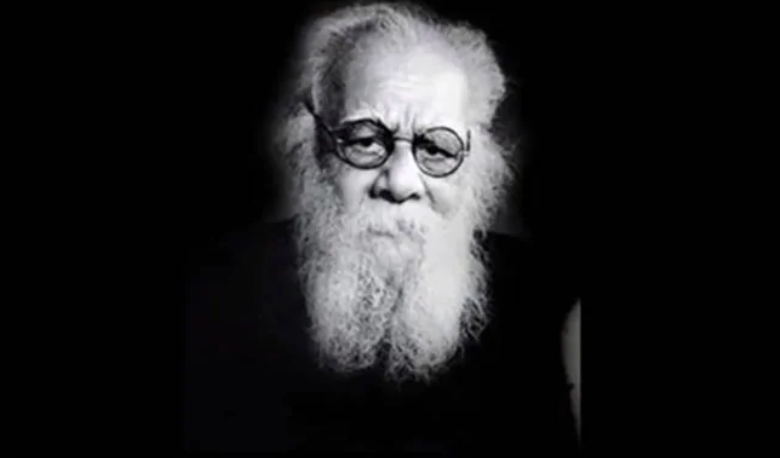
Image result for periyar
Periyar : Image – Courtesy velivada.com

क्या अभिव्यक्ति की स्वतंत्रता का अधिकार महज आस्थावानों के लिए ही लागू होता है ?

कभी कभी साधारण से प्रश्न का उत्तर पाने के लिए भी अदालती हस्तक्षेप की जरूरत पड़ती है।

मद्रास उच्च न्यायालय की – न्यायमूर्ति एस मनिकुमार और सुब्रहमण्यम प्रसाद की – द्विसदस्यीय डिवीजन बेंच को पिछले दिनो ंयह दोहराना पड़ा कि अभिव्यक्ति का अधिकार – जो भारत के संविधान के तहत मिले बुनियादी अधिकारों में शुमार है – सार्वभौमिक है और इसे समयविशेष के बहुमत के आंकड़ों के आधार पर तय नहीं किया जा सकता।

मालूम हो कि किन्ही दैवानायागम ने न्यायालय में यह जनहितयाचिका दाखिल की थी और कहा था कि तमिलनाडु के त्रिची में पेरियार की मूर्ति पर जो नास्तिकता के उद्वरण दिए गए हैं, वह ‘सार्विक ईश्वर’ को माननेवालों के लिए आपत्तिजनक हैं और उन्हें हटा दिया जाए। याद रहे रामस्वामी नायक / 17 सितम्बर 1879-24 दिसम्बर 1973/ जिन्हें ‘पेरियार’ नाम से जाना जाता है, वह आत्मसम्मान आन्दोलन के अग्रणी थे, द्रविड कझगम के संस्थापक पेरियार एक जुझारू किस्म के समाज सुधारक भी थे। याचिकाकर्ता ने मूर्ति पर लिखे उद्धरण के बारे में ‘‘कोई ईश्वर नहीं है, ईश्वर नहीं है और वाकई ईश्वर नहीं है..’ के पेरियार द्वारा कहे जाने पर भी सवाल खड़े किए थे। Continue reading ‘ईश्वर नहीं है’ कहने का अधिकार

There is no God And You Can Say so

Academics focus on secularism when secularisation can save the day.

There is no God And You Can Say so

Image Courtesy : NDTV

A simple query sometimes occasions judicial intervention: Does the right to freedom of expression apply merely to believers? On September 6, the Madras High Court dismissed a Public Interest Litigation filed by M Deivanayagam raising such a question. The petitioner wanted the atheistic inscriptions placed under the statue of Periyar, father of the Dravidian movement, installed in Tiruchirappalli, to be removed. He argued that the inscriptions are offensive to those who believe in a “universal god”.

The court upheld the right to freedom of expression—which is a part of the fundamental rights under India’s Constitution. It has reiterated that this right is universal and cannot be altered by numerical majority at any point of time.

Deivanayagam had also challenged the authenticity of the inscriptions attributed to Periyar. It reads as follows: “There is no god, no god, there really is no god/ He who created god is a fool/ He who preaches god is a scoundrel/ He who prays to god is uncivilised.”

The division bench of Justices S Manikumar and Subramonium Prasad dismissed the petition, emphasising that if a believer has the constitutional right under Article 19 to express her or his views on the existence of god and religion, then a non-believer has equal right to disagree and claim that there is no god.

Ramasamy Naicker, who is known as Periyar, pioneered the self-respect movement which sought equal status for the backward sections of in Tamil Nadu. He also founded the Dravida Kazhagham anti-caste movement and was a militant social reformer who died in 1978.

( Read the full text here :https://www.newsclick.in/There-no-God-You-Can-Say-so)

Everyday Tips for Surviving Tyranny: Anonymous

Guest Post by ANONYMOUS

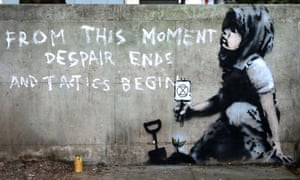
Suspected Banksy mural in London in support of environmentalist protest. 

As authoritarian right-wing populist leaders across the world unleash a reign of tyranny and hate, there is a need to think together about everyday strategies of survival. As an individual, it can get a bit overwhelming. Everything could look pointless. Many friends talk about how they find it impossible to write or work in an atmosphere of hate and violence. However, it is important to remember that what might look invincible today may not last for even half a decade. But while it lasts, how does one live under tyranny and what are the ways of building non-violent resistance? Continue reading Everyday Tips for Surviving Tyranny: Anonymous

Lynchistan

Southern trees bear a strange fruit,

Blood on the leaves and blood at the root,

Black bodies swinging in the southern breeze,

Strange fruit hanging from the poplar trees.

The word lynching conjures up images of a dark period in the history of the United States of America. Between 1877 and 1950, white supremacist gangs murdered 4,000 African Americans, while the government and the police looked the other way. James Baldwin, whose essays Dark Days captures the unfolding violence, wrote, ‘A mob is not autonomous. It executes the real will of the people who rule the State’. In 1888, white supremacists lynched seven African American men for drinking from a well – which they had said was for ‘white’s only’. Baldwin recounts that story and writes, ‘The blood is on the hands of the state of Alabama which sent those mobs into the street to execute the will of the State’.

The lyrics quoted above are from the iconic song – Strange Fruit – written by the communist artist Abel Meeropol and sung by Billie Holiday. Continue reading Lynchistan

Against Aachaaram: When is Your Cloth Clean/Pure/ Both?

This is the third in the series titled Against Aachaaram: A Dossier from Malayalam on Kafila. Both excerpts have been chosen and translated by HARIKRISHNAN S. The prefatory note below is by J Devika. They are about the notions of purity of clothing harboured by the traditional caste elite in Kerala, which were revised by the neo-savarna of twentieth century Kerala.

The neo-savarna refers to a twentieth-century social formation that comprises of the upper-caste elite of traditional Kerala – the sudras (nair and ambalavasi), the samanthas and kshathriyas (the members of erstwhile ruling houses, minor and major), and the brahmins. The richer sections of the ex-untouchable Ezhava caste-community who have in effect abandoned the teachings of their chosen Guru, Sree Narayana, now actively seek membership in the neo-savarna, but are yet to be accepted fully.

Continue reading Against Aachaaram: When is Your Cloth Clean/Pure/ Both?

A War For Scientists to Join

Scientists have barely offered resistance to pseudoscience. This must change—IIT students show how.

Ramesh Pokhriyal

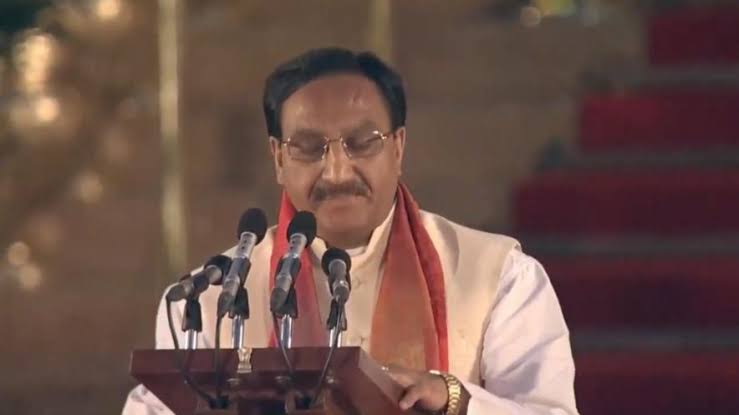
Surely India’s scientific community must be waking up to the realisation that their silence is detrimental to scientific development and allows many varieties of mischief to breed. In a rare show of gumption, students of the elite engineering institute, IIT Bombay, have slammed the recent decision to invite the Human Resources Development (HRD) Minister Ramesh Pokhriyal ‘Nishank’ to chair their graduation ceremony.

For too long India’s scientists have remained silent—even the credulous claims by Prime Minister Narendra Modi in a speech at the Ambani hospital in November 2014 was not challenged by them for a long time. A key role has to be played by the scientific community in the ongoing battle of ideas. Perhaps students of IIT Bombay show the way.

They have said in their in-house publicationInsight IIT Bombay, that a guest who “recognised, embodied and endorsed the scientific and moral values” of their institute should have been invited instead of the minister. Their problem is with Pokhriyal’s speech, pervaded by unscientific claims and “twisted facts”. They are under no illusion the speech tried to stoke “patriotic feelings”. To the IIT students, the speech was a “mild form of scientific blasphemy”.

( Read the full article here : https://www.newsclick.in/war-scientists-join)

Books About Wars in Your Country

A brief history of books, resistance, the police and politicians.

War and Peace

It is humanly impossible for even the most learned judge to have read every book referred to in their court. For a brief while this week, the judge conducting the trial of activist Vernon Gonsalves, an accused in the Bhima Koregaon incident of 2018, became an example of this. That was until the judge clarified that he is, in fact, aware of the Russian writer Leo Tolstoy and his epical novel War and Peace.

His response when the Bhima Koregaon charge sheet was placed before his court proves he knew of the provenance and contents of War and Peace. The confusion, it now appears, arose because the charge sheet had mentioned another book with a similar title. That is how the judge had ended up asking Gonsalves’ lawyers why their client possessed a book about wars in “other countries.”

It is not the judge’s knowledge of great literature but his belief that books about wars in other countries should not be owned (or read) by Indians that is a bigger surprise. Of course, since that remark, many commentators have pointed out that Tolstoy’s writings supported peace and not war. Accordingly, Mahatma Gandhi’s long correspondence with the literary legend is being highlighted afresh.

That said, this is not the first time that judges have expressed a curious indifference to the value of the written word, whether fictional or literary. The question arises, how can we tell if this incident is an aberration or the tip of an iceberg of flimsy excuses to keep people behind bars.

( Read the full article here : https://www.newsclick.in/books-about-wars-your-country)

Against Aachaaram: Lalitambika Antharjanam

This is the second in a series titled Against Aachaaram: A Dossier from Malayalam on Kafila. The note on Lalithambika Antharjanam is by J Devika. The excerpt from her story Vidhibalam (The Power of Fate) is translated by GEORVIN JOSEPH.

Lalitambika Antharjanam (1909-1987) was the first Malayali woman to achieve prominence in the field of modern Malayalam literature, and also among the first thinkers to reflect critically on modern gender as a framework for social existence in Malayali society. Born in the notoriously-aachaaram-bound Malayala brahmin community, she grew up to become one of its strongest and most vocal opponents. Her powerful short stories exposed the horrors that women suffered in conservative Malayala brahmin households. They indicted aachaaram again and again of dehumanising women, through heartbreaking accounts of their emotional and physical suffering, all sanctioned by the cold and ruthless workings of aachaaram.

Continue reading Against Aachaaram: Lalitambika Antharjanam

A Crime of ‘Pure’Indifference

The ethic that dehumanises dalits continues 72 years after the country’s Independence.

A Crime of ‘Pure’

What, to the American slave, is your Fourth of July? I answer: a day that reveals to him, more than all other days in the year, the gross injustice and cruelty to which he is the constant victim. To him, your celebration is a sham; your boasted liberty, an unholy license; your national greatness, swelling vanity; your sounds of rejoicing are empty and heartless… There is not a nation on the earth guilty of practices more shocking and bloody than are the people of the United States, at this very hour.

These fiery lines from a speech delivered on July 4, 1852 in New York by Frederick Douglass, a former slave who had become a national leader of the abolitionists, rattled a predominantly White audience. The speech was delivered 10 years before slavery in the Southern states was abolished.

More than 80 years later, on August 14, 1931, Dr Bhimrao Ambedkar, a Columbia University and London School of Economics graduate, who was then leading a movement of the oppressed and exploited in India, met Mahatma Gandhi for the first time. “Gandhiji, I have no homeland,” Ambedkar told Gandhi, according to a transcript of that meeting. “No untouchable worth the name will be proud of this land.” As expected, the Varna (caste) mindset that dominated India then did not take kindly to Ambedkar’s charge.

( Read the full article here : https://www.newsclick.in/A-Crime-Pure-Indifference-Dehumanises-Dalits)

Mujh se integration karogi? Sanghvaad and its war on women

Determined, defiant – not the Kashmiri women of Sanghi fantasies

Protest in Srinagar against the abrogation of Article 370 on August 11, 2019, despite the clampdown by the Indian government. Image courtesy The Wall Street Journal.

When trolls on social media started circulating photographs of young Kashmiri girls, gloating, “now we can marry them”, it was only the overt manifestation by Sanghis of the real spirit behind abrogating Article 370. While Prime Minister Narendra Modi held forth at length on development, rights to education, rights for women and for Dalits, all of which the people of J&K were deprived of because of Article 370, the truth of course, is that J&K stands in the top 10 to 15 states on  different indicators ranging from life expectancy, people served per government doctor, poverty rate and infant mortality rate, to human development index.

Or as Haseeb Drabu puts it:

The level of economic empowerment is evident from the fact that more than 25% of the household earnings in J&K are from own cultivation. In “prosperous” Punjab, it is only 18%, in “vibrant” Gujarat, it is less than 16% and in “terrific” Tamil Nadu, it is only 3%. And yet, J&K is being portrayed as a “sick” state.

Continue reading Mujh se integration karogi? Sanghvaad and its war on women

83 Delhi University English Teachers’ Statement against Politically Motivated Attacks on Syllabus

The following is the full text of the statement issued by 83 English teachers of Delhi University against the attack on the syllabus:

We, the teachers of English across Delhi University are shocked and appalled at the unacademic, politically motivated attack on our syllabus. This is a democratically drafted syllabus, which involved faculty participation from around 40 colleges; over 2 years, and more than 3000 working hours have been spent on it. It is a matter of sorrow and deep academic concern that the syllabus is now being maligned, and is sought to be scuttled, by certain political groups at the University.

Continue reading 83 Delhi University English Teachers’ Statement against Politically Motivated Attacks on Syllabus

Militarising Minds, Hindutvaising the Nation

A military school under RSS is worrisome because of earlier experiences, such as the Malegaon and Nanded blasts, that were concretised with the intervention and involvement of Hindutva activists.

RSS military school

Representational image. | Image Courtesy: Money Control

Rare are the occasions when the Rashtriya Swayamsewak Sangh (RSS) — which could be said to be the biggest organisation of Hindu men — moves beyond its founder member Dr Hedgewar to build memorials.

Whatever might be the consideration behind it, but it came as a little surprise that the RSS has decided to start a school in the memory of its first non-brahmin and non-Maharashtrian supremo Rajendra Singh alias Rajju Bhaiya (1922-2003), who was its chief from 1994-2000. This proposed ‘Rajju Bhaiya Sainik Vidya Mandir’, will be set up in Shikarpur tehsil of Bulandshahr district, where the former supremo was born and it will start functioning from next year.

Vidya Bharati, the education wing of the RSS, which already runs 20,000 schools across India, would be running this military school as well. It is being said that this Army School will follow the Central Board of Secondary Education (CBSE) curriculum and will have classes running from Class 6 to Class 12.

Normally, an idea to start a school is met with jubilation, but this news has caused an opposite effect. From educationists, to social activists to political leaders, one can hear voices of concern.

( Read the full article here : https://www.newsclick.in/RSS-Military-School-Uttar-Pradesh-Hindutva)

Return of Hindutva: A Challenge for Secularism

Guest Post by Gargi Chakravartty

BOOK REVIEW

Hindutva’s Second Coming by Subhash Gatade; published by Media House, Delhi; 2019; pages: 272; Rs 395 (US $ 18).

The return of Modi to power with a huge margin in this 2019 election is a clear verdict for the Hindutva plank. Why and how it happened leave us, the secular billions, to ponder about the reality and its aftermath. And at that juncture Subhas Gatade’s 272-page analysis titled ‘Hindutva’s Second Coming’ gives us something concrete to think over once again. This in-depth study with rich academic perception is a commendable work, bereft of jargons and convoluted expressions, often found in books written from a high pedestal which goes beyond the mental reach of lay readers. Precisely for this reason the author needs to be specially acclaimed for bringing out facts at one place based on notes and references which are so far scattered in divergent historical materials. It serves as a Reader for millions who are combating communalism and distortion of history at the grassroot level.

( Read the full text here : http://www.mainstreamweekly.net/article8847.html)

Against Aachaaram: Srinarayana Guru

The excerpt below is translated by DARSHAN SUBRAMANIAM. The note that follows is by J Devika.

Continue reading Against Aachaaram: Srinarayana Guru

Against Aachaaram: A Dossier from Malayalam – Announcement

This is to announce a new series of postings I will be doing, relating to aachaaram in Kerala.

Aachaaram is loosely translated as ‘customary practices’ or ‘customary rituals’, but in 19th century Malayali society, it referred to a massive, inter-connected, all-pervading web of practices, rituals, and ideas which bolstered the domination of the upper-castes — in Kerala’s context, this meant the Brahmin-sudra nexus — over the lower castes. It touched the most intimate and personal aspects of a person’s life; through it,  the allegiances and the labour of lower caste communities were extracted to benefit the upper castes. The lower-caste assertions of the late 19th and early 20th centuries here, through which modern democracy became a possibility at all, were directed against this web. Aachaaram, however, survived this phase through shrinking its spatial presence to savarna homes and temples; later, after the re-consolidation of brahmin-sudra power, towards the end of the 20th century, the rise of spiritual capitalism had led to aacharam’s resurrection as the vehicle of gendered savarna power — and as the provider of opening gambits for the Hindu fundamentalists — in Kerala .

In this series, I will post translations of selections/excerpts from the writings of the critics of aachaaram from early 20th century Kerala, with short reflections on each for the present. The many different readings of Hinduism that arose in that period when the Brahmin-sudra nexus was thrown into confusion, as well as the many different dreams of social liberation from different parts of the world that entered Malayali society then — from C Krishnan’s Buddhism to Marxism — produced powerful critical exposures that revealed aachaaram to be nothing but a vehicle and instrument of the power of certain groups over others. The effort made by these voices to point to the danger that it posed to a dream of a just society was largely ignored by the mainstream, especially the mainstream left.

The first of these is an excerpt from a conversation between the well-known social revolutionary, the avarna-born seer, spiritual leader, and philosopher, Srinarayana Guru and his disciples in which the annual pilgrimage to Sivagiri was planned, which I will post separately.


Will India Remember Dadri’s Akhlaq, as Germany Recalls Victims of Nazi Barbarism?

The German acceptance for stolpersteine plaques helps them honour victims of Nazism. One wonders if it will ever be possible to take up similar projects in this part of South Asia.

Germany Recalls Victims of Nazi Barbarism

Hier Wohnte Bernhard Marx

JB 1897

Deportiert 20.07.1942

Minsk

Ermordet 24.07.1942

‘Here lived Bernhard Marx

Year of Birth 1897

Deported 20.07.1942

Minsk

Assassinated 24.07.1942’

It was while walking past a desolate street in Bonn that we stumbled upon some brass plates on which the names of the members of a family were engraved. The name Bernhard, supposedly the head of this family, was engraved on the first plate, followed by three to his right: Erna Marx Geb Hartman, (born 1899), Helena (1929) and Julie (1938).

This was an ill-fated Jewish family from Bonn, deported to the dreaded Minsk concentration—rather extermination—camp that was brutally murdered just four days after they got there. The youngest, Julie was barely four when she died.

Estimates of how many died in this camp over a period of two years vary but at least 65000, mainly Jews, perished there until it was liberated by the Soviet forces.

The young researcher who was our host and guide to the city said that the brass plaques, raised on stone, are called stolpersteine. Stolper means to stumble in German and steine means stone. The idea behind erecting stolpersteine is to raise awareness about events that took place in the late thirties and early forties in this region, when millions of innocent people—Jews, Romas, Jehovah’s Witnesses, homosexuals and political dissidents—were sent to the gas chambers or brutally killed by the Nazi regime.

( Read the full article here : https://www.newsclick.in/India-Remember-Dadri-Akhlaq-Germany-Victims-Nazi-Barbarism)

Modinama : Issues That Did Not Matter

In May 2019, the party of the Hindu Right, Bharatiya Janata Party, under Narendra Modi, won a spectacular electoral victory.

The victory seemed to defy common sense – why did conversations of life and livelihood not dominate the election? Why did the thuggery of the Hindutva vigilantes seem inconsequential to vast numbers of ordinary, decent people? Why is an aggressive, masculine fundamentalism so normalized in our society today?

In other words, why didn’t the issues that matter, seem to matter? The question goes deeper than electoral arithmetic. It asks if Modi and the BJP have not only changed the electoral map, but also begun to corrode social norms.

This book, based on Modi’s first five years as prime minister, is a warning for the next five.

SUBHASH GATADE

Subhash Gatade is a left activist and author. He is the author of Charvak ke Vaaris (Hindi, 2018), Ambedkar ani Rashtriya Swayamsevak Sangh (Marathi, 2016), Godse’s Children: Hindutva Terror in India (2011) and The Saffron Condition (2011). His writings for children include Pahad Se Uncha Aadmi (2010).

978-81-934666-9-8

LeftWord Books, New Delhi, 2019

Language: English

128 pages, 5.5″ x 8.5″

Price INR 195.00 Book Club Price INR 137.00

(https://mayday.leftword.com/catalog/product/view/id/21450)


Why I Celebrate the Wedding of Nusrat Jahan: Zakia Soman

Guest post by ZAKIA SOMAN 

The wedding of Nusrat Jahan the TMC MP to Nikhil Jain is refreshing news. It is heartening to see two young Indians from different faith backgrounds uniting and celebrating their marriage in the times of religious hate and division.

The mixing of politics and religion has led to a climate where marrying a person from another faith has become extremely difficult specially for young people. The case of Hadiya may have been highlighted in the media but it is certainly not the only instance where a couple had to undergo tremendous hardships for falling in love. The self-appointed guardians of religion who seem omnipresent in family, community, police, judiciary, government, media would walk great lengths to prevent inter-faith marriages from taking place. Continue reading Why I Celebrate the Wedding of Nusrat Jahan: Zakia Soman

Gujarat Today Could be What ‘Hindu Rashtra’ Will Look Like for Dalits

The recent spate of attacks on dalits in the state is an indicator of the fact that the unfolding project of RSS’s Hindu Rashtra has entered a new phase where the community is being construed as the ‘new other’.

Hindu Rashtra

When I was born, I was not a child

I was a dream, a dream of revolt

that my mother, oppressed for thousands of years,

dreamt.

Still it is untouched in my eyes

Covered with wrinkles of thousand years, her face

her eyes, two lakes overflowing with tears

have watered my body….

– Sahil Parmar (Noted Gujarati Poet)


‘You are Welcome to Enter … Village of Hindu Rashtra’!

It was around two decades ago that headlines in a few national newspapers reported the ‘arrival’ of Hindu Rashtra in parts of Gujarat. A few inquisitive journalists had even displayed photographs detailing the nascent phenomenon then.

The shock generated by the news died down in a short while.

Hardly anybody then could have a premonition that it won’t take much time for the idea of Hindu Rashtra to gain wider acceptability across India with a commonsense gaining ground rather getting consolidated where religious minorities were increasingly understood as ‘the other’.

Could it be said that the recent spate of attacks on dalits — leading to at least three deaths in the past one month in the same state, coupled with growing instances of life of insecurity of many concerning their lives or their continued deprivation by the dominant castes, is an indicator of the fact that the unfolding project of Hindu Rashtra has entered a new phase where dalits are being construed as the ‘new other’, one who could wreck the project of ‘Hindu Unity’ from within.

Perhaps it is too early to draw any such conclusion, but portents are there for everyone to see.

( Read the full article here : https://www.newsclick.in/Hindu-Rashtra-Gujarat-BJP-RSS-Dalits)

Statement of Academics on Rabindra Bharati University Incident of Harassment

Dear Friends,

As some of you might be aware, our friend and colleague, Dr. Saraswati Kerketta (Assistant Professor in the Department of Geography, Rabindra Bharati University), has recently been a victim of caste-based attack in the university. We write this statement to unequivocally condemn the attack.

We, the concerned faculty members/research scholars across institutions in India and abroad, are deeply disturbed by this incident of caste-based attack on Dr. Kerketta. Dr. Kerketta is a young faculty member from a Scheduled Tribe background, and the sole faculty member appointed in a substantive position in her department, thereby taking on the tremendous task of running the department on her young shoulders. This brazen instance of caste-based harassment meted out to her by a group of students who claim to be affiliated to a political party has hurt and disturbed us immensely as citizens of India. The nature of attack meted out to her – for instance she has been followed by the students up till home after the incident – also showcases the gendered nature of her vulnerability. The incident has been followed by mass resignation on the part of other faculty members from various positions in the university, thereby showing indirect proof of the same.

Continue reading Statement of Academics on Rabindra Bharati University Incident of Harassment