Category Archives: Movements

Desirable Deaths, Malignant Neglect

Coronavirus reveals that in the capitalist world there is still no such thing as society.

Coronavirus

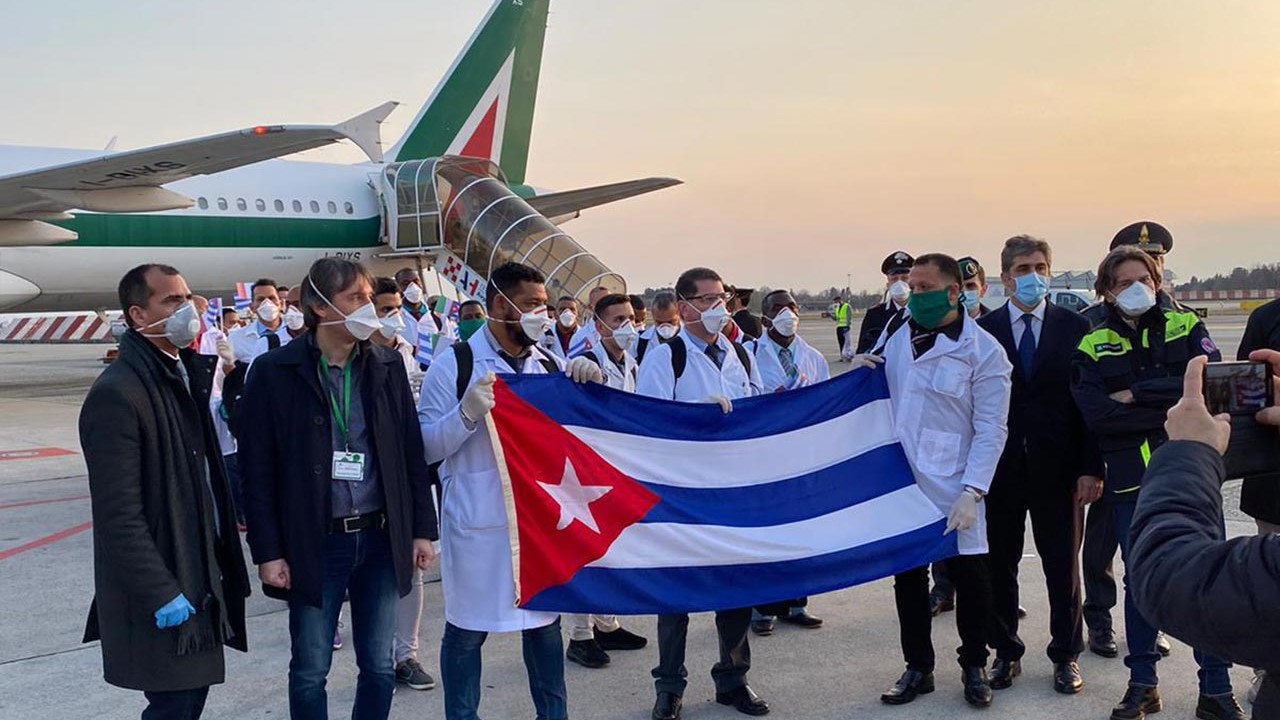
Bella Ciao! Bella Ciao! A song which traces its origins to the struggles of working women (rice-weeders) in 19th-century Northern Italy, and which later became an anthem of anti-fascist struggles there, recently made a comeback on the streets of Rome.

Well, there was no mass gathering, obviously, but you could hear people’s voices sing not only Bella Ciao from windows and balconies but many other patriotic numbers, some newly-composed.

With the world’s eighth-largest economy under lockdown, people restricted to their homes and fatalities due to novel coronavirus already over 1,400, this collective singing was the Italian people’s way of finding a moment of joy in this time of anxiety. It “lifted their spirits” and became a unique way for them to declare solidarity with each other.

( Read the full story here : https://www.newsclick.in/Coronavirus-Crisis-Capitalist-Society-Public-Funded-Health-System)

Denying Interim Bail To Anand Teltumbde and Gautam Navlakha Is Alarming : MRSD

Guest Post by MRSD ( Mumbai Rises to Save Democracy)

Statement by MRSD on Supreme Court’s rejection of pre-arrest bail plea of Anand Teltumbde and Gautam Navlakha in the Bhima Koregaon violence case

Mumbai Rises to Save Democracy (MRSD) is deeply disappointed with the Supreme Court’s rejection of the plea by Anand Teltumbde and Gautam Navlakha seeking anticipatory bail in the cases registered against them in relation to the violence at Bhima Koregaon on 1st January 2018. Their arrest is imminent in next three weeks. Nine other activists and intellectuals who have been accused in this case and charged with sections of the draconian Unlawful Activities Prevention Act (UAPA) have been imprisoned since 2018.

The top court’s order to deny interim bail is alarming given that the case against the activists is based on very thin evidence. Moreover, the cyber forensic analysis by credible investigative journalists and technical experts discredit the evidence used by Pune police to incriminate the activists. The analysis reveals that the letters which were allegedly recovered from the hard disk of Rona Wilson, one of the nine activists accused in the case, and used by the police to link the accused to a banned political party are most likely to have been planted in the disk through use of malware which allowed remote access to Wilson’s computer (https://caravanmagazine.in/politics/bhima-koregaon-case-rona-wilson-hard-disk-malware-remote-access). This clearly indicates manipulation of evidence and the fabricated nature of the case.

The government is sparing few chances for truth to emerge in this case. In January 2020, more than a year after the chargesheets were filed by the Pune police, the Union Home ministry got the case suddenly transferred to the National Investigation Agency (NIA) and thus brought the case under its control at a time when the Home department in the newly formed Maha Vikas Aghadi government in Maharashtra had announced a review of the case, setting up of a Special Investigating Team (SIT) and dropping of the false cases against the activists.

While full-blown attempts are being made by the government to incriminate the eleven intellectuals in a fabricated case, the investigation into the role of Hindutva brigade led by Milind Ekbote and Manohar Bhide in carrying out planned organised attacks on Dalits at Bhima Koregaon has come to a standstill. The state government’s failure to set up a SIT shows that the real perpetrators of violence are being shielded from prosecution.

These developments in the case and now the rejection of pre-arrest bail to two of the stalwarts of the democratic rights movement in the country on the grounds of what is not just flimsy but manipulated evidence shows the desperation of the government to repress democratic voices and spread a sense of fear amongst those who oppose the anti-people policies and actions of the Hindutva Fascist regime. MRSD extends its solidarity to the eleven activists who have been relentless defenders of human rights and people’s movements in this country and who now stand wrongly accused in this conspiracy case. We also reiterate our resolve to continue to struggle for their release and for the pursuit of truth about the violence unleashed on the peaceful Dalit-Bahujan masses at Bhima Koregaon.

  • MRSD

Participating Organisations: People’s Union of Civil Liberties (PUCL), Committee for Protection of Democratic Rights (CPDR), National Trade Union Initiative (NTUI), Trade Union Centre of India (TUCI), Student Islamic Organisation (SIO), Ambedkar Periyar Phule Study Circle (APPSC) – IIT Mumbai, Co-ordination Of Science And Technology Institute’s Student Association (COSTISA), LEAFLET, Police Reforms Watch, NCHRO, Bebaak Collective, Forum Against Oppression of Women (FAOW), LABIA- A Queer Feminist LBT Collective, Jagrut Kamgar Manch (JKM), Majlis, Indian Muslims for Secular Democracy (IMSD), Women against Sexual Violence and State repression (WSS), Bharat Bachao Andolan (BBA), Indian Social Action Forum (INSAF), People’s Commission for Shrinking Democratic Spaces (PCSDS), Human Rights Law Network (HRLN), Cause Lawyers Alliance, National Alliance of People’s Movements (NAPM), Nivara Hakk Suraksha Samiti, Kashtakari Sanghatna – Palghar, Sarvahara Jan Andolan – Raighad, Jagrut Kashtkari Sanghatana, students from various colleges in Mumbai including Homi Bhabha Research Centre, St.Xaviers and Tata Institute of Social Sciences.

Delhi Elections and the Difficult Terrain of Antifascist Struggle


Three incidents of firing in four days – two in Jamia Millia Islamia and one in Shaheen Bagh – quickly followed open calls to violence (‘goli maro saalon ko‘) by Union minister of State for Finance Anurag Thakur and the demonization of Shaheen Bagh protesters by BJP MP Pravesh Verma (‘the protesters will enter your homes and rape and kill your daughters’ if Modi and Shah aren’t there). In the case of the Shaheen Bagh shooter, Kapil Gujjar, the Delhi Police (which has till date not managed to find out the JNU attacker Komal Sharma’s affiliation) was quick to link him to the Aam Aadmi Party (AAP) – an allegation expressly denied by his father. All these episodes, so obviously set up, basically aimed at provoking the protesters into committing some violence that the lapdog television channels would then play up, in their usual hysterical style (some of them may even have appeared on air in police uniform!), to vitiate the atmosphere.

On the very first shooting, one such channel did indeed keep doing precisely that till long after the identity of the shooter (in the clip above) had been clearly established. The clips were circulating almost instantaneously and you can hear the gunman shouting Delhi Police zindabad, and there was little chance of mistaking him for an anti-CAA protester. The channel knew exactly what it was doing and at whose behest but kept on at it till 9 o’clock at night.

Continue reading Delhi Elections and the Difficult Terrain of Antifascist Struggle

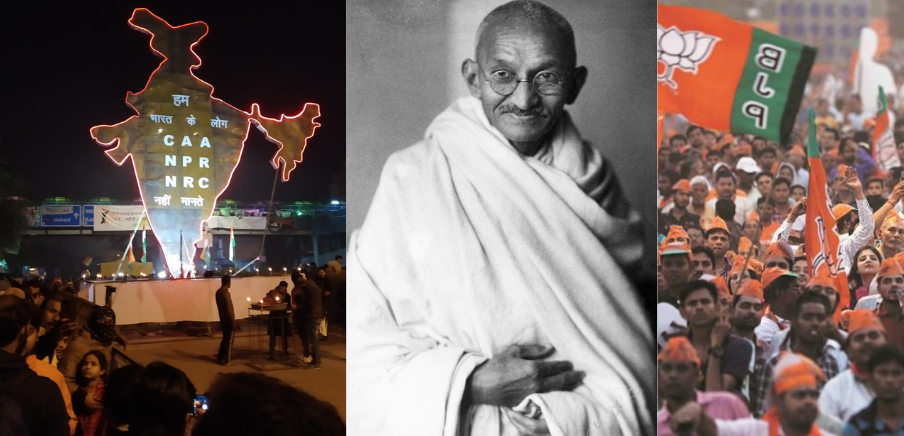
Gandhi and the Hindutva Right

From Nehru to Patel and Ambedkar, the saffron party has appropriated freedom-fighters or tarnished legacies. Gandhi, however, poses a different problem.

Why BJP’s Subjugation of Gandhi

Death ends all enmity’ (Marnanti Vairani) goes a maxim in Hinduism.

The story also goes that when Ravana was on death bed, Ram had even asked Laxman to go to him and learn something which no other person except a great scholar like him could teach him, declaring that though he has been forced to punish him for his terrible crime, ‘you are no more my enemy’.

It is a different matter that Hindutva supremacists — who are keen ‘to transform Hinduism from a variety of religious practices into a consolidated ethnic identity’ — are believers in the exact opposite.

For them, once the enemy is dead, the enmity flares up without any limits. They have no qualms that their adversary is no more to defend himself/ herself.

It has been more than five and half years that they are in power at the Centre and we have been witness to complete vilification, demonisation and obfuscation of many of their adversaries, all great leaders of the anti-colonial struggle. Of course, few were found to be ‘lucky’ enough that were promptly co-opted/appropriated by them, of course, in a sanitised form.

( Read the full article here : https://www.newsclick.in/BJP-Subjugation-Gandhi-Legacy-Roadblock-Shaheen-Bagh

The Constitution as the ‘Social Contract’ of Modern India


The  Constitution of India should be seen as a work-in-progress – not because it has been amended ever so often by different governments but because it has been taken over by ‘we, the people’, repeatedly, especially since the 1990s. The ‘authorized’ interpreters of the Constitution and Law are no longer its sole interpreters. The continuous battles over its interpretation in the courts of law are only one way in which meaning is contested. But from the dalits reclaiming it as “Babasaheb’s Constitution” to the pathalgadi movement  of the Jharkhand adivasis and finally as the banner of citizenship movement today, its meaning has been contested time and again in the streets and in villages.

It is customary, in most secular-nationalist and left-wing circles, to invoke the “great values of the national movement”, which is seen as synonymous with the “freedom struggle”, which in turn is reduced to the “anticolonial struggle”. On 15 August 1947, India attained Independence from colonial rule and on 26 January 1950, “we, the people of India” gave to ourselves the Constitution of India. The anticolonial struggle came to an end in August 1947 but that did not mean that all the currents that  comprised the larger “freedom struggle” – the jang-e-azadi – got their freedom. We perhaps need to make a distinction today between the “freedom struggle” (that is still ongoing) and the “anticolonial nationalist” movement.

We need to state emphatically that the “freedom struggle” of different social groups is not – and never was – reducible to the “anticolonial struggle”. There were many different strands and currents that  either functioned at a distance from mainstream nationalism , or even worked in opposition to it.

Continue reading The Constitution as the ‘Social Contract’ of Modern India

The Ongoing Movement Against CAA and the ‘Political’ Question


The question that is uppermost on most people’s minds today is what will happen to the Citizenship Amendment Act (CAA) and how long will the protests continue? The home minister Amit Shah declaring that the Act will not be withdrawn and the government will not move an inch, regardless of the  protests, is a direct challenge to the people of India. With  the Supreme Court looking the other way, taking up challenge thrown by Shah can only mean one thing now: if the Act does not go, the regime must. Mass movements have been known to  bring down oppressive regimes, and even in the recent past, we have seen that happen in different parts of the world.

Subsequent developments, however, also indicate that often forces emerge that basically take advantage of the mass movements to hijack them and install equally unpopular regimes – a matter we need to discuss very seriously. I will briefly return to this ‘political question’ later as it is of utmost importance that we grasp the possibilities and dangers inherent in the present moment.

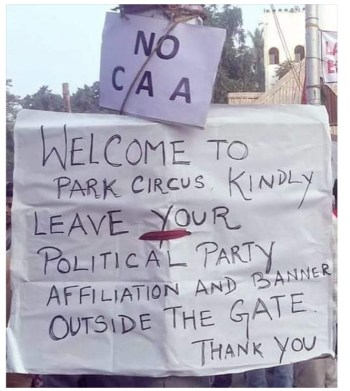
Notice outside the Park Circus protest venue

Continue reading The Ongoing Movement Against CAA and the ‘Political’ Question

Shaheen Bagh – A New Kind of Satyagraha, A Culture of Dialogic Protest: Pradip Kumar Datta

Guest post by PRADIP KUMAR DATTA

Pictures by author

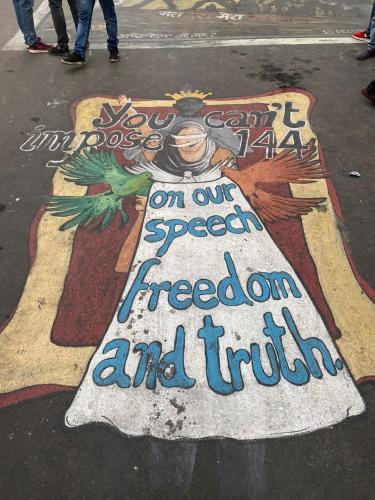
Street art in Shaheen Bagh

Amidst the bustle of talk and announcements on stage, there is a surprise at Shaheen Bagh. A young, slim girl student in ankle length boots, dark pants and shirt is invited to take the podium. She begins her speech by saying that the Citizenship Amendment Act (CAA) has put her in a dilemma. She studies in Jharkhand where many of her close friends are Rashtriya Swayamsevak Sangh (RSS) and Bharatiya Janata Party (BJP) members. Their opinions matter to her personally. At the same time, when she comes to Shaheen Bagh she is gripped by the dangers and stakes involved in the CAA.

Continue reading Shaheen Bagh – A New Kind of Satyagraha, A Culture of Dialogic Protest: Pradip Kumar Datta

Statement Issued by ‘Netherlands against CAA’ (Citizenship Amendment Act)

Guest Post by ‘Netherlands against CAA’

अंतरराष्ट्रीय न्यायालय के सामने विरोध-प्रदर्शन।

(A series of protests have been held in Netherlands against CAA by the Indian diaspora since last few days.  There was a protest at International Court of Justice ( ICJ) based in Hague on 30 th December. It was the fifth protest in last ten days. Pasted below a statement issued on the occasion.)

Statement for Press Release: ICJ Protest

In light of the recent events in India, a group of Indian diaspora residing in the Netherlands, deeply disturbed by the turn of events have decided to protest against the Government of India before the Peace Palace. The protest is directed against the enactment of Citizenship (Amendment) Act, 2019 (“Act”) followed by gross perpetration of human rights violation against its citizens by the Government of India. Continue reading Statement Issued by ‘Netherlands against CAA’ (Citizenship Amendment Act)

Your Government Wants Revenge From You

Uttar Pradesh is dealing with CAA as it dealt with crime : encounters

Uttar Pradesh is dealing with CAA as it dealt with crime

Image Courtesy: PTI

Seventy-six year old advocate Mohammad Shoaib fought to have innocents branded as terrorists under repressive laws released, and risked multiple assaults by right-wing lawyers as he took these cases through various courts in Uttar Pradesh. His contemporary, former police officer SR Darapuri became a human rights activist and writer after he retired. Neither would have imagined one day they would be lodged in jail, charged with rioting and creating disaffection, under similarly draconian laws.

But as everybody knows, in Uttar Pradesh today Shoaib and Darapuri are not exceptions. They are just two notable figures among the hundreds of socio-political activists, writers and cultural workers—not to forget ordinary folks—who have been packed into various state prisons for opposing the Citizenship Amendment Act (CAA) and the National Register of Citizens (NRC). These protests are going on across the country, and started peaking after 19 December, when students spontaneously poured out in the streets against the new law and the proposed policy.

Uttar Pradesh’s administration has come down on those protesting with a heavy hand. The Chief Minister, Yogi Adityanath, tried to project the opposition to the bill as a purely ‘law and order issue: therefore, he sought to justify seeking “revenge” against those who damaged public or private property.

( Read the full article here : https://www.newsclick.in/your-government-wants-revenge-you)

10,000 Academics, Students, Teachers and Civil Society Against Police Brutality at Jamia Millia Islamia and Aligarh Muslim University

We, the undersigned, condemn in the strongest possible terms the police brutality in Jamia Millia Islamia University, New Delhi, and the ongoing illegal siege and curfew imposed on Aligarh Muslim University, Aligarh. On 15th December 2019 Delhi police in riot-gear illegally entered the Jamia Millia campus and attacked students who are peacefully protesting the Citizenship Amendment Act. The Act bars Muslims from India’s neighboring countries from the acquisition of Indian citizenship. It contravenes the right to equality and secular citizenship enshrined in the Indian constitution.

On the 15th at JMIU, police fired tear gas shells, entered hostels and attacked students studying in the library and praying in the mosque. Over 200 students have been severely injured, many who are in critical condition. Because of the blanket curfew and internet blockage imposed at AMU, we fear a similar situation of violence is unfolding, without any recourse to the press or public. The peaceful demonstration and gathering of citizens does not constitute criminal conduct. The police action in the Jamia Millia Islamia and AMU campuses is blatantly illegal under the constitution of India.

We stand in unconditional solidarity with the students, faculty and staff of Jamia Millia Islamia and Aligarh Muslim University, and express our horror at this violent police and state action. With them, we affirm the right of citizens to peaceful protest and the autonomy of the university as a non-militarized space for freedom of thought and expression. The brutalization of students and the attack on universities is against the fundamental norms of a democratic society.

As teachers, students, scholars and members of civil society across the world, we are watching with extreme concern the situation unfolding at Jamia Millia Islamia and Aligarh Muslim University. We refuse to remain silent at the violence unleashed on our colleagues (students, staff, and faculty) peacefully protesting the imposition of a discriminatory and unjust law.

This statement with a full list of signatories is available here: Jamia Millia and AMU solidarity statement.

CAA-NRC: Turning India Into a Warzone of ‘Peace’

Is the Indian state turning into a religious dystopia, like some of its neighbours?

CAA-NRC: Turning India Into a Warzone of ‘Peace’

Image Courtesy: Free Press Journal

The Bharatiya Janata Party-led central government has pushed the Citizenship Amendment Act through, but it is struggling to manage its fallout and the national outrage that a related proposal to create a National Register of Indian Citizens or NRIC has generated. At first, BJP leaders desperately assured those who were excluded in the NRC, or national register of citizens, that was finalised in October this year for the people of Assam. Its pleas were meant to reassure the Hindus who were excluded in the state’s citizen-count that it would hold a fresh all-India count of citizens, in which they will be included. The reason for the BJP’s desperation was the outcome of the Assam NRC, which turned out to be contrary to its expectations: out of 19 lakh found “illegal” in the state, only about 5 lakh are Muslim, almost all the rest are Hindu.

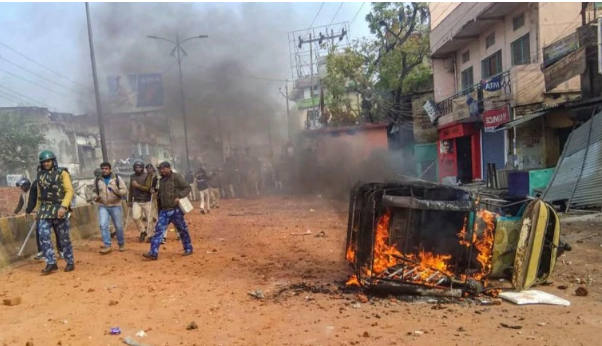
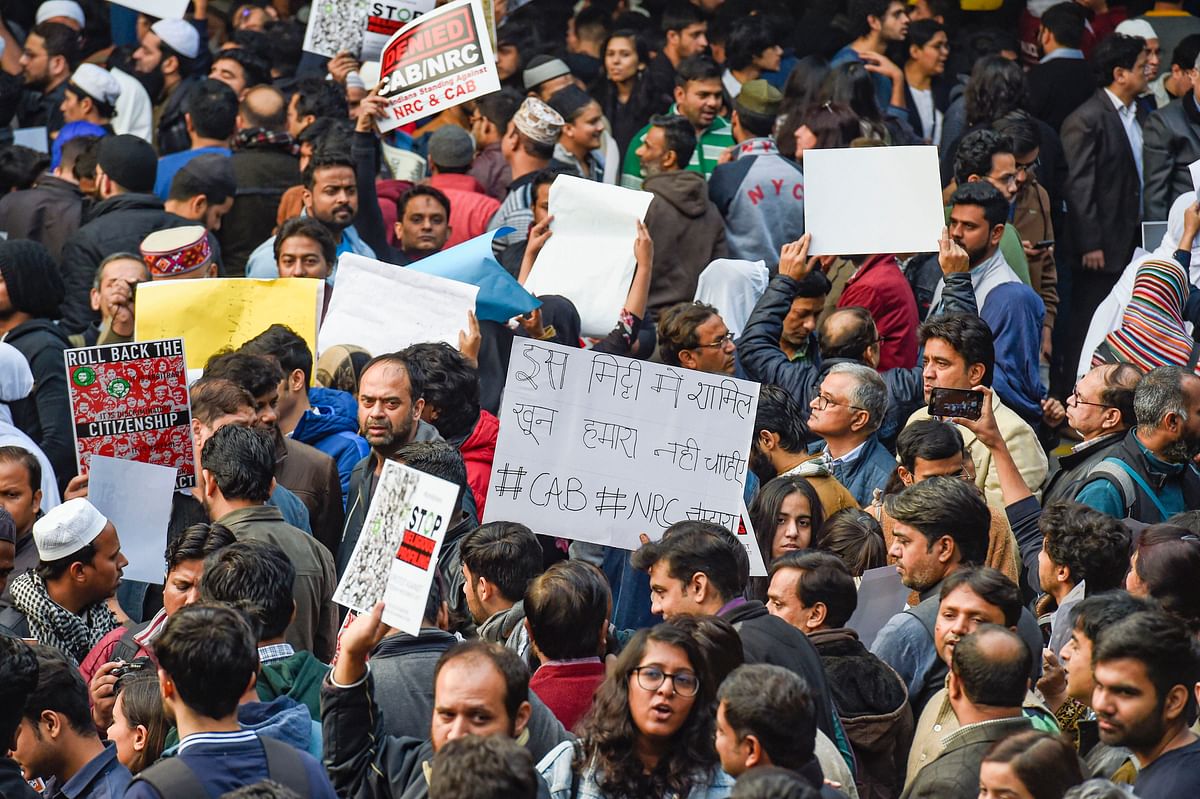
Yet, the fears of the citizenship law, combined with the resistance to an all-India NRC, have now given rise to tremendous mass resistance across India. There have been massive marches and rallies in many places, some of them culminating in aggressive confrontations with police and security forces. There is an ongoing massive crackdown on several universities, including in Lucknow, Aligarh, and Delhi where students were agitating against the new citizenship law and the all-India listing of citizens or NRIC.

( Read the full story here : https://www.newsclick.in/CAA-NRC-turning-india-earzone-peace)

Why the JNU #FeesMustFall is a Mass Intersectional Movement: Paresh Hate

Guest Post by PARESH HATE

It has been more than a month that students in JNU have been protesting against the new IHA Hostel Manual. The fight had initially begun against the exorbitant fee hikes, introduction of curfew timings and dress codes, lack of reservations and deprivation points in the manual, and the undemocratic manner in which the manual was passed. At this juncture, the movement has become broader, and articulates its resistance to the National Education Policy and its defence of the idea of public university and what it stands for.

While there have been many attempts to characterize the students’ movement as anti-national and free-loading as usual by the right-wing media, it is clear that the political articulation of students has managed to transcend these limited dimensions offered by the discourse set by the public perception. Even the propagandists are this time at a loss as to how to demonise the movement. All they have been able to come up with is that the protests ‘disrupted traffic’ and that the protests are ‘political’. One is unable to understand how the latter is a jibe, when protests are obviously always political in nature, especially this one. The demonization of JNU is not simply about the social sciences, or left-oriented student politics, but also a manufacturing of consent toward the commercialization and a legitimizing of this government’s agenda to destroy public avenues of welfare. However, due to the developments that have taken place in the last few weeks, politics itself of the campus is churning, wherein what is emerging is a cultivated intersectional discourse that has resulted in the breathing of new life into the campus. Continue reading Why the JNU #FeesMustFall is a Mass Intersectional Movement: Paresh Hate

Faculty Feminist Collective, JNU, condemns police violence on students

December 11, 2019

We, members of Faculty Feminist Collective, Jawaharlal Nehru University, condemn in the strongest terms the unprovoked police brutality on the peaceful protest marches of JNU students against the illegal adoption of a revised Hostel Manual by the JNU administration and the proposed steep rise in fees. Three times since November 11, 2019, the day of the JNU Convocation, the police have lathi-charged assembled and marching students. The first time, students were expressing a legitimate demand to meet the Vice Chancellor who now conducts all business outside the campus and has not met any member of the JNU community for some time now. On the second occasion it was a march to Parliament, to meet the elected representatives of this country; and the third time, to meet the President of India who is also the Visitor of JNU, to press upon them the urgency of the situation in which nearly half of the current students of JNU will not be able to come back next semester if the IHA Manual and the fee hike is not rolled back. Continue reading Faculty Feminist Collective, JNU, condemns police violence on students

Exit Azad! Enter Savarkar!!

Even at the breakneck pace at which its proponents are rewriting history in the Hindutva mould, its real past will habitually catch up with it.

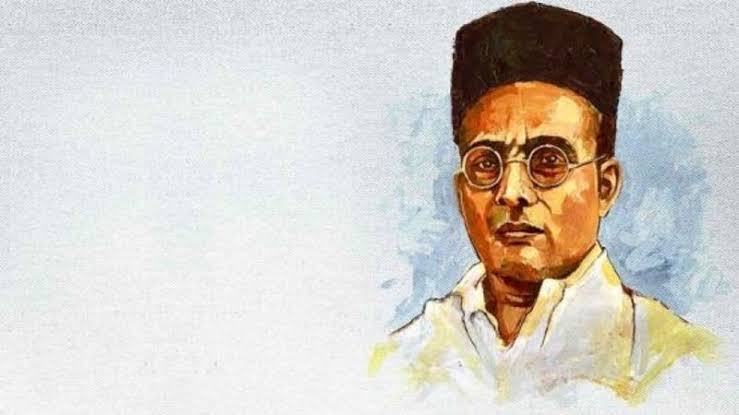
Savarkar

Last year, a statue of freedom fighter and first education minister of independent India, Maulana Abul Kalam Azad, was destroyed by Hindutva mobs at Kankinara in North 24 Parganas district, West Bengal. At the time, there were communal flare-ups in many districts of the state in the aftermath of aggressive Ram Navami marches, the first of their kind in the country.

The episode was immediately forgotten. Few would have had the premonition that the incident was was merely a precursor to the larger game-plan of the Hindutva right, to erase not just the legendary freedom fighter’s statute, but his name from history.

Now, for some reason, the Indian Council for Historical Research (ICHR) has decided to organise a seminar on ‘Veer Damodar Savarkar: Life and Mission’ on 11 November, the birth anniversary of Maulana Azad, perhaps gives an indication of their intent. This particular date also has no apparent connection with Savarkar, who was born on 28 May 1883 and died on 26 February 1966.

Besides, just over a decade ago, 11 November was declared as National Education Day, to commemorate Azad and recall his contribution to policies and institutions that streamlined the educational needs of newly-independent India. It was a day to reflect on and discuss the country’s education system and its future.

( Read the full article here : https://www.newsclick.in/exit-azad-enter-savarkar)

Politainment : Why Hindutva Brigade Spews Lies

Their fantasy is to control India’s fate by distorting historical events.

Nishank

History is witness that Buddhism, which originated in the Indian subcontinent, posed a challenge to brahmanical Hinduism. It is also recorded history that Buddhism was completely wiped out of this region centuries later, through means violent and non-violent. But the Hindutva supremacists, compelled by their desire and fantasy to re-shape national identity, want India’s past to match their views on religion. And for them, India is a nation only of and for Hindus.

That is why, through repeated false statements on the subcontinent’s “history”, they are challenging and demolishing India’s past. That is their way of attacking its multicultural present. With the goal to establish Hindu dominance in all fields, they are starting backwards, with untrue claims about “time immemorial”. The recent fabrication of Badris University by a Union minister is a step in that direction.

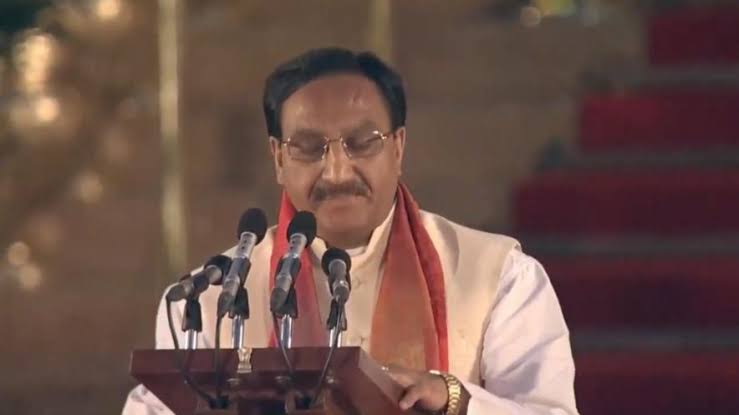
The Minister of Human Resource Development, Ramesh Pokhriyal Nishank, has said that the oldest university in the world was in Badrinath, a town in Chamoli district of Uttarakhand. The university was called “Badris”, the minister claimed in a lecture he delivered in Dehradun, a prominent city of Uttarakhand, last week. No such institution ever existed according to historical record, but Pokhriyal has insisted that will be “restored to its full glory”, presumably from funds taken from his ministry’s grants.

( Read the full article here : https://www.newsclick.in/politainment-why-hindutva-brigade-spews-lies)

‘ईश्वर नहीं है’ कहने का अधिकार

Image result for periyar
Periyar : Image – Courtesy velivada.com

क्या अभिव्यक्ति की स्वतंत्रता का अधिकार महज आस्थावानों के लिए ही लागू होता है ?

कभी कभी साधारण से प्रश्न का उत्तर पाने के लिए भी अदालती हस्तक्षेप की जरूरत पड़ती है।

मद्रास उच्च न्यायालय की – न्यायमूर्ति एस मनिकुमार और सुब्रहमण्यम प्रसाद की – द्विसदस्यीय डिवीजन बेंच को पिछले दिनो ंयह दोहराना पड़ा कि अभिव्यक्ति का अधिकार – जो भारत के संविधान के तहत मिले बुनियादी अधिकारों में शुमार है – सार्वभौमिक है और इसे समयविशेष के बहुमत के आंकड़ों के आधार पर तय नहीं किया जा सकता।

मालूम हो कि किन्ही दैवानायागम ने न्यायालय में यह जनहितयाचिका दाखिल की थी और कहा था कि तमिलनाडु के त्रिची में पेरियार की मूर्ति पर जो नास्तिकता के उद्वरण दिए गए हैं, वह ‘सार्विक ईश्वर’ को माननेवालों के लिए आपत्तिजनक हैं और उन्हें हटा दिया जाए। याद रहे रामस्वामी नायक / 17 सितम्बर 1879-24 दिसम्बर 1973/ जिन्हें ‘पेरियार’ नाम से जाना जाता है, वह आत्मसम्मान आन्दोलन के अग्रणी थे, द्रविड कझगम के संस्थापक पेरियार एक जुझारू किस्म के समाज सुधारक भी थे। याचिकाकर्ता ने मूर्ति पर लिखे उद्धरण के बारे में ‘‘कोई ईश्वर नहीं है, ईश्वर नहीं है और वाकई ईश्वर नहीं है..’ के पेरियार द्वारा कहे जाने पर भी सवाल खड़े किए थे। Continue reading ‘ईश्वर नहीं है’ कहने का अधिकार

Everyday Tips for Surviving Tyranny: Anonymous

Guest Post by ANONYMOUS

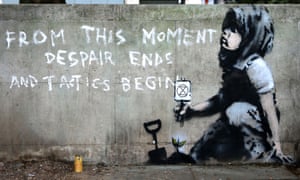
Suspected Banksy mural in London in support of environmentalist protest. 

As authoritarian right-wing populist leaders across the world unleash a reign of tyranny and hate, there is a need to think together about everyday strategies of survival. As an individual, it can get a bit overwhelming. Everything could look pointless. Many friends talk about how they find it impossible to write or work in an atmosphere of hate and violence. However, it is important to remember that what might look invincible today may not last for even half a decade. But while it lasts, how does one live under tyranny and what are the ways of building non-violent resistance? Continue reading Everyday Tips for Surviving Tyranny: Anonymous

Wishful visions, dishonest tales and bitter fruit

Review of ‘Malevolent Republic : A Short History of New India’ by K. S. Komireddi

Image result for malevolent republic

‘The idea of a peace-loving, nonviolent India exists, persists, as part of a selectively constructed and assiduously cultivated national self-image in the midst of a society pervaded by social and political violence…’ argued Prof Upinder Singh, in her well-researched voluminous book ‘ Political Violence in Ancient India’ which had appeared around two years back. She had also added that pioneers of independence struggle were instrumental in creating this ‘[m]yth of non-violence in ancient India which obscures a troubled, complex heritage.’

‘Malevolent Republic’ – A Short Hisotry of New India’ by K. S. Komireddi – a commentator, critic and journalist who has written for leading western publications, reminds one of this debate. The book tries to chronicle the trajectory of post-independence India from Nehru to Modi – and does not shy away from raising uncomfortable questions which demand broader contemplation as well as deep soul searching.

( Read the full story here : https://epaper.telegraphindia.com/calcutta/2019-09-06/71/Page-11.html)

Arvind Kejriwal, Article 370 and a Blind Alley

(Photo Courtesy : http://www.newslaundry.com)

He came, he saw and he concurred

– Caption of a RK Laxman cartoon in early 90 s


AAP’s stand on article 370 has confused and disheartened many.

For its workers the party has opened itself to attacks by its adversaries because of its support to stripping of statehood for Jammu and Kashmir and thus weakening its own plank for full statehood for Delhi which was its key slogan during the 2019 Lok Sabha campaign.

A section of its fellow-travelers who had high hopes of the experiment, activists/scholars – who were rather enthused with its ‘participatory’ approach – also feel betrayed or disheartened now.

It is a different matter that not many have made their displeasure known.

May be it is a sign of their increasing fatigue or possible cynicism with politics in general, they have preferred to share their frustrations at private levels only. Continue reading Arvind Kejriwal, Article 370 and a Blind Alley

Marx in Brussels

The most remarkable development during his time in Brussels was the penning down of the Communist Manifesto, which firmly established Marx as well as Engels as the intellectual leaders of the working class movement.

Marx in Brussels

Karl Marx

Lived in Brussels from February 1845 to March 1848

He celebrated New Year’s Eve 1947/48 together with the “Deutscher Arbeiterverein” and the “Association Democratique” in this place

The plaque put on a building which housed a restaurant ‘Le Cygne, The Swan’ now is the only memory left of the days when history was ‘made’ here. According to legend, it is the same place ‘[w]here the First International had convened’  and Marx and his lifelong friend and comrade Engels ‘[h]ad written the Communist Manifesto’.

No doubt it was the same place when Marx, Engels, Mozes Hess – who was another early luminary of socialism and who supposedly had influenced Engels about communism – and other associates of the surging workers movement pondered over many of those ideas which have been memorialised in the opening sentences of the Manifesto, “A spectre is haunting Europe — the spectre of communism….”

May be the historic slogan ‘Workers of the World Unite, You have nothing to lose but your chains’ which later reverberated throughout the world – whose echoes are still heard – had its ‘humble’ beginning in one of those very rooms, where Marx and his close associates used to educate workers about their exploitation.

Scores of people sitting in this particular restaurant which was serving them sumptuous food and choicest drinks were completely oblivious of all those details. Few of them rather looked at us with a sense of disbelief and dismay, when they witnessed us taking photos of the nondescript wall which had the plaque put on it. Perhaps they looked more satisfied that they are enjoying food at a place which is situated on the Grand Place or Grote Markt, which is the central square of Brussels and is considered one of the most beautiful squares in Europe and is also part of UN Heritage.

( Read the full article here : https://www.newsclick.in/karl-marx-in-brussels)

Gujarat Today Could be What ‘Hindu Rashtra’ Will Look Like for Dalits

The recent spate of attacks on dalits in the state is an indicator of the fact that the unfolding project of RSS’s Hindu Rashtra has entered a new phase where the community is being construed as the ‘new other’.

Hindu Rashtra

When I was born, I was not a child

I was a dream, a dream of revolt

that my mother, oppressed for thousands of years,

dreamt.

Still it is untouched in my eyes

Covered with wrinkles of thousand years, her face

her eyes, two lakes overflowing with tears

have watered my body….

– Sahil Parmar (Noted Gujarati Poet)


‘You are Welcome to Enter … Village of Hindu Rashtra’!

It was around two decades ago that headlines in a few national newspapers reported the ‘arrival’ of Hindu Rashtra in parts of Gujarat. A few inquisitive journalists had even displayed photographs detailing the nascent phenomenon then.

The shock generated by the news died down in a short while.

Hardly anybody then could have a premonition that it won’t take much time for the idea of Hindu Rashtra to gain wider acceptability across India with a commonsense gaining ground rather getting consolidated where religious minorities were increasingly understood as ‘the other’.

Could it be said that the recent spate of attacks on dalits — leading to at least three deaths in the past one month in the same state, coupled with growing instances of life of insecurity of many concerning their lives or their continued deprivation by the dominant castes, is an indicator of the fact that the unfolding project of Hindu Rashtra has entered a new phase where dalits are being construed as the ‘new other’, one who could wreck the project of ‘Hindu Unity’ from within.

Perhaps it is too early to draw any such conclusion, but portents are there for everyone to see.

( Read the full article here : https://www.newsclick.in/Hindu-Rashtra-Gujarat-BJP-RSS-Dalits)